
Services
Web Design and Development for Southern California Service Businesses
A website that answers the questions your customers actually ask.
- Starting at
- $6,500+
- Timeline
- Most builds run 8 to 14 weeks
- Services
- 11 included areas
Call (714) 823-3164 or ask a question. Clear recommendations, even if we never work together.
Web design and development is the work of planning, designing, building, and launching a website. Design covers layout, brand, and how a page guides a visitor. Development covers the code, hosting, speed, and structure underneath. For service businesses the point of both is turning visits into phone calls.
Jump to a section
- The problem
- What Web Design is
- Who it is for
- What is included
- Our process
- What it costs
- What changes
- All Web Design services
- One van, one shop, or six locations
- Where a phone visitor drops off
- The three speed numbers Google measures
- Honest comparison with the other ways to get a site
- The mistakes that cost the most
- How to tell at 60 days whether it is working
- When not to buy a new website
- Two questions owners ask late in the process
- Questions
The problem
Most service business websites were built once, by a cousin or a cheap template shop, and then left alone for six years. They load in nine seconds on a phone, the contact form goes to an email nobody checks, the phone number is not tappable, and half the services the company now offers are not mentioned anywhere. The owner knows it is bad but has no idea which part is costing money. So it sits, quietly losing jobs to competitors whose sites answer the same questions in three seconds.
What web design actually is
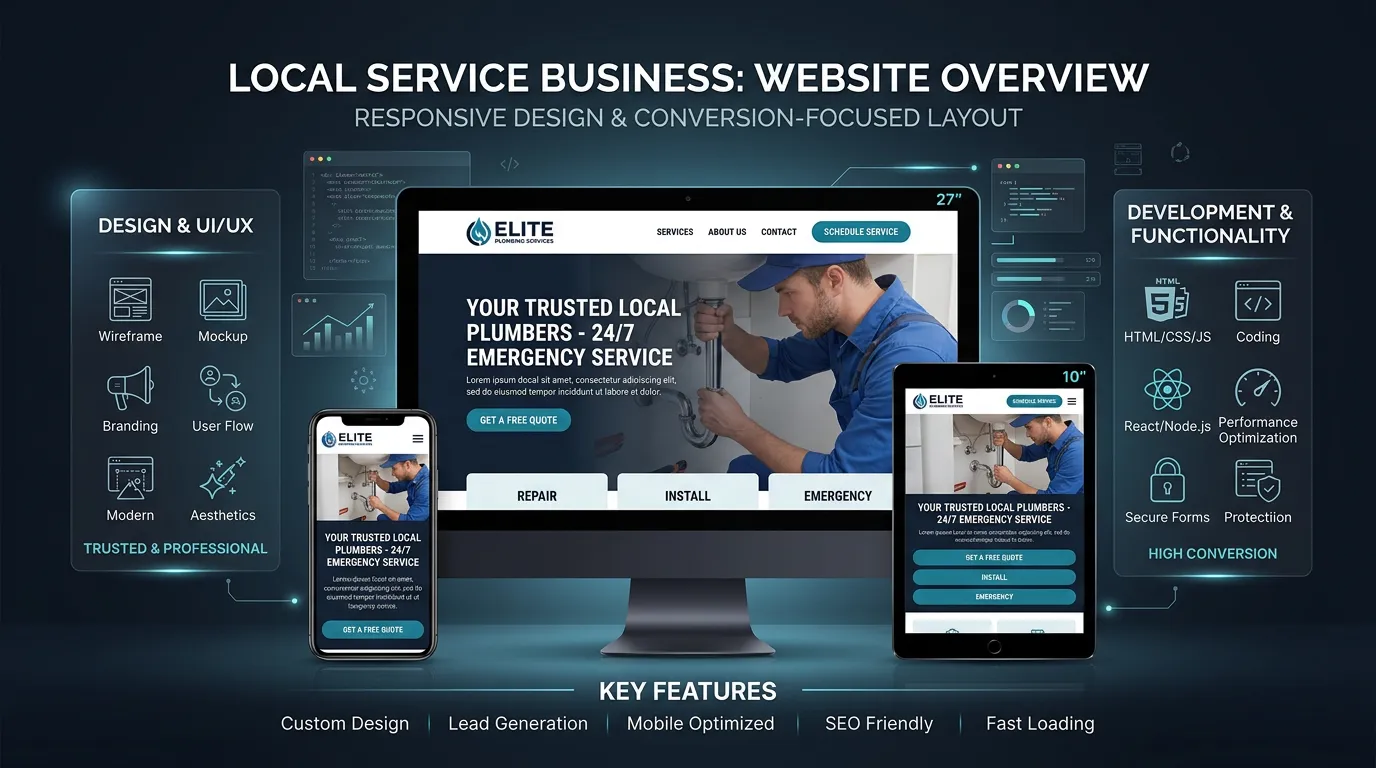
We design and build websites for local service businesses. Design means the structure of the pages. It covers what goes first, and what a visitor sees before scrolling. It also covers how the site looks and reads on a phone in someone's driveway. Development means the platform, the code, the hosting, and the speed. It also covers the schema markup and the other pieces that search engines and AI answer tools read. We build sites a business owner can actually run. A marketing team can add to them for years without a rebuild.
Who it is for
This fits service businesses that get most of their work locally. You need the website to produce calls, not awards. That means contractors, medical and dental practices, home care agencies, law firms, and shops with a service area. It fits best when you have real photos of real work, or are willing to go get them. It is a poor fit if you want a site that sits there and looks nice. If you have no plan to keep it current, this is not for you. A site nobody updates loses ground every year.
What is included
- Discovery workshop covering services, customers, and the questions you get on every call
- Sitemap and page by page content outline before any design starts
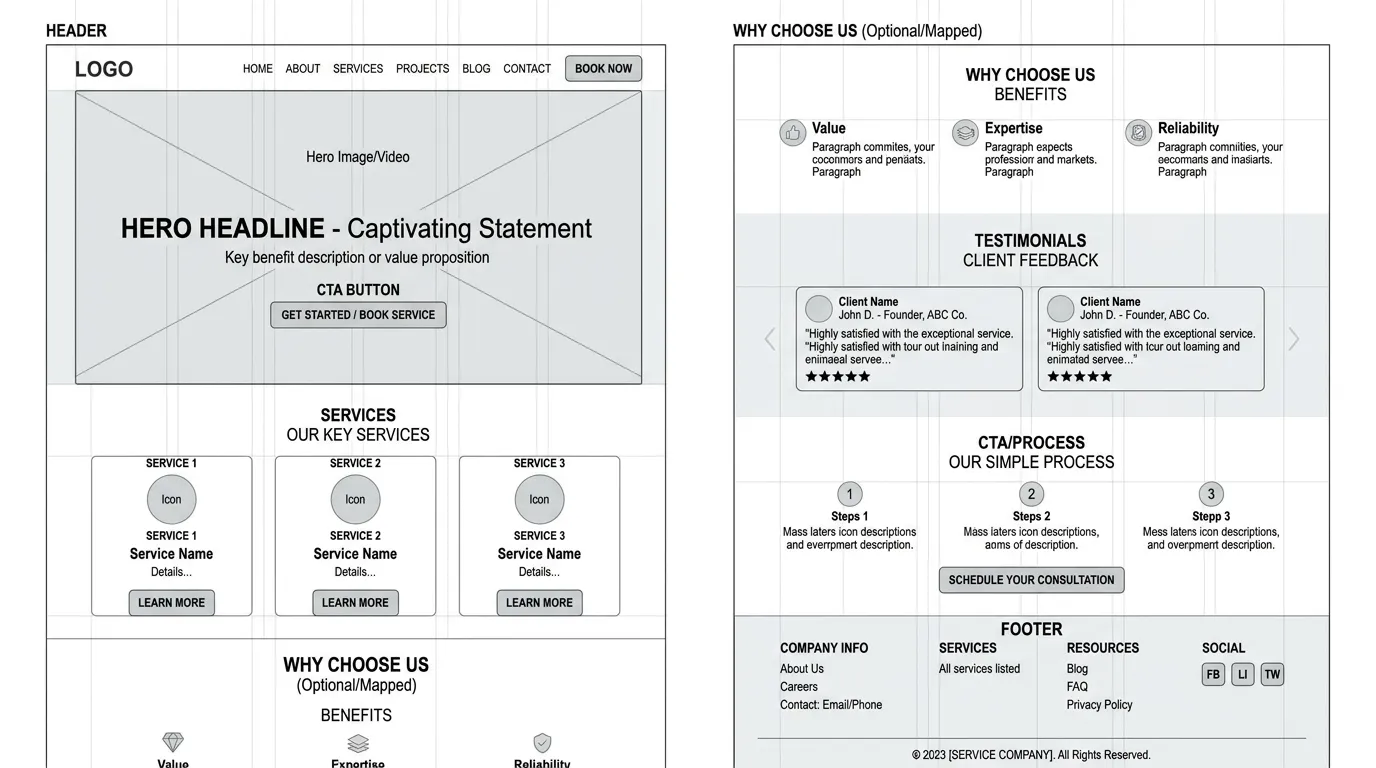
- Custom design in Figma with desktop, tablet, and phone views
- Built pages for every service, service area, and trust page
- Mobile layout with a tappable phone number and a sticky call bar
- Contact forms with spam filtering, routing rules, and confirmation emails
- LocalBusiness and Service schema markup on the pages that need it
- Speed work targeting Core Web Vitals thresholds on real phones
- Analytics, Google Tag Manager, and conversion events configured at launch
- Training session plus a written guide so your team can make edits
Our process
Discovery and Content Plan
Week 1 to 2We interview you about your services, your best customers, your pricing structure, and the objections you answer on every estimate. Then we build a sitemap and outline what each page must say before anyone opens a design tool.
Design
Week 3 to 5You see a homepage and one interior template first, in phone and desktop views. We revise those until the direction is right, then apply the approved system to the rest of the pages so you are not reviewing 20 designs one at a time.
Content and Photography
Week 4 to 7We write the pages using your real details: warranty terms, service areas, license numbers, and review quotes. If your photos are weak we schedule a shoot, because stock images of models in hard hats hurt trust.
Build and Technical Setup
Week 6 to 11Pages get built on a staging site with hosting, SSL, schema markup, forms, tracking, and speed optimization. You review on your own phone, not just a desktop screenshot.
Launch and Redirects
Week 12We map every old URL to a new one, set 301 redirects, submit an updated sitemap, and watch Search Console daily for two weeks. Launch happens midweek in the morning, never on a Friday afternoon.
Post Launch Watch
Days 1 to 30 after launchFor 30 days we monitor rankings, crawl errors, form submissions, and page speed, and fix anything the launch shook loose at no extra cost.
Realistic timeline: Most builds run 8 to 14 weeks. The variable is almost never our build speed. It is how fast content, photos, and approvals come back from your side.
What it costs
A five to eight page site for one service business in one city sits near the bottom of the range. Price climbs with page count, custom photography and video, multi location structures, booking or payment integrations, and migrations off a platform that fights you. We quote a fixed number after a scoping call, not an open hourly estimate.
Published ranges are starting points. The final number depends on your market, your current position, and how much ground there is to make up. You get a fixed scope in writing before anything begins.
What changes
A site that loads in under three seconds on a normal phone connection instead of eight or nine
More of your existing traffic turning into calls, usually a two to four times lift when the old site was a template with a buried phone number
Every service you sell has a page that can rank, instead of one services page listing nine things
Search rankings preserved or improved through a redesign rather than lost, because redirects were mapped before launch
A site your office manager can update without calling a developer for a price change
Clean tracking from day one, so future marketing spend can actually be measured
All web design and development services
Every area we cover under web design and development. Each one has its own page with process, deliverables, and timelines.
Custom Website Design
Designed from your services, not adapted from a stock template
Custom Website DesignConversion Focused Design
One obvious next step on every screen of every page
Conversion Focused DesignTechnical Foundation
Hosting, CMS, URL structure, backups, staging, SSL, and schema
Technical FoundationSpeed and Core Web Vitals
Three measures: loading, responsiveness, and layout stability
Speed and Core Web VitalsAccessibility Compliance
Measured against WCAG 2.2 level AA, the standard courts reference
Accessibility ComplianceOngoing Website Support
Updates tested on staging first, never straight onto the live site
Ongoing Website SupportWebsites That Convert
Three to eight percent of visitors taking action is the normal band
Websites That Convert
Where we do this work
Based in Chino, serving Chino, the Inland Empire, Orange County, Los Angeles County, Riverside County, and San Bernardino County.
One van, one shop, or six locations
A one van operator needs 6 to 10 pages, and that is not a compromise. Home, one page for each service you sell, a service area page, an about page with your face on it, and a contact page. Someone selling a 40 page build to a one van business is selling page count, not customers.
A shop with a crew and an office manager usually lands at 12 to 20 pages. You add a financing page, a warranty page, and maybe four city pages you can back up with photos of work in those towns. The new question at this size is who edits the site, because now somebody on staff has to.
Multi location is a different build. Each location gets its own page with its own address, phone, hours, map, and staff photos. One contact page listing six addresses helps nobody. Most of the work here is template discipline, so one change lands correctly on all six pages.
Where a phone visitor drops off
Most phone visits end before anyone reads a word of your copy. Here is where people fall out, in order, and what each step is really asking.
Fix the earliest failing step first. A great trust section cannot rescue a page that took nine seconds to load.
The three speed numbers Google measures
Fast is not a feeling. Google publishes exact thresholds and measures them on real visits. A page passes only when 75 percent of visits clear all three.
Honest comparison with the other ways to get a site
A full build is one option out of five. Here is how they stack up for a local service business.
| Option | Rough cost | Good for | Where it falls short |
|---|---|---|---|
| DIY on a site builder | 200 to 500 a year | A brand new business testing an idea | Costs your weekends, and it shows |
| Template shop | 1,000 to 3,000 | A site that just has to exist | Same layout as 400 other companies |
| Freelance designer | 3,000 to 8,000 | A small, clearly defined build | One person, no backup, slow replies |
| Fixing the site you have | 1,500 to 5,000 | Sound platform, weak conversion path | Cannot save an abandoned page builder |
| Full design and build | 6,500 and up | Sites that have to produce calls | Costs more and takes 8 to 14 weeks |
Ranges are what we see around Southern California, not quotes from us. Two of these rows are often the right answer instead of hiring us.
The mistakes that cost the most
Most of the damage we find was not caused by neglect. It came from one confident choice made without checking it on a phone.
Do this
- Put the phone number in the header as tappable text, never inside an image
- Shoot 30 photos of your own crew and your own finished work before design starts
- Send every form to two inboxes plus a text alert, so one vacation cannot swallow a lead
- Review every page on a real phone, on cell data, outside in daylight
Not this
- Do not bury services in a menu that takes three taps to open
- Do not put your best message on slide three of a homepage slider, because almost nobody gets there
- Do not let anyone set light gray text on white, since half your customers are over 50
- Do not delete the old site files until the new one has run clean for 30 days
How to tell at 60 days whether it is working
Sixty days is long enough to judge and early enough to fix. If three or more of these fail, ask hard questions.
Calls from the website went up, and you can name the number
Use a tracking number or call reporting. Memory is not data.
A test form you send yourself arrives in under a minute
Do this monthly. Forms break quietly and nobody notices for weeks.
Search Console shows nearly all your pages indexed
Half your page count indexed means something is blocking crawling.
Impressions are flat or climbing, not sliding
A dip in the first two or three weeks is normal. Week eight is not.
The Core Web Vitals report says Good for mobile
Read the field data in Search Console, not a one off lab score.
Someone on your staff has edited a page without calling anyone
If nobody in house can update it, the site starts rotting on day one.
You can name which page produced each of last month's leads
Landing page report in GA4, tied to a real conversion event.
Your top three service pages each brought in at least one lead
If one page gets them all, the others are not answering the question.
When not to buy a new website
If your site is under three years old, loads in about three seconds, and runs on a platform that still gets updates, you do not need a rebuild. You need pages. Adding six real service pages to a decent site beats replacing a decent site.
If you get 40 visits a month, a new site just multiplies a small number. Ten percent of almost nothing is still almost nothing. Put the money into your Google Business Profile, reviews, and one paid channel first. Rebuild when there is traffic worth converting.
Wait if you are about to change your name, buy another company, or sell within the year. Wait too if you cannot free up time for photos and answers over the next eight weeks. A half fed build stalls at 80 percent and sits there, which is worse than the site you have now.
Two questions owners ask late in the process
What does it cost to keep a website running each year?
How many pages do I actually need?

Frequently asked questions
How long does a new website take?
Do I own the website when it is done?
What platform do you build on?
Will a redesign hurt my Google rankings?
Can you just fix my current site instead of rebuilding?
Do I need to write the content?
What happens after launch?
Sources
- Google Search Central: Core Web Vitals(opens in a new tab) Core Web Vitals are part of Google's page experience signals and are measured from real user visits.
- web.dev: Web Vitals(opens in a new tab) The 2.5 second LCP, 200 millisecond INP, and 0.1 CLS thresholds, assessed at the 75th percentile of visits.