Services
Generative Engine Optimization for Southern California Service Businesses
Get named when someone asks an AI who to call.
- Starting at
- $1,500+
- Timeline
- Baseline testing and the audit take 2 to 3 weeks
- Services
- 6 included areas
Call (714) 823-3164 or ask a question. Clear recommendations, even if we never work together.
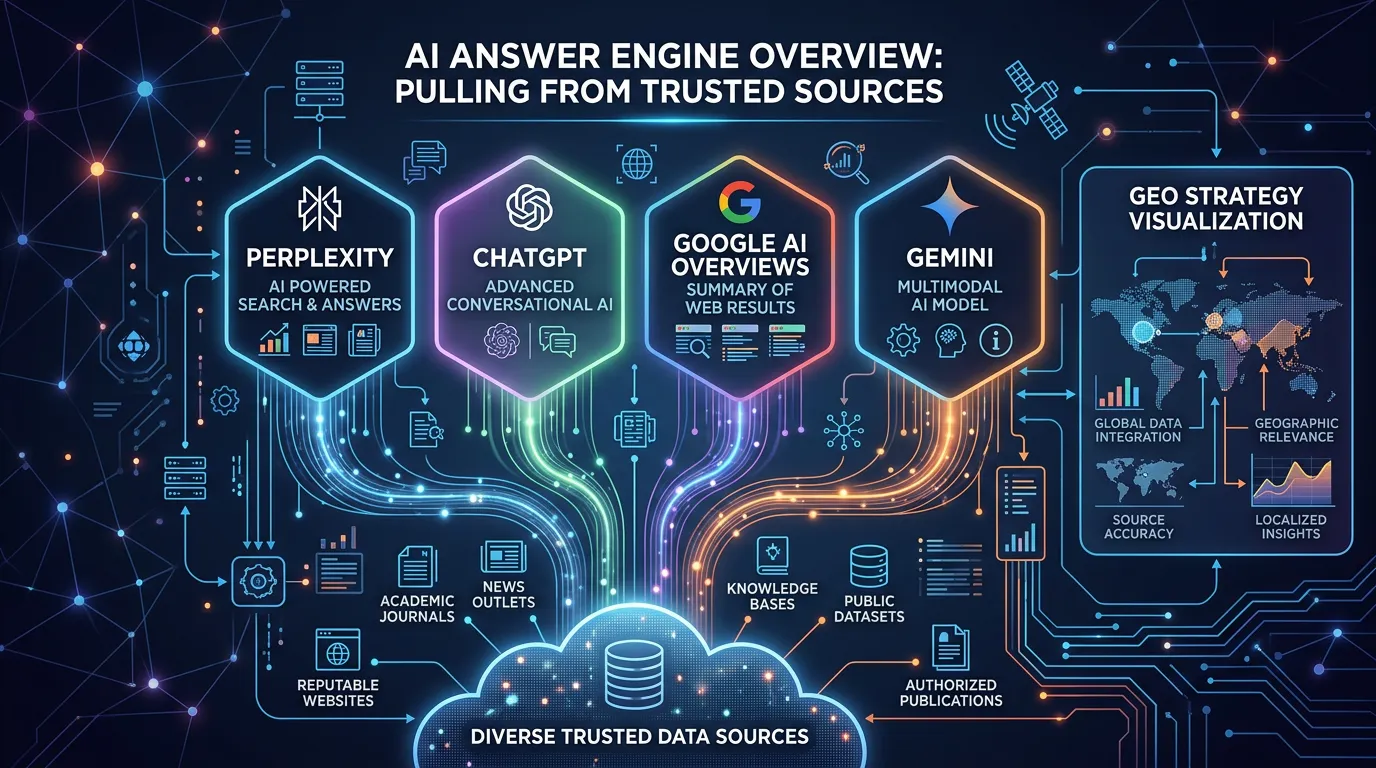
Generative engine optimization is the work of getting your business named inside AI answers. Those answers come from tools like ChatGPT, Google AI Overviews, Perplexity, and Gemini. The work uses clear answer first content, entity and structured data signals, and outside citations so AI systems know your business and name it.
Jump to a section
- The problem
- What GEO is
- Who it is for
- What is included
- Our process
- What it costs
- What changes
- All GEO services
- One van, three trucks, or four locations
- Where each engine gets its answers
- How a business ends up named in an answer
- Small habits that decide whether you get named
- How to tell at 60 days whether it is working
- When not to buy this service
- Questions that come up once the reports start
- Questions
The problem
A growing share of your customers never look at a list of ten blue links. They ask ChatGPT which HVAC company in Ontario handles commercial rooftop units. They type a question into Google and read the AI Overview at the top without scrolling. In both cases an answer gets written for them, and either your business is named in it or it is not. Most local companies have no idea which one is true, because rank tracking software reports positions, not mentions. So the traffic shifts quietly, the phone rings a little less than it used to, and nobody can point at a cause. Meanwhile the three or four competitors who show up in those answers get treated like a recommendation from a trusted friend rather than an ad.
What geo actually is
Generative engine optimization makes AI systems sure enough about your business to name it out loud. Those systems build answers from three things. First, content they can read and quote. Second, a clear picture of what your business is and where it works. Third, other websites that say the same thing about you. So the work runs on three tracks. Content gets restructured so a direct answer sits in the first two sentences of a section, with real specifics a model can lift. Then entity signals get cleaned up. Your name, address, and phone data must match everywhere. Organization and LocalBusiness schema go in as JSON-LD. The about page gets written for a machine as well as a person. And sameAs links tie every profile back to one company. Last, outside support gets built through directories, trade associations, local press, supplier partner pages, and forum answers. A model rarely names a business that only that business talks about. Progress gets measured by running a fixed set of real customer prompts against the major engines every month and logging who gets named.
Who it is for
This fits businesses that already have a working website and a real presence in local search. GEO builds on a presence you already have. It does not create one from nothing. It is a strong fit when customers research before they buy. It also fits when your service involves a decision people ask questions about. And it fits when the purchase comes with an obvious comparison, like repair versus replace or which type of roof to install. Professional services do especially well here. People ask AI for help choosing an attorney, a dentist, or a Medicare plan, in a way they would feel awkward asking a stranger. It is a poor fit if your site has three thin pages, no reviews, and no citations anywhere. Fix that first, because the AI engines pull from the same sources local search does.
Industries where this works hardest:

What is included
- Baseline AI visibility report across ChatGPT, Google AI Overviews, Perplexity, and Gemini
- Tracked prompt set of 30 to 60 real customer questions, re-run monthly
- Answer first rewrites of your priority service and location pages
- Organization, LocalBusiness, Service, and FAQPage schema in JSON-LD
- Entity consistency cleanup across your site, profiles, and data aggregators
- Citation and mention plan targeting the sources the engines actually cite
- AI crawler access review plus an llms.txt file where it makes sense
- Competitor answer analysis explaining why the named businesses get picked
- Monthly report of prompts won, prompts lost, and referral sessions by engine
Our process
Build and run the baseline prompt set
Week 1 to 2We write 30 to 60 questions the way your customers actually ask them, including buying questions, comparison questions, and problem questions. Then we run every one against ChatGPT, Gemini, Perplexity, and Google AI Overviews and record who gets named and which URLs get cited. This is the scoreboard everything else gets measured against.
Audit your sources and entity data
Week 2 to 3We look at what the engines are citing today for your topics, then compare it to what your site and profiles say. This surfaces the gaps: pages with no extractable answer, missing or broken schema, name and address mismatches across directories, and topics where you have no page at all.
Rewrite content and ship schema
Week 3 to 8Priority pages get restructured so the answer comes first and the supporting detail follows. Headings become questions. Vague claims get replaced with numbers, named tools, and real timeframes. Schema goes in at the same time and gets validated with the Schema Markup Validator and Google Rich Results Test.
Build outside corroboration
Month 2 to 5We work the sources that show up in citations for your category: industry directories, association member pages, chambers, local news, supplier and manufacturer partner lists, and community threads where your category gets discussed. Volume is not the point. Being present on the specific sites the engines quote is the point.
Re-test, report, and adjust
Ongoing, monthlyThe full prompt set gets re-run every month against the same engines so wins and losses are visible. Pages that lost a mention get diagnosed. New questions get added as they show up in your call recordings and GA4 search data. Model updates get treated as normal weather, not emergencies.
Realistic timeline: Baseline testing and the audit take 2 to 3 weeks. Content and schema work ships over the following 6 weeks. First new AI mentions usually appear 60 to 120 days in, and they arrive unevenly: Perplexity tends to move first because it leans on fresh crawls, while ChatGPT and Gemini lag. Expect month to month noise. Engines update models without notice, and a mention you had in March can vanish in April for reasons nobody outside that company can see.
What it costs
The number moves with how many service lines and cities need tracking, how much existing content has to be rewritten, and how thin your outside mention footprint is at the start. A single location business with three services and decent content sits near the low end. Multi location companies, regulated fields like medical and legal where claims need review, and businesses starting with almost no third party mentions run higher, because the corroboration work is slower and cannot be rushed.
Published ranges are starting points. The final number depends on your market, your current position, and how much ground there is to make up. You get a fixed scope in writing before anything begins.
What changes
Your business named in AI answers for questions your customers actually ask
A tracked prompt list showing exactly where you appear and where you do not
Cleaner entity data, which also helps map pack and traditional rankings
Referral sessions from ChatGPT, Perplexity, and Gemini visible in GA4
Fewer answers where only your competitors get named
Content that reads well for people and extracts cleanly for machines
All generative engine optimization services
Every area we cover under generative engine optimization. Each one has its own page with process, deliverables, and timelines.
AI Search Visibility Strategy
Measures where you appear in AI answers before anyone changes anything
AI Search Visibility StrategyContent Optimization for AI Answers
Rewrites pages so a model can quote a clean answer without guessing
Content Optimization for AI AnswersEntity and Structured Data for Generative Search
Removes the ambiguity that makes AI systems skip your business
Entity and Structured Data for Generative SearchCitation and Mention Building
Builds mentions on the specific sites AI engines quote in your category
Citation and Mention BuildingOngoing Generative Optimization
Re-runs your prompt set monthly so wins and losses are visible
Ongoing Generative OptimizationGEO for Local Service Businesses
Targets questions that include a city, neighborhood, or near me phrasing
GEO for Local Service Businesses
Where we do this work
Based in Chino, serving Chino, the Inland Empire, Orange County, Los Angeles County, Riverside County, and San Bernardino County.
One van, three trucks, or four locations
A one van operator does not need 60 tracked prompts. Twenty is plenty. Cover your top three jobs and the towns you actually drive to. The rest is cleanup: one correct name and phone everywhere, an about page that says who you are, and six pages that answer what you explain on the phone.
A three truck shop with two service lines has a different problem. Each line has its own questions and its own competitors in the answers. Track them apart. Merged, a strong month for drains hides a bad month for water heaters.
Multi location groups fail on entity data long before they fail on writing. Two offices sharing one tracking number, or a location page with no street address, confuses a model faster than dull prose ever will. Fix the facts first, then budget about one prompt set per city. An answer for Chino tells you nothing about Corona.
Where each engine gets its answers
Each engine builds its answers differently. That changes what you fix first and how soon anything moves.
| Engine | Where it looks | How fast it shifts | What moves it most | Traffic shows as |
|---|---|---|---|---|
| Google AI Overviews | Google's own index | Fast, tied to search | A strong page with a clear answer | Normal Google organic |
| Google AI Mode | Google index, deeper digging | Fast | Pages covering narrow follow up questions | Normal Google organic |
| ChatGPT | Own crawler plus a search partner | Weeks | Being named on trusted outside sites | chatgpt.com referral |
| Perplexity | Live crawl plus its index | Fastest, often days | A fresh page that answers directly | perplexity.ai referral |
| Gemini | Google search grounding | Follows Google closely | Clean entity data and valid schema | gemini.google.com referral |
A mention inside a Google AI Overview usually does not show as its own traffic source, so judge Google by your prompt log, not by GA4.
How a business ends up named in an answer
A model does not rank you. It decides whether naming you is safe. Every step below has to hold.
The weak link is almost always step three. Outside sites that agree about your facts turn a maybe into a name.
Small habits that decide whether you get named
None of these are big projects. They are what decides whether a model treats your facts as settled or as a guess.
Do this
- Pick one exact business name, including the Inc or LLC ending, and use it everywhere.
- Write your service area out as a plain list of city names, not just a map embed.
- Give facts a model can quote: years in business, license number, warranty length, response window.
- Ask happy customers to describe the job in the review, not only leave stars.
- Keep one clear page per real question so a model can lift a clean answer.
Not this
- Do not hide your best answers inside a PDF or behind a lead form.
- Do not let a chat widget or a slow script push your text out of reach.
- Do not buy directory bundles that list you on hundreds of sites with sloppy details.
- Do not rewrite a page that is already getting cited unless something on it is wrong.
- Do not judge a month on one prompt. Read the whole set before you react.
How to tell at 60 days whether it is working
Sixty days is early. You are not looking for a flood of mentions yet. You want proof the pieces are moving.
A few prompts changed status
Not named has turned into cited or named on a handful of your list.
Your URL shows up in source lists
Perplexity and Gemini list sources. Getting cited comes before getting named.
Brand prompts return correct facts
Ask an engine who you are. Hours, cities, and services should come back right.
Schema passes with no errors
Run priority pages through Google's Rich Results Test and clear what it flags.
GA4 shows a first AI referral
Even a few sessions from chatgpt.com or perplexity.ai count at this stage.
New outside pages carry your details
Two or three fresh listings with the same name, address, and phone.
The prompt list grew from real calls
Questions your phone staff heard this month belong in next month's run.
When not to buy this service
Say no if your phone is already full from repeat customers and referrals. Put the money into capacity. This work pays off when you need people who have never heard of you.
Say no if the basics are missing. An unclaimed Google Business Profile, under a dozen reviews, or a site where the text is drawn by script are cheaper problems. Fixing them helps AI answers too, and costs less than this service.
Say no if you cannot fund six months. Outside corroboration takes time you cannot buy back, so a three month trial is closer to a donation than a test. If money is tight, spend it on your profile, your reviews, and a few strong service pages first. We will say so when that is the better call.
You are not trying to beat a ranking. You are trying to be the answer a machine feels safe giving, and safe means several sources already agree about you.
Questions that come up once the reports start
I was named in March and gone in April. What broke?
Do AI mentions really send traffic?
Can I track any of this myself?

Frequently asked questions
Is generative engine optimization just SEO with a new name?
Can you guarantee ChatGPT will recommend my business?
How do you actually measure whether an AI mentions me?
Should I block AI crawlers or let them in?
Is this worth doing while AI search is still small?
What makes an AI pick one company over another?
Do I need local SEO before GEO makes sense?
Sources
- Google Search Central: AI features and your website(opens in a new tab) Google states that AI Overviews and AI Mode surface links from its own index and that standard Search best practices apply, which supports the table rows describing the Google engines and how their traffic appears.
- Google Search Central: Intro to how structured data markup works(opens in a new tab) Google documents JSON-LD structured data and points to the Rich Results Test for validation, which supports the 60 day checklist item about clearing schema errors.