
Resources
Video Marketing Resources
Video for a service business is not a production problem
Call (714) 823-3164 or ask a question. Clear recommendations, even if we never work together.
Video resources cover what to film, how to film it with a phone, and where each clip belongs afterward. You get shot lists for job site footage and script outlines for owner introductions. You also get caption and title practices for YouTube, plus how short vertical clips differ from a two minute service page video.
Video for a service business is not a production problem. It is a subject matter problem. The footage that works is boring to shoot and convincing to watch. Think of a tech explaining what failed, or an owner walking a finished job. Think of ninety seconds on what a permit inspection actually involves. These resources cover what to film and where each clip belongs once it exists. There are shot lists for job site footage. There is a phone setup that solves most audio problems for under a hundred dollars. There are script outlines for the four videos nearly every service business should have. Distribution gets equal space, because the same footage does different jobs in different places. A two minute explainer belongs on a service page. A thirty second cut belongs on a Google Business Profile, where most competitors still underuse video. Vertical clips belong on social and need different framing, so the guides cover shooting once and cutting three ways. The YouTube material covers titles, descriptions, and chapters. It also explains why a video answering one specific question beats a general company overview. Owners who hate being on camera get their own track, since plenty of effective service video never shows a face at all. This section fits companies that already have a phone, a truck, and jobs worth showing. That describes most of them.
More resources
Local SEO Guides
Local SEO GuidesGoogle Business Profile Checklists and Guides
Google Business Profile Checklists and GuidesReputation Management Resources
Reputation Management ResourcesPPC and Advertising Guides
PPC and Advertising GuidesWebsite Conversion Guides
Website Conversion GuidesContent Marketing and Topical Authority Guides
Content Marketing and Topical Authority Guides
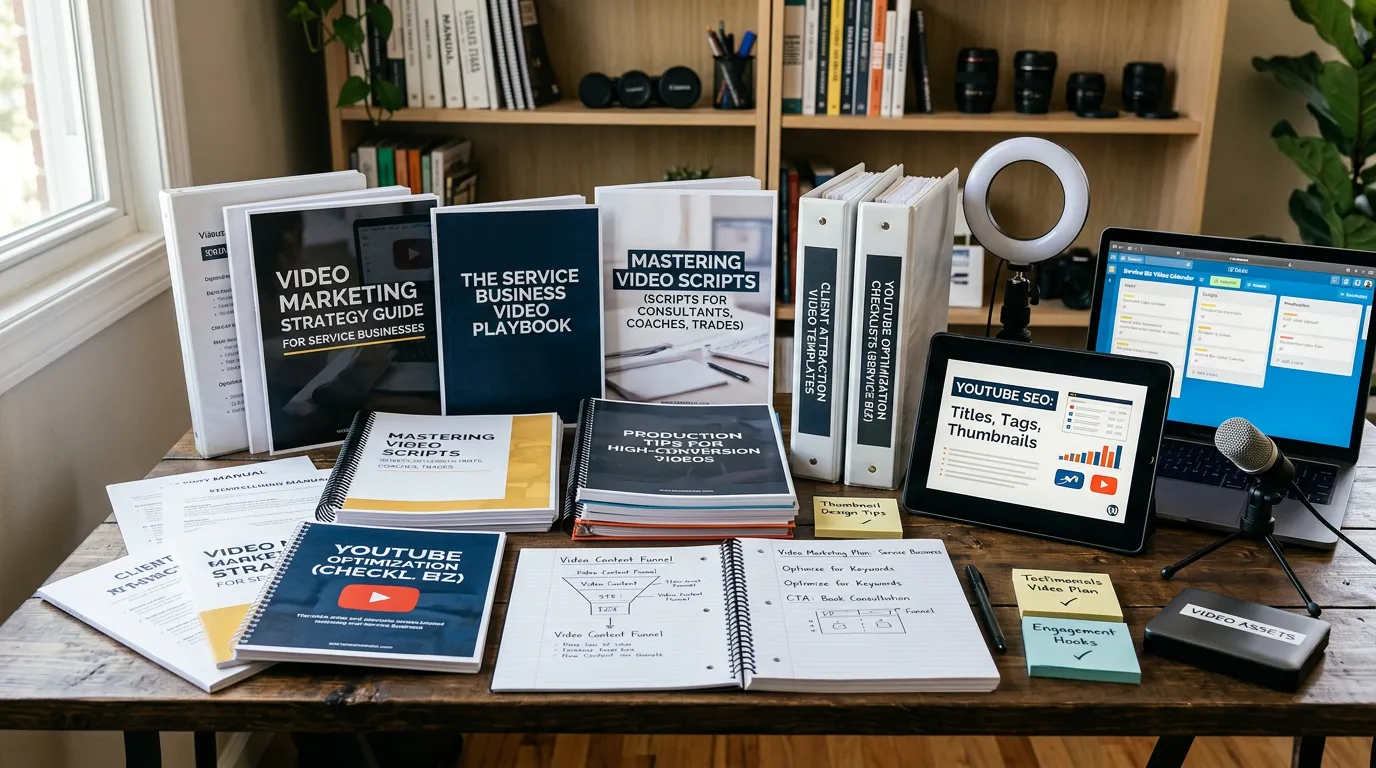
A one hour filming day that yields six clips
Do not schedule a video day. Attach filming to a job you already have on the calendar. Pick one that is visual, arrive 20 minutes early, and film five setups while the video marketing work happens around you.
The five are always the same. The arrival, showing the truck and the street. The problem, filmed close up before anyone touches it. The tech explaining what failed, in one take, in normal words. The fix in progress, with hands in frame. The finished result, with a slow pan.
That footage cuts into six usable pieces. A 90 second explainer for the video marketing service page, a 30 second result clip for the Google profile, two vertical clips for social, one before and after with no talking, and a short piece the office can attach to estimates for that job type.
The whole thing adds about an hour to a job you were doing anyway. Companies that treat video as an event film twice a year. Companies that attach it to the schedule end up with a library.
Phone setup that fixes most problems
Nearly every bad clip fails for one of these eight reasons. None of them cost money to fix.
Wipe the lens first
One pass on a shirt. It does more than any camera setting.
Shoot horizontal for the site, vertical for social
Or shoot wide and leave room to crop a vertical out of it later.
Put the sun behind the camera
Sun behind the person turns them into a dark shape.
Get a microphone within two feet
Wind and street noise ruin more takes than anything else.
Brace the phone on something solid
A small tripod, a ladder step, or the edge of a truck bed.
Frame the eyes about a third down
Not dead center, and never cut off at the top of the head.
Record five seconds before and after
It gives whoever edits room to make a clean cut.
Say the answer in the first sentence
People decide in about three seconds whether to keep watching.
One shoot, four places it goes
The same footage does different jobs in different places. What changes is length, shape, and how fast you get to the point.
| Where it goes | Length | Shape | What changes |
|---|---|---|---|
| Service page | 90 to 180 seconds | Horizontal | The full explanation, captions on by default |
| Google Business Profile | Under 30 seconds | Either | Result only. No intro, no logo animation |
| YouTube | 2 to 6 minutes | Horizontal | Title written as the question, chapters added |
| Social feeds | 15 to 45 seconds | Vertical | A hook in the first second, large captions |
| Estimate follow up email | 45 to 60 seconds | Either | Speaks to the exact job they asked about |
Profile video has a 30 second ceiling, so cut for that first. Everything else is a longer version of a clip you already have.
Filming customers, jobs, and property
Most trades film inside other people's homes. That comes with rules, and getting them wrong costs more than the video is worth.
Do this
- Ask permission before you film anything at a customer property.
- Keep house numbers, plates, and mail out of frame.
- Film the problem before you fix it, because you cannot go back.
- Say the city name out loud in the first ten seconds.
- Add captions, since most people watch with the sound off.
Not this
- Film anything after a customer has said no.
- Show a customer's face without written permission.
- Post an address, or a shot that makes one obvious.
- Use music loud enough to fight with the talking.
- Reshoot a good take because someone stumbled over one word.
The four videos to make first
Start with the question your office answers most on the phone. If every third caller asks how long a repipe takes, film 90 seconds on that, standing in front of an actual job. You already know the answer by heart, which is why this one gets made instead of postponed.
Second is the money question. What does this cost and why does it vary. Give the range and name the three things that move it. Most competitors dodge this, so the company that answers it plainly tends to get the call.
Third is what happens on the day. Where the truck parks, how long water is off, how much dust there will be, when they can use the room again. Homeowners worry about disruption more than price, and almost nobody films it.
Fourth is the diagnostic. How to tell whether you need this video marketing work at all. It feels like giving something away. In practice it brings you the people who do need it, already half convinced, and it is the one an AI assistant is most likely to quote.