Web Design and Development
Website Redesign Services
Rebuilds design and structure without throwing away your rankings
- Timeline
- Ten to sixteen weeks for a full redesign with migration
Call (714) 823-3164 or ask a question. Clear recommendations, even if we never work together.
A website redesign rebuilds an existing site's design, structure, and platform. It does that while protecting the search rankings and traffic you already have. A good website redesign and a costly one differ in one place: the migration work. That means a content inventory, a URL map, 301 redirects, and weeks of watching after launch.
The problem
The horror story is common enough that owners fear redesigns. A company pays 12,000 dollars for a beautiful new site, launches it, and within three weeks organic traffic is down 60 percent. What happened is almost always the same thing: the new site used different URLs, nobody set up redirects, and every page that had ranked for years now returns a 404. The links other sites had built point at nothing. Rankings the business spent four years earning are gone in a month, and rebuilding them takes longer than earning them did.
What it is
A website redesign is really two projects. One is design and build, which is the visible part. The other is migration, which is the part that decides whether you keep your traffic. Migration starts with a full crawl of the existing site to inventory every URL, its traffic, its rankings, and its inbound links. Pages that earn traffic get preserved or improved, not quietly deleted. Every URL that changes gets a 301 redirect mapped in a spreadsheet and tested on staging before launch. After go live we watch Search Console, crawl errors, and rankings daily for two weeks and weekly for two months.
Signs you need this
- Your site runs on a platform or plugin that is no longer supported
- You are afraid to touch the site because something always breaks
- The design predates the services you now sell
- A previous redesign cost you traffic and it never came back
- Your site is not secure, or shows mixed content warnings on some pages

What is included
- Full crawl and inventory of every existing URL with traffic and ranking data
- Backlink report showing which pages other sites link to
- Keep, merge, rewrite, or delete decision for every page
- URL map with a 301 redirect for every changed address
- Redirect testing on staging before launch, not after
- Preservation of title tags and content on pages that already rank well
- Updated XML sitemap and robots file submitted at launch
- Search Console monitoring daily for two weeks, weekly for two months
- Analytics continuity so historic data and the new site sit in one property
- Rollback plan documented before launch day
Our process
Inventory and Baseline
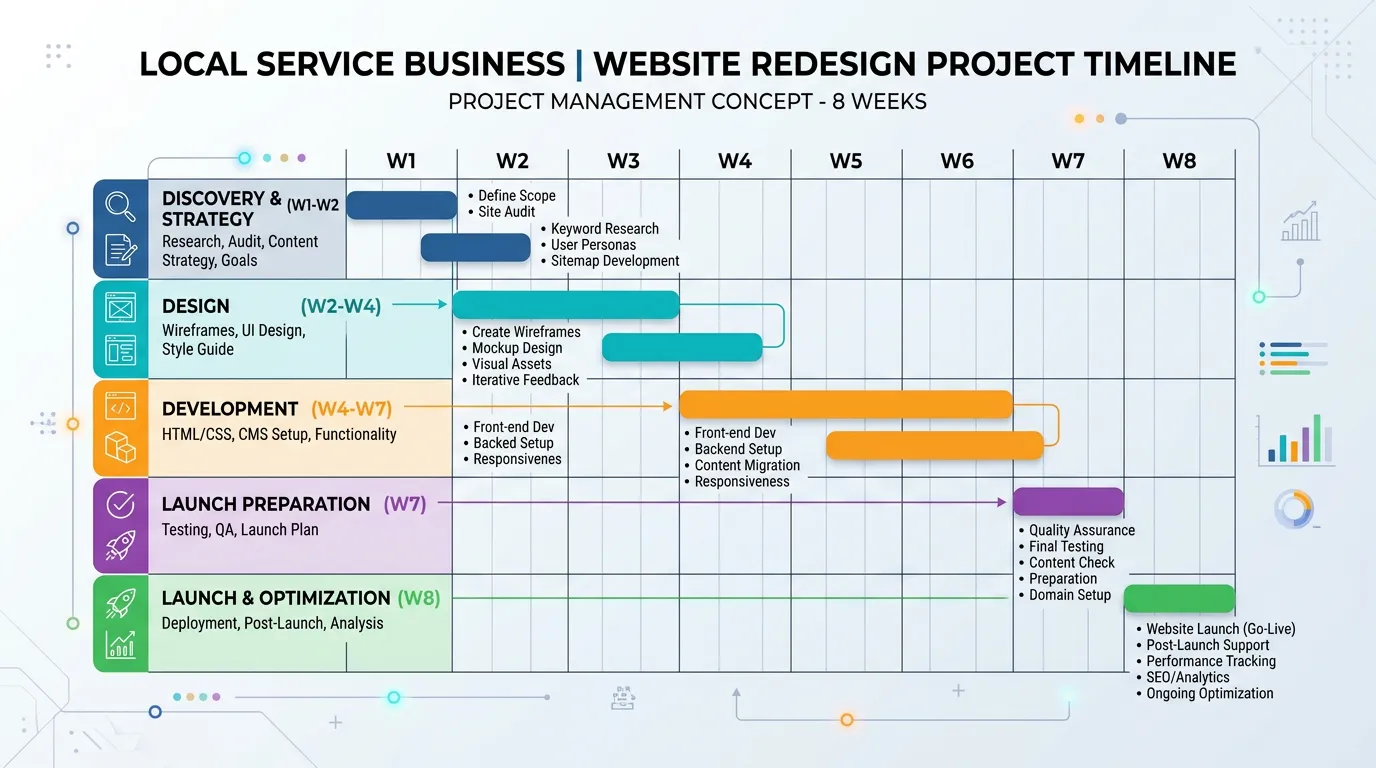
Week 1We crawl the existing site, export 12 months of organic landing page data, pull ranking positions, and list every page with inbound links. This becomes the scorecard we measure the launch against.
Keep, Merge, or Cut
Week 2 to 3Every page gets a decision. High traffic pages are preserved nearly word for word even if the design changes. Thin duplicate pages get merged into one stronger page. Pages with no traffic and no links get cut, and their URLs still get redirected.
Design and Build on Staging
Week 3 to 10The new site is built on a staging environment that is blocked from search engines. You review on your own phone and desktop, and we run the full site through a crawler to catch broken links before anyone else sees it.
Redirect Map and Dry Run
Week 10 to 11Every old URL is mapped to its new destination in a spreadsheet, loaded into staging, and tested row by row. A redirect that chains through three hops or lands on the homepage counts as a failure, not a pass.
Launch and Watch
Week 12 and 30 days afterWe launch midweek in the morning, submit the new sitemap, request indexing on priority pages, and check Search Console coverage, crawl stats, and rankings every day for two weeks.
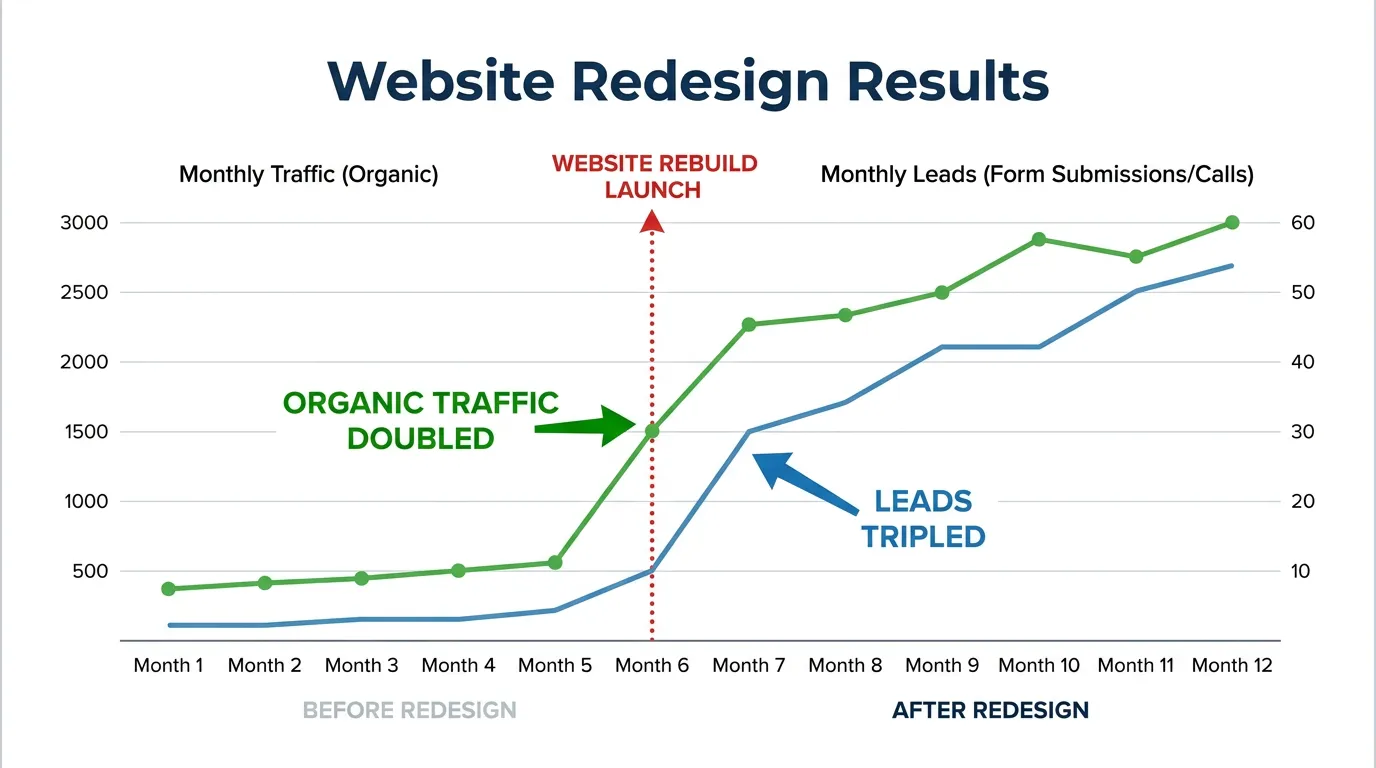
Realistic timeline: Ten to sixteen weeks for a full redesign with migration. Expect a two to four week dip in rankings around launch on many sites, then recovery and usually improvement by week eight.
What a Redirect Map Row Looks Like
The redirect map is a spreadsheet, one row per old address. Owners rarely see one, so here is what the rows actually contain.
| Old URL | Decision | New URL | Redirect type |
|---|---|---|---|
| /services/water-heaters.html | Keep, it ranks well | /services/water-heater-repair/ | 301 permanent |
| /blog/?p=417 | Merge into a stronger page | /services/repiping/ | 301 permanent |
| /about-us/team/john | Delete, that person left | /about/ | 301 permanent |
| /index.php?page=12 | Delete, no traffic and no links | /services/ | 301 permanent |
| /thank-you/ | Keep live, keep out of search | no redirect needed | noindex tag |
Every changed address gets a row. A redirect that dumps the visitor on the homepage instead of the matching page counts as a miss, not a pass.
The Week Before Launch
This is the list we run in the last five days. Skipping a line here is how a website redesign turns into a traffic loss.
Crawl staging for broken links
Every 404 found now is one you do not fix in public.
Test every redirect row by hand
Load the old URL, confirm one hop to the right page.
Confirm staging is still blocked
Then confirm the block is removed the moment you go live.
Copy title tags from top pages
Pages already ranking keep their titles, word for word.
Send a test form from a phone
Confirm it lands in a real inbox someone reads daily.
Point analytics at the new pages
Same property, so last year's numbers still compare.
Save a full backup of the old site
Files and database, stored somewhere off the server.
Write the rollback steps down
Who does what, in what order, if launch goes wrong.
What the First Eight Weeks Usually Look Like
Week one is quiet. Google has not recrawled most of the site yet, so rankings look unchanged. What moves first is crawl activity in Search Console, and that is the number we watch that week.
Weeks two and three are the dip. Positions wobble as pages get reassessed, and impressions often fall before they recover. On most sites this is normal, and it is the worst possible time to start changing things in a panic.
By week six most pages sit near where they started. By week eight the gains from better speed, cleaner structure, and stronger pages usually show up. If one page is still down at week eight, we look at that page on its own rather than blaming the launch.
Redesign Questions Owners Ask Late
Can we launch in pieces instead of all at once?
What about old blog posts nobody reads?
Do we need to tell Google we redesigned?