Industries and people we service
Marketing for Multi Location and Growing Service Businesses
Two locations or twenty, with consistent local visibility at each one.
Call (714) 823-3164 or ask a question. Clear recommendations, even if we never work together.
Multi location marketing is for service businesses running two or more real locations, or one location getting ready to open more. It differs because every multi location needs its own Google Business Profile, its own page, and its own tracking. Meanwhile the brand, the review flow, and the reporting stay the same across all of them.
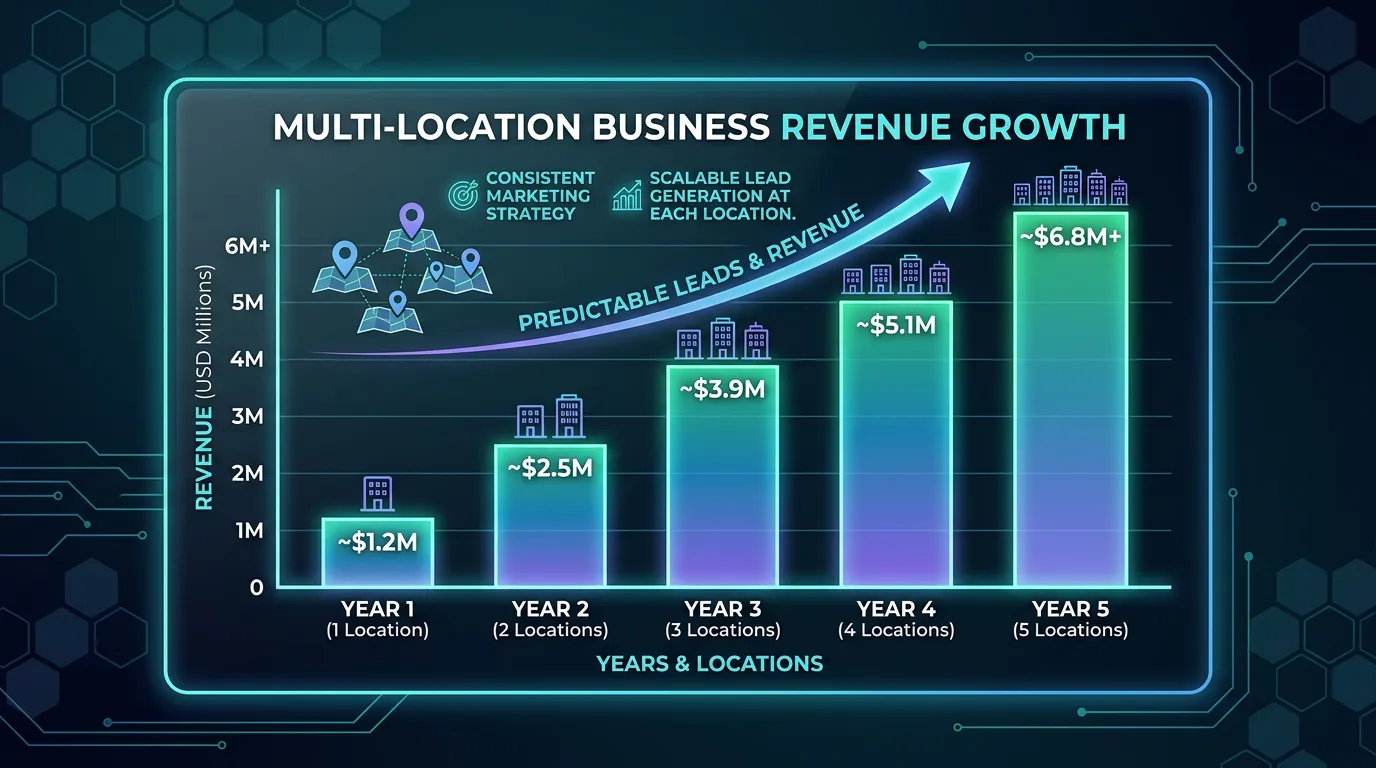
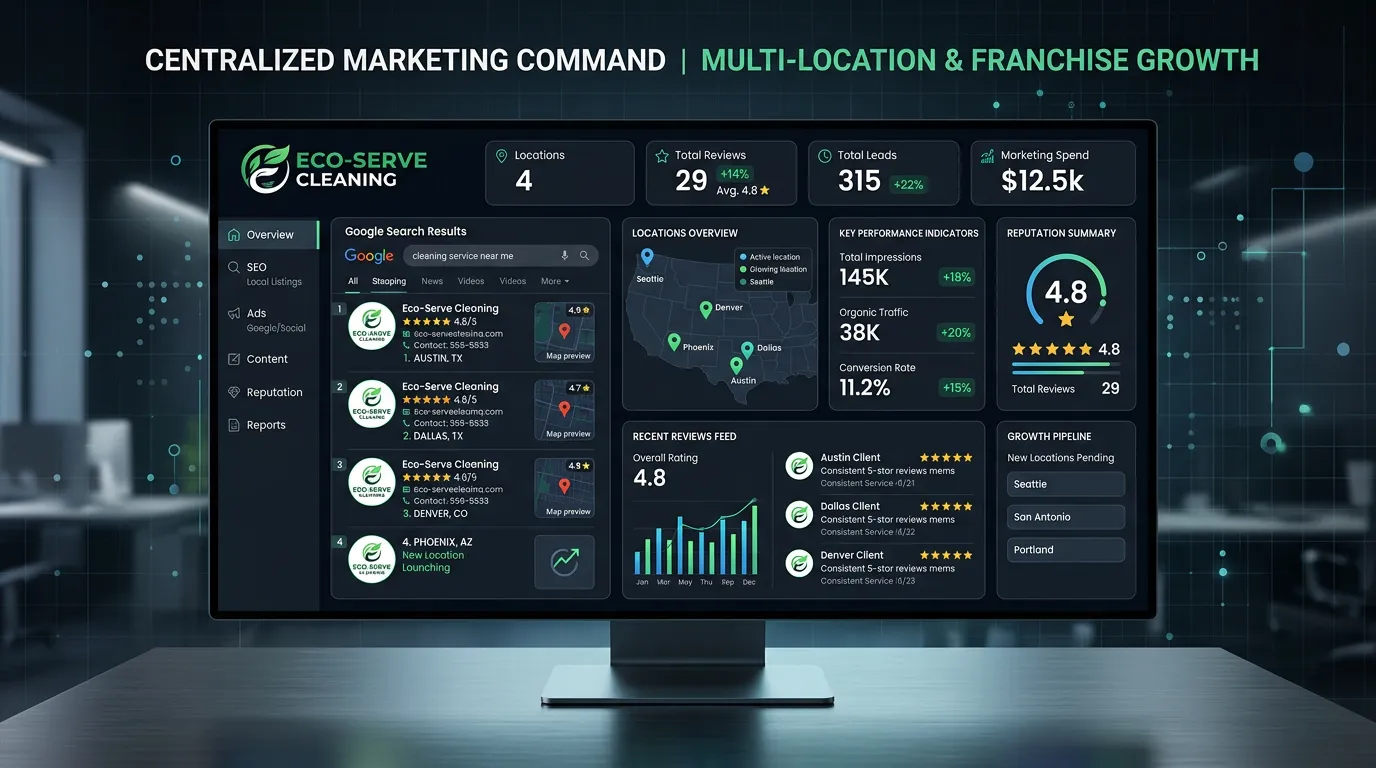
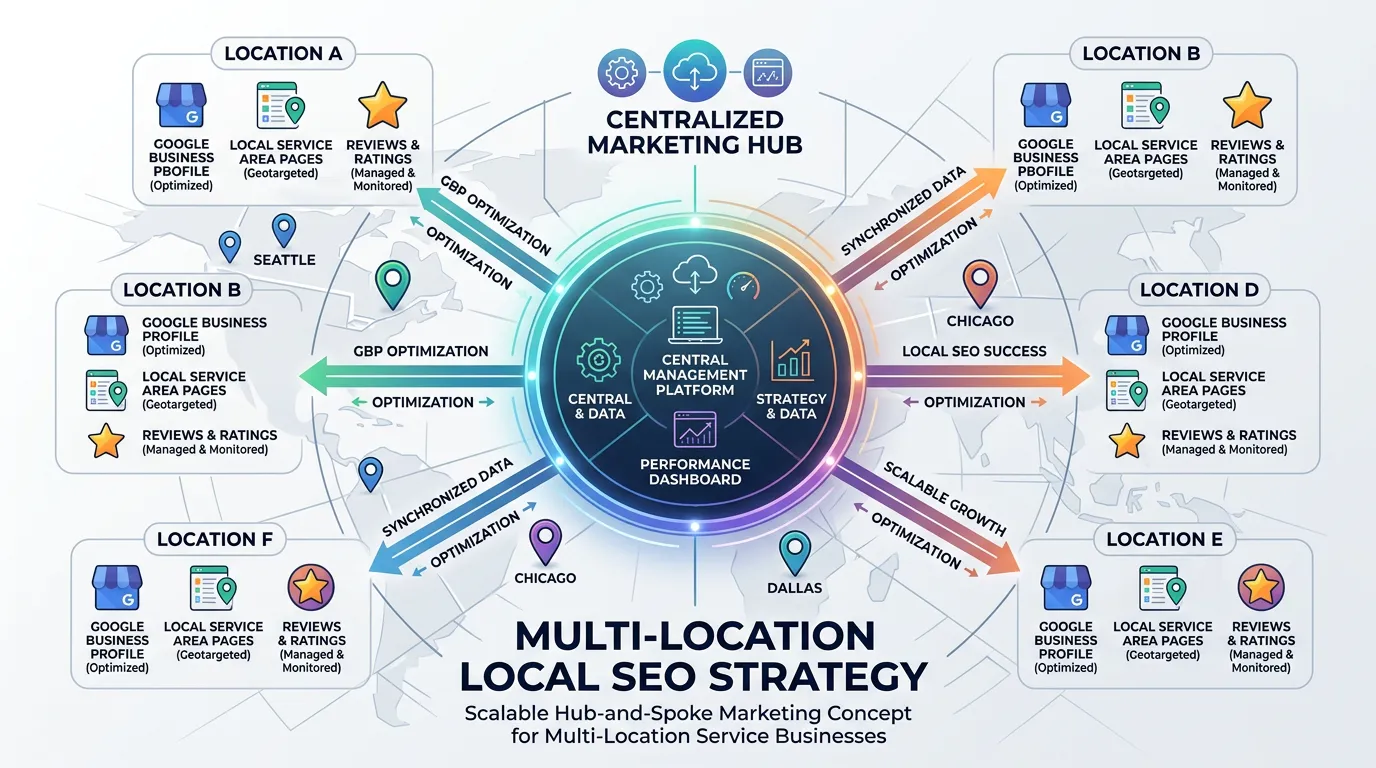
Multi location work is mostly an organization problem wearing a marketing costume. The rules are simple, and they get broken constantly. One Google Business Profile per real, staffed location, verified at that address. Never one per city you would like to serve. One page per location on the site, carrying that multi location's staff, hours, photos, driving directions, and the neighborhoods it actually covers. Copy the same paragraph across all of them and search engines filter them out. That is why so many growing companies rank well in their original city and nowhere else. Locations also compete with each other. Google usually shows a single listing per brand in a given map pack, so two shops seven miles apart trade positions rather than both appearing. That is fine as long as you plan for it. Measure combined coverage across the service area instead of chasing rankings location by location. Reviews are where central control breaks first. When one office sends every review request from a single system, reviews land on the wrong profile or on none at all. Route the requests by the multi location that did the work. Reporting has to split by location too, or it hides the useful information. Two locations can produce the same lead volume and very different revenue, because one manager answers the phone and the other lets it ring. Growth adds a launch sequence. Profile verification can take weeks, so a new location's profile, page, and call tracking should be moving sixty days before opening. Acquisitions bring their own mess: old profiles under a previous owner's name, duplicate listings, and reviews attached to the wrong address.
Where most engagements start
Google Business Profile Optimization
Turn your profile into the strongest lead source you own.
Google Business Profile OptimizationReputation Management
Generate reviews on purpose and protect the rating you have.
Reputation ManagementPay Per Click Advertising
Paid traffic that produces calls instead of clicks.
Pay Per Click AdvertisingWeb Design and Development
Fast, accessible websites built to turn visits into calls.
Web Design and Development
What counts as a location, and what does not
Half the trouble in this category comes from a fuzzy definition. Google has a fairly clear one, and it is stricter than most owners expect.
A location earns a profile when it has an address customers can visit, or a staffed base you operate from, with your own signage and people there during the hours you post.
A virtual office, a mailbox, a shared desk, or a friend's warehouse does not count. Those get profiles suspended, and losing a verified profile costs you rankings and reviews you spent years building.
If your crews drive to customers from one base, you are a service area business with one profile and a service area, not five locations. That is not a lesser setup. It means growth comes from pages, reviews, and ads rather than more pins on a map.
Three ways to grow, and what each one demands
Growth here takes one of three shapes. They are not equally hard, and the marketing work is different in each.
| Growth path | Time to visibility | Main risk | First move |
|---|---|---|---|
| Open a new location | Three to six months | Paying rent with no visibility | Start the profile 60 days early |
| Buy an existing business | Weeks, if handled right | Losing their reviews and rankings | Claim and audit their profile first |
| Add crews from one base | Almost immediate | Outrunning your own service quality | Prove capacity before you spend |
Buying is the fastest path to visibility and the easiest to ruin. A rushed name change or a merged profile can erase years of reviews in an afternoon, and there is often no way to get them back.
The 60 day launch sequence
Work backward from opening day. Each step below depends on the one before it, which is why late starts stay late.
Verification is the step that slips. Postcards get lost, video verification gets rejected, and a second attempt adds two or three weeks. Start it first and everything else has room to move.
Buying a business without losing its search equity
Acquisitions are where hard won local visibility disappears quietly. Work through this before anything changes in public.
Transfer the Google profile, never recreate it
A new profile starts at zero reviews. A transferred one keeps every one of them.
Get the old owner's logins before closing
Profile, website, domain registrar, review platforms, and directory listings.
Search for duplicate profiles at that address
Older businesses often have two or three. Merge them rather than deleting them.
Change the name in one step, not five
Repeated edits invite a manual review and sometimes a suspension.
Keep the old website live and redirect it page by page
Pointing everything at your home page throws away most of the value.
Audit their citations before you touch anything
You need a list of everywhere the old name, address, and number appear.
Tell customers the story on the site
Silence about new ownership reads as a downgrade to long time customers.
Watch reviews closely for ninety days
Any drop in service quality after a sale shows up here first.
Location pages that do not eat each other
The most common multi location failure is ten pages that say the same thing. Search engines treat that as one page and pick a winner.
Do this
- Put that location's own staff, phone number, and hours on its page.
- Describe the neighborhoods and landmarks around that specific address.
- Use photos taken at that location, including the building and the parking.
- Embed the map and write real driving directions from a nearby freeway.
- Link every location page from the main navigation, not just a dropdown.
Not this
- Do not reuse the same opening paragraph with the city swapped.
- Do not point every location page at one central phone number.
- Do not create location pages for places you do not staff.
- Do not bury location pages three clicks deep.
- Do not leave a closed location's page live without a redirect.
Questions from owners running two or more sites
Should each location have its own social accounts?
How do we split a budget across locations?
Should each location have its own phone number?
Frequently asked questions
Do we need a separate Google profile for each location?
Our two locations are seven miles apart. Are they hurting each other?
Should we run one website or a site for each location?
When should we start marketing a multi location that has not opened yet?
How do we keep reviews going to the right location?