
Resources
Agency vs DIY Comparisons
Every comparison in this section puts two real options side by side and leaves the tradeoffs in
Call (714) 823-3164 or ask a question. Clear recommendations, even if we never work together.
These comparisons put two real options side by side, with the tradeoffs left in. They cover hiring an agency versus doing the work yourself, SEO versus paid ads, and local versus traditional search. They also cover full service versus one specialist, including the cases where the cheaper or simpler option is right.
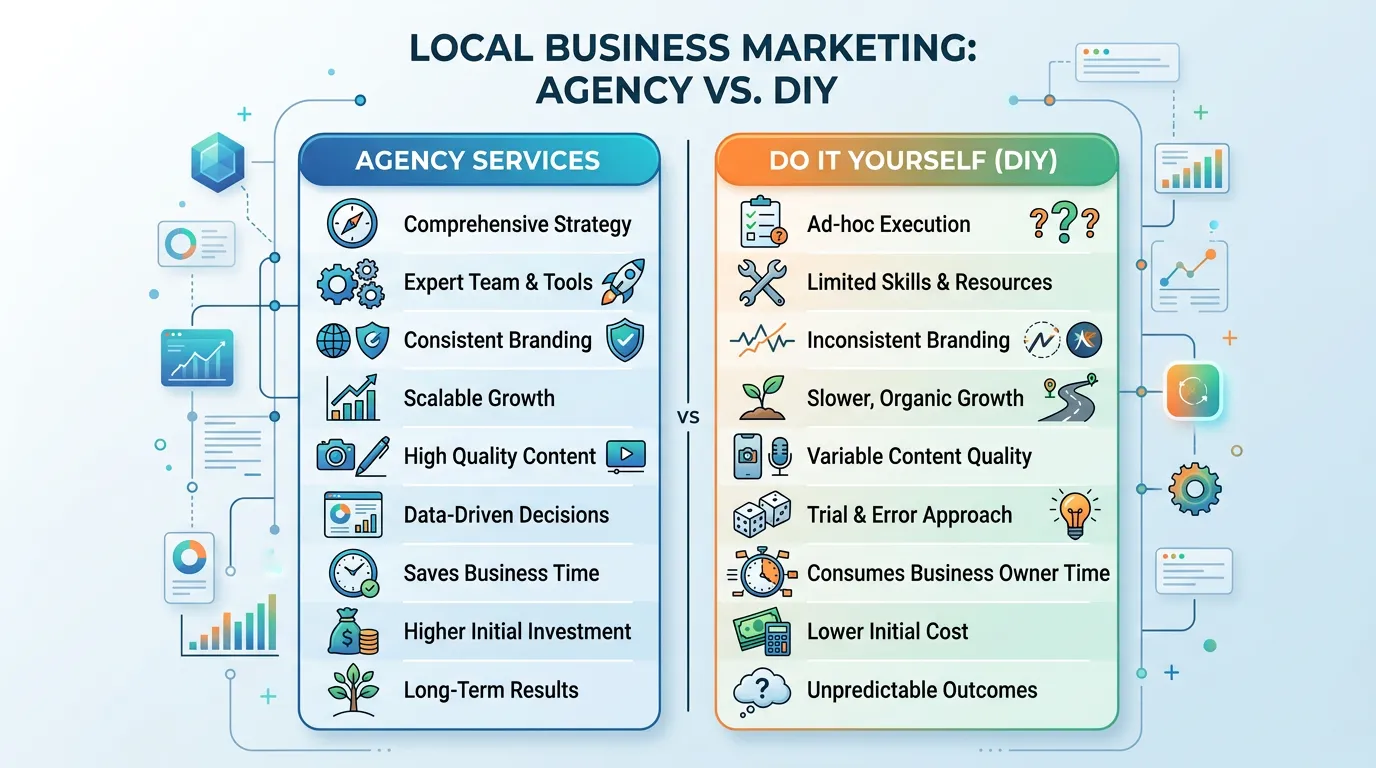
Every comparison in this section puts two real options side by side and leaves the tradeoffs in. Agency versus doing it yourself. SEO versus paid ads. Local search versus traditional search. An optimized Google Business Profile versus a listing you simply claimed. Active review management versus letting reviews arrive on their own. One full service partner versus one specialist doing one job well. The format repeats. A short verdict, then a table with a stated advantage on every line, then the questions people actually ask. The tables are the point. Each one gives ground to the other side. A comparison where one option wins every row was written to sell something, not to help somebody decide. Several of the verdicts recommend against hiring anyone, and they name the conditions where the cheaper or simpler choice is correct. These pages help at two moments. The first is early, when an owner is deciding whether to hire marketing out at all. The second is at renewal, after a program has run for a year. The question then is whether to expand it, narrow it, or bring part of it back in house. Read the verdict first. If it points toward the option you were already leaning toward, the table will tell you exactly what you give up by choosing it.
More resources
Local SEO Guides
Local SEO GuidesGoogle Business Profile Checklists and Guides
Google Business Profile Checklists and GuidesReputation Management Resources
Reputation Management ResourcesPPC and Advertising Guides
PPC and Advertising GuidesWebsite Conversion Guides
Website Conversion GuidesVideo Marketing Resources
Video Marketing Resources
What doing it yourself actually costs in hours
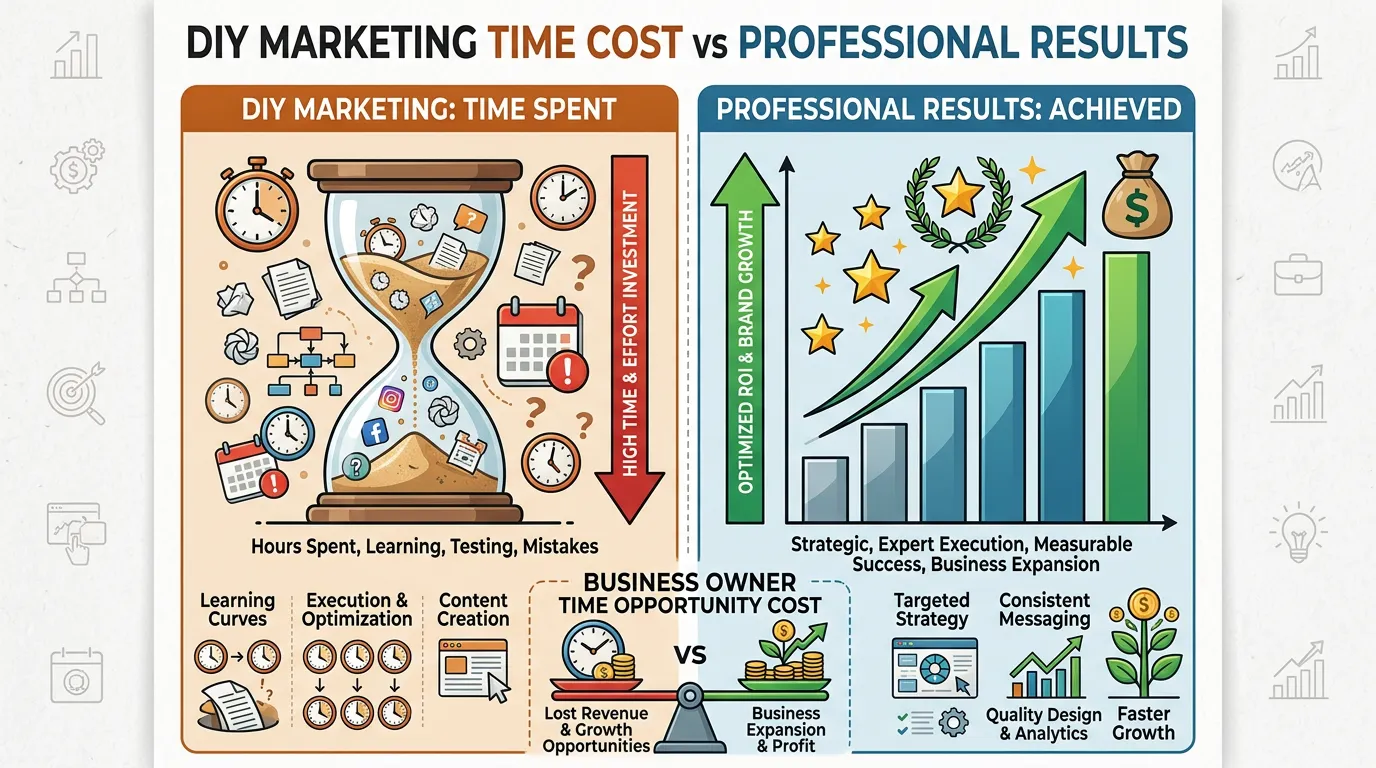
The DIY column always looks free because nobody counts the hours. So count them. Profile maintenance runs about an hour a month. Review requests and replies, two hours. One decent article, four hours including the research. One city page with real detail, three hours. Watching an ad account properly, four hours. Pulling numbers together, one hour.
That is about 15 hours a month for a modest program, and it lands on the person who is already the busiest. If your own hour bills at 120 dollars, those 15 hours carry an opportunity cost near 1,800 dollars, before anything is spent on tools or ads.
That does not make DIY wrong. Plenty of owners have the time in winter and not in summer, and plenty of office managers can absorb ten hours a month without anything else slipping. The point is to make the comparison honest.
Also count the learning. The first article takes eight hours, not four. The first ad campaign wastes money while you learn what to block. Those are real costs and they are one time costs, which is why DIY gets cheaper the longer you stick with it.
Which parts to keep in house
The best answer for most companies under about twenty staff is a split, not one side or the other. This is the usual line.
| Task | Best owner | Why |
|---|---|---|
| Asking for reviews | Your team | Only your crew is standing in front of the customer at the right moment |
| Job photos and video | Your team | Nobody else is on the roof or under the sink |
| Answering the phone | Your team | The lead dies on hold, no matter who generated it |
| Technical fixes and structured data | A specialist | Small mistakes here are expensive and hard to spot |
| Ad account management | A specialist, or nobody | Half attention burns budget faster than no ads at all |
| City and service pages | Split the work | You supply the job details, they write, edit, and publish |
The split works because the parts only you can do are the parts an agency cannot fake, and the parts that need practice are the parts you should not learn on your own money.
Signs you are ready to hire
Hiring too early wastes money. Hiring too late wastes years. These are the honest signals that the DIY phase is over.
You skipped the work two months running
Consistency is most of the result. Missing months undoes the good months.
You cannot say which channel produced last week's jobs
That means tracking was never really set up.
Nobody has opened the ad account in 30 days
The spend kept running the whole time.
You are turning down work you want
Your hour is now worth more doing the job than doing the marketing.
Something broke and you cannot tell what
Traffic or calls fell and nobody can say why.
You are guessing at technical changes
One bad edit can hide a whole site from search.
You have budget for at least six months
Three months buys a start and no result, which feels like being cheated.
You have someone who can feed them details
Agencies fail without job details, photos, and quick answers from you.
Hiring without regret
Most bad agency relationships were set up badly in the first two weeks, not ruined later.
Do this
- Start with one paid project before you sign a retainer.
- Grant account access rather than handing over passwords.
- Book a standing 30 minute call once a month and keep it.
- Agree in writing on what month one produces.
- Keep ownership of the domain, the accounts, and the content.
Not this
- Sign a year with someone who never looked at your site first.
- Hire in order to avoid a decision only you can make.
- Expect results while ignoring their requests for job details.
- Judge the whole thing at 60 days.
- Hire two firms to do overlapping work without telling either one.
When doing nothing is the right call
There are real cases where the answer is to spend nothing this quarter. If you are booked four weeks out, cannot hire, and your crews are already working Saturdays, more leads produce longer waits and worse reviews. Fix capacity first.
Another case is cash. If you have less than two months of payroll in the bank, a twelve month marketing commitment is a risk in the wrong place. Marketing pays back over months and payroll is due Friday.
The third case is operations. If your recent reviews complain about scheduling, callbacks, or cleanup, marketing will multiply that complaint. Every channel you turn on sends more people through the same process, and the process is what they are unhappy with.
Marketing multiplies what already happens. That is the whole reason a good comparison sometimes ends with a recommendation to wait, and why any provider who never says wait is not really comparing anything.
Two questions about the middle ground
Can I hire a freelancer instead?
What if I want to bring it back in house later?
Frequently asked questions
Are these comparisons written to sell your services?
Which comparison should I read first?
Do you ever recommend doing nothing?
How current are the cost figures?