
Resources
Content Marketing and Topical Authority Guides
Publishing more articles does not build topical authority
Call (714) 823-3164 or ask a question. Clear recommendations, even if we never work together.
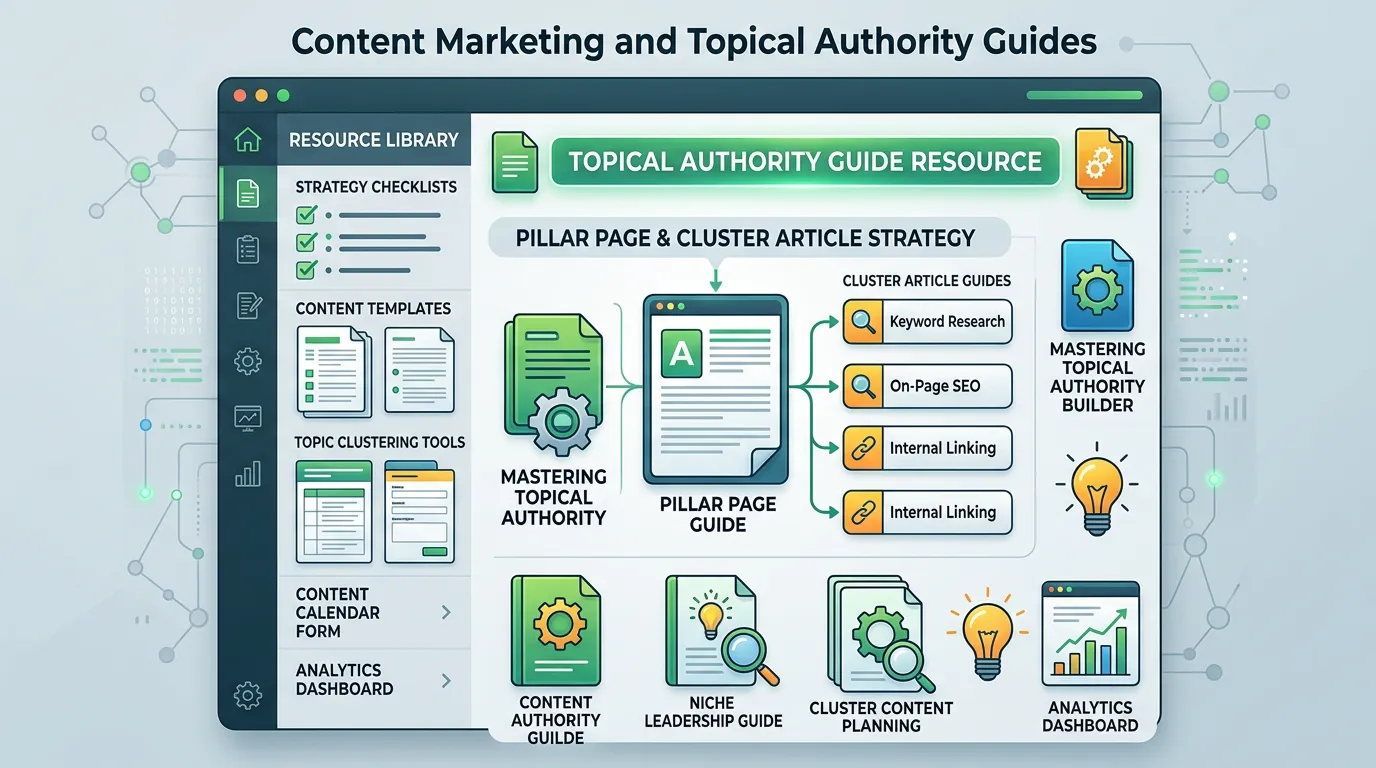
These guides explain how to build full coverage of a topic instead of publishing scattered posts. They cover keyword research for service businesses, pillar pages and clusters, internal linking, and refreshing old articles. They also show how to write something a customer finishes reading, not an article written for a search engine.
Publishing more articles does not build topical authority. Covering a subject completely does. These guides explain the difference and the work behind it. You will find keyword research aimed at service businesses. That means starting from the questions customers ask on the phone, not from a volume column in a tool. There is material on pillar pages and clusters. There is material on internal linking that passes real value, instead of stuffing a footer with city names. And there is material on when to update an old page rather than write a new one. Updates get serious attention here. Refreshing six existing articles often beats publishing six new ones, and it takes less time. The writing guides push hard toward specifics: what a repipe costs in this region, what a permit takes in a given city, what actually happens on day two of an install. Generic advice is invisible now, and AI systems repeat concrete details far more readily than they repeat filler. A separate track covers editorial process. It includes how to pull real detail out of a busy owner in a thirty minute call and turn it into something readable. This section helps owners doing their own writing, in house marketers running a calendar, and anyone who has published for a year without seeing traffic. Start with the research pieces. Most content that fails was aimed wrong before the first sentence was written.
More resources
Local SEO Guides
Local SEO GuidesGoogle Business Profile Checklists and Guides
Google Business Profile Checklists and GuidesReputation Management Resources
Reputation Management ResourcesPPC and Advertising Guides
PPC and Advertising GuidesWebsite Conversion Guides
Website Conversion GuidesVideo Marketing Resources
Video Marketing Resources
Where topics come from when the tools say zero
Type a real customer question into a keyword tool and you will often see a volume of zero. That does not mean nobody searches it. It means the tool cannot measure a number that small, and small local numbers are exactly what a service business lives on.
So start somewhere else. Pull 30 questions from the phone log and the estimate notes, and sort them by how often they came up. That list is your first year of content, ranked by demand you have already proven with your own customers.
Then use the tools for confirmation, not for discovery. Check whether anything close to the question has volume, look at what already ranks, and read the questions Google shows under the results. If nothing decent ranks for the question your customers keep asking, that is an opening, not a warning.
Low volume pages earn their keep three ways. They bring in a small number of people who are ready to buy, they answer the question before your sales call, and they give AI systems something concrete to repeat about your trade and your area.
One subject, five pages, worked out
Here is what a real cluster looks like for an HVAC company. Notice that each page has one job and one reader, and every page links back to the main one.
| Page | Question it answers | Who reads it | Links to |
|---|---|---|---|
| AC replacement guide | What is involved, what it costs, how long it takes | An owner about three weeks from buying | All four pages below |
| Repair or replace | Is my 14 year old unit worth fixing | Someone whose AC quit this morning | The guide and the cost section |
| What size unit do I need | Why a bigger unit is not a better unit | Someone holding two very different quotes | The guide |
| Permits and inspection | What the city requires and how long it adds | An owner worried about delays | The guide and the city page |
| Financing and rebates | What is available and what it costs monthly | An owner comparing payments, not prices | The guide and the contact page |
Five linked pages on one subject do more than twenty pages on twenty subjects. The links are not decoration. They are how the set gets read as one body of work.
Refreshing an old page, step by step
Updating usually beats writing new. Work through this in order on any page that gets impressions but few clicks.
Pull the query list in Search Console
Look for terms you rank for but never actually mention on the page.
Fix the date and every stale number
One out of date price undoes the trust the rest of the page built.
Answer the main question in the first 60 words
If the answer is in paragraph five, move it to the top.
Add headings in the words people type
Their words, not your internal service names.
Add one detail only your business knows
A city rule, a real timeline, a photo from a job you did.
Add three internal links pointing at it
Links coming in matter more than links going out.
Cut the sections that say nothing
Shorter and specific beats long and general every time.
Resubmit the page in Search Console
Then leave it alone for a month before you judge it.
Writing that earns a link and a citation
The pages that get quoted, linked, and repeated all share a few habits. So do the ones that get ignored.
Do this
- State numbers with the year and the place attached.
- Put the answer before the backstory.
- Use the customer's word next to the technical one, such as repipe and whole house replacement.
- Publish the process, including the parts that go wrong.
- Keep it to one page per question.
Not this
- Pad a short answer to reach a word count.
- Open with a paragraph about what this article will discuss.
- Write a general overview of a topic nobody asked about.
- Hide the answer under three paragraphs of background.
- Publish ten pages that all chase the same search.
How long a new page takes to do anything
People give up on content in month two, which is roughly one month before anything is readable. This is the normal shape for a service business page.
Expect roughly half your pages to never rank for anything. That is normal. Keep the ones showing impressions, improve them, and retire the rest.