
Services
Online Reputation Management for Southern California Service Businesses
Earn more good reviews, handle the bad ones well, and own your name in search.
- Starting at
- $600+
- Timeline
- New reviews start arriving within 2 to 3 weeks of launch
- Services
- 9 included areas
Call (714) 823-3164 or ask a question. Clear recommendations, even if we never work together.
Reputation management is the ongoing work of earning good reviews, replying to feedback, and watching what people say about your business online. It also means shaping what shows up when someone searches your business name. For service businesses, it directly affects how many people call after they find you.
Jump to a section
- The problem
- What Reputation is
- Who it is for
- What is included
- Our process
- What it costs
- What changes
- All Reputation services
- The math of moving your star rating
- What happens in the first 48 hours after a one star review
- Review habits that work, and ones that backfire
- Audit your own reputation this afternoon
- One truck versus five locations
- When not to buy this, and how to tell if it is working
- Questions we get after the first month
- Questions
The problem
Somebody finds you, likes what they see, then checks your reviews. That is where the decision actually gets made. A 3.8 star average with the newest review from two years ago costs you calls every single day, and nobody tells you it happened. Most owners deal with reviews reactively: they panic over a bad one, argue with the customer in public, and never build the steady flow of good ones that would have made the bad one irrelevant. Meanwhile a former employee, an old complaint site, or a competitor's comparison page is sitting on page one for your business name.
What reputation actually is
Reputation management has three parts. The first is generation. That means a system that asks happy customers for a review at the right moment, so new reviews arrive every week instead of every few months. The second is response. That means a plan for replying to reviews, especially the negative ones, so the reply reassures the next reader instead of making things worse. The third is monitoring and control. You watch every platform where you get reviewed or mentioned. You track the themes in what people say. And you make sure page one for your business name is made up of pages you control, or pages that treat you fairly. It is operations work as much as marketing, because reviews mirror how the business really runs.
Who it is for
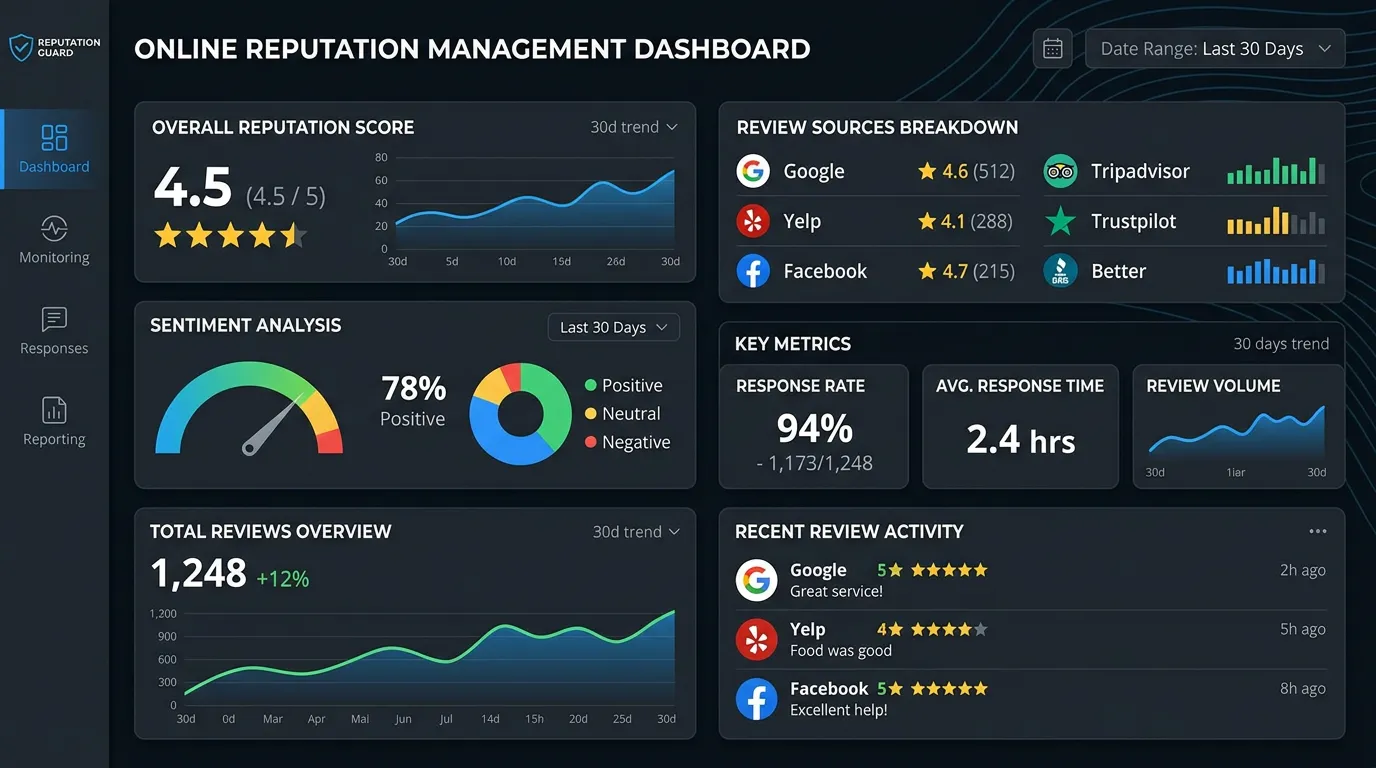
Service businesses where trust decides the sale. That includes anyone who enters a customer's home. It includes anyone who works on a person's health. And it includes anyone who handles money or legal matters. HVAC, plumbing, roofing, and remodeling companies live and die on reviews. Dental, medical, chiropractic, and senior care get judged even harder, because the stakes are personal. Insurance agents, law firms, and financial advisors get searched by name before the first meeting. If a customer will spend more than a few hundred dollars with you, they are reading your reviews first.
Industries where this works hardest:
What is included
- Review request system with text and email templates
- Direct review links and QR codes for every platform you use
- Staff training on when and how to ask
- Response writing for every new review across platforms
- Monitoring across Google, Yelp, Facebook, BBB, and industry sites
- Removal requests for reviews that violate platform policy
- Sentiment and theme tracking tied back to operations
- Brand search page one review and improvement plan
- Crisis playbook for a complaint that gets loud
- Monthly reporting on volume, rating, response rate, and themes
Our process
Audit and baseline
Week 1 to 2We count reviews, ratings, velocity, and response rate on every platform where you appear, compare against your top competitors, and search your business name to see what a customer actually finds on page one.
Fix the obvious damage
Week 2 to 4Unanswered reviews get responses, starting with the negative ones. Reviews that clearly violate platform policy get reported. Incomplete or abandoned profiles on major platforms get claimed and filled in.
Install the generation system
Week 3 to 5Review links, QR codes, text templates, and staff scripts go live. We pick the ask moment inside your existing workflow so it does not depend on anyone remembering an extra step.
Set response standards
Week 4 to 6Templates and rules for who responds, how fast, and what never gets said in public. Regulated industries get compliant language, since a healthcare provider confirming someone was a patient is a privacy violation.
Monitor, track, report
Ongoing, monthlyDaily alerts across platforms, monthly theme tagging so recurring complaints get back to operations, and a monthly report showing volume, rating trend, and what customers keep saying.
Realistic timeline: New reviews start arriving within 2 to 3 weeks of launch. Visible rating movement in 2 to 4 months depending on how many existing reviews dilute the average. Recovering from a serious reputation problem takes 6 to 12 months.
What it costs
The number moves with how many platforms you need covered, how many reviews arrive each month for us to respond to, and whether you are starting from a healthy base or repairing real damage. A single location with Google and Yelp sits at the low end. Multi location practices, regulated industries needing compliance reviewed language, and active recovery work sit higher. Recovery engagements are quoted separately since they front load the effort.
Published ranges are starting points. The final number depends on your market, your current position, and how much ground there is to make up. You get a fixed scope in writing before anything begins.
What changes
A steady flow of new reviews instead of long gaps and occasional bursts
A higher and more current average rating on the platforms customers check
Negative reviews answered in a way that reassures the next reader
Recurring complaint themes surfaced early enough to fix operationally
More control over what appears on page one for your business name
Better call to booking rates because trust questions are answered before the call
All reputation management services
Every area we cover under reputation management. Each one has its own page with process, deliverables, and timelines.
Review Generation Systems
Text requests sent within minutes beat emails sent days later
Review Generation SystemsReview Response Protocols
Responses are written for future readers, not for the reviewer
Review Response ProtocolsReputation Recovery
Fixes the operational cause first, since marketing cannot outrun bad service
Reputation RecoveryReview Platform Management
Every platform has different rules, especially Yelp
Review Platform ManagementLong Term Reputation Strategy
Sets 12 to 24 month review and rating targets from competitor data
Long Term Reputation StrategyOnline Review Management
The weekly routine: requests out, replies written, alerts cleared
Online Review ManagementReputation Management for Service Businesses
Built for businesses whose reviews name the technician, not the company
Reputation Management for Service Businesses
Where we do this work
Based in Chino, serving Chino, the Inland Empire, Orange County, Los Angeles County, Riverside County, and San Bernardino County.
The math of moving your star rating
Star averages move slower than owners expect, and the reason is arithmetic. Here is what it takes to move yours, assuming every new review is five stars. Real life runs slower because some of the new ones will be four stars.
| Where you are now | Reviews you already have | New 5 star reviews to reach 4.5 | New 5 star reviews to reach 4.7 |
|---|---|---|---|
| 3.5 stars | 25 | 50 | 100 |
| 3.8 stars | 40 | 56 | 120 |
| 4.0 stars | 100 | 100 | 233 |
| 4.2 stars | 60 | 36 | 100 |
| 4.4 stars | 200 | 40 | 200 |
The formula: reviews needed equals your current count times the gap you want to close, divided by five minus your target. Two things fall out of it. A big review count is armor once your rating is good, and a weight around your neck once it is bad. And 4.7 costs far more than 4.5, because you are dividing by a much smaller number.
What happens in the first 48 hours after a one star review
The engagement process above covers the first six weeks. This is the loop that runs every time a bad review lands after that.
The call comes after the public reply, not before it. Waiting to post until the phone call happens is how reviews sit unanswered for three weeks.
Review habits that work, and ones that backfire
Do this
- Send the request from the person who did the work, with their name in it
- Put the review QR code on the invoice and inside the estimate folder
- Read your four star reviews closely, because most of them name a real problem
- Test every review link on a real phone once a quarter, since platforms change URLs
- Write down who answers reviews while the owner is on vacation
Not this
- Do not use a tool that surveys customers first and sends only the happy ones to Google. That is review gating and it breaks platform policy
- Do not email five years of past customers in one week. Sudden waves get filtered
- Do not paste the same thank you on thirty reviews. Readers notice, and it reads as automated
- Do not name the customer, their address, or their job details in a public reply
- Do not report a real customer's honest complaint as fake. Bad filings train the platform to ignore the ones that matter
Audit your own reputation this afternoon
All of this takes about ninety minutes and costs nothing. Do it before you hire anybody, including us. If it turns up nothing, you may not need this service yet.
Search your business name in a private browser window
Write down all ten results. Anything on that page you do not control is a project.
Check the date on your newest Google review
Older than six weeks means the asking habit has already stopped.
Count the reviews on your three closest competitors
Note their newest review date too. The gap in pace matters more than the gap in total.
Count your unanswered reviews under four stars
Every one of them is a prospect reading a complaint with no reply under it.
Open your Yelp page and click Not Recommended at the bottom
Reviews parked there are invisible to most people and do not count toward your rating.
Send yourself your review link and open it on a phone
If it takes more than two taps to reach the star buttons, the link is the problem.
Find out which email address gets your review notifications
It is often an employee who left, which explains the reviews nobody answered.
Search your trade plus your city on two industry directories
Unclaimed profiles carrying old reviews turn up more often than owners expect.
Prospects read your worst review first, then they read your reply. The review belongs to the customer. The reply belongs to you, and it is the part that decides whether they call.
One truck versus five locations
For a small operator the work is almost all habit. One profile, one owner, usually 30 to 80 reviews. The job is asking on every visit, replying within two days, and keeping the link somewhere you can reach it in five seconds. Review software rarely pays for itself below about 40 jobs a month. A saved text template and fifteen minutes on a Friday does the same work for free.
Multi location businesses have a different problem. Each location has its own profile, its own rating, and its own crew, so the company average hides the one address that is dragging everything down. Reporting has to be per location or it tells you nothing. You also need to decide who is allowed to reply. A branch manager answering an angry review at ten at night is how a company ends up with a reply it cannot delete.
The middle case is one address with several providers or service lines. Dental practices with three hygienists and shops with four technicians get reviews that name a person, not the business. Tag those reviews by name from the start. It changes review data from a marketing report into something you can use in a Monday meeting.
When not to buy this, and how to tell if it is working
Skip reputation management while an operational problem is still running. If three reviews this month say the crew showed up late, dispatch is the fix, not marketing. Paying someone to write graceful replies to a complaint that keeps happening buys you nicer wording on the same problem. Skip it too if your volume is very low. Under roughly 20 jobs a month there are not enough customers to move an average, and your money does more in local SEO or your Google Business Profile first.
Judging whether it is working takes about four months, and you check the numbers in a specific order. First, are requests actually going out, measured against completed jobs. Second, how many new reviews arrive each month. Set your own baseline from the first ninety days and hold it, since the ratio of reviews to jobs varies a lot by trade and ticket size. Third, response rate and average response time. Rating is last, because the table above shows why it lags.
A useful sign at month three has nothing to do with stars. It is when your last five reviews all mention the same strength, and it is a strength your website does not talk about yet. That is customers telling you what to sell.
Questions we get after the first month
Why did some of my Google reviews disappear?
Can I put my Google reviews on my website?
What is a good review response rate?
Frequently asked questions
Can you remove a bad review?
How many reviews do I need?
Is it legal to ask customers for reviews?
How fast should I respond to a negative review?
Do reviews affect my Google rankings?
What if the negative review is actually our fault?
Should I use a review software platform?
How long does reputation recovery take?
Sources
- Google: Improve your local ranking on Google(opens in a new tab) Review count and rating feed the prominence signal Google uses to rank local businesses.
- Google Search Central: Review snippet structured data(opens in a new tab) Self serving reviews about your own business are not eligible for review rich results.