Home Services and Trades
Digital Marketing for ADU Builders
Content and city specific rule pages drive most qualified inquiries
Call (714) 823-3164 or ask a question. Clear recommendations, even if we never work together.
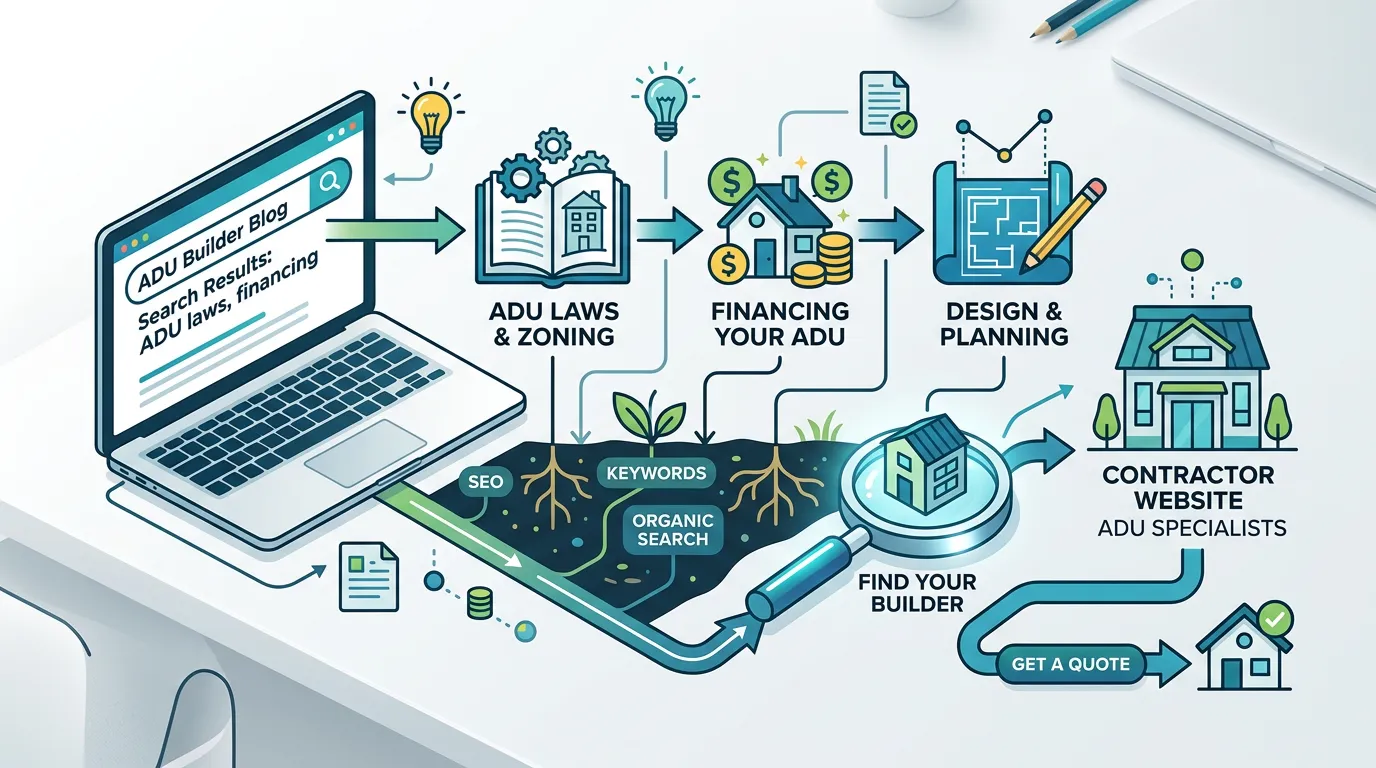
ADU marketing is mostly education. Homeowners spend months learning what their lot allows, what a build costs, and how to pay for it. Only then do they contact anyone. The adu builders who win publish city by city rules, real cost ranges by size, feasibility checks, and financing options. Then they stay in touch through a long planning process.
Jump to a section
- What usually goes wrong
- Which channels matter
- Seasonality
- What we measure
- Common concerns
- Where we start
- The money question comes before the design question
- Unit types, sizes, and where each one usually stalls
- Three ways to build the same unit
- Running a feasibility call that saves you a trip
- Two questions ADU builders ask us
- Questions
What usually goes wrong
- Half the inquiries are curiosity. People want a number before they know whether their lot even works.
- Every city in the Inland Empire and Orange County applies state ADU law a little differently, and homeowners expect you to know all of it.
- Financing is the real blocker. Most homeowners have equity and no clear path to use it.
- Prospects compare a modular unit, a panelized kit, and a site built ADU as if they were the same product.
- The sales cycle runs six to eighteen months, which breaks any marketing judged month to month.
- Plan check and utility connections add months, and the delay gets blamed on the builder.
- New competitors appear every quarter because the category keeps growing.
What usually makes an owner start looking
- State or city rule changes create a wave of homeowner questions nobody is answering clearly.
- Moving from general contracting into ADUs as a dedicated business line.
- Getting a set of pre approved plans accepted by a city and needing to sell them.
- Lead cost from directories and marketplaces climbing past what a build can support.
- Adding a sales consultant who needs a full calendar of feasibility calls.
- Finishing several ADUs in one city and wanting to own that city in search.
Which channels actually matter
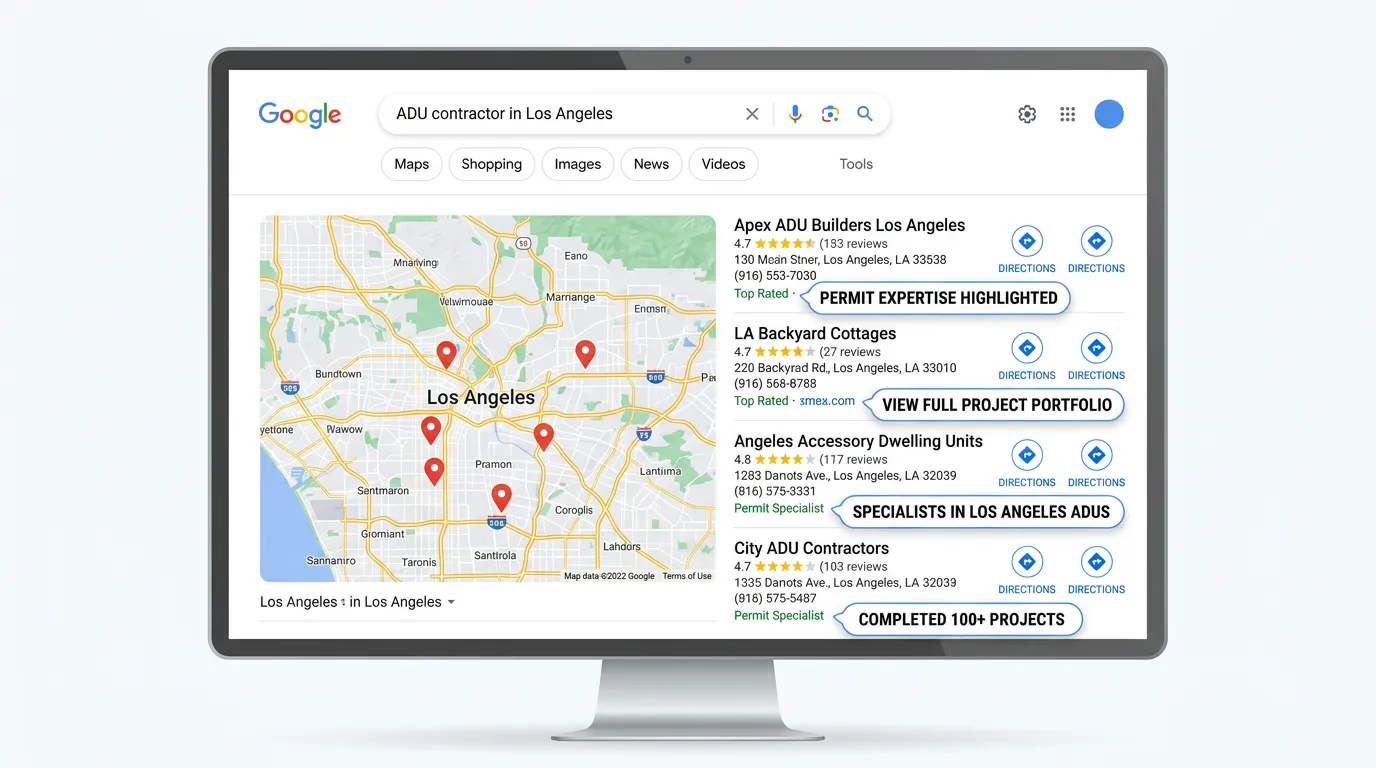
Not every channel deserves the same weight for adu builders. This is how we would prioritise.
| Channel | Weight | Why |
|---|---|---|
| Content marketing | Primary | This category is decided by research. Cost by size, financing paths, timeline expectations, and what a lot can support are the questions people search, and the builder who answers them best gets the call. |
| Local SEO and city pages | Primary | ADU rules are set city by city. A page on ADU requirements in a specific city, with real setback and height detail, ranks well and pulls homeowners who are already committed to building. |
| Paid search | Secondary | ADU cost and ADU builder terms convert while content ranks. Paid search fills the pipeline in the first months and lets you test which cities and unit sizes actually produce contracts. |
| Email and marketing automation | Secondary | A twelve month decision needs contact over twelve months. Financing explainers, finished project tours, and permit updates keep you present while the homeowner works through the money. |
| Generative engine optimization | Supporting | Homeowners now ask AI tools what they can build on their lot. Structured, factual pages about state and city rules are exactly the kind of source those answers pull from. |
Seasonality
ADU demand tracks interest rates and rule changes more than weather. Inquiries rise in late winter and spring as homeowners plan for the year, then dip through the holidays. Plan check and permitting take months. So the busy summer build season runs on leads you brought in the previous winter. Cut marketing in a slow quarter and you get an empty schedule two quarters later.
What we measure
Feasibility consultations booked, not raw form fills
Consultations that reach a signed design agreement
Design agreements converting to construction contracts
Average contract value by unit size and construction type
Lead to contract time and pipeline value six months out
Concerns we hear
We are booked out nine months already.
Which means today you are selling next year, and next year gets decided by the pipeline you build now. ADU leads take six to eighteen months to close anyway. Starting marketing when the backlog runs out puts the gap right in the middle of build season.
Homeowners just want a price per square foot.
They ask that because nobody has explained what moves the number. Site conditions, utility connections, foundation type, and finish level change it enormously. A page that shows ranges by size and lists those factors turns a price question into a real conversation.
Content takes too long. We need leads now.
Then we run both. Paid search and the Google profile can produce feasibility calls in the first month while the content builds. In a category with a year long cycle, skipping the content work means starting from zero again every time ad budget tightens.
We already rank for ADU builder near me.
Good, and that is one search out of hundreds people actually run. The volume sits in cost questions, city rule questions, financing questions, and unit size comparisons. Those searches reach the same homeowner months earlier, before they have a shortlist.
Marketplaces and directories send us plenty of leads.
They also send that homeowner to four other builders and raise the price whenever demand goes up. Nothing wrong with using them. Depending on them means someone else owns your customer acquisition and can reprice it any quarter.
Where we would start
The services that move the needle fastest for adu builders.
Generative Engine Optimization
Get named when someone asks an AI who to call.
Generative Engine OptimizationEmail and Marketing Automation
Follow up every time, without anyone remembering to.
Email and Marketing AutomationPay Per Click Advertising
Paid traffic that produces calls instead of clicks.
Pay Per Click AdvertisingWeb Design and Development
Fast, accessible websites built to turn visits into calls.
Web Design and DevelopmentLead Generation Systems
Capture, track, and follow up on every inquiry automatically.
Lead Generation Systems
Where we serve this industry
The money question comes before the design question
Most ADU projects stall on financing, not on design. The homeowner has equity in the house and no clear idea how to turn it into a building.
So they research quietly for months. They are not comparing builders yet. They are trying to find out whether this is even possible for them.
A plain page about how people pay for an ADU catches that person early. Home equity lines, cash out refinance, construction loans, and paying in stages all belong on it. Name a lender or two you have worked with, and say clearly that you are not the lender.
Unit types, sizes, and where each one usually stalls
Homeowners ask for a price per square foot because nobody has shown them how different these products are. This is the table that answers it once.
| Unit type | Typical size | Typical range | Where it usually stalls |
|---|---|---|---|
| Garage conversion | 350 to 450 square feet | 100,000 to 200,000 dollars | Old slab and drainage |
| Junior ADU inside the home | Under 500 square feet | 80,000 to 150,000 dollars | Kitchen and entry rules |
| Attached addition | 500 to 800 square feet | 200,000 to 350,000 dollars | Setbacks and the main house |
| Detached one bedroom | 500 to 750 square feet | 225,000 to 400,000 dollars | Utility runs across the lot |
| Detached two bedroom | 800 to 1,200 square feet | 350,000 to 600,000 dollars | Budget once plans are drawn |
Typical Southern California ranges for planning only. Site conditions, utilities, and finish level move every line.
Three ways to build the same unit
Homeowners compare these as if they were one product. A page that explains the tradeoffs saves you the same call forty times.
Say which method you use and why. When nobody explains it, the cheapest quote looks equal to the best one.
Running a feasibility call that saves you a trip
The first call decides whether this is a project or a hobby. Fifteen minutes on the phone can replace an hour of driving.
Do this
- Ask for the property address and pull up the lot before you talk price.
- Ask what the unit is for. A rental, a parent, or an office changes the design.
- Ask how they plan to pay, and listen for a real answer.
- Give a range for their size and say what would move it.
- Send a short written recap the same day, even when the answer is no.
Not this
- Do not quote a square foot number before you have seen the lot.
- Do not spend an hour with a caller who will not give an address.
- Do not promise a permit timeline. That clock belongs to the city.
- Do not delete a no from your list. Rules change and so do budgets.
Two questions ADU builders ask us
Should we market the rental income angle?
A rule changed. How fast should we publish?