Web Design and Development
Custom Website Design
Designed from your services, not adapted from a stock template
- Timeline
- Five to six weeks for custom website design on a typical service business site
Call (714) 823-3164 or ask a question. Clear recommendations, even if we never work together.
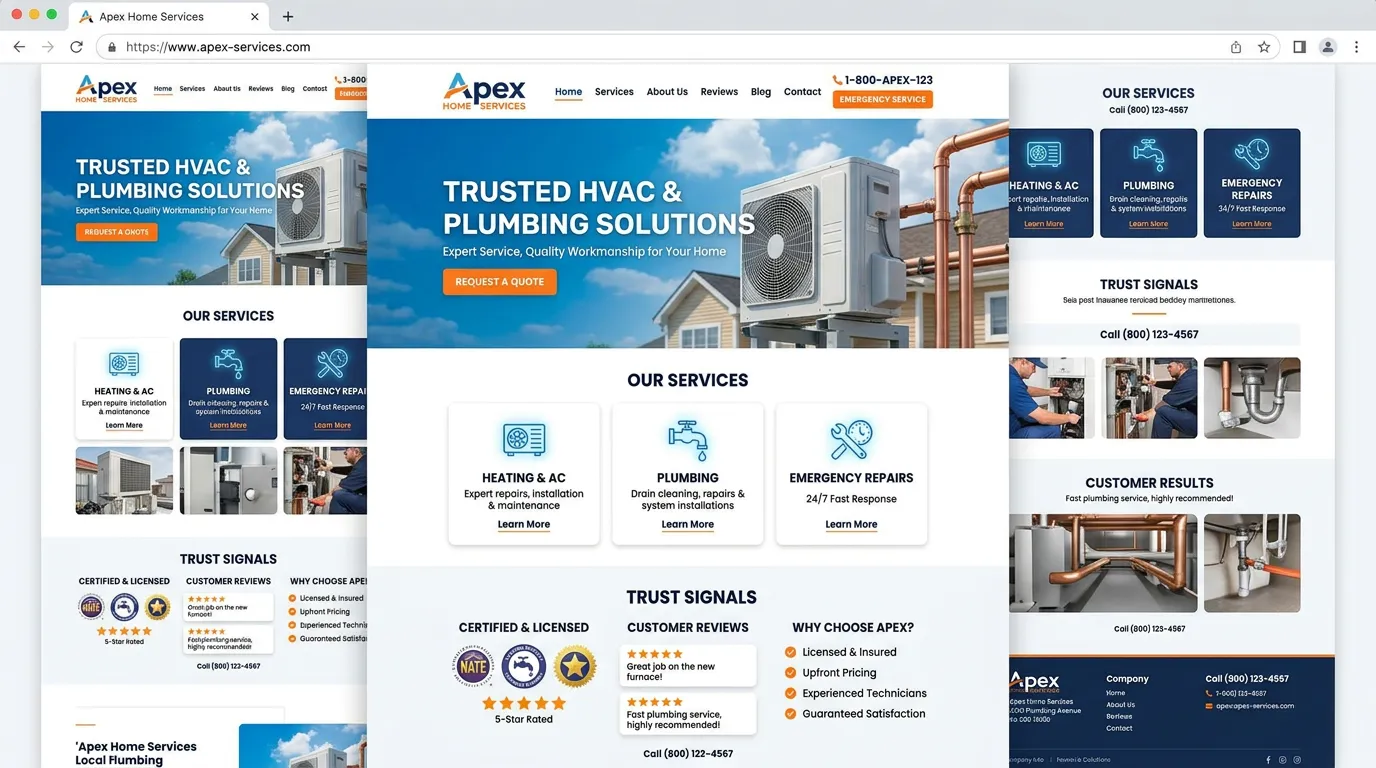
Custom website design means designing a site from your business instead of adapting a template you bought. We choose the layout, page structure, color, type, and photography for your services and your customers. It costs more than a template. What you get is a site your competitors cannot buy a copy of.
Jump to a section
The problem
Templates start cheap and get expensive. The layout was built for a photographer or a restaurant, so a plumbing company ends up forcing five service lines into a section designed for three portfolio images. The stock photo of a smiling man in a clean hard hat appears on four competitor sites in the same county. And because the template was never built for your content, every future page needs a workaround. Three years in, the site nobody wants to touch is the reason a whole rebuild gets quoted.
What it is
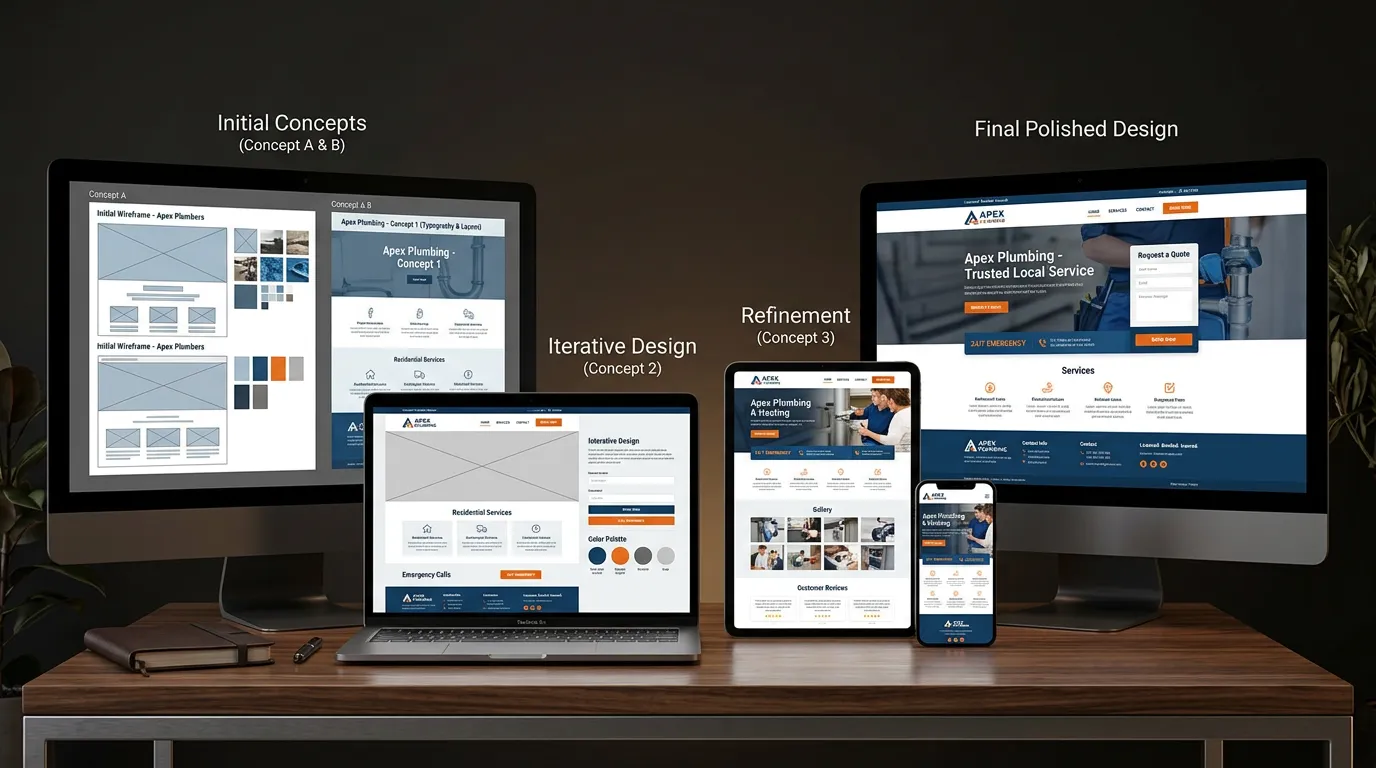
Custom design starts with your content, not a layout. First we map what each page has to say. Then we design a system for the site: type scale, color palette with accessible contrast, button styles, card patterns, form styling, and photo treatment. You approve a homepage and one interior template first, in phone and desktop views. Only then do we apply the system across the rest of the site. The output is a Figma file with named components and a style guide. Any developer or designer you hire later can extend the site without guessing at your rules.
Signs you need this
- Your site looks like three competitors in the same county
- You cannot add a new service page without breaking the layout
- Every photo on the site is stock imagery of people you never met
- Your brand colors fail contrast checks and text is hard to read on a phone
- The site was built around a page builder plugin nobody wants to update
What is included
- Discovery workshop and competitor design review in your trade and county
- Sitemap and page level content outline approved before design begins
- Homepage design in phone and desktop views with two revision rounds
- Interior page templates for service, service area, about, and contact
- Custom website design system covering type scale, color palette, buttons, forms, and cards
- Accessible color contrast checked to WCAG 2.2 AA on every text pairing
- Photography direction list telling you exactly which shots to capture
- Icon and graphic set drawn or selected to match the brand
- Figma file with named components handed over at project close
Our process
Discovery Workshop
Week 1A 90 minute session covering your services, your best and worst customers, your pricing structure, what competitors do well, and what you want a visitor to feel in the first five seconds. We record it and pull language from it later.
Structure Before Style
Week 1 to 2We build a sitemap and outline what every page must say and in what order. Approving structure first is what keeps design revisions to two rounds instead of nine, because most custom website design disagreements are really content disagreements.
Direction Concepts
Week 3 to 4You see the homepage and one interior template in phone and desktop views, plus a style tile showing type, color, and buttons. We revise the direction here, while changes are cheap.
System Rollout
Week 4 to 5The approved system gets applied to every remaining page template. Because these are built from shared components, you review patterns rather than 20 separate page designs.
Handoff
Week 5 to 6Custom website design goes to the build team with a component library, spacing rules, and states for hover, focus, and error. You get the Figma file and a written style guide to keep.
Realistic timeline: Five to six weeks for custom website design on a typical service business site. Add two weeks if a logo or brand refresh is part of the project.
What Lives Inside a Design System
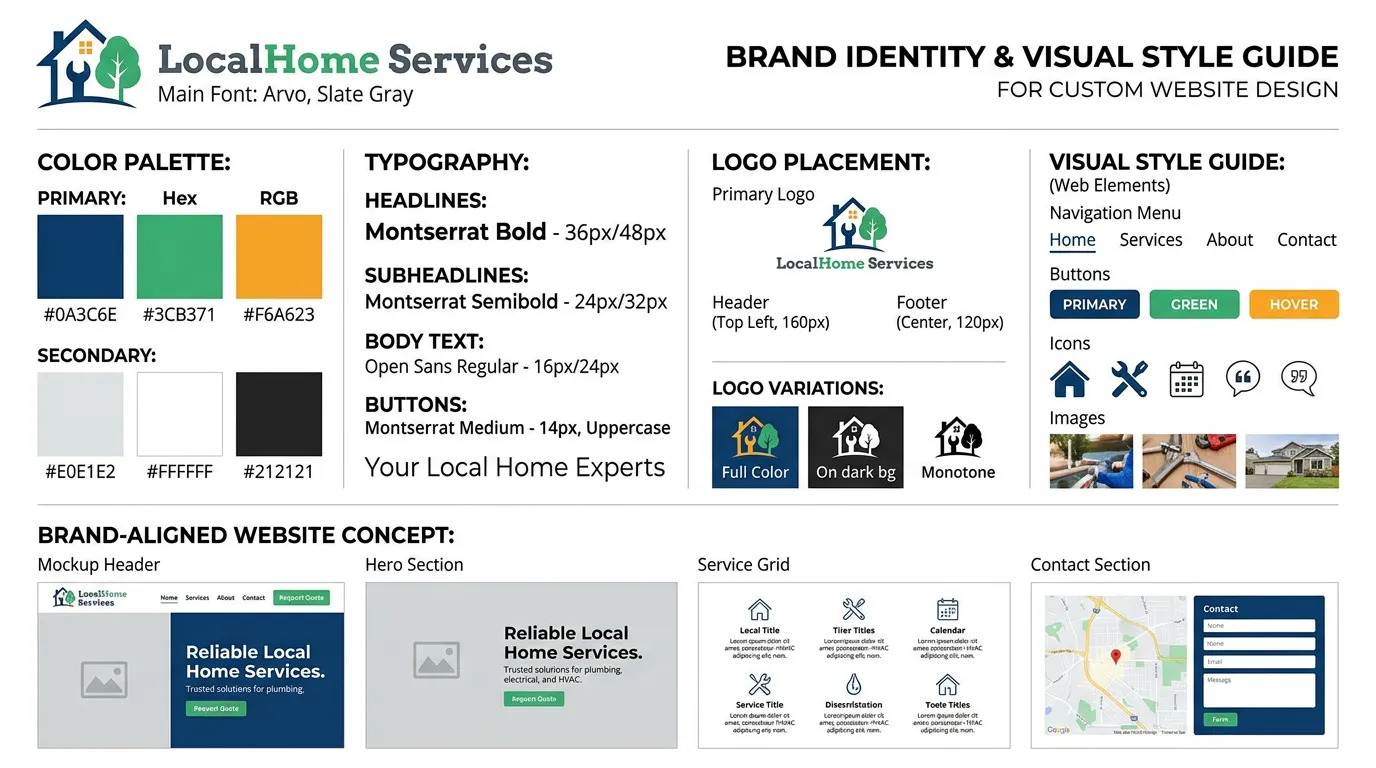
A custom website design system is not a mood board. It is a set of rules a builder can follow without stopping to ask you a question. Ours lists a type scale with six sizes, a color palette with exact hex values and where each color is allowed, and spacing steps in multiples of four pixels.
It also covers states. A button has a resting look, a hover look, a pressed look, a focus outline, and a disabled look. Template sites often design only the first one. That is why their forms feel broken the moment something goes wrong.
The value shows up in year two. You add a financing page, the designer opens the file, pulls the card pattern and the button style, and the new page matches. Nobody guesses.
Where Templates Break for Service Businesses
Templates are built around an imagined business. Here is what happens when your real business does not match that shape.
| What your business has | What a template does with it | What a custom design does |
|---|---|---|
| Nine service lines | Three feature cards, the rest hide in a menu | A grid sized for nine, ordered by what you sell most |
| A license and bonded status | No slot for it, so it lands in the footer | A trust row under the first headline, where doubt starts |
| Photos of finished work | A fixed crop that cuts the top off a roof | Photo sizes chosen after we look at your real photos |
| Three service cities | One address block in the footer | City pages built from a repeatable template |
| Prices that change twice a year | Numbers baked into a graphic | A price block your office manager can edit |
The layout assumed a business shape. Yours is a different shape.
What We Take From Competitor Sites, and What We Do Not
Part of discovery is opening the top six competitor sites in your trade and county on a phone. We are not hunting for a look to copy. We are looking for what all six fail to answer.
It is usually the same short list. Nobody posts a price range. Nobody names the cities they cover. Nobody shows the same crew twice. When five competitors all hide the same thing, showing it plainly beats any layout choice you could make.
We do copy one thing on purpose: patterns customers already know. Phone number top right. Menu icon in its usual corner. A form that behaves the way forms behave. Being clever there only costs you calls.
Getting Photos a Designer Can Actually Use
Photography shapes how a custom site feels more than color or type does. These rules make a shoot usable.
Do this
- Shoot in the morning or late afternoon when the light is soft
- Take every shot wide and again upright, so phone and desktop both work
- Leave empty space on one side of the frame for headline text
- Get the crew in clean company shirts and wash the trucks first
- Photograph the finished job and the messy before shot from the same spot
Not this
- Do not shoot into midday sun bouncing off a white driveway
- Do not crop tight, the designer needs room to cut the image later
- Do not send screenshots of photos, send the original files
- Do not use a shot with a competitor logo or a face you have not cleared
- Do not mix five filters, it makes the site look assembled from parts
Design Questions That Come Up Late
Who owns the Figma file if we stop working together?
What if my partner and I disagree on the direction?