
Home Services and Trades
Digital Marketing for Remodeling Companies
Inquiries arrive nine to eighteen months before a signature
Call (714) 823-3164 or ask a question. Clear recommendations, even if we never work together.
Remodeling marketing has to survive a long, emotional decision. A homeowner saves ideas for a year, then asks three companies to quote. They pick the one that made the process feel predictable. So show before and after proof and honest cost ranges. Add a structured design step and follow up that keeps you in front the whole time.
Jump to a section
- What usually goes wrong
- Which channels matter
- Seasonality
- What we measure
- Common concerns
- Where we start
- The eighteen month customer
- Typical remodel ranges and what moves them
- A year in the life of a remodeling lead
- Having the budget conversation early
- What to build during the quiet weeks of December
- Questions
What usually goes wrong
- Homeowners inquire nine to eighteen months before they are ready to sign anything.
- Design consultations get booked and then no showed because nothing was committed.
- Budget mismatch wastes weeks. A sixty thousand dollar vision meets a twenty five thousand dollar budget at the first meeting.
- Every competitor uses the same stock photos, so nothing on the site proves the work is yours.
- Change orders and schedule slips produce the reviews that hurt most, even on projects that ended well.
- Material lead times move the finish date and the customer only remembers the original one.
- Financing exists but nobody explains it until the price is already on the table.
What usually makes an owner start looking
- Interest rate changes slow inquiries and the pipeline visibly thins.
- Opening a design studio or showroom that needs booked appointments to justify the lease.
- Hiring a designer or in house salesperson who needs consistent leads.
- Watching three straight bids go to a competitor with a stronger portfolio.
- Finishing a standout project and having nowhere good to show it.
- Wanting fewer, larger projects instead of a calendar full of small ones.
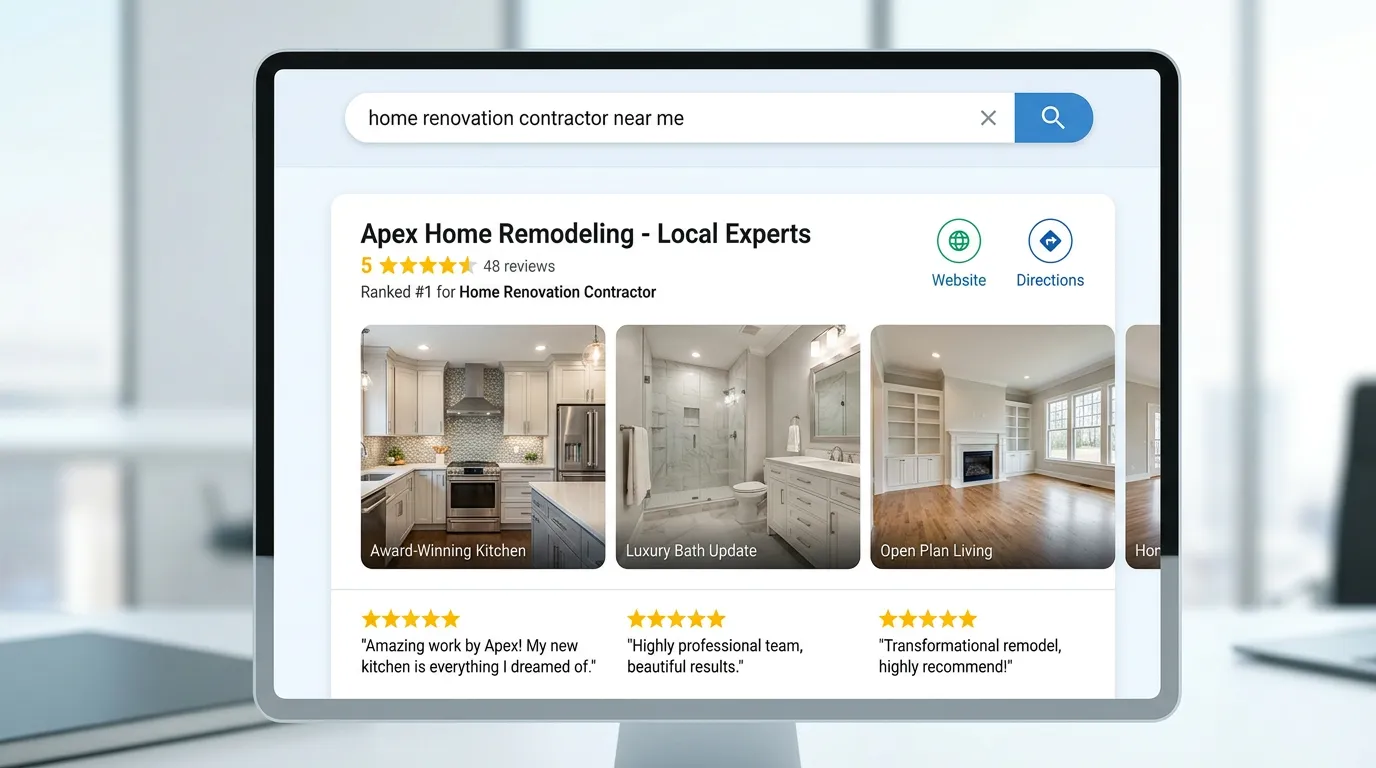
Which channels actually matter
Not every channel deserves the same weight for remodeling companies. This is how we would prioritise.
| Channel | Weight | Why |
|---|---|---|
| Website and conversion rate optimization | Primary | Remodeling buyers judge you on the portfolio and the clarity of your process. Most remodeling sites already get traffic and convert poorly, so the page is usually the constraint, not the audience. |
| Paid search and remarketing | Primary | Remodel cost and design build searches carry real intent, and remarketing keeps you in front of a homeowner through the months between the first click and the first meeting. |
| Social media | Secondary | Nobody hires a remodeler from a post, but nearly every homeowner checks the profile before a consultation. A steady feed of real local projects answers whether you do work like theirs nearby. |
| Email and marketing automation | Secondary | A year long decision needs a year long conversation. Project galleries, cost guides, and financing explanations sent over time turn old inquiries into current consultations. |
| Local SEO | Supporting | Map visibility brings in nearby homeowners and supports the referral checks, though it is a smaller share of remodeling revenue than in the emergency trades. |
Seasonality
Southern California remodeling gets planned in winter and built in spring and summer. Inquiries climb from January through April as households set budgets. They climb again in early fall, when families want work finished before the holidays. Mid November through December is the quiet stretch. That makes it the right time to build content and remarket to everyone who inquired earlier in the year.
What we measure
Design consultations booked and held
Consultation to signed project rate
Average project value and gross margin by project type
Pipeline value by stage rather than raw lead count
Cost per signed project against average contract value
Concerns we hear
Our showroom traffic and referrals fill the calendar.
Until they do not, and remodeling demand moves with interest rates and consumer confidence. The companies that stay full through a soft year are the ones with a pipeline they built when things were good. Starting that build during a slow quarter is late by about six months.
Leads from the internet are unqualified.
Usually because the site asks for nothing. A form with name and phone gets browsers. A form asking project type, rough budget range, timeline, and city gets fewer submissions and far more real ones. We would rather report twelve good inquiries than sixty bad ones.
We do not want to publish prices.
Publish ranges instead. Remodeling buyers search cost questions constantly, and pages with honest ranges rank, get quoted by AI tools, and pre qualify people. Hiding the number means budget mismatch gets discovered in your first meeting, which costs you hours you will never bill.
Instagram has never brought us a job.
It probably will not directly, and that is not its role. It is the proof step. Homeowners look at it after they find you and before they book. Treat it as a portfolio that runs on autopilot rather than a lead source and it starts earning its place.
We already tried a marketing company and got nothing.
Ask what they measured. Most remodeling programs are judged on monthly lead count, which is the wrong measure for a decision that takes a year. We report consultations held, pipeline value, and signed projects, and we expect the first two to move well before the third does.
Where we would start
The services that move the needle fastest for remodeling companies.
Web Design and Development
Fast, accessible websites built to turn visits into calls.
Web Design and DevelopmentConversion Rate Optimization
Get more calls from the traffic you already have.
Conversion Rate OptimizationPay Per Click Advertising
Paid traffic that produces calls instead of clicks.
Pay Per Click AdvertisingEmail and Marketing Automation
Follow up every time, without anyone remembering to.
Email and Marketing AutomationSocial Media Marketing
Social proof that supports the sale instead of random posting.
Social Media Marketing
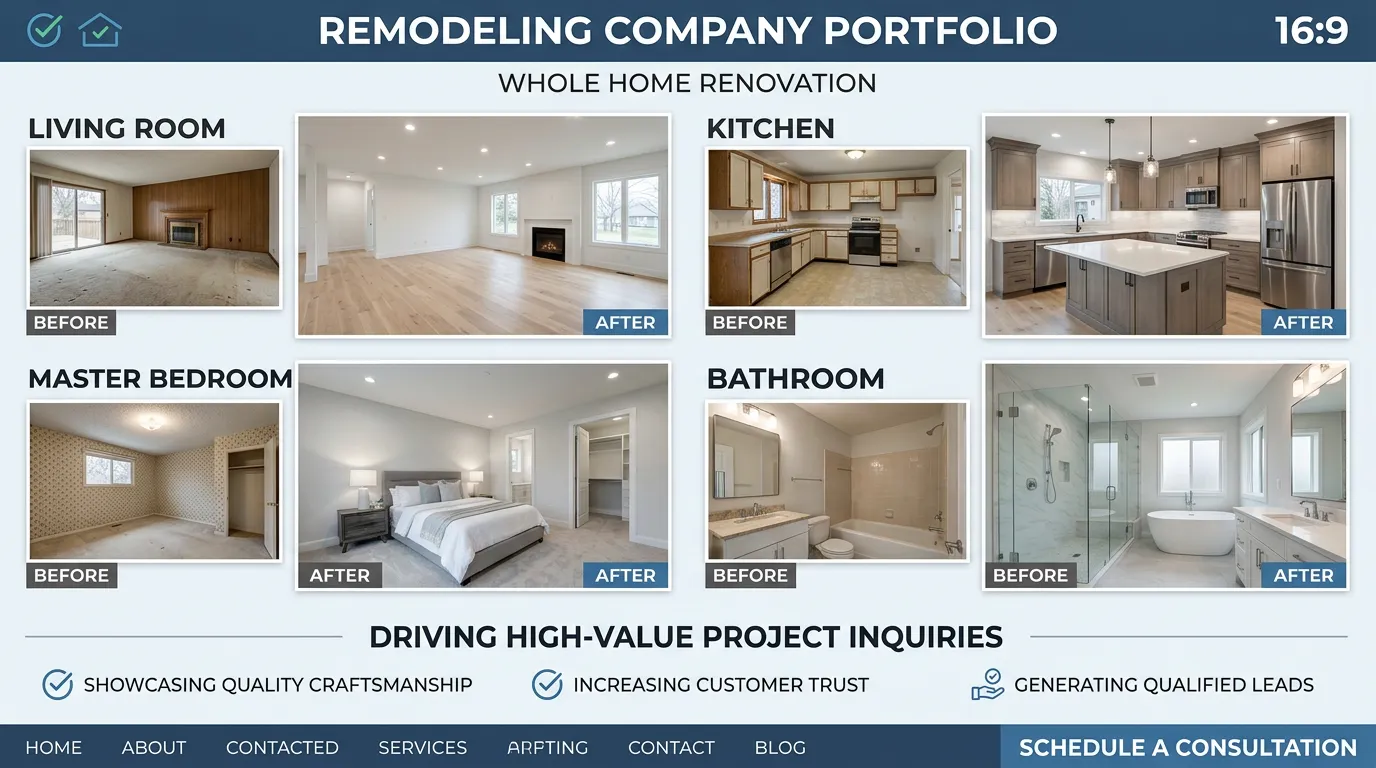
Where we serve this industry
The eighteen month customer
A remodeling buyer does not appear the week they are ready. They save photos for a year, talk it over with family, price out a loan, and then contact three companies in the same week.
That means the inquiry you got in March was created by something they saw last summer. Judging a marketing program on this month's lead count misreads how the whole business works.
The practical answer is contact that does not depend on you remembering. One email a month with a finished project, one cost question answered, and a plain note about financing keeps you in the conversation for the entire wait.
Typical remodel ranges and what moves them
Publishing ranges is what stops budget mismatch from showing up in your first meeting. These are typical Southern California ranges to start from, not quotes.
| Project | Typical range | Time on site | What moves the price most |
|---|---|---|---|
| Guest bath refresh | 15,000 to 30,000 dollars | 2 to 3 weeks | Tile choice and layout changes |
| Primary bath remodel | 35,000 to 80,000 dollars | 4 to 6 weeks | Moving plumbing, glass, stone |
| Kitchen refresh | 25,000 to 50,000 dollars | 3 to 5 weeks | Keeping the existing layout |
| Full kitchen remodel | 65,000 to 150,000 dollars | 8 to 12 weeks | Cabinets, appliances, moved walls |
| Whole house remodel | 200,000 dollars and up | 4 to 9 months | Structural work and permits |
Set these numbers from your own last twenty jobs. A published range you cannot stand behind is worse than none.
A year in the life of a remodeling lead
This is the normal path, not the exception. Your marketing has to be present at every one of these points.
The company that showed up helpfully at month three and month six rarely loses at month twelve.
Having the budget conversation early
Budget mismatch is the most expensive problem in remodeling. It is also one of the easiest to prevent.
Do this
- Put ranges on every project page, with the three things that move them.
- Ask for a budget range on the form and offer brackets instead of a blank box.
- Explain financing before the price, not after it.
- Say plainly what a project at the low end of your range includes.
- Offer a paid design step so a serious buyer can commit to something small first.
Not this
- Do not quote a kitchen over the phone to protect the appointment. It falls apart later.
- Do not hold a consultation without knowing their range first.
- Do not use a contact form that asks only for a name and a phone number.
- Do not treat every delay complaint as a review problem. Most are a communication problem.
What to build during the quiet weeks of December
Mid November through December is the slowest stretch for remodeling inquiries. It is the best time all year to build the things that pay off in spring.
Photograph every project from this year
Go back for the ones you never shot. Past clients will let you in for twenty minutes.
Write three cost pages
One per project type, with a range, an itemized breakdown, and real photos of your work.
Rebuild the intake form
Project type, city, budget bracket, timeline, and whether they own the home.
Email everyone who inquired this year
Not a sale. A short recap of finished projects and what financing looks like now.
Time your reply speed
Measure how long an inquiry sits before a human answers. Under an hour changes results.
Update the process page
Design, selections, permits, build, punch list. Say how long each step usually takes.
Set the January ad plan
Inquiries climb from January through April. Be live before the first week of the year.