
Resources
Generative Engine Optimization Guides
When someone asks an AI assistant for a plumber in Chino Hills, a short list comes back
Call (714) 823-3164 or ask a question. Clear recommendations, even if we never work together.
These guides cover how to get named when someone asks ChatGPT, Perplexity, or a Google AI overview who to hire. They explain answer first writing, entity and schema work, and third party mentions that models can read. They also show how to check whether an AI tool now recommends you or a competitor.
When someone asks an AI assistant for a plumber in Chino Hills, a short list comes back. These guides cover what puts a business on that list. The honest starting point is that this field is young and the measurement is rough. You cannot query an AI system the way you query a rank tracker. Answers vary by user and by session. Any guide claiming a fixed formula is guessing. What we can observe is this. These systems favor pages that answer a question directly in the first paragraph. They favor sources that carry their own reputation. And they favor facts repeated the same way in more than one place. So the material covers answer first writing. It covers entity clarity through schema and a business description that stays identical everywhere. It covers earning mentions on sites a model has likely already read. There is a testing track as well. You learn how to prompt several assistants the same way each month, log what they say about your category, and watch which competitors keep appearing. The overlap with traditional SEO is heavy, and these guides say so plainly. A page that ranks well is usually a page a model has already ingested. Owners in competitive categories and marketers who need to answer a board question about AI search will find this useful. Expect a shorter shelf life here than in the other sections, because the systems change every few months.
More resources
Local SEO Guides
Local SEO GuidesGoogle Business Profile Checklists and Guides
Google Business Profile Checklists and GuidesReputation Management Resources
Reputation Management ResourcesPPC and Advertising Guides
PPC and Advertising GuidesWebsite Conversion Guides
Website Conversion GuidesVideo Marketing Resources
Video Marketing Resources
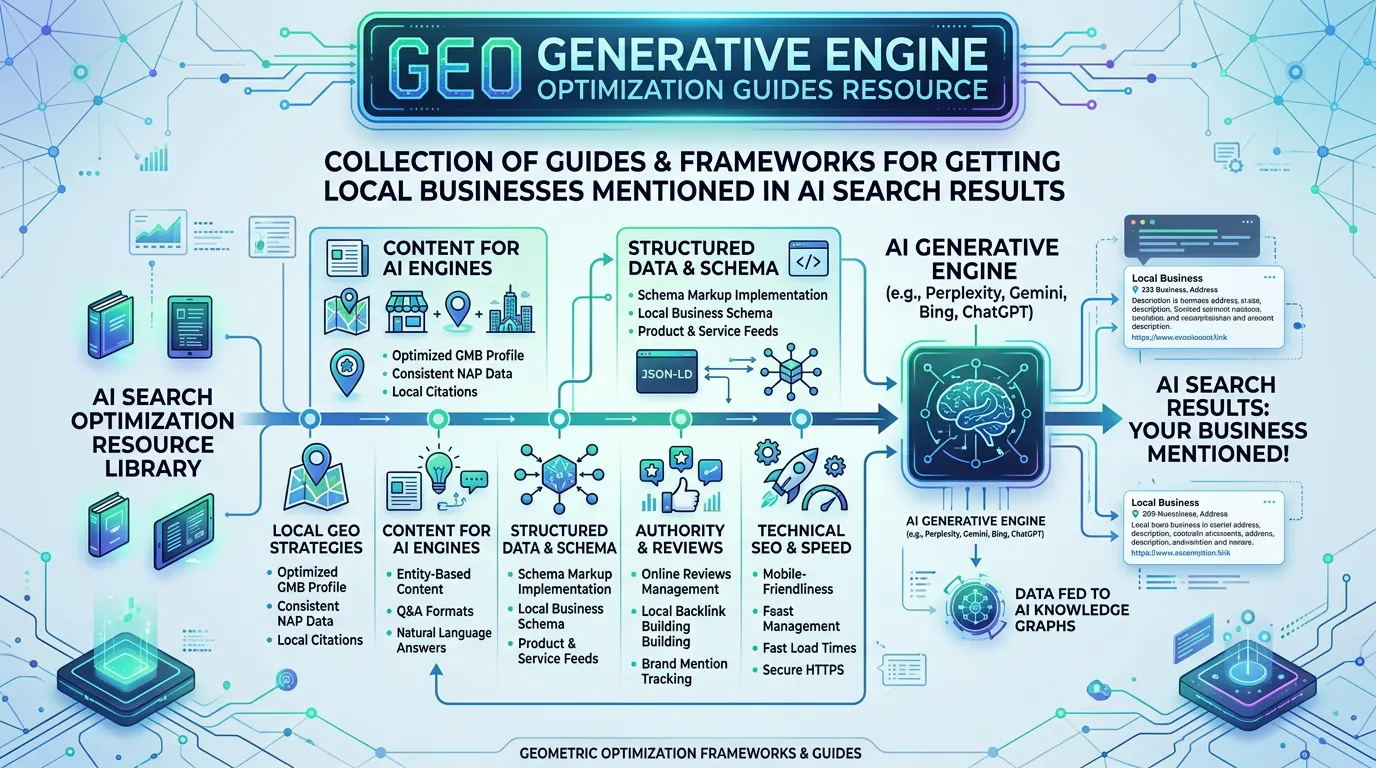
What an AI assistant actually reads about you
These systems do not have a file on your company. They assemble an answer from whatever they can read, and for a local business that is a short list: your website pages, your Google profile data, directory and association listings, the text of your reviews, local news, and community threads where somebody asked for a referral.
Two things follow from that. First, agreement matters more than volume. When six sources say the same address, hours, and service list, the model states it with confidence. When they disagree, you get left out of the answer or described wrong.
Second, some of your best material is invisible. A price list inside a PDF, a service area drawn on an image map, and a phone number sitting in a logo cannot be read. If a fact matters, it needs to exist as plain text on a page.
That is the whole job, and it is less mysterious than it sounds. Be readable, be consistent, and be specific enough to be worth quoting.
A monthly AI visibility check in 20 minutes
There is no rank tracker for this. There is a repeatable habit that shows you a trend, and it takes about 20 minutes a month.
Write five prompts a customer would type
Include your city and the job. Save them so they never change.
Run them in three tools, logged out
Same wording, same day of the month, no follow up questions.
Save the full answers as text
Screenshots are hard to compare six months later.
Note every business named
Watch who repeats month after month. That is the real list.
Note which sources get cited
Those pages are where a mention would be worth earning.
Check the facts said about you
Wrong hours, wrong service area, and old phone numbers are common.
Fix wrong facts at the source
Your site first, then the profile, then the directory that carried it.
Repeat on the same date each month
Different dates and different wording make the comparison useless.
Where the answer comes from, and what you control
Owners often try to influence the parts they cannot touch and skip the parts they own outright. This is the honest split.
| Source type | Example | How much you control it |
|---|---|---|
| Your own pages | Service pages, city pages, pricing guides | Full control, and they get read often |
| Your Google profile | Categories, hours, service list, service area | Full control, and it takes an afternoon |
| Directories and associations | Chamber of commerce, trade bodies, supplier locators | Partial. You submit, they publish, you check yearly |
| Review text | The words customers used about your work | Indirect. You earn it, you cannot write it |
| Community threads | A neighborhood group asking who to call | None at all, and it still carries weight |
The two you fully control are the two most businesses leave half finished. Start there before chasing anything clever.
Writing a page a model will quote
The habits that get a page quoted are the same habits that help a hurried human. That overlap is the useful part of this whole field.
Do this
- Put a 40 to 60 word answer directly under the heading.
- Write the heading as the question a person would ask.
- State place, price range, and timeframe in one plain sentence.
- Keep the same business description everywhere it appears.
- Date the page and update the date only when you really change it.
Not this
- Bury the answer under a story about your company history.
- Write it depends without ever giving the ranges.
- Use a different description of your business on every directory.
- Publish pages with no company name, author, or contact detail.
- Buy a service that promises a fixed formula for AI rankings.
The limits, stated plainly
There is no position to hold here. Two people asking the same question in the same city get different answers, and the same person asking twice can get different answers. Any tool selling you an AI rank as a number is presenting a guess as a measurement.
Volume is also small compared with the map pack. For most local trades, the phone still rings because of Google Maps and search. AI answers matter more each year, and they are not where this quarter's revenue comes from.
There is one useful pattern worth knowing. These systems often name a list rather than a business, such as a best of roundup or a directory page. Getting onto the lists that already get cited is frequently faster than trying to be named directly.
So fund this the cheap way. Do the work that serves both jobs, which is clear answers, accurate structured data, consistent facts, and mentions on real sites. That is the same list a good SEO program already has.