Local SEO
Google Maps Ranking Strategy
Maps which parts of your area are winnable and which are not
- Timeline
- Two to four weeks to produce the geographic plan
Call (714) 823-3164 or ask a question. Clear recommendations, even if we never work together.
A Google Maps ranking strategy decides where a business can really rank across its service area. It also decides how to cover the rest. It maps your visibility on a map grid. It finds the proximity ceiling that limits your reach. It weighs honest expansion options, then covers the areas you cannot reach with paid or organic instead.
The problem
Owners set goals that Google's ranking system will not allow. Rank first in Maps in nine cities from one address twenty miles away, for example. Distance is a real ranking factor, so past a certain radius no amount of optimization puts you in the three pack. The wrong response to that is renting a virtual office, which gets profiles suspended. The right response is knowing where the ceiling is and choosing a different tool for the area beyond it.
What it is
This is the geographic planning layer that sits above day to day map work. We scan your visibility on a grid across the whole service area. That shows how far your reach extends today. Then we estimate how far it could extend, given how prominent the businesses closer to those points are. Cities get sorted into three groups. Winnable means the Google maps ranking strategy work we already do should get you there. Contested means it is worth a longer campaign. Out of reach means you cannot get there from your current address. For that last group we plan coverage another way. That could mean Local Services Ads, Google Ads with location targeting, or strong organic city pages. It could also mean a real second location, if the revenue supports staffing one. We also review competitor listings for guideline violations. Where fake addresses are distorting the results, we file redressal complaints.
Signs you need this
- You want to rank in a city twenty miles away and never appear there
- A competitor holds six listings with addresses that are clearly houses or mailboxes
- Someone suggested renting an office purely to rank in another city
- Your visibility drops off sharply about five miles from your pin
- You serve nine cities and get calls from two of them
What is included
- Wide geogrid scan covering your full stated service area
- Proximity ceiling analysis showing where visibility realistically ends
- City by city winnability scoring with the reasoning written out
- Expansion decision framework for a real second location
- Guideline review of your setup so you avoid suspension risk
- Competitor spam redressal filings with evidence packets
- Paid coverage plan for areas Maps cannot reach organically
- Quarterly review of the geographic plan as rankings shift
Our process
Wide grid mapping
Week 1We run a large geogrid across the full area you say you serve, not just the tight radius around your address. This produces a heat map of where you are visible, where you fade, and where you never appear at all.
Ceiling analysis
Week 1 to 2For the grid points where you rank poorly, we look at who does rank and how prominent they are. If three businesses within two miles of that point have double your review count, that point is not winnable this year and we say so.
Bucket and prioritize
Week 2Cities get sorted into winnable, contested, and out of reach. Effort concentrates on winnable and contested. Out of reach areas move to a different channel rather than absorbing budget that will not produce a map position.
Guideline and spam review
Week 2 to 4We audit your own setup for anything that risks suspension, then check the pack holders in your target cities for keyword stuffed names, fake addresses, and lead generation listings, and file redressal complaints with photo evidence.
Coverage plan and review
Every 3 monthsWe build the plan for areas Maps cannot reach: Local Services Ads where available for your trade, location targeted search ads, and organic city pages. Quarterly re-scans show whether the boundaries have shifted.
Realistic timeline: Two to four weeks to produce the geographic plan. Winnable cities usually respond within 3 to 6 months. Redressal complaint outcomes are unpredictable and range from two weeks to no response at all.
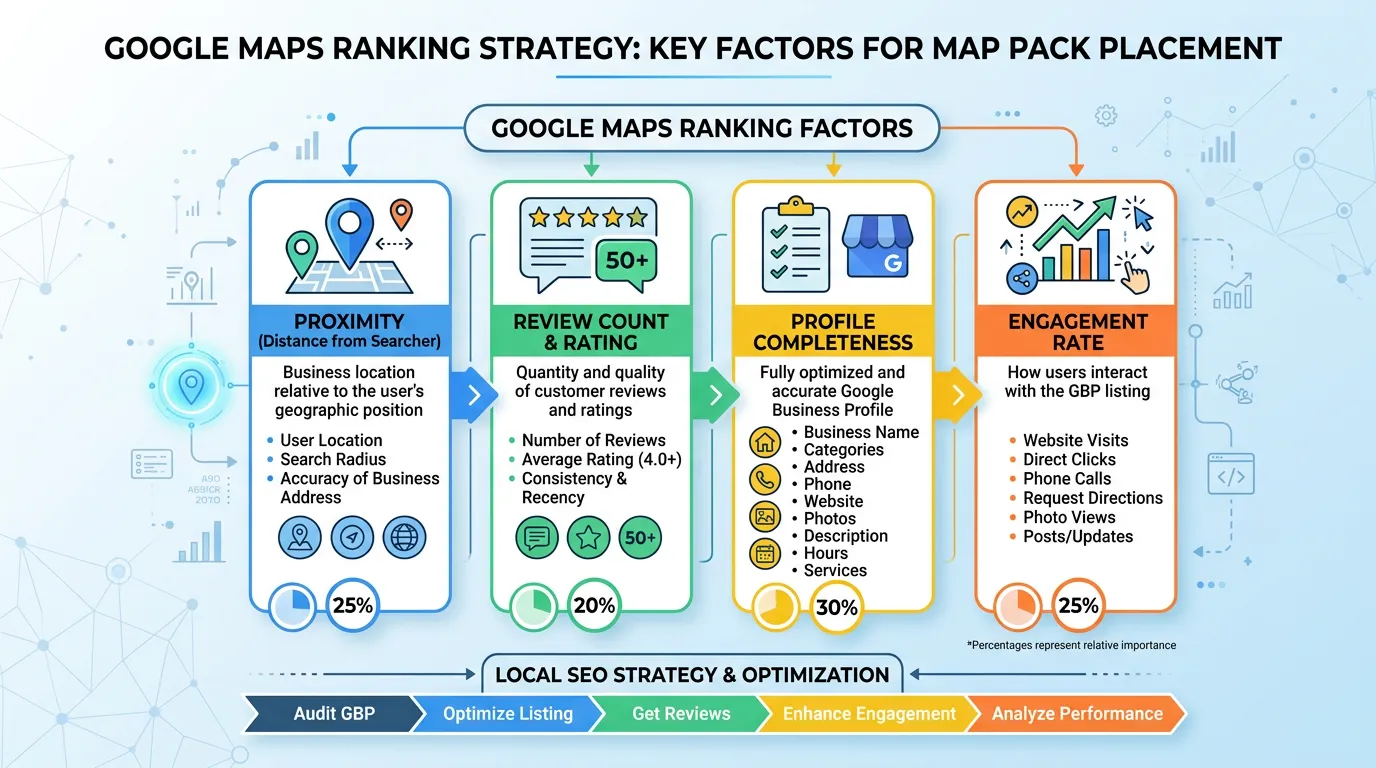
Reading one grid point at the edge of your area
Here is a made up example of a single search from a spot about eight miles from your address, and why the three results come out in this order.
Distance is doing most of the sorting here. More reviews may move you past the franchise over time. Nothing moves your address.
Pick the tool that fits the distance
Every band around your address behaves differently, so the budget should not be spread evenly across all of them.
| Distance from your address | What usually happens in Maps | Best tool for that band | What to expect |
|---|---|---|---|
| 0 to 3 miles | You can hold a pack spot | Profile work, reviews, photos | Steady calls at the lowest cost |
| 3 to 6 miles | In and out depending on the search | Reviews, links, a real city page | Slow gains across several months |
| 6 to 10 miles | Rarely in the pack | City page plus search ads | Organic clicks and paid calls |
| Past 10 miles | Almost never in the pack | Local Services Ads or search ads | Pay per lead, and it stops when you stop |
These bands stretch or shrink with population. In a dense city core two miles can be the edge. Your own grid scan gives the real numbers.
What actually pushes your edge outward
Your address is fixed, so the only lever is prominence. Prominence is how well known and well regarded your business looks, and Google weighs it against the businesses near the point being searched, not against your whole city.
Reviews are the fastest moving part of that. What matters is not your lifetime total but how you compare to the three or four businesses closest to that grid point, and how recently people wrote them. A steady trickle beats forty reviews every spring.
Links and organic strength do the slower half of the job. When your city page ranks well in the normal results for the same phrase, the profile tends to hold its spot farther out. That is why link work and page work belong in a Maps plan at all.
Sometimes the map moves for you. A competitor closes, moves, merges, or gets suspended, and a point that was locked opens up. That is the real reason to scan again every quarter instead of scanning once and filing it away.
Rules for a second location that survives
A second address can genuinely extend your reach. It has to be a real place with real people in it, because Google now verifies with video.
Do this
- Staff it during the hours you post, every day you post them.
- Put your name on the door or the window where a verifier can film it.
- Give it its own page, its own photos, and reviews from customers served by that crew.
- Register the address with the state and your licensing board where that is required.
- Point the profile at that location page instead of the homepage.
Not this
- Rent a mailbox or a shared desk and call it a branch.
- Post hours nobody is there to keep.
- Copy your main city page and swap out the city name.
- Use photos of the same building on both profiles.
- Open it in a month when nobody can staff it. A suspension costs more than waiting.