Home Services and Trades
Digital Marketing for General Contractors
Proof of finished work matters more than ad spend
Call (714) 823-3164 or ask a question. Clear recommendations, even if we never work together.
General contractor marketing is a trust sale, not a lead race. Homeowners handing over six figures want to see finished projects, licensing, and how you handle change orders. You need a portfolio site that holds up under a close look. Add project pages for the general contractors work you want more of. Then follow up for the months a decision takes.
Jump to a section
What usually goes wrong
- Work arrives in lumps. Two large jobs overlap, then nothing signs for eight weeks.
- Referral flow cannot be turned up when the calendar develops a hole.
- Homeowners compare a licensed, bonded bid to an unlicensed one and only see the difference in price.
- Estimating takes hours per bid, and most of it goes to people who were never going to sign.
- Permit timelines differ in every city, and the delay always gets blamed on the contractor.
- The website shows ten photos from years ago and nothing from the general contractors work you are proudest of.
- Subs and suppliers know the quality of your work, but nothing online says it.
What usually makes an owner start looking
- A large project wraps and there is nothing signed behind it.
- Moving from subcontract work for other builders into direct to owner projects.
- Hiring a project manager who needs enough signed work to stay busy.
- Wanting to shift the mix toward additions and ADUs instead of small repairs.
- Losing three bids in a row to companies with better presentation and worse work.
- A slow permit season leaving crews idle and forcing a hard look at where leads come from.
Which channels actually matter
Not every channel deserves the same weight for general contractors. This is how we would prioritise.
| Channel | Weight | Why |
|---|---|---|
| Website and project portfolio | Primary | This is the whole sale. Real projects with scope, city, and finished photos are what convince a homeowner to hand over a large contract, and it is where every referral goes to check you first. |
| Content marketing | Primary | Cost guides, permit explainers, and project timeline articles bring in homeowners months before they hire and quietly qualify them on budget before you spend an hour estimating. |
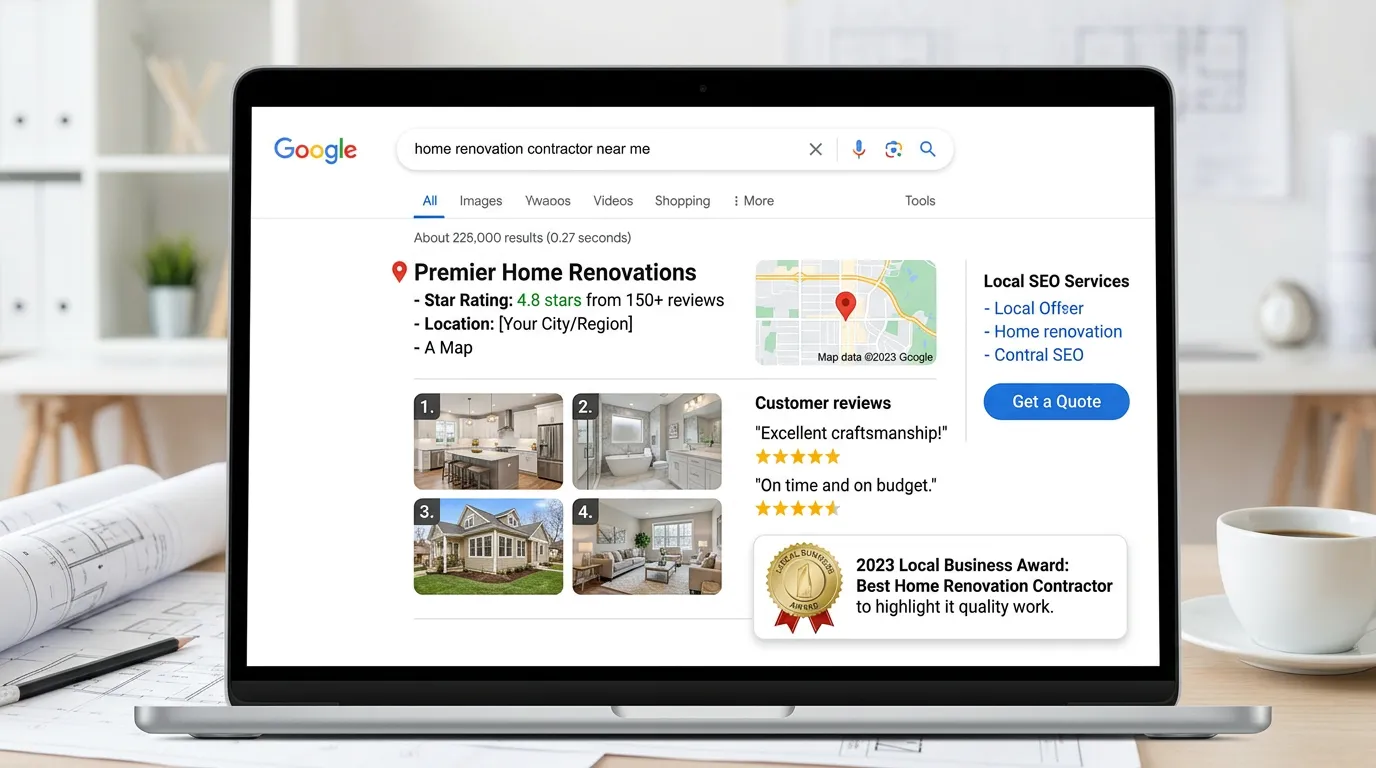
| Local SEO | Secondary | General contractors near me searches still matter, and a complete profile with recent project photos wins them. It is a smaller share of revenue here than in the emergency trades. |
| Lead nurture and automation | Secondary | A three to nine month decision needs contact that does not depend on you remembering. Sequences keep the relationship warm through permitting, financing, and family debate. |
| Video | Supporting | Walkthroughs of completed projects and short explanations of your process answer the questions homeowners are too polite to ask about change orders and schedule. |
Seasonality
General contracting in Southern California is driven more by decisions than by climate. Inquiries rise in late winter and spring as homeowners set project budgets for the year. They rise again after tax refunds land. Exterior, foundation, and site work bunches into the dry months. Framing and interior projects carry the winter calendar.
What we measure
Qualified project inquiries that meet your minimum job size
Consultations booked and site visits actually held
Bid to contract conversion rate
Average signed contract value and pipeline value by month
Months of backlog on the schedule
Concerns we hear
All our work is referral. We do not need marketing.
Referrals still search your name before calling. They find your reviews and look at your work. A thin profile and a stale website lose some of them quietly. Marketing also gives you a way to fill a hole in the schedule instead of waiting for the phone to ring.
We do not want small jobs, and online leads are all small jobs.
That is a filtering problem. Pages that state your minimum project size, your typical range, and how your process works turn away the wrong homeowner before they book a meeting. Fewer, better inquiries is the actual goal here, not lead volume.
Our projects are custom. You cannot put a price on the site.
Not a price, but a range with the factors behind it. Homeowners searching addition cost per square foot are going to find a number somewhere. Better it comes from you with context than from a national calculator that sets an expectation you then have to argue with.
I do not have time to send photos every month.
Then we make it a five minute habit for whoever is already on site. A short shot list, a shared folder, and a phone camera is enough. We handle the rest. General contractors who solve this one thing consistently outperform contractors who spend twice as much on ads.
SEO does not work for contractors.
Generic SEO does not. Ranking for contractor in a big region is expensive and low value. Ranking for room addition cost in your county, ADU permit questions in specific cities, and the project types you want is realistic and produces inquiries that match your minimum job size.
Where we would start
The services that move the needle fastest for general contractors.
Web Design and Development
Fast, accessible websites built to turn visits into calls.
Web Design and DevelopmentLead Generation Systems
Capture, track, and follow up on every inquiry automatically.
Lead Generation SystemsDigital Marketing Strategy
Know which channels deserve your budget before you spend it.
Digital Marketing Strategy
Where we serve this industry
What an unpaid estimate really costs
Count the hours. A real bid on an addition takes a site visit, measurements, sub pricing, and a written proposal. Three to eight hours is normal, and none of it is billable.
Now multiply by the bids you lose. If you close one in four, every signed job carries the cost of three you did not get. That is a real number on your overhead, and most general contractors never write it down.
This is why lead volume is the wrong goal. Fewer inquiries that fit beat more inquiries every time. The site's job is to say who you build for and what your projects cost, so the wrong homeowner never books the visit.
Project types, contract size, and time to signature
Marketing that treats a bathroom and an addition the same way will misjudge both. These are typical Southern California patterns to plan against.
| Project type | Typical contract | First contact to signature | What decides it |
|---|---|---|---|
| Bathroom remodel | 20,000 to 60,000 dollars | 3 to 8 weeks | Photos and schedule |
| Kitchen remodel | 40,000 to 120,000 dollars | 6 to 16 weeks | Design and cabinet lead time |
| Room addition | 120,000 to 350,000 dollars | 4 to 9 months | Plans and plan check |
| Detached ADU | 200,000 to 400,000 dollars | 6 to 18 months | Financing and city rules |
| Whole house remodel | 250,000 dollars and up | 6 to 12 months | Trust, more than price |
Typical ranges only. Your own closed jobs from the last two years are a better guide than any published figure.
The five minute jobsite photo habit
The highest return habit for a general contractor is documenting work you already do. It costs nothing, and almost nobody does it consistently.
Shoot before photos on day one
Same three angles per room. Without a before, the after photo means nothing.
Take one progress photo a week
Framing, rough in, drywall. This is the proof that you build and do not just finish.
Shoot the finished room clean
Blinds open, lights on, no tools out, no truck in the driveway.
Put the city in the file name
Chino Hills kitchen 03. It makes the page and the profile post easy to write later.
Ask permission at signing
Add a photo release line to the contract. Nobody says no at the start of a project.
Use one shared folder
One place, one naming rule. If photos live on a phone they never get published.
Publish one project a month
Website, Google profile, and one social post. Twelve real projects a year is plenty.
Qualifying on the first phone call
Five questions in the first call save hours later. Ask them plainly and most homeowners respect it.
Do this
- Ask what range they have set aside, and give yours before they answer.
- Ask whether they have plans, and whether the city has seen them yet.
- Ask when they want to start and when they need to be finished.
- Ask who else is bidding. The answer tells you what you are being compared to.
- Say your minimum project size out loud on the call and on the website.
Not this
- Do not book a site visit for a project under your minimum, hoping it grows.
- Do not answer what does it cost with it depends. Give a range and the factors.
- Do not skip the budget question because it feels rude. It is kinder than a wasted afternoon.
- Do not send a proposal without a follow up date already on your calendar.
Where contractor inquiries fall out
Every stage below loses some people, and that is normal. Knowing which stage leaks tells you what to fix first.
High inquiries and low qualified means fix the pages. High proposals and low signings means fix the presentation.