Senior Care
Digital Marketing for In Home Care Agencies
Adult children do the research and make most first calls
Call (714) 823-3164 or ask a question. Clear recommendations, even if we never work together.
Marketing for a non medical home care agency has to reach two people at once: the family and the caregiver. The adult child is the one researching help for a parent. The caregiver is the one who will do the work. Local search, honest reviews, and plain answers about cost and hours bring most private pay inquiries.
Jump to a section
- What usually goes wrong
- Which channels matter
- Seasonality
- What we measure
- Common concerns
- Where we start
- What one home care client is actually worth
- Who pays for home care, and what each payer changes
- The first call decides the case
- Running caregiver recruiting as its own campaign
- What to fix first when money is tight
- Questions
What usually goes wrong
- Caregiver turnover eats the schedule, so new clients can arrive faster than staff to serve them
- Families call four agencies, compare hourly rates, and have no idea what separates one from another
- Discharge planners and case managers send referrals to whichever agency they saw most recently
- Registries and gig style apps undercut your rate because they carry no payroll, training, or workers comp
- A four hour minimum turns away callers who only want two hours in the morning
- Cases end with no warning when a client passes away or moves into a facility
- Families assume Medicare pays for companion care and get upset when they learn it does not
What usually makes an owner start looking
- Billable hours drop after two or three long term clients end in the same month
- You finish your California Home Care Organization license and need to fill a first schedule
- A national franchise opens an office in your county and starts outranking you on search
- You hire a scheduler or care manager and payroll needs more billable hours behind it
- Referrals from one hospital or facility dry up after a discharge planner changes jobs
- You add a service line such as live in care or hospital to home transitions
Which channels actually matter
Not every channel deserves the same weight for in home care agencies. This is how we would prioritise.
| Channel | Weight | Why |
|---|---|---|
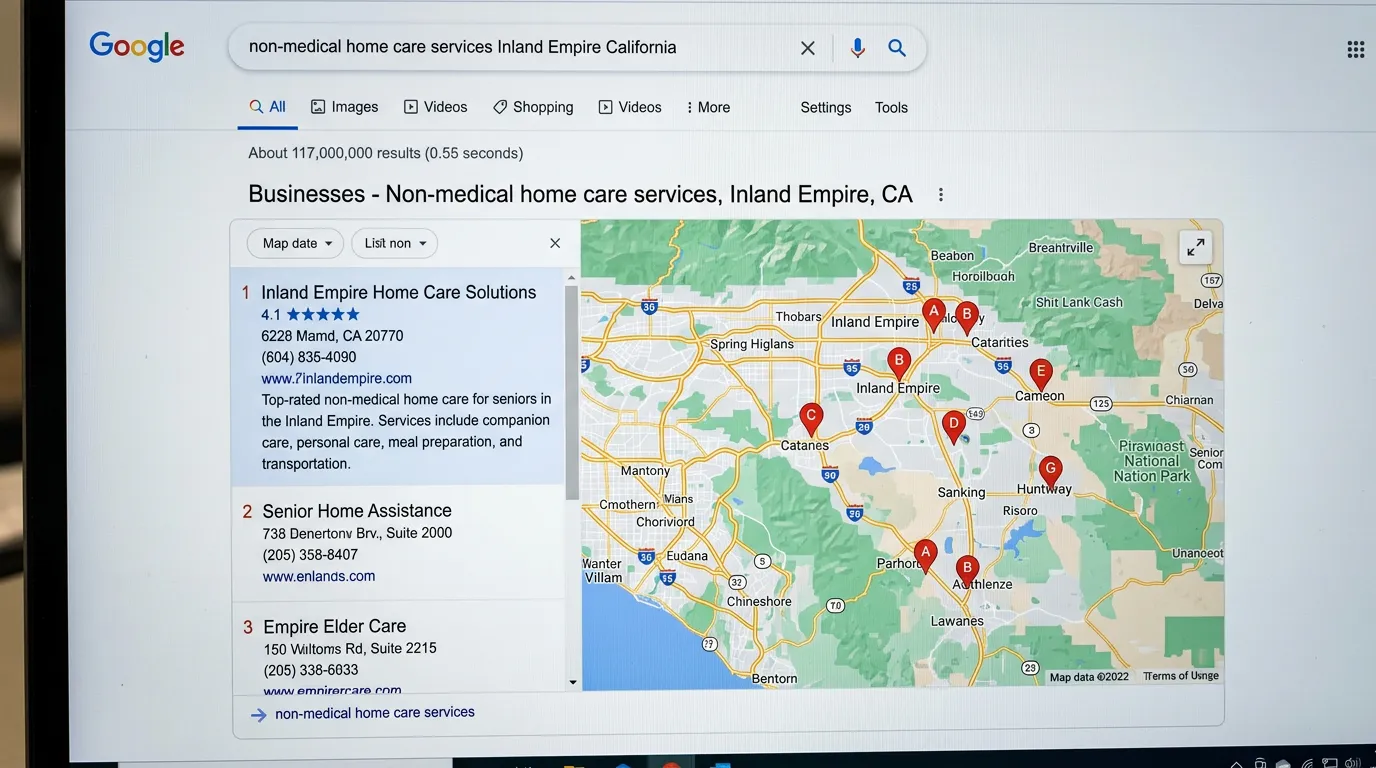
| Local SEO | Primary | Families search by city and by phrases like in home care near me. The map pack decides which three agencies get called first. |
| Content Marketing | Primary | Cost per hour, what Medicare does and does not cover, and how to start the conversation with a parent are the questions that bring families to you months before they are ready to buy. |
| Reputation Management | Primary | You are asking a family to let a stranger into a parent's home. Recent reviews that name caregivers by first name do more than any ad. |
| Google Business Profile Optimization | Secondary | Real staff photos, a full service list, and posts about openings help a service area business show up nearby without a storefront. |
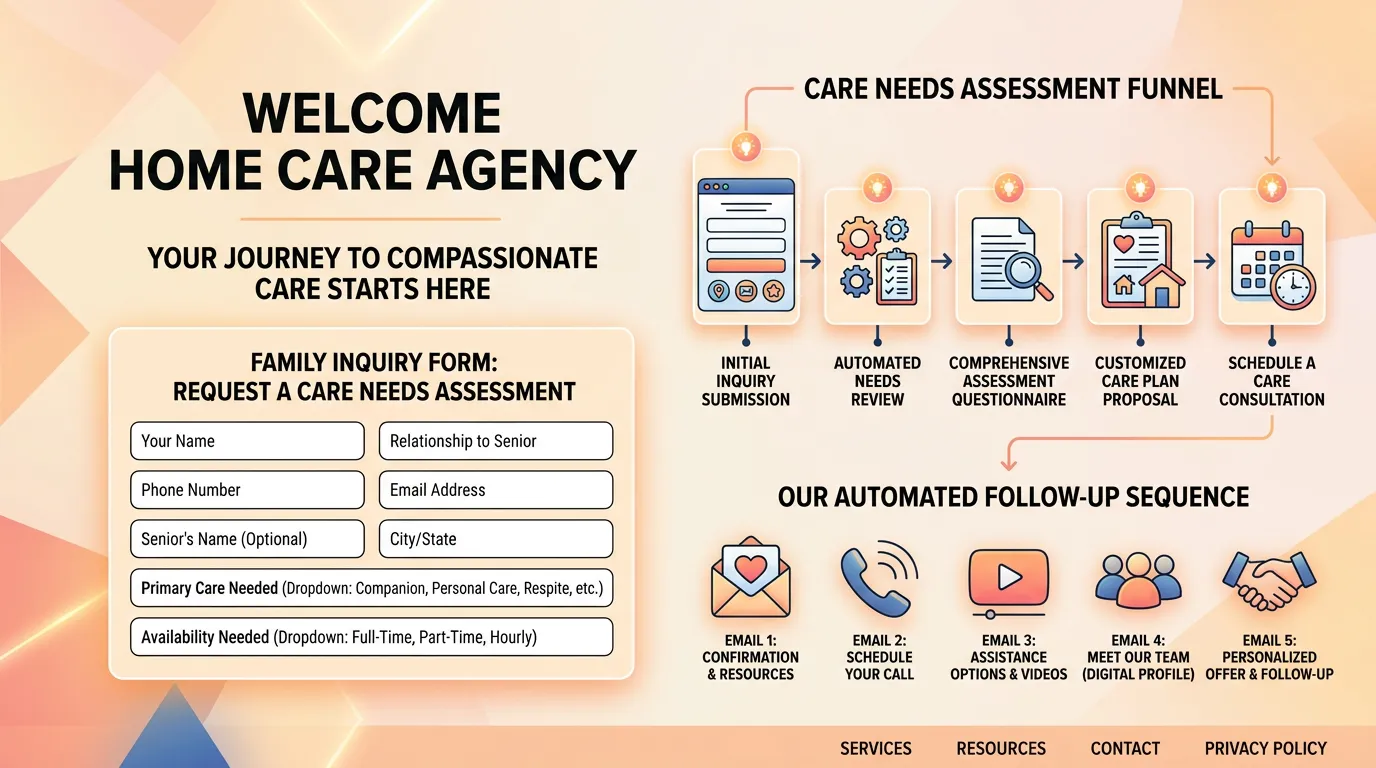
| Lead Generation Systems | Supporting | Inquiries arrive at night and on weekends. Call tracking and fast follow up decide whether the family talks to you or to the next agency on their list. |
Seasonality
The holidays drive the year. Families visit a parent over Thanksgiving and Christmas and see the decline for themselves. Inquiry volume climbs from late November through February. Southern California heat waves from July through September create a second bump. A parent alone in a house with weak air conditioning worries everyone. Summer travel weeks bring short respite requests, and those often turn into ongoing care.
What we measure
Billable hours per week and the trend month over month
New client starts and average weekly hours per client
Cost per qualified family inquiry
Caregiver applications per open position
Average length of service before a case ends
Concerns we hear
We get all our clients from hospital and facility referrals.
Those referrals still get checked. A discharge planner names two agencies, the family looks up both, and the one with recent reviews and a clear website usually wins the call. Marketing protects the referrals you already earn and adds private pay families who never speak to a discharge planner at all.
My real problem is finding caregivers, not clients.
Then we run recruiting as its own campaign. A careers page listing pay range, shift types, and the cities you staff, plus an application that works on a phone, fills applications the same way a service page fills inquiries. Most agencies need both tracks running at once.
Families only care about price.
Some do. Most are frightened and looking for a reason to trust someone. When your site answers the cost question honestly and then shows how you screen, train, and back up caregivers, price stops being the only thing on the table.
Privacy rules make it hard to market anything.
You can market without ever naming a client. We use general education, staff stories, and reviews families choose to write themselves. Nothing we publish includes client health information, and we get written permission before using any photo or story.
We tried a lead vendor and the leads were terrible.
Purchased leads usually go to several agencies at once, so you are calling someone who already spoke to three others. We build the sources you own instead: your profile, your pages, your reviews. Slower to start, but those calls come to you first.
Where we would start
The services that move the needle fastest for in home care agencies.
Reputation Management
Generate reviews on purpose and protect the rating you have.
Reputation ManagementGoogle Business Profile Optimization
Turn your profile into the strongest lead source you own.
Google Business Profile OptimizationLead Generation Systems
Capture, track, and follow up on every inquiry automatically.
Lead Generation SystemsWeb Design and Development
Fast, accessible websites built to turn visits into calls.
Web Design and Development
Where we serve this industry
What one home care client is actually worth
Most agencies set a marketing budget per lead. Set it per client instead. You need three of your own numbers: your billable rate, average hours per week, and how many months a case runs before it ends.
A common Southern California case runs 20 to 30 hours a week. At a typical private pay rate that is a few thousand dollars a month in revenue, and plenty of cases run six months to a year. One client can be worth more than a used car.
Now work backward. If one inquiry in four becomes a client, and a client is worth that much, you can pay real money for a family inquiry and still come out well ahead. Most agencies spend far less than the math allows.
Do this with your own rate and your own close rate. The method is the useful part, not our numbers.
Who pays for home care, and what each payer changes
Families almost never call knowing how they will pay. The payer they land on changes which page they found you through and what that page has to say.
| Payer | What it usually covers | Where the family starts | What your site needs |
|---|---|---|---|
| Private pay | Any hours and any tasks, no approval needed | A search like home care near me | Your hourly range and your minimum, in writing |
| Long term care policy | Hours up to a daily benefit, after a waiting period | The policy binder, then a search | A page on how you bill and document claims |
| VA Aid and Attendance | A monthly benefit a veteran or spouse can spend on care | A veterans service officer, or an adult child online | A plain page on who qualifies and how long it takes |
| Medi-Cal IHSS | County managed hours, with the recipient choosing the provider | The county office, not you | One honest line on whether you take part or not |
| Medicare | Nothing for ongoing companion or personal care on its own | A search that starts with does Medicare pay | A page that answers no, then shows the real options |
Program rules change and every policy is different. Check the current rules before you publish any of this.
The first call decides the case
By the time a family dials, they have already read your page. The next 90 seconds decide whether you get the assessment visit or the agency after you does.
Agencies lose more cases here than in search. Listen to five of your own recorded calls this week.
Running caregiver recruiting as its own campaign
Client marketing and caregiver marketing look alike and behave nothing alike. Applicants move fast, apply to six places at once, and stop answering after two days.
Do this
- Put the pay range in the ad. Ads without pay get scrolled past.
- Name the cities and the shift types you actually need filled.
- Keep the application under five minutes on a phone.
- Call every applicant the same day, even the ones you will pass on.
- Track applications per opening the way you track inquiries per week.
Not this
- Do not send applicants to a PDF or a desktop only form.
- Do not write a job post that reads like a legal notice.
- Do not mix recruiting and client inquiries on the same page.
- Do not buy job board clicks while your careers page loads slowly.
- Do not pause recruiting in a full month. Turnover does not take a break.
What to fix first when money is tight
If you can only pay for a few things this quarter, do them in this order. Each one is cheap, and each one is leaking money right now.
Answer the phone after hours
Even a live answering service beats voicemail for a frightened family.
Put your hourly range on the site
A range and a minimum. It screens out calls you could not serve anyway.
Ask ten current families for a review
A review naming a caregiver by first name outsells any headline you write.
Load real photos of your office and staff
Stock photos of smiling models read as a franchise page.
Fix the mobile application
Open it on your own phone and try to finish it in five minutes.
Finish your Google Business Profile
Service areas, hours, full service list, and your license number.
Write one page on what Medicare does not cover
It catches searches nobody else in your city wants to answer.
Put call tracking on the main number
You cannot budget until you know which calls came from where.