Services
Conversion Rate Optimization for Service Businesses
Get more calls from the traffic you already have.
- Starting at
- $1,800+
- Timeline
- Tracking and evidence take 3 to 4 weeks
- Services
- 7 included areas
Call (714) 823-3164 or ask a question. Clear recommendations, even if we never work together.
Conversion rate optimization is the work of turning a bigger share of your website visitors into calls and form fills. It uses analytics, session recordings, and controlled tests to find what gets in their way. Then you fix it, so the traffic you already have brings you more leads.
Jump to a section
- The problem
- What CRO is
- Who it is for
- What is included
- Our process
- What it costs
- What changes
- All CRO services
- When CRO Is the Wrong Call
- What CRO Looks Like at Your Size
- Where Visitors Quietly Drop Off
- Mistakes That Cost the Most
- Your 60 Day Check
- CRO Versus the Other Ways to Get Leads
- Questions Owners Ask Before Starting
- Questions
The problem
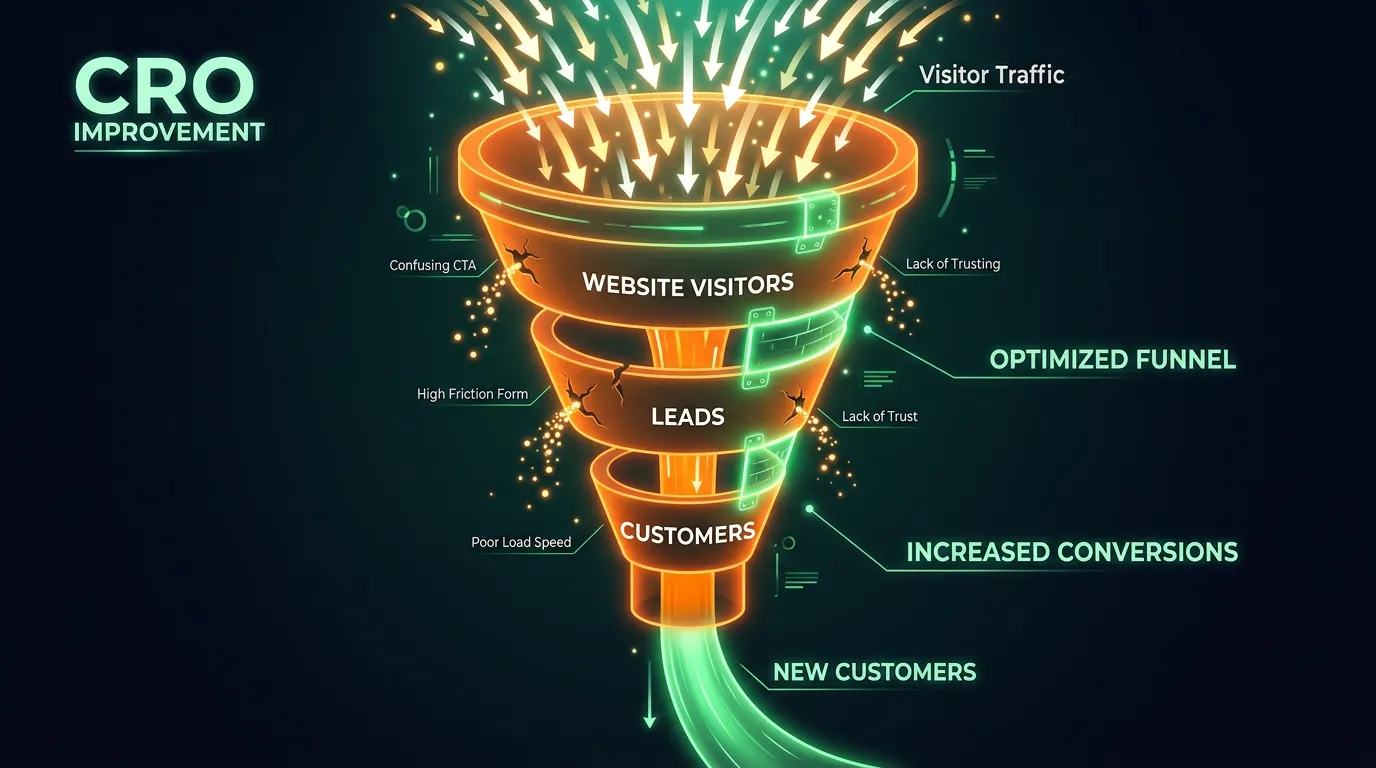
Most service businesses fix lead volume by buying more traffic. They raise the ad budget, add another keyword, start another channel. Meanwhile the website converts two percent of visitors and nobody has looked at why the other 98 percent left. The reasons are usually simple and embarrassing: the phone number is buried in the header on mobile, the form asks for a street address before anyone has decided to talk to you, the page never says which cities you serve, and there is no pricing signal anywhere so visitors leave to find one. Doubling traffic doubles the cost. Doubling conversion rate costs nothing per visit and improves every channel at once.
What cro actually is
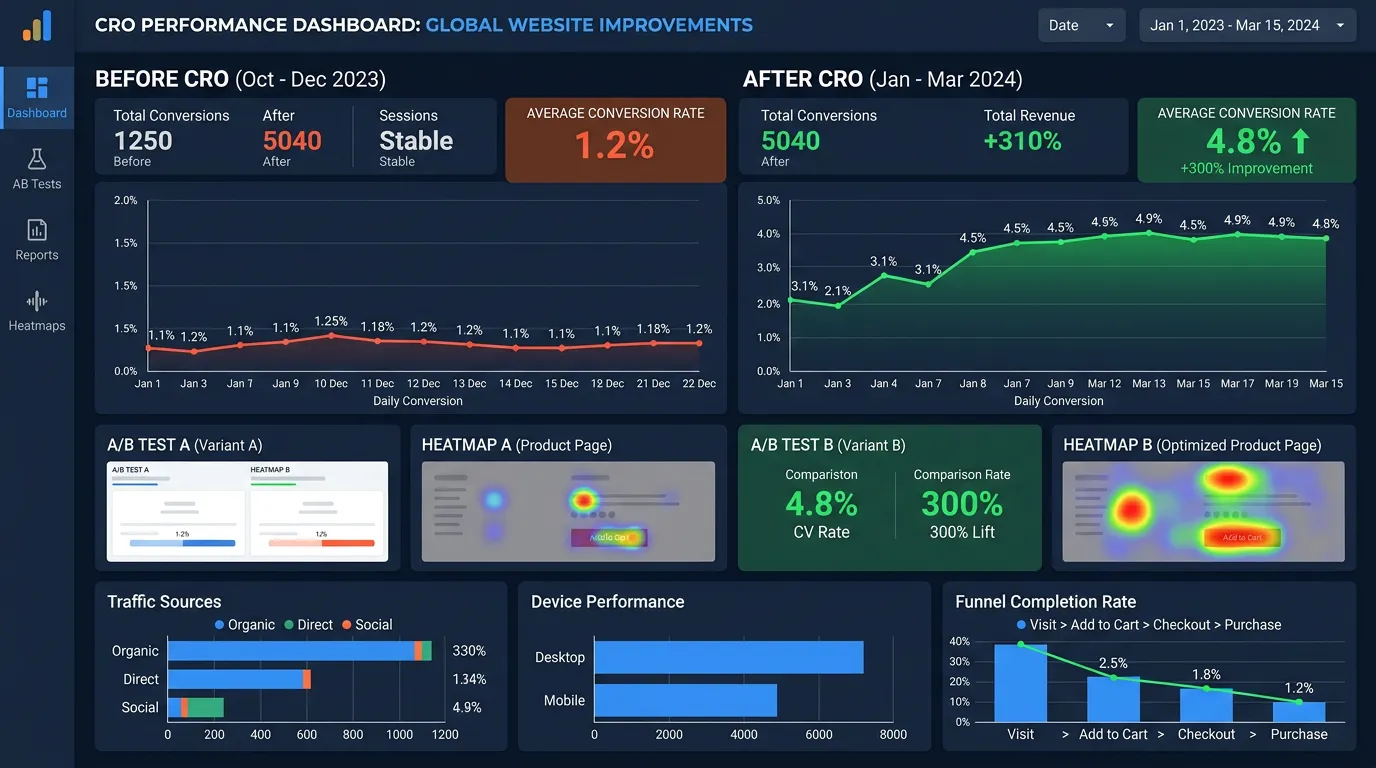
Conversion rate optimization is a loop, not a redesign. First you measure what is really happening. You look at where people land, how far they scroll, where they hesitate, and where they leave. GA4 funnel exploration, session recordings from Microsoft Clarity or Hotjar, and call tracking from CallRail give you that picture. Then you write down specific ideas about why people leave. You rank them by how much traffic they touch and how sure you are. You change one thing at a time, so you can tell what caused the result. On sites with enough traffic, you check the change with an A/B test. On smaller sites you compare before and after periods, lean on evidence you can see rather than measure, and use judgment. You are honest when a result is not certain. The output is a higher share of visitors who call, book, or submit.
Who it is for
This works best for businesses that already get real traffic. That means roughly 1,000 sessions a month or more, or real money going into ads. If you get thirty visitors a month, put the money into visibility first. It is a strong fit when your cost per click keeps climbing. It fits when your ads bring clicks but few calls. It fits when traffic went up after an SEO push and lead volume did not follow. It also suits businesses that answer the phone well and close well. CRO makes more of whatever happens after the call connects, good or bad.
What is included
- Conversion tracking setup and verification in GA4 and call tracking
- Session recording and heatmap installation with a review of the footage
- Friction inventory ranked by traffic touched and expected lift
- Rewritten calls to action and offer framing on key templates
- Form redesign with field reduction and error handling fixes
- Mobile call path improvements including a sticky call element
- Trust element placement: reviews, licenses, guarantees, and real photos
- A test plan with sample size math for each proposed test
- Monthly conversion reporting split by device, channel, and page
Our process
Measurement setup
Week 1 to 2Before changing anything we make sure conversions are counted correctly. That means GA4 events for calls, form submits, and chat, plus call tracking with dynamic number insertion so we know which channel produced which call. Most sites we inherit are miscounting something.
Evidence gathering
Week 2 to 4We watch session recordings, read heatmaps, review the last 90 days of GA4 behavior data, and listen to real call recordings. Call recordings are the most underused evidence source in this work, because customers tell you exactly what confused them.
Friction inventory and hypotheses
Week 4 to 5Every observed problem becomes a written hypothesis with the evidence attached, the pages affected, and the expected direction of change. Items get ranked so the cheapest high traffic fixes go first.
Fix the obvious, then test the uncertain
Week 5 to 10Broken forms, missing call buttons, and dead ends get fixed immediately without testing, because there is no argument for keeping them. Genuinely uncertain choices such as offer framing or page order get tested.
Test, measure, and document
Ongoing, monthlyTests run to a predetermined sample size rather than being stopped when the numbers look good. Every result, win or loss, gets written down with what we learned so the same idea does not get retried in a year.
Realistic timeline: Tracking and evidence take 3 to 4 weeks. The first fixes usually ship in week 5 and show effect within 30 days. Meaningful compounding gains take 4 to 6 months of iteration. Sites with low traffic take longer because every read needs more time to be trustworthy.
What it costs
The number moves with traffic volume, page count, and how much development access we have. A single template service site with one form is near the low end. Multi location sites, sites with booking systems, or programs that include ongoing A/B testing at statistical rigor cost more. Sites under about 1,000 monthly sessions usually get better value from a one time conversion audit than a monthly program.
Published ranges are starting points. The final number depends on your market, your current position, and how much ground there is to make up. You get a fixed scope in writing before anything begins.
What changes
More calls and form fills from the same traffic and the same ad budget
Lower cost per lead across every paid channel at once
Clear data on which pages produce leads and which just collect visits
Fewer wasted clicks from visitors who never had the information to decide
A documented record of what works on your site, not generic best practice
Better call quality when the page sets expectations honestly upfront
All conversion rate optimization services
Every area we cover under conversion rate optimization. Each one has its own page with process, deliverables, and timelines.
A/B and Multivariate Testing
Settles arguments with data instead of who has the strongest opinion
A/B and Multivariate TestingUser Experience Improvements
Clear beats clever on every service business website
User Experience ImprovementsCall to Action Optimization
What the button says matters as much as where it sits
Call to Action OptimizationPage Level Conversion Strategy
One conversion approach for the whole site wastes most of your pages
Page Level Conversion StrategyCRO for Service Business Websites
The phone call is the conversion, so everything points at it
CRO for Service Business Websites
Where we do this work
Based in Chino, serving Chino, the Inland Empire, Orange County, Los Angeles County, Riverside County, and San Bernardino County.
When CRO Is the Wrong Call
Some months the honest answer is no. If your site gets under 1,000 sessions a month, a monthly program bills you for data that does not exist yet. Buy a one time audit, fix what it finds, and put the rest into visibility.
Skip it too if your phone already goes unanswered. More calls into a voicemail box is wasted work. Fix answering first, even if that means paying for an answering service. That is cheaper and faster than anything we do to a page.
And if your site is a ten year old build nobody can safely edit, small changes cost more than they return. A rebuild comes first, with the conversion thinking built in, so you do not pay for the same work twice.
What CRO Looks Like at Your Size
The work carries the same name for a one truck plumber and a company with four branches. What happens is different.
| Area | One truck operator | Three or more locations |
|---|---|---|
| Traffic reality | A few hundred sessions a month | Enough volume for real tests |
| Main lever | Call button, service area, price signal | Location routing and page consistency |
| How you prove it | Before and after periods plus recordings | A/B tests on the busiest templates |
| Tracking setup | One tracking number and one form | A number per branch plus routing checks |
| Biggest leak | Calls missed while you are on a job | Leads sent to the wrong branch |
| Sensible spend | One time audit, then a quarterly check | Monthly program with a test queue |
Same method, different order. Size decides how much you can prove.
Where Visitors Quietly Drop Off
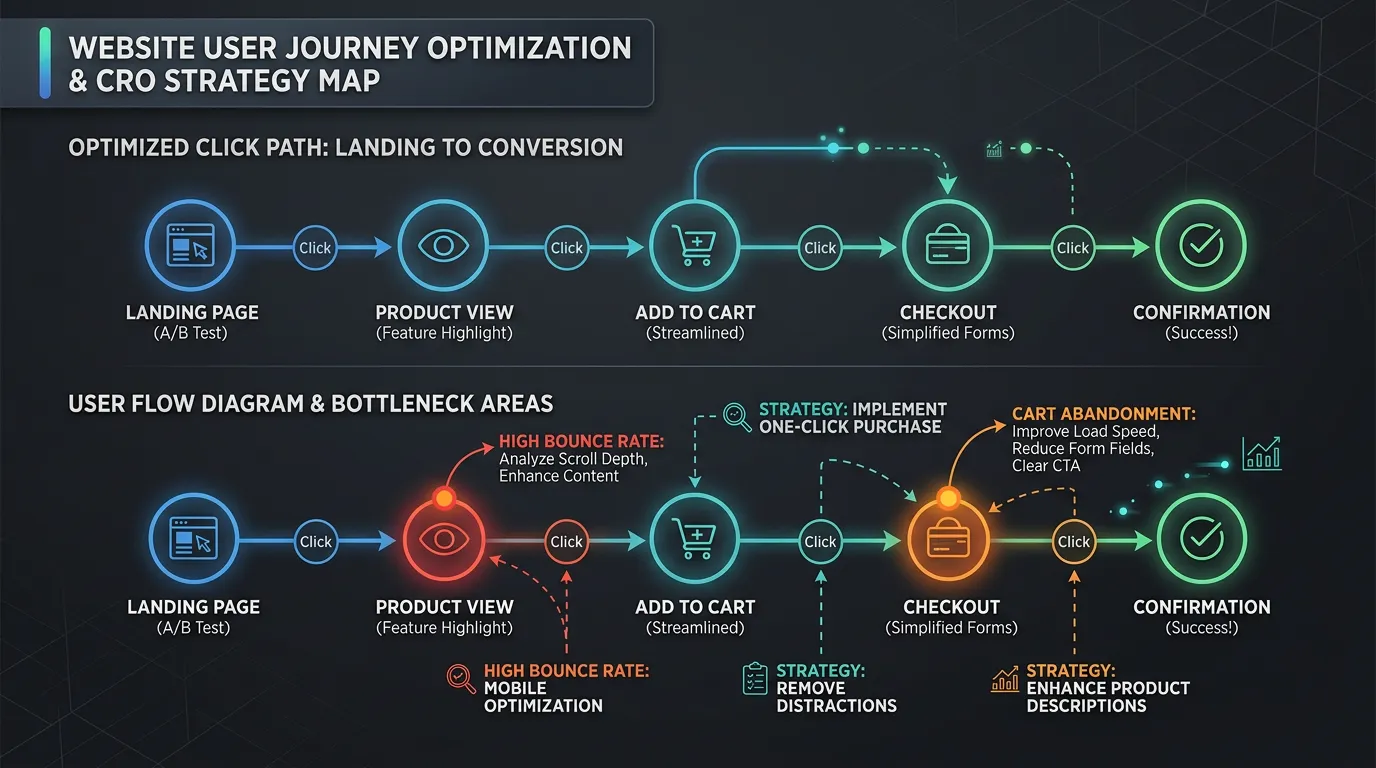
Almost every visitor who leaves without calling stops at one of five points. Naming the point tells you which fix to make. Recordings show which one is yours.
Fix the earliest stage first. A better form does nothing if nobody scrolls that far.
Mistakes That Cost the Most
These are the errors we see most often, and the ones that quietly cost real money.
Do this
- Fix broken things right away, and only test the choices you genuinely cannot call.
- Change one thing at a time on a low traffic site, then give it a full 30 days.
- Watch ten recordings of sessions that did not convert before anyone argues about layout.
- Keep A/B tests temporary and canonical to the original page, which is what Google's testing guidance asks for.
- Write down every change with the date, so you can match it to the graph months later.
Not this
- Do not stop a test early because one version is ahead in the first few days.
- Do not strip text off a page that ranks well just to make it look cleaner.
- Do not add a visible captcha puzzle to stop spam. It blocks real customers too.
- Do not ship three changes in one week and then guess which one moved the number.
- Do not judge a change on one good week. Weather and season move service leads too.
Your 60 Day Check
Two months in, you should answer these without asking anyone. If most are no, ask for a straight answer.
Conversions are counted once, not twice
Check one week in GA4 against your real call log and inbox.
Calls are tied to a page and a channel
You can name the page that produced last Tuesday's call.
Behavior moved, even if lead count has not
Scroll depth, call button taps, and form starts shift first.
Form completion rate went up
Starts versus finishes. This one usually moves within two weeks.
Mobile is closing the gap on desktop
Most service traffic is mobile, so this is the number that matters.
The office says call quality held or improved
Ask whoever answers the phone. They hear it before the report does.
At least one change has been reverted
Nothing ever reverted means nothing is really being measured.
CRO Versus the Other Ways to Get Leads
CRO is one of four things you can do when the phone is quiet. It is not always the right one.
| Option | What it costs | Time to first effect | Best when |
|---|---|---|---|
| More ad spend | Rises with every click | Days | You already convert well and want volume now |
| Buying shared leads | Per lead, sold to rivals too | Days | You need work this week and close fast by phone |
| More SEO | Steady monthly fee | 4 to 8 months | You want cheaper leads later, not this month |
| Full redesign | Large and one time | 3 to 6 months | The current site cannot be edited safely |
| CRO | Monthly, or one audit | 30 to 60 days | You have traffic and it is not turning into calls |
These stack. CRO makes the other three cheaper per lead.
Questions Owners Ask Before Starting
Who from my team has to be involved?
What happens if we stop after six months?
Can we do this while the site is being rebuilt?
The cheapest lead you will ever get is the visitor who already found you and left without calling.
Frequently asked questions
What is a good conversion rate for a service business website?
How much traffic do I need before CRO makes sense?
Will CRO hurt my SEO?
Do you redesign the whole website?
How do you track phone calls as conversions?
How long should an A/B test run?
What if a test makes things worse?
Sources
- Google Search Central: Website testing and Google Search(opens in a new tab) Google permits A/B testing and asks that tests stay temporary and use rel canonical to the original page.
- Microsoft Clarity(opens in a new tab) Free session recordings and heatmaps as the evidence source for finding where visitors drop off.