Senior Care
Digital Marketing for Assisted Living
The buyer is the adult child, often out of state
Call (714) 823-3164 or ask a question. Clear recommendations, even if we never work together.
Assisted living marketing works on a long, emotional decision cycle. Families research for months, then move fast after a fall or a hospital stay. So the job is to stay visible during the research, be easy to tour, and be honest about pricing. Do that and you fill apartments without paying a placement fee on every move in.
Jump to a section
What usually goes wrong
- Placement agencies take a large share of first month rent on move ins you could have earned directly
- Occupancy swings hard when three or four residents move out or pass away in the same quarter
- Families tour, ask for a price sheet, then disappear for six months
- Corporate owned communities nearby run bigger budgets and newer buildings
- Your website hides pricing, so families assume the worst and never call
- Tour requests arrive after hours and nobody responds until Monday morning
- Staffing limits how many higher acuity residents you can safely accept
What usually makes an owner start looking
- Occupancy slips below the number the annual budget was built on
- A new community opens within a few miles and starts a lease up push
- Placement agency invoices for the year cross the cost of a full marketing program
- You finish a renovation or open a memory care neighborhood and need to announce it
- A new executive director or sales director inherits a soft census
- Two or three move outs in one month leave apartments sitting empty

Which channels actually matter
Not every channel deserves the same weight for assisted living. This is how we would prioritise.
| Channel | Weight | Why |
|---|---|---|
| Local SEO | Primary | Families search assisted living plus a city name, often from another state. Ranking for the cities around your building is what puts you on the tour list. |
| Web Design and Development | Primary | Floor plans, real photos, a starting price range, and a tour request form that works on a phone decide whether a researching family calls or moves on. |
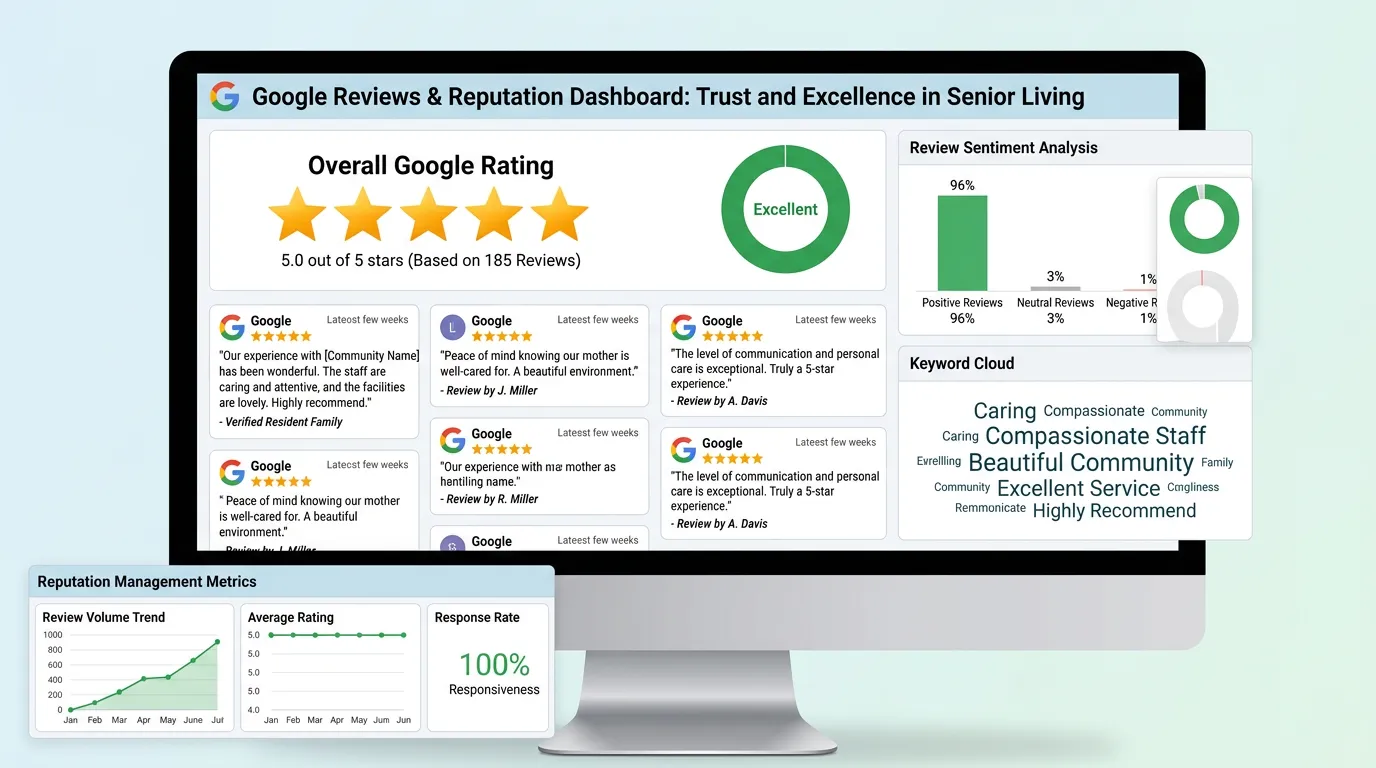
| Reputation Management | Primary | One angry review about a billing dispute can cost several tours. A steady flow of family reviews balances it and shows what daily life is actually like. |
| Content Marketing | Secondary | Guides on cost, levels of care, and how assisted living differs from memory care reach families months early and keep you in the running. |
| Pay Per Click Advertising | Secondary | Paid search fills gaps during a lease up or after a run of move outs, and usually costs far less per move in than a placement agency fee. |
Seasonality
Move ins slow through Thanksgiving and December. Families do not want a parent moving during the holidays. January through April is the heaviest stretch. It is fed by decisions delayed over the holidays, and by winter illness and falls. Inquiry volume also rises after Southern California heat waves, when families see that a parent is not managing well alone.
What we measure
Census occupancy percentage
Move ins per month with the source recorded for each
Cost per tour and cost per move in
Direct move ins compared to placement agency move ins
Tour to move in conversion rate
Concerns we hear
We fill through placement agencies. Why spend on marketing?
Do the math on one year of referral fees. In most communities that number pays for a full marketing program several times over. We are not saying drop the agencies. We are saying every direct move in you earn keeps money in the building.
Corporate will not let us publish pricing.
You do not need an exact rate. A starting range with a plain explanation of what changes it answers the question families are actually asking. Communities that show a range typically field fewer price shopping calls and more tours that end in a deposit.
Our residents are in their eighties. They are not online.
Your residents are not the audience. The adult child, usually between 50 and 65 and often several hours away, does the searching, reads the reviews, and books the tour. Everything on the site should be written for that person.
Marketing cannot fix a staffing problem.
It cannot. It can make sure the tours you can support actually happen, and it can run caregiver and med tech recruiting on the same system. If you are short staffed we would rather slow lead volume than fill a building you cannot serve well.
We are already at 95 percent occupancy.
Then the goal changes. We work on the waitlist, on care level mix, and on staying visible so the next soft quarter does not start from zero. Visibility built during a full year is what protects you during a slow one.
Where we would start
The services that move the needle fastest for assisted living.
Web Design and Development
Fast, accessible websites built to turn visits into calls.
Web Design and DevelopmentReputation Management
Generate reviews on purpose and protect the rating you have.
Reputation ManagementPay Per Click Advertising
Paid traffic that produces calls instead of clicks.
Pay Per Click AdvertisingGoogle Business Profile Optimization
Turn your profile into the strongest lead source you own.
Google Business Profile Optimization
Where we serve this industry
Where a move in comes from and what it really costs
Every move in has a price, even the ones that feel free. Compare the sources the way you would compare vendors, because that is what they are.
| Move in source | What it costs you | How fast it works | What it does to the year |
|---|---|---|---|
| Placement agency | A large share of the first month rent, every time | Fast, they already hold the family | Repeats on every single move in |
| Paid search | A monthly budget plus a cost per tour | Tours in two to four weeks | Stops the day you stop paying |
| Organic search | Time and content, four to six months up front | Slow to start | Keeps working after you stop building |
| Resident and family referral | Almost nothing | Unpredictable | The best margin in the building |
| Hospital or home health referral | Relationship time, not fees | Steady once it is built | Breaks when one person changes jobs |
Fee shapes vary by agency and contract. Pull your last twelve months of invoices before you judge any of this.
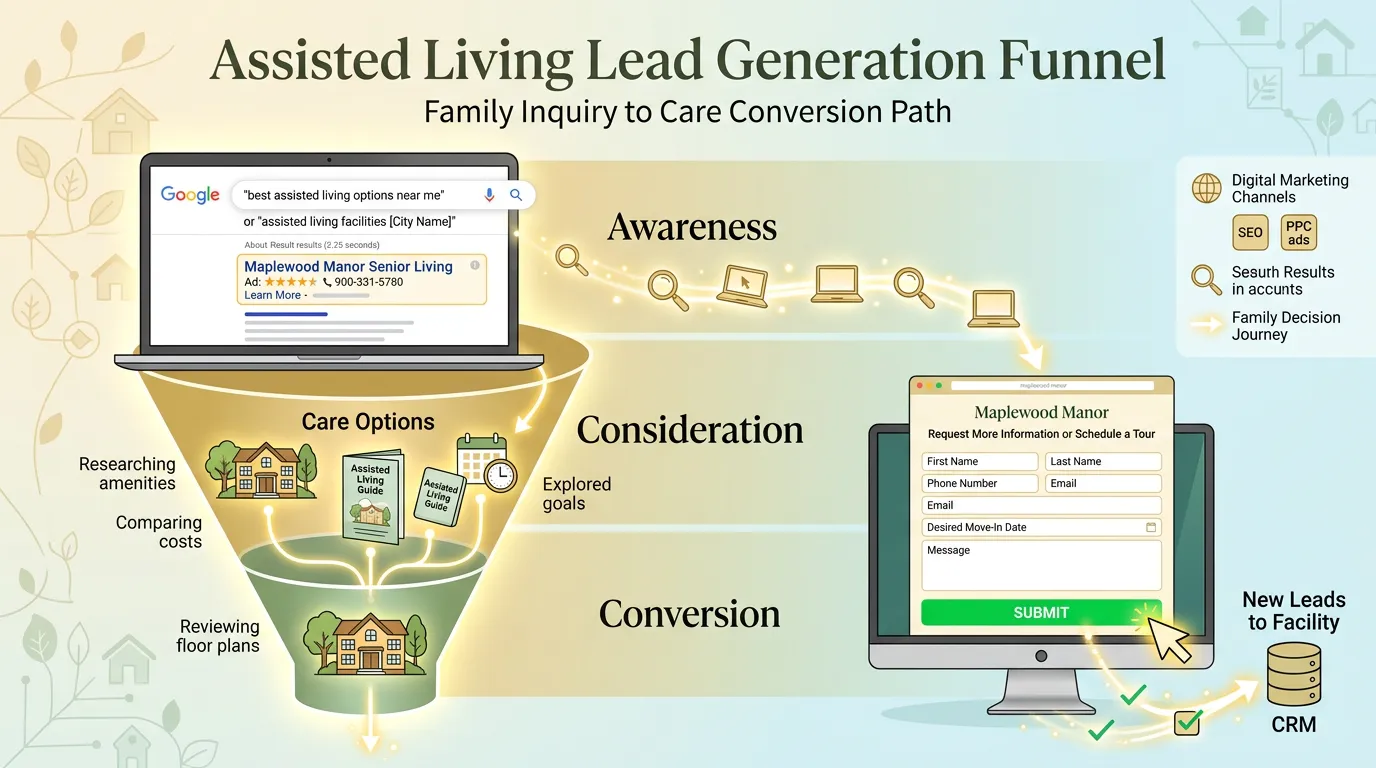
From first search to move in day
The gap between the first search and the deposit is the whole problem. Almost nobody tours the week they start looking.
Marketing only to families ready this month means bidding against everyone at the most expensive moment.
What belongs on a community page
A family compares three or four communities in one sitting, usually at night. These are the things they are looking for and rarely find.
A starting price range
One number, plus a plain note on what moves it up.
Every floor plan with square footage
Studio, one bedroom, shared. Include the small ones.
Photos taken this year
Real apartments and real residents, with written permission.
Care levels explained in dollars
Say how a care level change shows up on the monthly bill.
This week's activity calendar
A real calendar says more than a paragraph about life here.
Dining detail, not a stock plate
Meal times, choices, and what happens if someone misses one.
A tour form that works at 9 pm
Name, phone, and a preferred time. Nothing else.
Who answers and how fast
A named person and a response time you can keep.
Lease up and stabilized are two different jobs
A building in lease up and a building at 94 percent need opposite plans. Running one plan for both wastes money in one direction or the other.
In lease up you are buying speed. Paid search, an open house schedule, and a tour path that runs seven days a week. Cost per move in will be high, and that is fine, because an empty apartment earns nothing at all.
At stable occupancy the job changes to protecting the waitlist and the care mix. Spend shifts toward reviews, content, and staying visible in the cities around you. Cost per move in drops because you are no longer chasing.
The common mistake is running lease up spend forever, or cutting everything the month the building fills. Both leave you starting from zero the next time three residents move out in the same quarter.
The two weeks after a tour
Most communities lose the move in here, not on the tour. Families go quiet because they are arguing with each other, not because they said no.
Do this
- Follow up the same day with the exact floor plan they liked.
- Put the price you quoted in writing so nobody misremembers it.
- Ask which family member is not on board, then help with that person.
- Offer a second visit at a meal time instead of a sales appointment.
- Keep a light touch going for 90 days after the tour.
Not this
- Do not invent urgency about the last available apartment.
- Do not send a generic brochure they already have.
- Do not call only the person who booked the tour.
- Do not drop a family who says not yet. Not yet is the normal answer.
- Do not let follow up depend on one salesperson's memory.