
Services
Video Marketing for Southern California Service Businesses
Show the work, the crew, and the result before anyone has to call.
- Starting at
- $1,500+
- Timeline
- First videos live six to eight weeks from kickoff
- Services
- 9 included areas
Call (714) 823-3164 or ask a question. Clear recommendations, even if we never work together.
Video marketing is using video to attract, inform, and convince customers. It works across your website, your Google Business Profile, YouTube, social feeds, and ads. For service businesses, video shows the work being done, the crew doing it, and the result. Text and photos cannot prove that as quickly.
Jump to a section
- The problem
- What Video is
- Who it is for
- What is included
- Our process
- What it costs
- What changes
- All Video services
- One van, four trucks, or six locations
- The honest comparison of your five options
- Where one shoot day actually ends up
- The order that usually works
- The video mistakes that cost the most
- How to tell at 60 days whether it is working
- When not to buy video marketing
- Questions owners ask before the first shoot
- Questions
The problem
Most service businesses know they should be doing video and are stuck for the same three reasons. They think it needs a production company and a 15,000 dollar budget. They filmed something once, posted it, got 40 views, and decided video does not work for their trade. Or the owner freezes on camera and the project dies after one uncomfortable afternoon. Meanwhile the competitor with a phone on a tripod and a decent microphone is showing homeowners exactly what a repipe looks like, and winning the jobs where trust decides the bid.
What video actually is
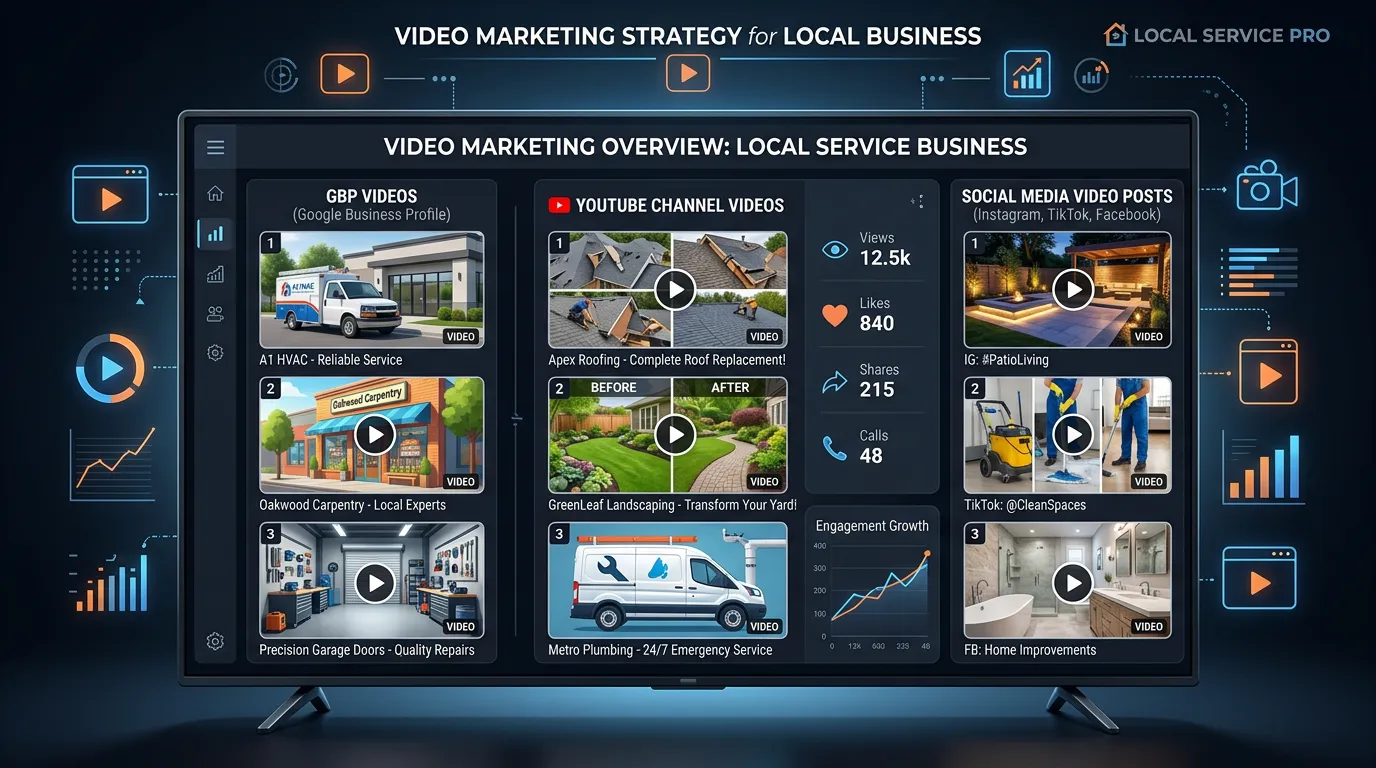
Video marketing covers everything from planning what to film to where the finished clips get used. For a local service business, that usually means a small set of high value videos. It is not a constant content machine. The set is an explainer on each main service, two or three customer stories, and a short introduction to the owner and crew. Add before and after job footage, plus a stack of vertical clips cut from the same footage. We plan it, script it, shoot it, and edit it. Then we place it where it actually gets seen: your service pages, your Google Business Profile, YouTube, ads, and social feeds.
Who it is for
Video pays off fastest when trust decides the sale and the job costs enough to be shopped around. That means remodeling, roofing, HVAC replacement, cosmetic dental, home care, collision repair, and law. It also works for any trade where customers do not understand what the work involves. Showing the process removes fear. It is a weaker fit for pure commodity services chosen on price alone. It is also a weak fit for owners who will not go on camera or put a crew member forward in their place.
What is included
- Video plan mapping which videos to make, in what order, and where each one runs
- Scripts, shot lists, and interview question sets before any filming day
- On location filming at your shop, office, or active job sites
- Edited videos delivered in horizontal, square, and vertical versions
- Burned in captions plus a separate transcript file for every video
- Thumbnails designed for YouTube and for social feeds
- Uploads and optimization on YouTube and your Google Business Profile
- Video embedded on the matching service pages with VideoObject schema
- Short vertical clips cut from long form footage for Reels, Shorts, and TikTok
- Monthly report showing watch time, retention, and video assisted conversions
Our process
Plan the Set
Week 1 to 2We decide which videos to make based on the questions you answer most on estimate calls and the services with the best margin. A short focused set beats an open ended content calendar nobody sustains.
Script and Prep
Week 2 to 3Explainers get written scripts. Customer stories get interview questions instead, because scripted testimonials sound fake. We send you the questions ahead of time and pick shoot locations that will not fight the audio.
Shoot Day
Week 4One organized day usually captures four to six long form videos plus enough extra footage for a dozen short clips. We use lavalier microphones because bad audio kills a video faster than bad picture.
Edit and Deliver
Week 5 to 7You review a first cut, request changes once, and then get final files in horizontal, square, and vertical, with captions burned in and transcripts attached.
Publish and Place
Week 7 to 8Videos go on the right service pages with schema markup, get uploaded to YouTube with proper titles and thumbnails, get posted to your Google Business Profile, and feed a short form posting schedule.
Measure and Refill
Ongoing, monthlyWe track retention, watch time, and whether pages with video convert better than pages without, then plan the next shoot around what held attention.
Realistic timeline: First videos live six to eight weeks from kickoff. Short form clips post weekly after that. Meaningful search and conversion effects usually show at three to six months.
What it costs
The monthly number covers planning, editing, publishing, and a set volume of short form clips from footage we already have. It goes up with additional shoot days, travel outside the Inland Empire and Orange County, on camera talent, animation or motion graphics, and multi location businesses. A single production only project can be quoted as a one time fee instead.
Published ranges are starting points. The final number depends on your market, your current position, and how much ground there is to make up. You get a fixed scope in writing before anything begins.
What changes
Service pages with video that hold visitors longer and typically convert better than the same pages without
Fewer repeated questions on estimate calls, because the video already answered them
A Google Business Profile with recent video, which competitors in most trades still do not post
A YouTube channel that picks up steady search traffic on how something works questions
Ad creative that costs less per lead than static images in most tests we run
A library you can reuse for a year or more across ads, email, and social
All video marketing services
Every area we cover under video marketing. Each one has its own page with process, deliverables, and timelines.
Script Development
Hook written first, because the first five seconds decide everything
Script DevelopmentYouTube Optimization
Titles written for what people search, not for clever wording
YouTube OptimizationVideo for Google Business Profile
Up to 30 seconds, under 75 megabytes, 720p or better
Video for Google Business ProfileShort Form Video Content
Vertical clips of real work, usually 7 to 30 seconds
Short Form Video ContentVideo Marketing for Local Businesses
Built for a service area, not for a national audience
Video Marketing for Local Businesses
Where we do this work
Based in Chino, serving Chino, the Inland Empire, Orange County, Los Angeles County, Riverside County, and San Bernardino County.
One van, four trucks, or six locations
A one van operator does not need a shoot day. You need a tripod, a clip on microphone, and a habit. Film the finished work before you clean up, say what the problem was, and stop. That is under 200 dollars in gear, and it feeds your Google Business Profile all year.
Four trucks changes the math. The owner is not on every job, so footage has to come from techs, and it only arrives if one person collects it. Set up a shared phone album and ask for one clip per completed job. Expect about half to show up. Half is fine. One shoot day a quarter fills the gaps.
Six or more locations needs a split. Brand videos get made once and used everywhere: how the service works, what the warranty covers, who the company is. Location videos get made per site, with the real shop and the real crew. A homeowner in Fontana does not connect with footage shot in Irvine, and profile posts are per location anyway.
The honest comparison of your five options
Hiring someone is not automatically the right call. Here is what owners actually choose, and what each costs in money and in your time.
| Option | Rough cost | Time from you | Best when | Where it breaks |
|---|---|---|---|---|
| Phone and tripod, you film | 150 to 300 one time | 20 minutes a clip | Short vertical clips and profile posts | Explainers feel thin, audio is rough |
| Videographer, per project | 1,500 to 4,000 a day | A full day plus reviews | You know exactly what you want | Files land in a folder and stay there |
| Production company | 8,000 to 25,000 | Several planning meetings | One brand film for a launch | One video, no clips, no placement |
| Managed video program | 1,500 and up monthly | Half a day a quarter | You want it filmed and placed | Wasted if you quit at month three |
| Stock footage and voice over | 50 to 300 | About an hour | Filler between real videos | Looks like every competitor |
Ranges are what we see around the Inland Empire and Orange County, not a quote from us. The real gap is not picture quality. It is whether anyone puts the finished video where buyers will see it.
Where one shoot day actually ends up
People picture video as a single file. It is closer to a supply chain. Here is what six hours of filming turns into.
The money is made or lost in the last two steps. Most wasted budgets die between the edit and the placement, when finished files sit in a folder nobody opens.
The order that usually works
If you can only make five videos, make these, in this order. First, your best margin service explained in about 90 seconds. Second, the question you answer most on estimate calls. Third, a customer talking about the exact job you want more of.
Fourth, a walk through of what happens on day one. Most cancellations come from people who do not know what to expect, and this removes that. Fifth, the owner introducing the crew, which matters when a stranger is about to walk into a house.
Notice what is missing. No company history, no mission statement, no drone shot of the building. Those get made first, watched least, and usually cost the most.
The video mistakes that cost the most
Almost every wasted video budget we see failed in the same few ways. None of them are about the camera.
Do this
- Clip a microphone to whoever is talking, even outside
- Film the job before you clean up, because the mess is the proof
- Answer one real estimate question per video, then stop
- Get written permission from the homeowner before filming their property
- Export profile videos at 720p or better and under 75 MB, which is what Google accepts
Not this
- Do not open with a logo animation. That is exactly where viewers leave
- Do not use music you found online. A copyright claim can mute or block the video
- Do not post a wide video into a vertical feed with black bars on it
- Do not film next to a running compressor and hope the edit saves the audio
- Do not chase views with clips that have nothing to do with your trade
How to tell at 60 days whether it is working
Sixty days is early, but honest signals exist by then. You can check every one of these yourself.
People stay past 30 seconds
Aim for half your viewers still there at the 30 second mark. Under a third means the opening is wrong.
Pages with video hold visitors longer
Compare a service page with video to one without. Longer visits mean people are watching, not scrolling.
Estimate calls got shorter
Ask whoever answers the phone. Callers who already know what the job involves show up before any metric does.
Your Business Profile has recent video
Open your listing on a phone. Video is still rare in most trades, so it stands out.
Short clips earn saves, not just views
A save means someone wants it later. That is the number closest to a buying decision.
Video ads beat the image version
Run both against the same audience and compare cost per lead. Clicks will mislead you here.
The footage is still producing clips
One shoot day should still be making new verticals in month three. If not, nobody is cutting them.
Somebody can send you the links
If nobody can name the pages your videos live on, they were filmed but never placed.
When not to buy video marketing
If your website does not convert the visitors it already gets, fix that first. Video only sends more people onto a page that is already leaking. A buried phone number loses the same share of buyers with or without a video above it.
If almost nobody is finding you yet, video is the wrong first spend. It persuades people who already showed up. Put the money into your Business Profile, your reviews, and real service pages, then come back when there is traffic worth convincing.
And skip it if you will not go on camera and nobody on your crew will either. We can work around that with narrated job footage, but it is the weaker version. Paying 1,500 a month for it is a bad trade for both of us.
Questions owners ask before the first shoot
Who owns the footage if we stop working together?
Do I need permission to film at a customer's house?
What happens if I use music from the internet?
Frequently asked questions
Do I have to be on camera?
How many views should I expect?
Can I just film on my phone?
How long should my videos be?
Does video actually help my SEO?
How often do I need new videos?
What does a shoot day actually look like?
Sources
- Video SEO best practices(opens in a new tab) Google finds videos through standard HTML video elements, structured data, and video sitemaps, and Search Console reports video indexing status.
- Video (VideoObject, Clip, BroadcastEvent) structured data(opens in a new tab) VideoObject markup controls the description, thumbnail, upload date, and duration shown in video results across Search, Video mode, Images, and Discover.
- Add photos and videos to your Business Profile(opens in a new tab) Google Business Profile videos must be up to 30 seconds, up to 75 MB, and 720p resolution or higher.