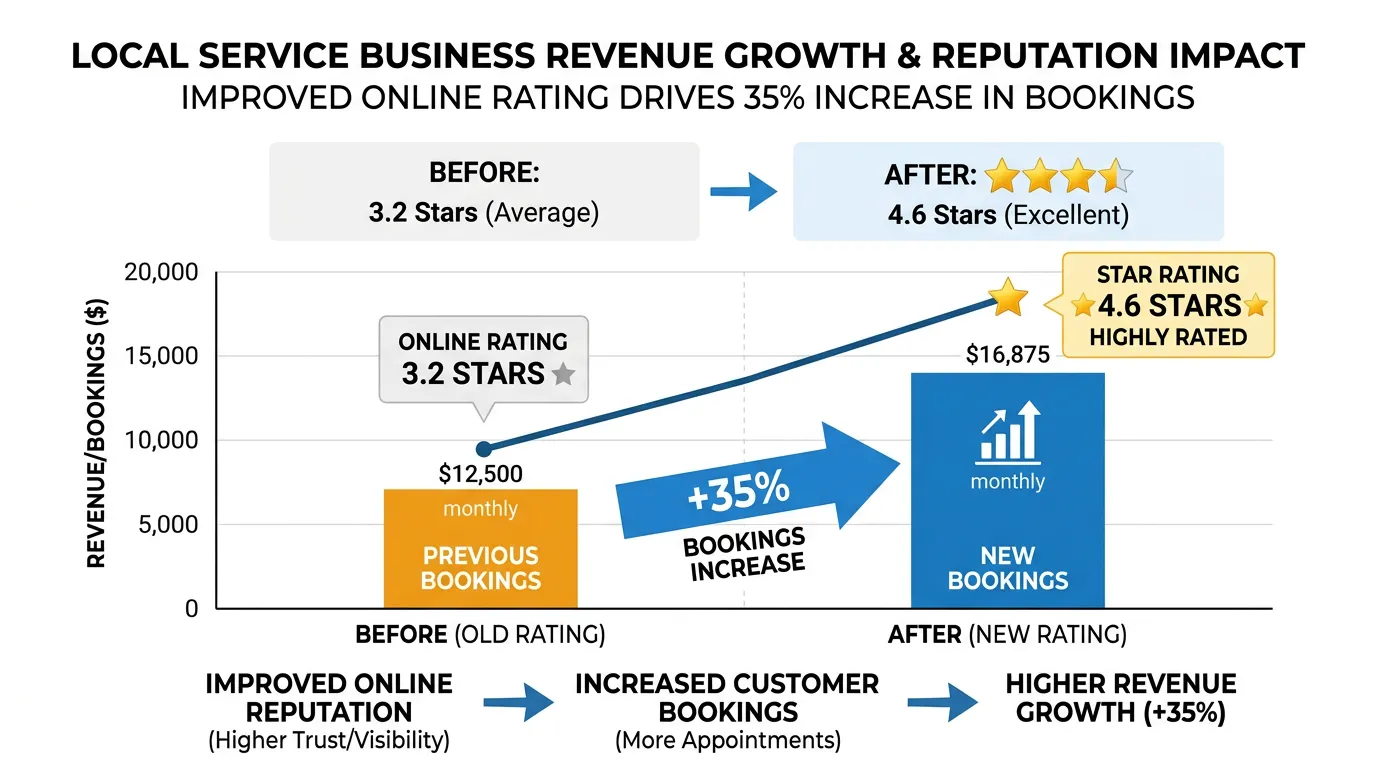
Reputation Management
Reputation Management for Service Businesses
Built for businesses whose reviews name the technician, not the company
- Timeline
- Setup and mapping inside 30 days
Call (714) 823-3164 or ask a question. Clear recommendations, even if we never work together.
Reputation management for service businesses is review and reputation work built for companies with field crews. It tracks reviews by technician. It handles the price shock complaints that are common in the trades, along with warranty and callback disputes. It also plans for the quality drop that shows up in reviews during peak season.
The problem
In the trades, your reputation walks into the customer's house wearing your logo. A single tech having a bad week produces four reviews you will be reading for years. Price complaints show up constantly because homeowners have no reference point for what a repair costs, and a call back on a warranty job generates a level of anger no other industry sees. Then July arrives, everyone works twelve hour days, quality slips, and your rating takes a hit in the exact month you were making the most money.
What it is
This is reputation work built around how field service really runs. We track reviews by technician. That shows you your best performers, and it shows you the one whose jobs bring in every complaint. Price objections get handled before they turn into reviews. You set expectations on the phone and at the estimate, not at the invoice. Callbacks and warranty visits get a set process, because how you handle the second visit decides whether the review is one star or five. Peak season gets a plan: adjusted staffing, a pause on asking after jobs where the crew was rushed, and closer watching during the weeks quality is most at risk. Reviews also become a hiring and training tool, since customers describe exactly what good work looks like from their side.
Signs you need this
- Your reviews name individual technicians more than the company
- Most of your negative reviews are about price, not the work
- Your rating dips every year during your busiest months
- Warranty callbacks turn into your worst reviews
- One crew generates all your complaints and nobody has counted
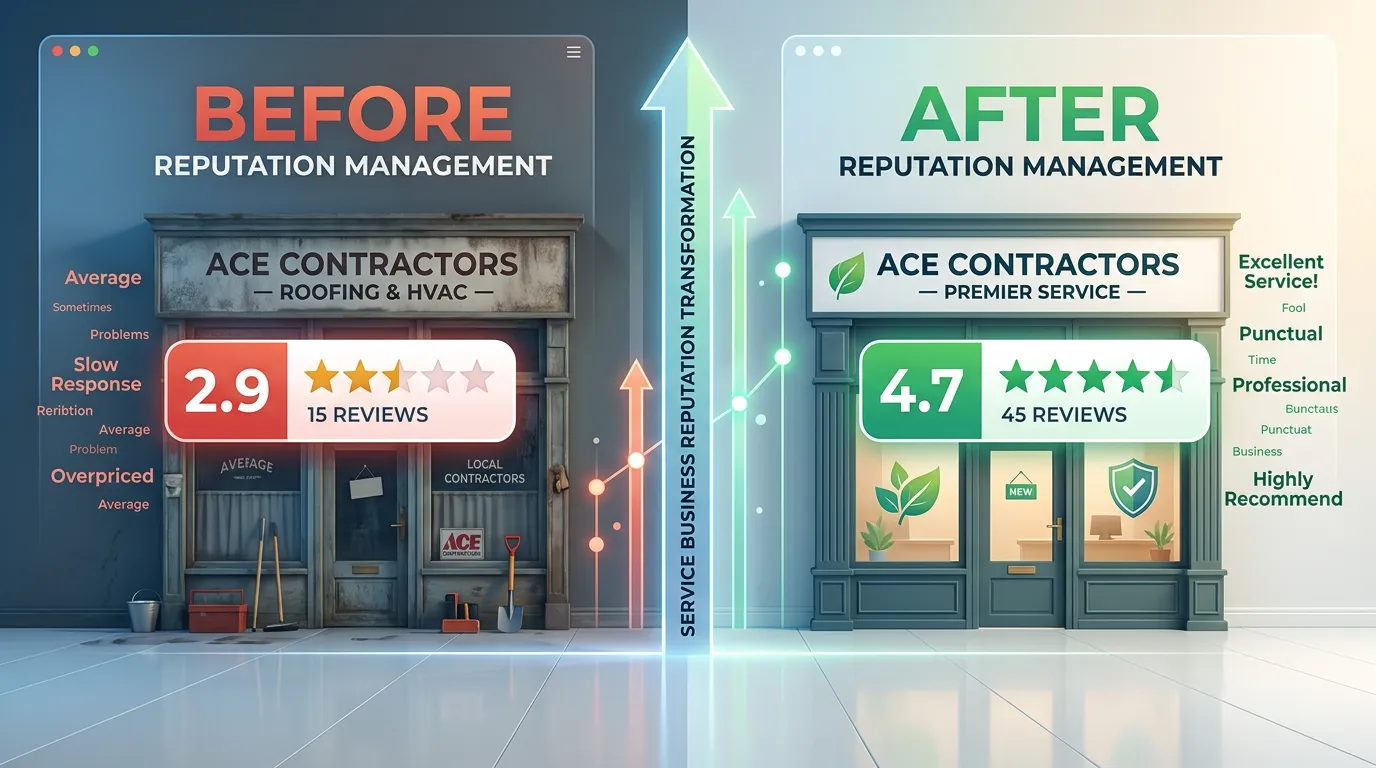
What is included
- Technician level review tracking with monthly per person reporting
- Price expectation scripts for phone intake and on-site estimates
- Callback and warranty visit protocol designed to protect the review
- Peak season monitoring plan with adjusted request timing
- Post job follow up call for high ticket work before a review gets written
- Response templates for price, timing, and warranty complaints specifically
- Field capture habit so techs collect photos and reviews on the same visit
- Review content fed back into technician training and hiring
- Monthly report tied to job volume rather than raw review counts
Our process
Map reviews to jobs and techs
Week 1 to 2We connect existing reviews to job records so every review has a technician, a service type, and a ticket size attached. Patterns appear immediately, and they are rarely what the owner expected.
Fix the price conversation
Week 2 to 4Most price complaints come from expectations set badly on the phone. We rewrite the intake script to cover diagnostic fees, ranges, and what happens if the job is bigger than expected, so the invoice is never a surprise.
Build the callback protocol
Week 3 to 5A callback handled fast, free, and without argument frequently produces a better review than a job that went right the first time. We define the response window, who calls, and what gets said.
Plan for peak season
Week 4 to 8We look at your review history by month, find the weeks where ratings dip, and plan for them: extra follow up calls, a pause on requests for rushed jobs, and closer monitoring so a bad pattern gets caught in week one.
Coach from the data
Ongoing, monthlyMonthly per technician numbers get used for coaching, not just reporting. The tech generating twelve reviews a month is doing something specific, and it can be taught to the one generating none.
Realistic timeline: Setup and mapping inside 30 days. Price complaint volume typically drops within 60 days of fixing intake scripts. A full seasonal cycle takes twelve months to measure, since the honest comparison is this July against last July.
Where the review is actually won on a job
By the time the request goes out, the review is already written in the customer's head. Five moments decide what it says.
Four of the five have nothing to do with marketing. In field service the review is a report card on the visit, and the only part you can add later is the ask.
When your rating dips, trade by trade
Ratings in the trades follow the calendar. Sort your own reviews by month and the pattern usually shows up. These are the ones we see most often in Southern California.
| Trade | Hardest weeks | What goes wrong | What to change first |
|---|---|---|---|
| HVAC | First heat wave to September | Long waits, rushed installs | Call every job from the peak week |
| Plumbing | First heavy rain, the holidays | After hours pricing shocks people | Say the after hours rate on the phone |
| Roofing | The weeks after a storm | Delays and unreturned calls | One status call a week, news or not |
| Landscaping | Spring startup | Crews run behind on every route | Give a wider arrival window |
| Pest control | Summer | A second treatment reads as failure | Explain the retreat up front |
| Auto repair | Holiday travel weeks | Parts delays hold the car | Text the delay before they call you |
The fix is almost always communication, not more trucks. Customers forgive a wait they were warned about. They punish a wait they had to discover on their own.
The callback visit, where reviews are made or lost
A callback is the highest risk hour in field service. The customer already paid and something is still wrong. That second visit decides the review more than the first one did.
Do this
- Answer the callback the same day, even if the fix has to wait until tomorrow
- Send the original tech back if the relationship is good, someone else if it is not
- Say the words no charge early, before the customer has to ask
- Write down what failed. Three callbacks on the same part is a buying problem
- Ask for the review at the end of the second visit, not the first
Not this
- Do not argue about what the warranty covers in the customer's hallway
- Do not send someone who cannot approve the fix
- Do not let a callback sit over a weekend with no phone call
- Do not charge a second diagnostic fee on the same complaint. Eating it costs less
- Do not blame the part, the brand, or the last company. They hear it as blaming them
The price complaint starts on the phone
Most price reviews are not about the number. They are about the surprise. A homeowner has no idea what a capacitor or a water heater should cost, so the invoice becomes their first reference point. Three numbers on the intake call fix most of it: the diagnostic fee, the usual range for that repair, and what happens if the job turns out bigger.
On site, the price goes in writing before any work starts, with the warranty attached to it. The tech who says the number out loud and then waits is doing reputation work, even though nobody calls it that. Rushing past the price to keep the job moving is what produces the review three days later.
On high ticket work, add a follow up call about 48 hours out. Ask one plain question. Did the final bill match what we told you. An unhappy customer will say so on the phone, where you can still fix it. Left alone, that same complaint shows up in public a week later.