Reputation Management
Long Term Reputation Strategy
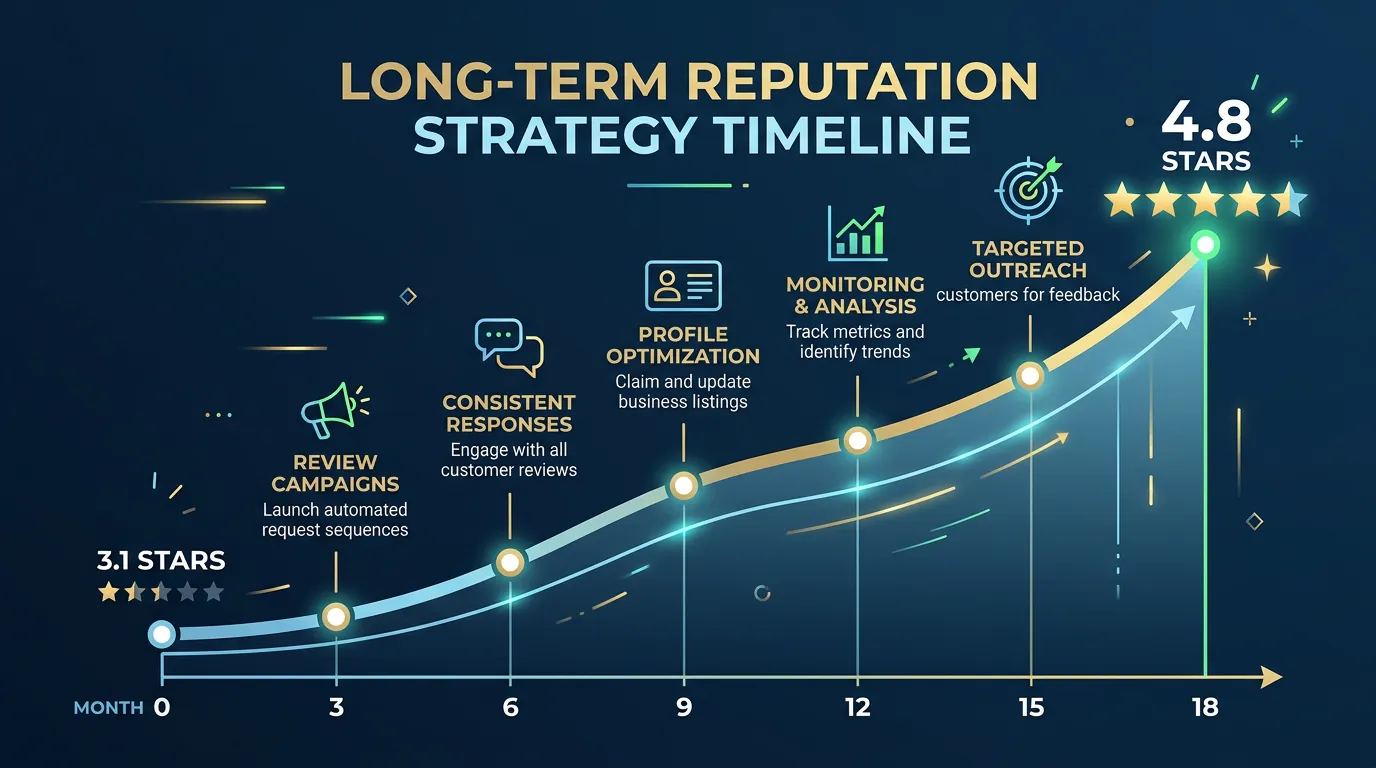
Sets 12 to 24 month review and rating targets from competitor data
- Timeline
- Long term reputation strategy document delivered in 4 to 6 weeks
Call (714) 823-3164 or ask a question. Clear recommendations, even if we never work together.
A long term reputation strategy is a multi year plan for what people find when they look into a business. It sets targets for review count and rating. It decides which pages should own page one for the business name, and plans the content and profiles that get there. It includes a crisis playbook, written before anything goes wrong.
Jump to a section
- The problem
- What it is
- Signs you need this
- What is included
- Our process
- Related services
- Which results can hold page one for your name
- The first two hours when something goes public
- Setting a review target you can actually hit
- Pushing a bad result down the page
- Questions owners ask about the two year plan
- Questions
The problem
Reputation gets managed month to month with no destination. Reviews arrive, responses go out, and nobody has asked what this should look like in two years or what shows up when a potential customer searches your name. Then something happens: a lawsuit, a bad news story, a former employee posting, a complaint site page ranking third for your business name. Without owned properties already sitting on page one and a plan already written, the response takes weeks and looks improvised.
What it is
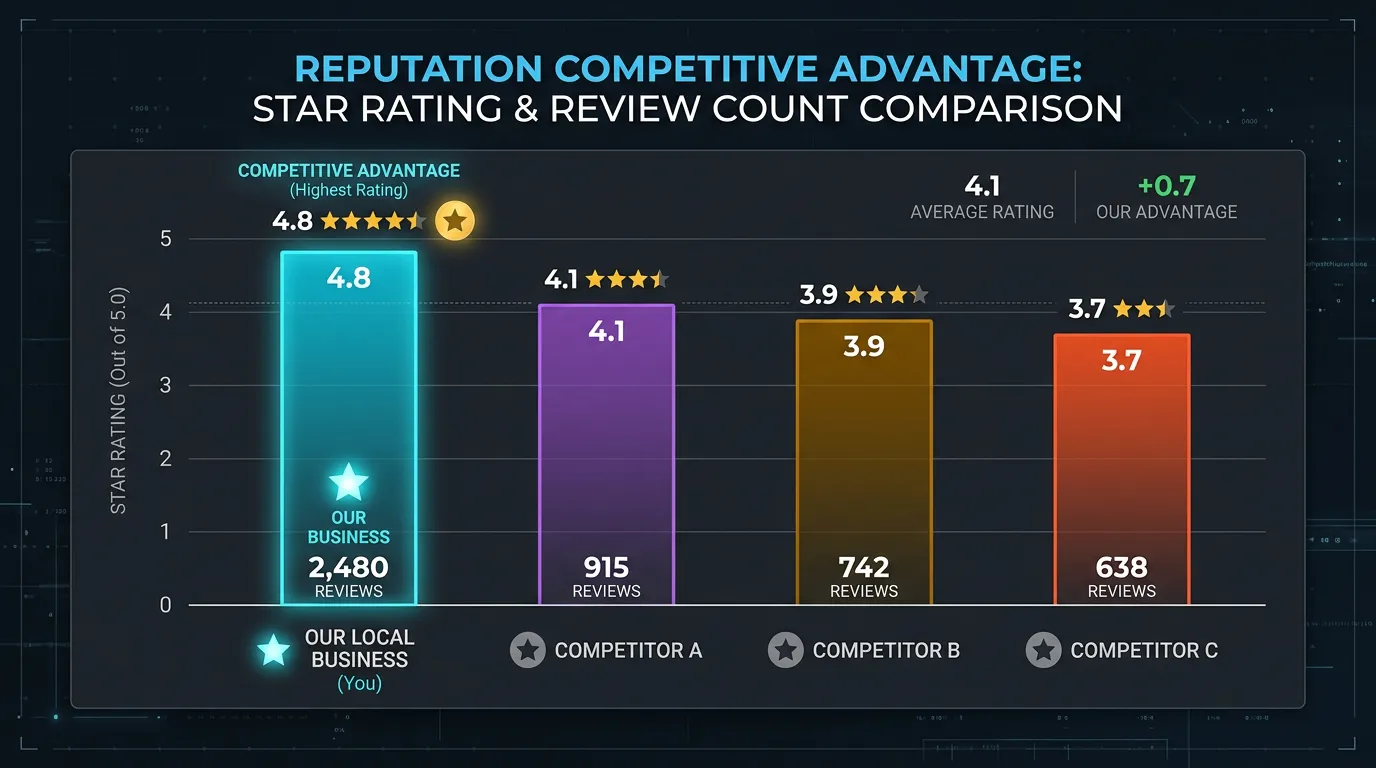
Long term reputation strategy work sets the destination and the route to it. We set a target rating and review count based on where your competitors will realistically be in twelve and twenty four months, not where they sit today. From that target we work backward into a monthly pace. We map what shows up today on page one for your business name, and for your name plus reviews, plus complaints, plus lawsuit. Then we decide which results should be there instead. That usually means strengthening your own site, your profiles, your social accounts, and any pages you control, like a news page or a directory profile. Last, we write the crisis playbook: who speaks, what gets said in the first two hours, which channels get watched, and what never gets said in public for any reason.
Signs you need this
- You have never searched your own business name past the first result
- A complaint site or old news article ranks on page one for your name
- Your review goals are vague, like get more reviews
- You have no plan for what to do or say if something goes badly wrong
- Job candidates mention things they read about you online
What is included
- Twelve and twenty four month review volume and rating targets with monthly pace
- Brand search audit of page one for your name and related queries
- Owned property plan naming which results should occupy page one
- Profile strengthening plan across search, social, and industry directories
- Content plan for pages that answer brand research questions
- Employee review platform strategy where hiring reputation matters
- Written crisis playbook with roles, timing, and approved language
- Annual strategy review with reset targets
Our process
Project the competitive picture
Week 1 to 2We take competitor review counts and growth rates and project where they will be in a year. Targets get set against that projection, since matching today's numbers in twelve months means still being behind.
Audit the brand search page
Week 2We search your business name and the follow up queries people use: name plus reviews, complaints, lawsuit, scam, and owner name. Whatever sits on page one is what a serious prospect will find, and most owners have never looked.
Plan the owned properties
Week 3 to 4We decide which results should hold page one: your site, your profiles, your social accounts, a news or press page, industry association profiles. Then we plan the long term reputation strategy work to strengthen each one enough to hold position.
Write the crisis playbook
Week 4 to 6Roles, response windows, approved holding statements, and the escalation path for legal review. It covers the realistic scenarios for your industry: an injury claim, a viral complaint, an employee incident, a licensing issue.
Review annually
AnnuallyOnce a year we re-run the brand search, reset targets against current competitor data, and update the playbook for any change in the business, such as new locations, new partners, or new service lines.
Realistic timeline: Long term reputation strategy document delivered in 4 to 6 weeks. Brand search page one changes take 6 to 12 months to materialize. Review targets are set on a 12 and 24 month horizon and reviewed annually.
Which results can hold page one for your name
Page one for your business name has about ten slots. Some are easy to claim and some take years. Here is how the common ones compare.
| Result | Work to rank it for your name | How stable | What it gives a searcher |
|---|---|---|---|
| Your website home page | Usually already there | Very stable | Your side of it, first |
| Google Business Profile | Claim it, fill it in | Very stable | Hours, photos, reviews |
| Facebook page | Details plus a weekly post | Slips if it goes quiet | Proof you are real |
| YouTube channel | A few real videos | Stable once it has views | A face and a voice |
| State license record | Nothing, if yours is current | Held by the state | Proof you are licensed |
Each one is a real property with a real audience, which is why it holds. The long term reputation strategy work is claiming it and linking it from your site.
The first two hours when something goes public
The playbook exists so nobody invents a plan while the phone is ringing.
The order matters. Answer before you know the facts and you spend a week correcting yourself. Say nothing for three days and it reads as guilt.
Setting a review target you can actually hit
Targets get set against where competitors will be, not where they are today. Say the shop above you has 240 reviews and adds eight a month. In a year they are near 336. If you sit at 95, matching that means 20 new reviews a month, every month. Now check your job count. At 120 jobs a month, with about one review per six finished jobs, 20 is realistic. At 40 jobs a month it is not, and pretending otherwise is how owners end up buying reviews.
When the gap cannot be closed, change what you compete on. Recency is the easier win, because a profile with a review from last week beats a bigger one that went quiet two years ago. Wording is the other. Reviews naming the long term reputation strategy service you want more of pull better than a higher raw count.
Pushing a bad result down the page
Suppression is slow, and it is mostly ordinary work. Here is what moves a result and what wastes money.
Do this
- Strengthen results you already own. A page that almost ranks is cheaper to move than a new one
- Link your profiles from your site and to each other, so they read as one business
- Publish the pages behind the search: license number, warranty terms, how you price
- Recheck page one every quarter. One new result can undo a year of work
Not this
- Do not threaten a review site or a former customer without a lawyer telling you the odds
- Do not buy links or blast press releases to bury a result. The harm outlasts the fix
- Do not open extra listings for your own company. Duplicates get merged or suspended
- Do not start this while the problem people are writing about is still happening
Questions owners ask about the two year plan
What do I check between the annual reviews?
Does the crisis playbook need a lawyer?