Conversion Rate Optimization
Page Level Conversion Strategy
One conversion approach for the whole site wastes most of your pages
- Timeline
- Page level conversion strategy and template design take 4 to 5 weeks
Call (714) 823-3164 or ask a question. Clear recommendations, even if we never work together.
Page level conversion strategy gives each page template its own goal, its own audience stage, and its own primary action. One approach across the whole site does not work. A homepage, a service page, a city page, and a paid landing page all serve different visitors, so each one should be built and measured differently.
Jump to a section
The problem
Companies apply one conversion playbook to every page and then judge every page by the same number. The blog post that answers a question for someone six months from buying gets called a failure because it produced no calls. The city page gets the same generic call to action as the homepage even though its visitor already knows what they want and only needs to confirm you cover their area. The paid landing page keeps the full site navigation, so half the expensive clicks wander off into the about page. Every page is doing a different job and nobody assigned the jobs.
What it is
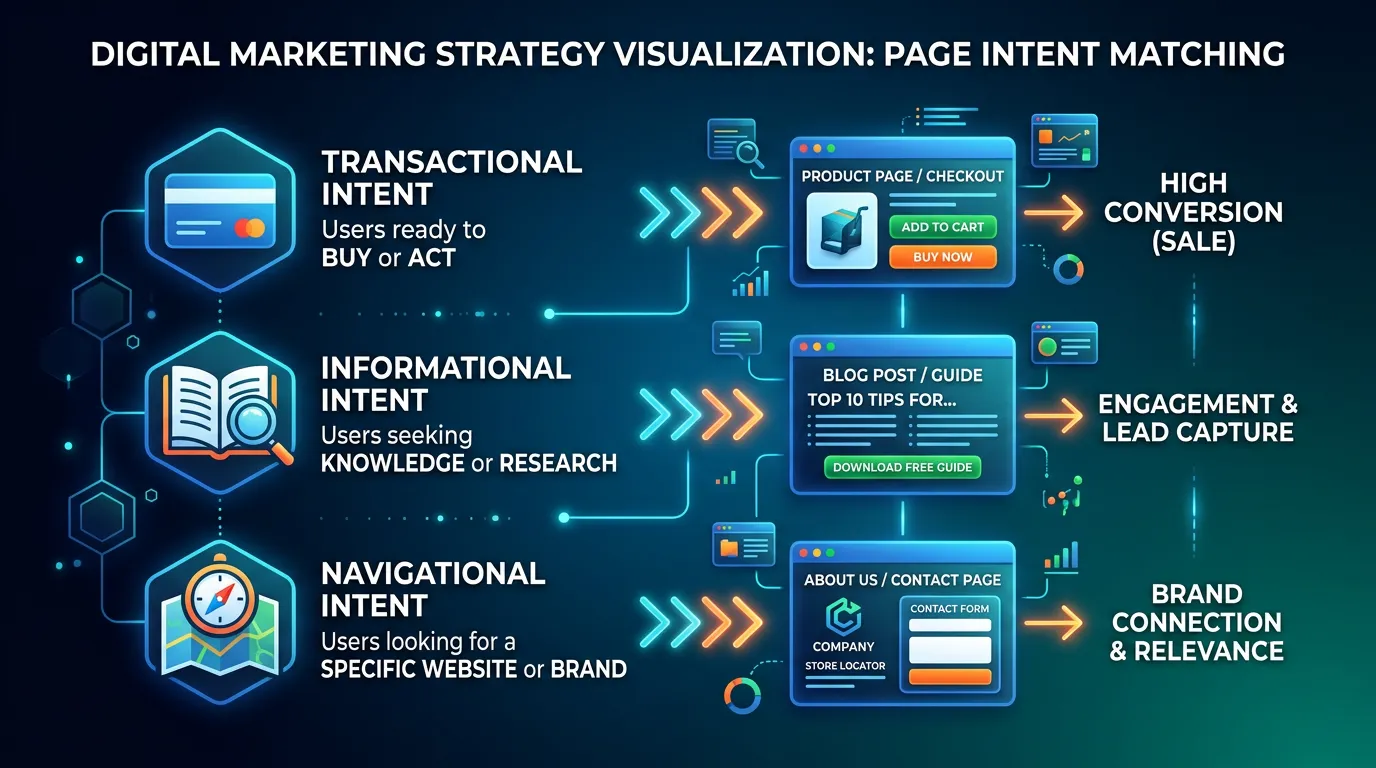
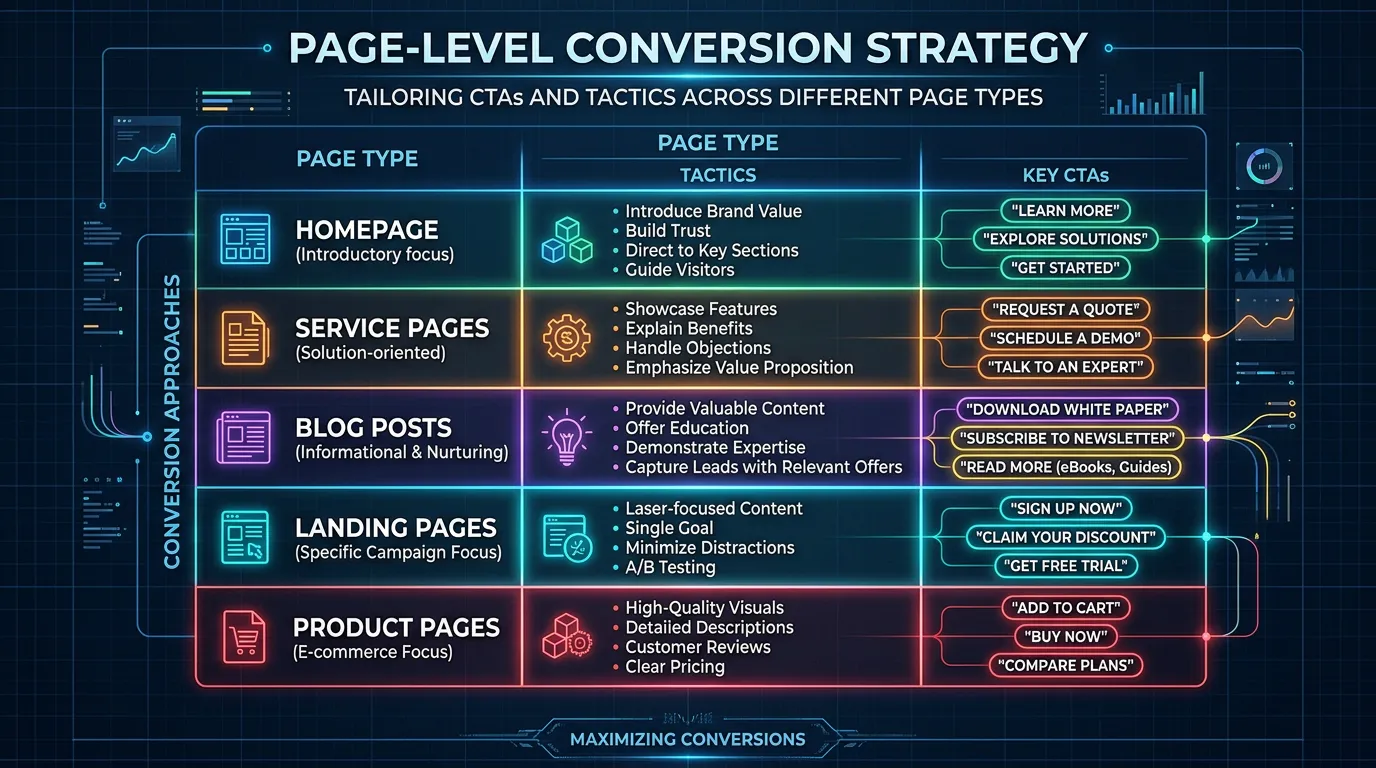
We build a conversion plan for each template. The homepage handles orientation. It says what you do and where you work, then sends visitors to the right service fast. We judge it by whether visitors reach a service page. Service pages handle the decision, with scope, a price signal, proof, and a direct action. We judge those by calls and forms. City pages handle qualification. They confirm you cover the area and show local proof, and we judge them by the contact rate from that page. Paid landing pages carry one narrow promise, with no navigation and one action, judged by cost per lead. Blog and resource pages handle capture. They offer a fitting next step such as a guide or a subscription, and we judge them by assisted conversions rather than direct ones. Each plan names the audience stage, the one action, the proof behind it, and the metric that judges it fairly.
Signs you need this
- Every page on your site ends with the same generic contact block
- Your blog gets traffic and you cannot tell if it does anything
- Paid landing pages use the full site navigation
- City pages read exactly like the main service page
- You judge every page by the same conversion number
What is included
- Template inventory naming every distinct page type on the site
- Audience stage and intent assignment per template
- One primary action defined per template with a fallback action
- Required proof elements listed per template
- Wireframe level section order for each template
- Metric definition per template so pages get judged fairly
- Internal linking rules moving visitors between stages
- GA4 configuration so each template reports against its own goal
Our process
Template inventory
Week 1We list every genuinely distinct page type and how much traffic each receives. Most sites have five to eight real templates even when they have four hundred pages, which is what makes this page level conversion strategy work efficient.
Stage and intent mapping
Week 1 to 2Each template gets matched to where its visitors are: emergency need, active comparison, early research, or already sold and looking for the phone number. The action follows from the stage, not from preference.
Section order design
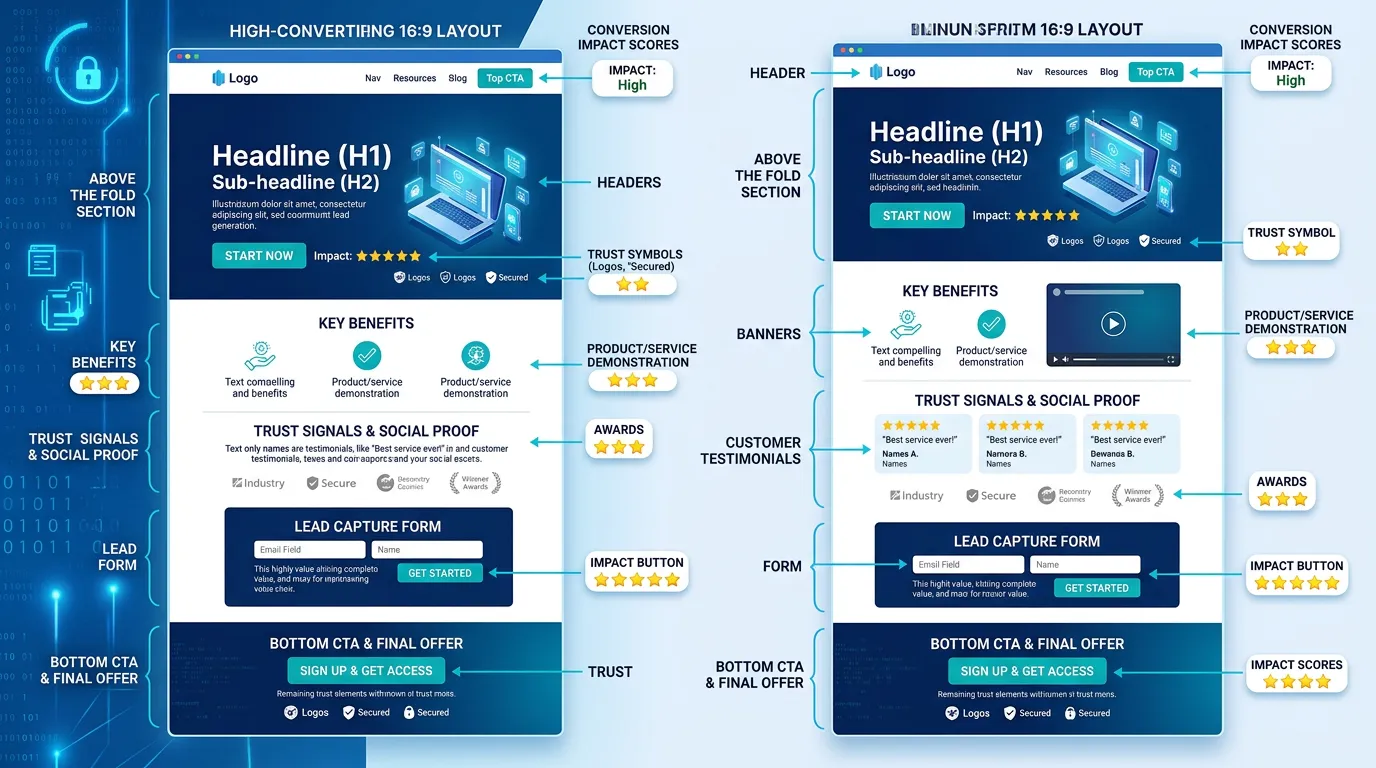
Week 2 to 4Each template gets a section order built to answer questions in the order that stage asks them. An emergency page leads with availability and phone. A remodeling page leads with process, cost range, and finished project photos.
Metric assignment
Week 3 to 5We configure GA4 so each template reports against its own goal. Blog pages get measured on assisted conversions and email signups. Service pages get measured on calls. Nobody gets blamed for the wrong number.
Rollout by traffic
Week 4 to 12Templates get rebuilt in order of traffic volume, so the highest impact changes land first and we learn from them before touching the rest of the site.
Realistic timeline: Page level conversion strategy and template design take 4 to 5 weeks. Rollout runs 8 to 12 weeks depending on how many templates need rebuilding. Per template conversion data becomes readable after 30 to 45 days of traffic on the new version.
Section order for the templates that carry your traffic
Same site, different jobs. This is what each template should open with, what proof it needs, and what does not belong on it at all.
| Template | Open with | Proof it needs | Cut from it |
|---|---|---|---|
| Emergency service | Availability and phone | Response time, license | Company history |
| Scheduled service | What the job includes | Price range, job photos | Long welcome paragraph |
| City page | Coverage confirmation | Nearby jobs and reviews | Repeated service copy |
| Paid landing page | The exact ad promise | Reviews and guarantee | Site navigation |
| Blog post | The direct answer | Author and sources | Hard sales block |
Templates get rebuilt in traffic order, so the busiest one teaches you the most first.
Internal links are how a visitor changes stage
A page rarely converts someone who is not ready. Its other job is to hand that visitor to the page that fits their next question.
So each template gets link rules instead of a random related posts block. Blog posts link down to the matching service page. Service pages link across to the city pages that cover the reader. City pages link straight to the call or booking path, since that visitor is already close.
Keep the links few and pointed. Three good links inside the body beat twenty at the bottom, which people skip. Put each one where the question it answers comes up, not in a pile at the end.
Rules for paid landing pages
Paid pages break the normal site rules on purpose. Every visit was bought, so nothing on the page should compete with the one action.
Do this
- Repeat the ad headline word for word at the top of the page.
- Keep one action, repeated down the page, and nothing else.
- Strip the navigation back to a logo and a phone number.
- Give the page its own tracked number so cost per lead stays clean.
- Build one page per offer, not one page for the whole campaign.
Not this
- Do not send paid clicks to your homepage.
- Do not add a newsletter box, a chat bot, and a blog feed to the same page.
- Do not use one page for both emergency and scheduled offers.
- Do not put the offer behind a long video.
- Do not let a heavy hero image push the phone number below the fold.
How to tell two templates apart from one
Not every page type needs its own plan. Two templates are really one when the visitor, the question, and the action all match.
Here is a quick test. Write the visitor's first question at the top of each page. If both say the same thing, merge them and save the page level conversion strategy work. If one asks do you serve my city and the other asks what does this cost, keep them separate.
Most service sites settle at five to eight real templates. Fewer than five usually means something is being forced together. More than eight usually means someone counted design variations instead of jobs.
Template strategy questions
Which template should we rebuild first?
What if one page gets huge traffic and fits no template?
Do the metrics change after rollout?