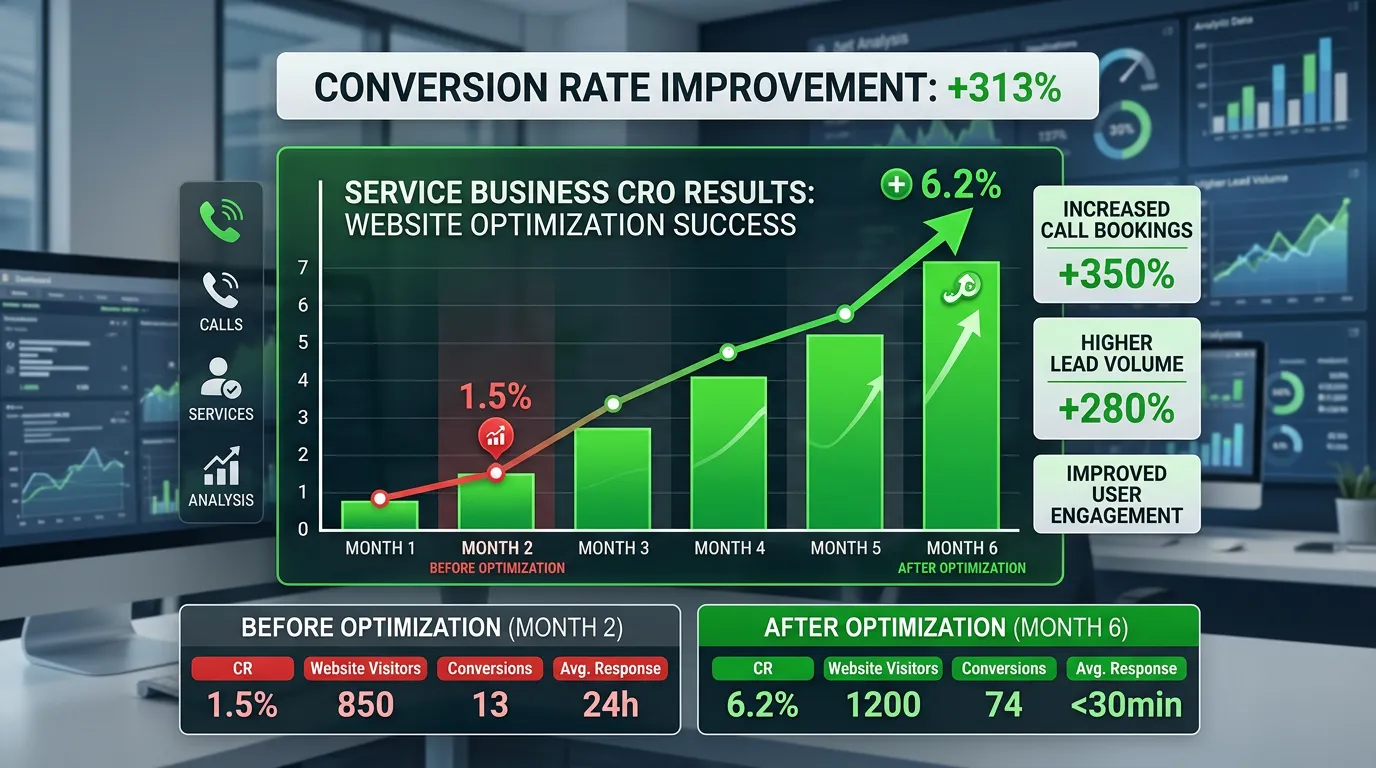
Conversion Rate Optimization
Conversion Rate Optimization for Service Business Websites
The phone call is the conversion, so everything points at it
- Timeline
- Eight to twelve weeks for a full pass
Call (714) 823-3164 or ask a question. Clear recommendations, even if we never work together.
Conversion optimization for service businesses treats the phone call as the main conversion, because most local customers call instead of filling out a form. For service businesses the work centers on making the number easy to find, stating the service area, signaling price, and handling after hours visitors. It also shows proof that the business is licensed, local, and available.
The problem
Generic conversion advice was written for software companies and ecommerce, where the conversion is a signup or a cart. Service businesses work differently. The customer often has an urgent problem, a limited window to deal with it, and two questions before anything else: do you come to my city, and roughly what will this cost. If the site does not answer both within a few seconds, they leave. Then there is timing. A large share of home service traffic arrives evenings and weekends when the office is closed, and most sites do nothing different for those visitors. And the conversion happens on the phone, so a site can be perfectly optimized while half the calls go unanswered and nobody connects the two.
What it is
This is conversion work shaped around how people actually buy local services. Call visibility comes first. That means a tappable number in the header, a call bar that stays on screen on mobile, and tracked numbers so we can measure what each page produces. The service area gets stated in plain text with city names, not a vague radius map, so visitors can qualify themselves right away. Price signaling gets added in whatever form the business can honestly support, from a diagnostic fee to a typical project range. Proof gets specific too. Think license numbers, years in business, insurance status, real photos of real jobs, and reviews from nearby cities rather than a generic star average. After hours traffic gets its own treatment, with a form promising a morning callback or a text option. We also look at what happens after the call connects. Answer rate and speed to call back usually matter more than anything on the page.
Signs you need this
- Your website visitors call instead of filling out forms and nothing tracks it
- Customers ask if you serve their city before anything else
- A lot of traffic arrives after hours and nothing on the site accounts for it
- Every photo on your site is stock and none show your actual work
- You cannot say how many inbound calls went unanswered last month
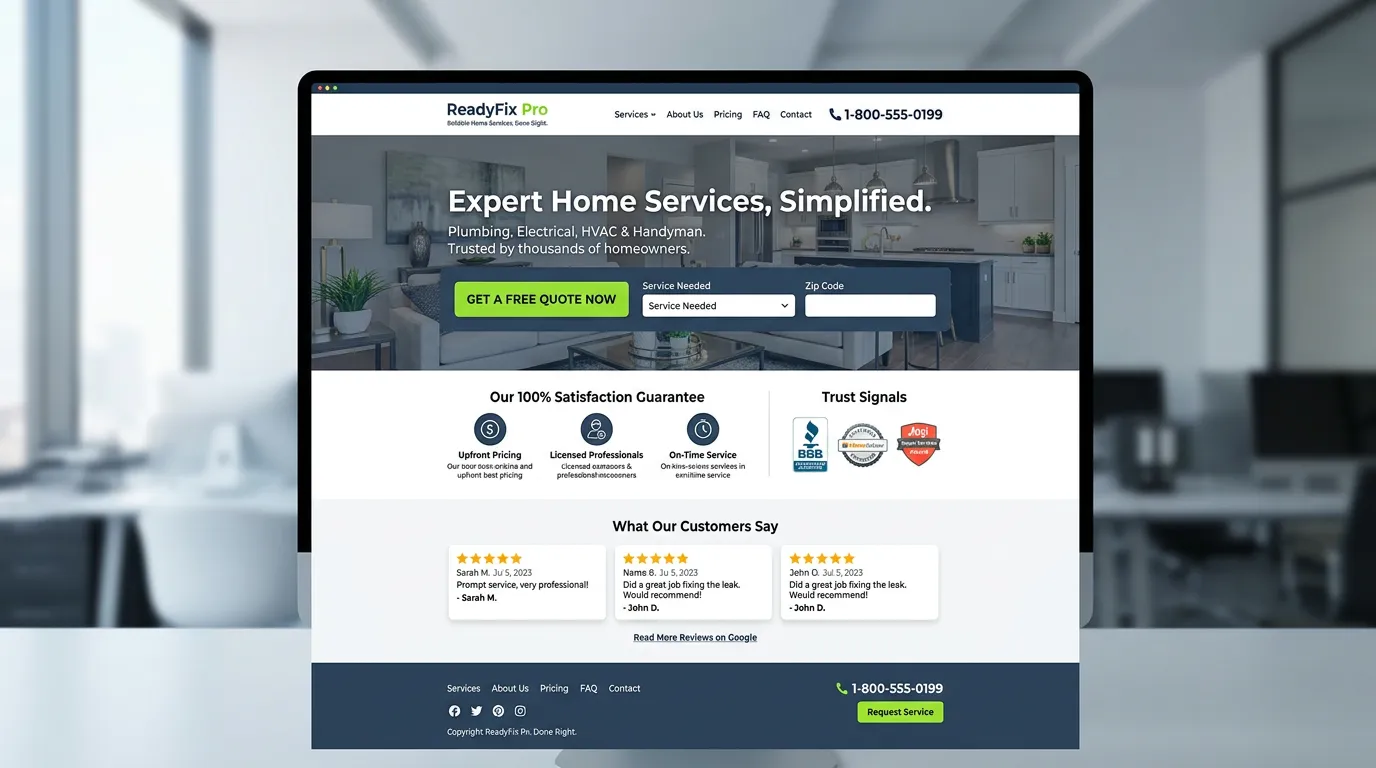
What is included
- Tracked click to call implementation across all templates
- Persistent mobile call element sized and positioned for one handed use
- Plain text service area listing with city names on relevant pages
- Price signaling appropriate to the trade, from diagnostic fee to ranges
- License, insurance, and credential display in checkable form
- Real job photos and nearby city reviews replacing stock imagery
- After hours experience with callback promise or text option
- Call answer rate and speed to lead review with your office team
- Emergency versus scheduled service routing on the site
Our process
Call data review
Week 1 to 3We start with call tracking data and recordings: how many calls come in, how many go unanswered, what time they arrive, and what customers ask first. This usually reshapes the whole plan within the first week.
Objection mapping
Week 3 to 4From the recordings we build the list of questions customers ask before agreeing to anything. Every one of those questions becomes something the page answers before the call so the call starts further along.
Call path and qualification build
Week 4 to 7Tracked call elements go on every template, the service area gets stated in text, and price signaling gets added in the form the business can defend. Emergency and scheduled paths get separated where the trade requires it.
Proof replacement
Week 6 to 9Stock photos get replaced with real job photos, generic claims get replaced with license numbers and years in business, and reviews get surfaced by city so a visitor in Ontario sees an Ontario review.
After hours and follow up
Week 8 to 12Evening and weekend visitors get a specific experience with a callback commitment or text option, and we review speed to lead with the office so the promise the site makes is actually kept.
Realistic timeline: Eight to twelve weeks for a full pass. Call volume changes usually appear within 30 days of the call path work, since that touches every page. Improvements from price signaling and proof take 60 to 90 days to read clearly because they affect call quality as much as call count.
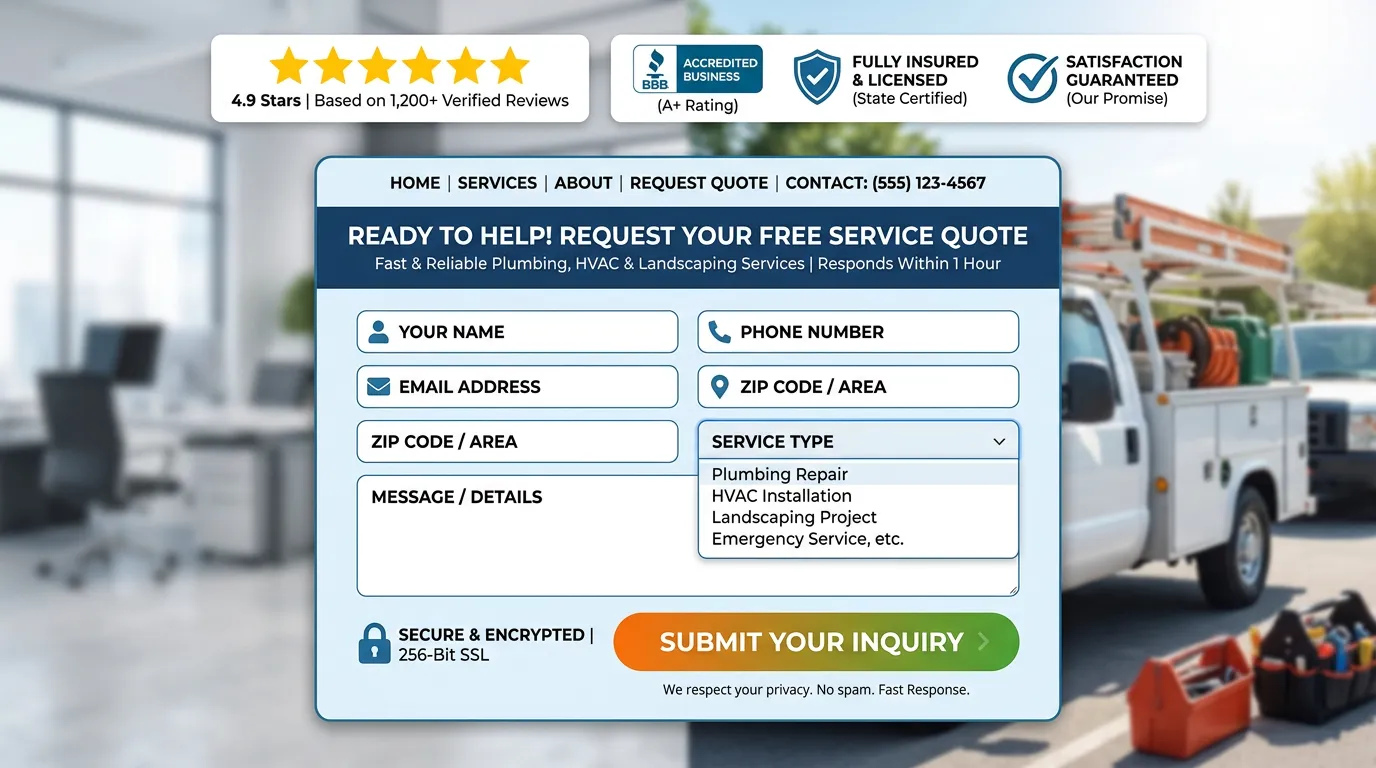
What Each Trade Has to Answer First
A homeowner with a burst pipe and a parent booking a cleaning act nothing alike. Answer the right question first.
| Business type | First question in their head | Action that usually wins | Price signal that works |
|---|---|---|---|
| HVAC | Can someone come today? | Tap to call, hours shown | Diagnostic fee, stated plainly |
| Plumbing | Do you handle emergencies? | Tap to call, 24 hour note | Flat rate for common jobs |
| Roofing | Repair or whole new roof? | Book a free inspection | Cost range per square |
| Dental office | Do you take my insurance? | Book a new patient visit | New patient exam price |
| Law firm | Do I even have a case? | Short case review form | Free consult or fee terms |
| In home care | How fast can care start? | Call, plus a family guide | Hourly rate range |
Start here, then check it against your own call recordings.
Busy Season Breaks What Slow Season Hides
Trade demand comes in spikes. A heat wave in August. The first hard rain. A cold snap in January. Traffic can double in two days and the phone stops keeping up.
That is when the page turns against you. It still promises same day service while the crew is booked three days out. Every caller starts annoyed, and your reviews pay for it later.
Write the busy season version of your top pages before the season starts. One honest banner about the current wait, one changed line under the form, and a note that real emergencies still get priority.
Peak is also when the form earns its keep. If callers cannot get through, the form is the only thing catching them.
The First Ten Minutes After a Form Arrives
How fast you answer moves form conversion more than form design does. This works for a two person office.
Give each step to a person by name. Speed promises with no owner get dropped in a week.
The After Hours Version of Your Site
A lot of home service traffic lands in the evening. Most sites treat 10pm exactly like 10am.
Do this
- State your real hours in plain text, including when you close today
- Offer a text option, since plenty of people will text at 10pm but not call
- Promise a callback time you can keep, such as before 8am
- List the after hours rate up front if you charge one
- Put the after hours message next to the phone number, not in the footer
Not this
- Do not leave Call Now as the only choice when nobody is there to answer
- Do not run a chat widget overnight with nobody staffing it
- Do not send evening ad clicks to a page that says Open Now
- Do not let voicemail be the plan, because most callers dial the next company
Chat, Text, and Map Listing Calls
Should I add a chat widget to a service site?
Is text messaging worth setting up?
Do calls from my Google listing count in this work?