
Generative Engine Optimization
Entity and Structured Data for Generative Search
Removes the ambiguity that makes AI systems skip your business
- Timeline
- Six to eight weeks for the initial build
Call (714) 823-3164 or ask a question. Clear recommendations, even if we never work together.
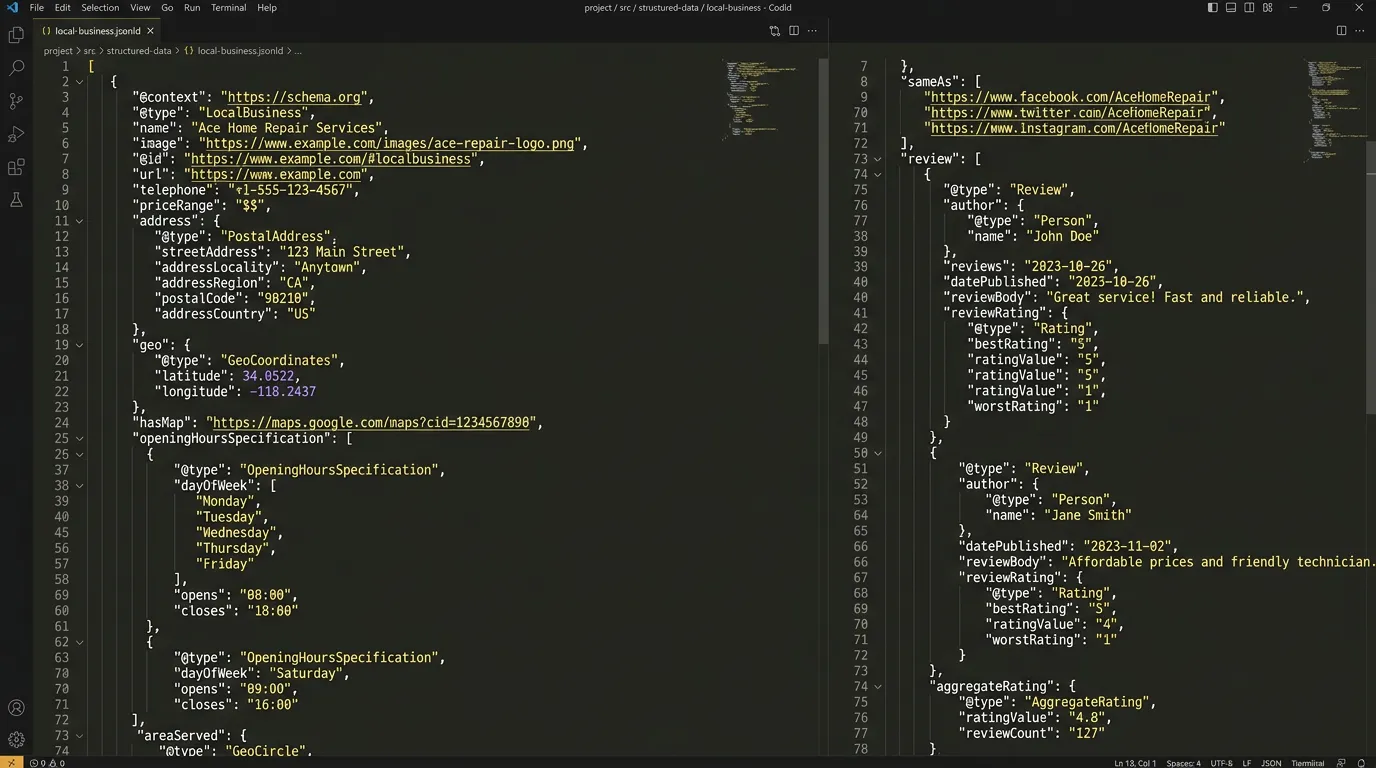
Entity and structured data work makes AI systems certain about what your business is, where it works, and what it does. It uses JSON-LD schema such as Organization, LocalBusiness, and Service. It keeps your name and address data the same everywhere. And it uses sameAs links to connect every profile back to one company.
The problem
A machine cannot infer what a website is about the way a person can. It needs to be told, and most service business sites tell it nothing. There is no Organization markup, so the site is a collection of pages rather than a company. The address in the footer says Suite 200 while the Google profile says Ste 200 and the Yelp listing says nothing at all, so a matching system sees three possible businesses. Two locations share the same phone number. The about page never states what the company does in a single plain sentence. Every one of those is a small doubt, and doubt is exactly what stops a model from naming you, because naming the wrong business is a worse failure for it than naming nobody.
What it is
This is the plumbing work, and it is not glamorous. We start with an entity audit. That means finding every place your business name, address, phone, hours, and service area appear. We check your site, your Google Business Profile, Apple Business Connect, Bing Places, Yelp, the Better Business Bureau, trade directories, and the data aggregators that feed the rest. Mismatches get corrected at the source. Then structured data goes in as JSON-LD rather than microdata inside the page. JSON-LD is easier to maintain and less likely to break when someone edits a page. A typical build puts Organization or LocalBusiness on the home and contact pages, and Service on each service page. BreadcrumbList goes sitewide. FAQPage goes where real questions exist, Person on named practitioners, and a sameAs array links your profiles together. Everything gets checked in the Schema Markup Validator and the Google Rich Results Test, then checked again in Search Console after it goes live. Where it applies, we also go after a Wikidata entry. Then we make sure your business reads as the same entity across the sources knowledge panels are built from.
Signs you need this
- Your address is written three different ways across your own website
- AI answers cite an old phone number or a location you closed
- You have no knowledge panel when someone searches your business name
- Search Console shows structured data errors nobody has ever looked at

What is included
- Entity audit of name, address, phone, hours, and service area across all sources
- Correction of mismatches at the source, including data aggregator submissions
- Organization and LocalBusiness JSON-LD with geo coordinates and hours
- Service schema on every service page, tied to the correct provider entity
- BreadcrumbList, FAQPage, and Person markup where the content supports it
- sameAs array connecting every social and directory profile to one entity
- About page rewrite that states plainly what the company is and does
- Validation reports from the Schema Markup Validator and Rich Results Test
- Search Console structured data monitoring with a fix list for errors
Our process
Inventory every mention of your business data
Week 1 to 2We pull your name, address, phone, hours, and service area from your site, your profiles, the major directories, and the aggregators. Everything goes into one sheet so the mismatches are visible instead of theoretical. Most businesses find at least four conflicting versions.
Pick the canonical version and correct sources
Week 2 to 5One format wins for every field, matching what is on the Google Business Profile and legal registration. Then corrections get submitted everywhere else, starting with the aggregators because they repopulate the smaller directories automatically.
Design and deploy the schema
Week 3 to 6We map which types belong on which templates, write the JSON-LD, and deploy it through the CMS or Google Tag Manager depending on your stack. Values reference real page content rather than being invented, since markup that contradicts the visible page is a violation and a risk.
Validate and connect profiles
Week 6Every template gets run through the Schema Markup Validator and Rich Results Test. The sameAs array gets populated with live profile URLs, and each profile gets a link back to the site so the connection is confirmed in both directions.
Monitor and maintain
Ongoing, monthlySearch Console structured data reports get checked monthly for errors introduced by theme updates or plugin changes, which is the most common way good markup quietly breaks. New service pages get markup as they publish.
Realistic timeline: Six to eight weeks for the initial build. Schema itself deploys in two to three weeks. The long pole is directory and aggregator corrections, which can take 30 to 90 days to propagate, and some listings require mail or phone verification you have to complete yourself.
Which markup belongs on which page
Schema is a map of your business, not a pile of tags. Each template gets the type that matches what the page actually is.
| Page | Main type | Properties worth getting right | Common mistake |
|---|---|---|---|
| Home | Organization or LocalBusiness | name, url, logo, telephone, sameAs | Two different company names on one site |
| Contact or location | A LocalBusiness subtype | address, geo, openingHoursSpecification, areaServed | Hours in markup that differ from the profile |
| Service page | Service | serviceType, provider, areaServed | Provider never tied back to the business entity |
| Team or bio page | Person | name, jobTitle, worksFor, credentials | A stock bio with no real credentials in it |
| Pages with real questions | FAQPage | Question and answer text that matches the page | Questions that appear nowhere on the page |
Markup has to match what a visitor can see. Anything else is a risk, not a shortcut.
The entity cleanup nobody enjoys
This is the part that decides whether a matching system sees one company or three. Work it in this order.
Pick one legal name and one trading name
Write both down, then use them the same way everywhere.
Pick one address format and freeze it
Suite or Ste, spelled out or not. Match the Google profile.
Give every location its own phone number
A shared number merges two locations into one.
Fix the data aggregators first
They refill the smaller directories on their own.
List every profile you have ever created
Old accounts you forgot still tell a different story.
Link in both directions
sameAs points out, each profile links back to the site.
Say what you do in one plain sentence
Put it in words near the top of the about page.
Recheck after every theme or plugin update
This is how good markup quietly disappears.
Why propagation takes longer than the build
Writing the schema is the fast part. Two or three weeks and it ships. The slow part is everything that lives outside your website.
Directory corrections move at their own speed. Some update in days. Others sit in a queue, and a few need a postcard or a phone call that only you can complete. Thirty to ninety days is normal for the full set to settle.
That is why the listing work starts in week two, before the markup is written. If the outside sources still show the old suite number in month three, clean markup on your site is just one more version of the truth.
A model does not skip your business because it dislikes you. It skips you because it is not certain you are one company.
Markup we usually leave out on purpose
Not every schema type earns its place on a service business site. Several add maintenance and change nothing, so we skip them.
Reviews you write about your own business are the clearest example. Google stopped showing self serving review markup in rich results, and marking up ratings a visitor cannot find on the page invites trouble rather than traffic.
Speakable, HowTo bolted onto a sales page, and deep product markup on a service site are the others. The types that earn their keep describe who you are, where you work, and what you sell. That is the whole job.