
Generative Engine Optimization
Content Optimization for AI Answers
Rewrites pages so a model can quote a clean answer without guessing
- Timeline
- Six to eight weeks for a first batch of eight to fifteen pages, depending on how much subject matter input we need from you
Call (714) 823-3164 or ask a question. Clear recommendations, even if we never work together.
Content optimization for AI answers means rewriting your pages so language models can find, understand, and quote them. Every section opens with a direct answer in the first two sentences. Headings get written as questions. Specifics like numbers and named tools go in. And each section stays short enough to lift cleanly.
The problem
Most service business content was written to fill space and hit a word count. It opens with a paragraph about how the company has been proudly serving the community since 1998, then wanders for six hundred words before saying anything a customer could act on. A language model reading that page finds no clean sentence to lift, so it quotes a competitor who wrote one. The same problem shows up in blog posts stuffed with phrases like it depends and every situation is different. That may be technically true, but a model cannot extract an answer from a hedge, and neither can a customer skimming on a phone.
What it is
This is line by line rewriting, done with extraction in mind. Every section starts with a sentence that answers the heading directly. It is stated as a fact, not a promise. Headings get written as the questions people actually ask, so your heading matches the question put to the model. Vague claims get replaced with things a model can quote and a reader can check: a real price range, a real timeframe, a named brand of equipment, a specific code requirement, a step count. Sections stay around 50 to 150 words. That way the chunk the model pulls holds the whole thought instead of half of it. Comparison content gets tables, because tables survive extraction better than paragraphs do. We also add an author with real credentials, an honest last updated date, and internal links between related answers. None of this makes the page worse for people. Pages rewritten this way usually read faster and convert at least as well, because customers skim the same way models chunk.
Signs you need this
- Your pages get traffic but never appear as a cited source in AI answers
- Your content opens with company history instead of the answer
- Competitors with worse websites keep getting quoted instead of you
- Your blog posts hedge constantly and never commit to a number

What is included
- Page priority list based on commercial value and current AI citation gaps
- Question mining from call recordings, Search Console, and People Also Ask
- Answer first rewrite of each priority page with heading restructure
- Definition block near the top of every service and topic page
- Comparison tables for repair versus replace and similar decisions
- Specific facts added: price ranges, timeframes, named tools, code references
- Author bio blocks with credentials, plus honest last updated dates
- Internal linking pass connecting each answer to its related pages
- Post publish re-test of the affected prompts to see what changed
Our process
Pick the pages worth rewriting
Week 1We combine the prompt gap list with page level revenue value. A page tied to a high margin service that loses every AI mention outranks a blog post that gets traffic but no calls. Usually eight to fifteen pages carry most of the opportunity.
Mine the real questions
Week 1 to 2For each page we collect the questions customers ask about that topic, from call recordings, email threads, People Also Ask, and forum posts. These become the headings. Guessed headings are the single most common reason a rewrite fails to get quoted.
Rewrite for extraction
Week 2 to 6Each section opens with the answer, then supports it. We cut hedging language, replace generalities with specifics, and hold sections to a length a retrieval system can use whole. Word count usually drops while usefulness goes up.
Add proof and attribution
Week 4 to 6Credentials, license numbers, years in the trade, and a named author give the content the experience signals these systems weigh. Dates get set to when the page was actually reviewed, not refreshed automatically, because false freshness gets caught.
Publish and re-test
Week 6, then monthlyRewritten pages get submitted for indexing, then the related prompts get re-run at 30, 60, and 90 days. Pages that still lose usually need outside corroboration rather than another rewrite, which changes what we do next.
Realistic timeline: Six to eight weeks for a first batch of eight to fifteen pages, depending on how much subject matter input we need from you. Re-testing runs for 90 days after publish. Pages that are entirely new take longer to get cited than rewrites of pages that already have crawl history and links.
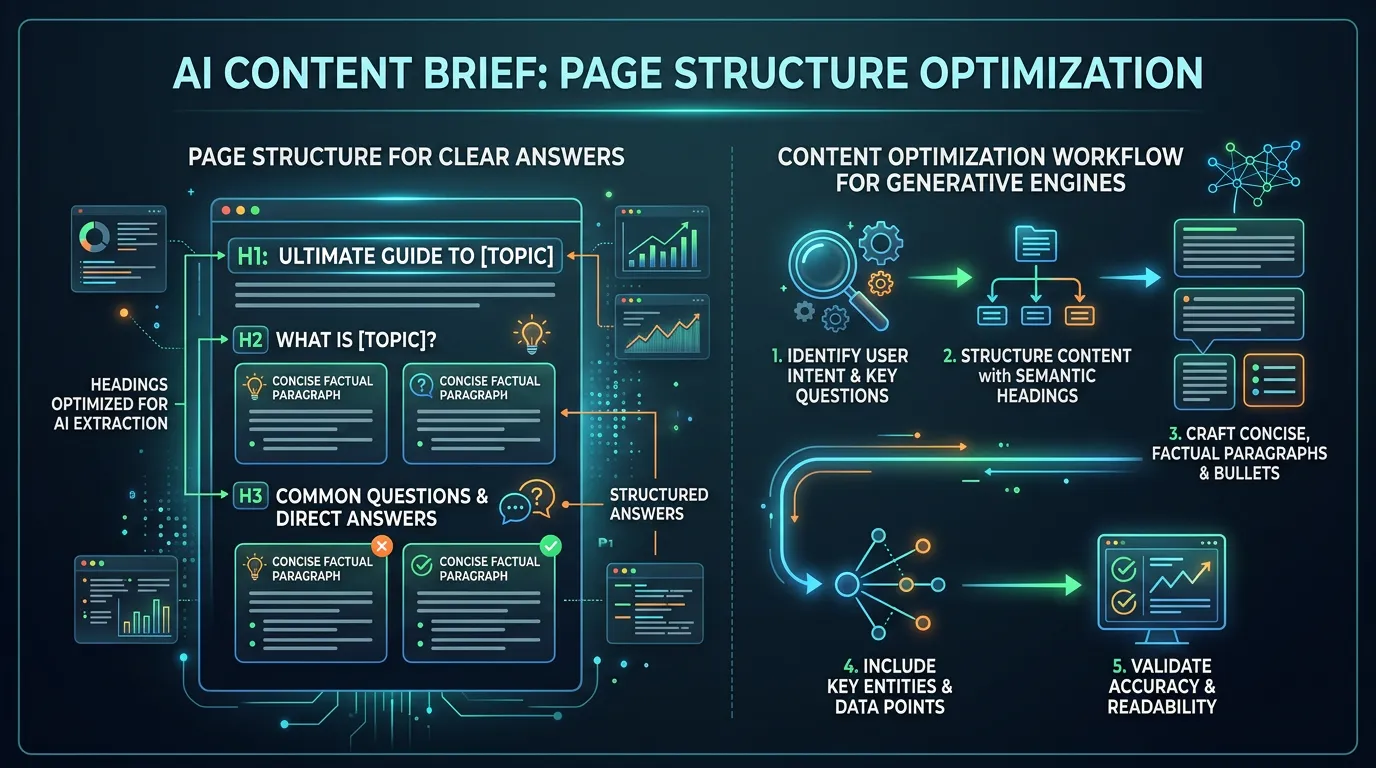
The same sentence, before and after
Rewriting for extraction happens at sentence level. Here is what changes and why it matters to a model reading your page.
| Weak version | Why a model skips it | Stronger version | What it gives the model |
|---|---|---|---|
| It depends on many factors. | Nothing to quote | A 200 amp panel upgrade is a one day job in most homes. | A size and a timeframe |
| Proudly serving the area since 1998. | History, not an answer | We repair rooftop package units across the Inland Empire. | A service plus a service area |
| We use only top quality parts. | Nothing a reader can check | We stock Bradford White and Rheem water heaters. | Names it can match elsewhere |
| Call us for a quote. | A dead end | Cost moves with panel location, permit fees, and meter work. | Named cost drivers |
These are example sentences, not quotes from a client. The pattern is what matters: swap a hedge for something a person can check.
Section level rules we write to
Extraction happens at the section level, not the page level. Most of a rewrite is spent making each section stand on its own.
Do this
- Answer the heading in the first sentence, then support it.
- Write headings as the question a customer would actually say.
- Keep sections between 50 and 150 words so one chunk holds one whole thought.
- Repeat the subject by name instead of writing it or they.
- Put comparisons in a table, since tables survive extraction better than prose.
Not this
- Do not open with company history. Nobody asked, and no model will quote it.
- Do not spread one answer across three sections and a sidebar.
- Do not hedge with every situation is different and then stop there.
- Do not stack five headings that all repeat the same keyword.
- Do not bury the answer under a video or an image gallery.
What a chunk is, and why it decides your writing
Retrieval systems do not read a page the way you do. They cut it into pieces, store each piece, and pull back the piece that best matches a question. That piece is called a chunk.
So the unit of work is the chunk, not the page. If your answer starts in one section and finishes two headings later, the model gets half of it. Half an answer loses to a competitor's whole one.
This is also why pronouns hurt. A chunk that opens with They usually handle this in a day has lost its subject. Write the noun again. It reads slightly repetitive to you and perfectly clear to a machine.
Two questions that come up on every rewrite
Should I put a summary box at the top of every page?
What if my field limits what I am allowed to claim?