Email and Marketing Automation
Email Marketing Strategy
Decides who gets what message before anyone writes an email
- Timeline
- Three to four weeks from kickoff to a delivered strategy
Call (714) 823-3164 or ask a question. Clear recommendations, even if we never work together.
An email marketing strategy is a written plan for who is on your list, how they are grouped, what each group gets, and how often. It sets the send calendar and gives every campaign a stated purpose. It also names the numbers you will use to judge whether email brings in revenue.
The problem
Email programs usually fail from lack of planning rather than lack of effort. Somebody sends a newsletter in March because the season felt right, gets a mediocre response, and never sends another one. Or every contact in the database receives the identical message, so a customer who bought last week gets the same offer as a lead from 2019, and both find it irrelevant. Without a plan, the person responsible defaults to whatever they thought of that morning, and the whole channel gets written off as not working for this industry.
What it is
Email marketing strategy work starts with the list you actually have. We pull the contacts out of your job software, your website forms, and whatever spreadsheets are floating around. Then we sort them by service purchased, last job date, city, and lifetime value. Those groups decide the plan. A past HVAC customer three years out needs a different message than a lead who asked for an estimate last Tuesday. From there we map the moments worth emailing about. For most service businesses that means seasonal service windows, maintenance intervals, follow up on open estimates, and requests sent after a job. The result is a twelve month calendar with a purpose written next to every send. It comes with a set of numbers to judge it by, tied to booked jobs rather than opens.
Signs you need this
- You have thousands of customer emails and have never sent a campaign
- Everyone on your list gets the same email regardless of history
- Your last email went out more than six months ago
- You cannot say which segment of your list is worth the most
- Email gets discussed every quarter and never actually starts
What is included
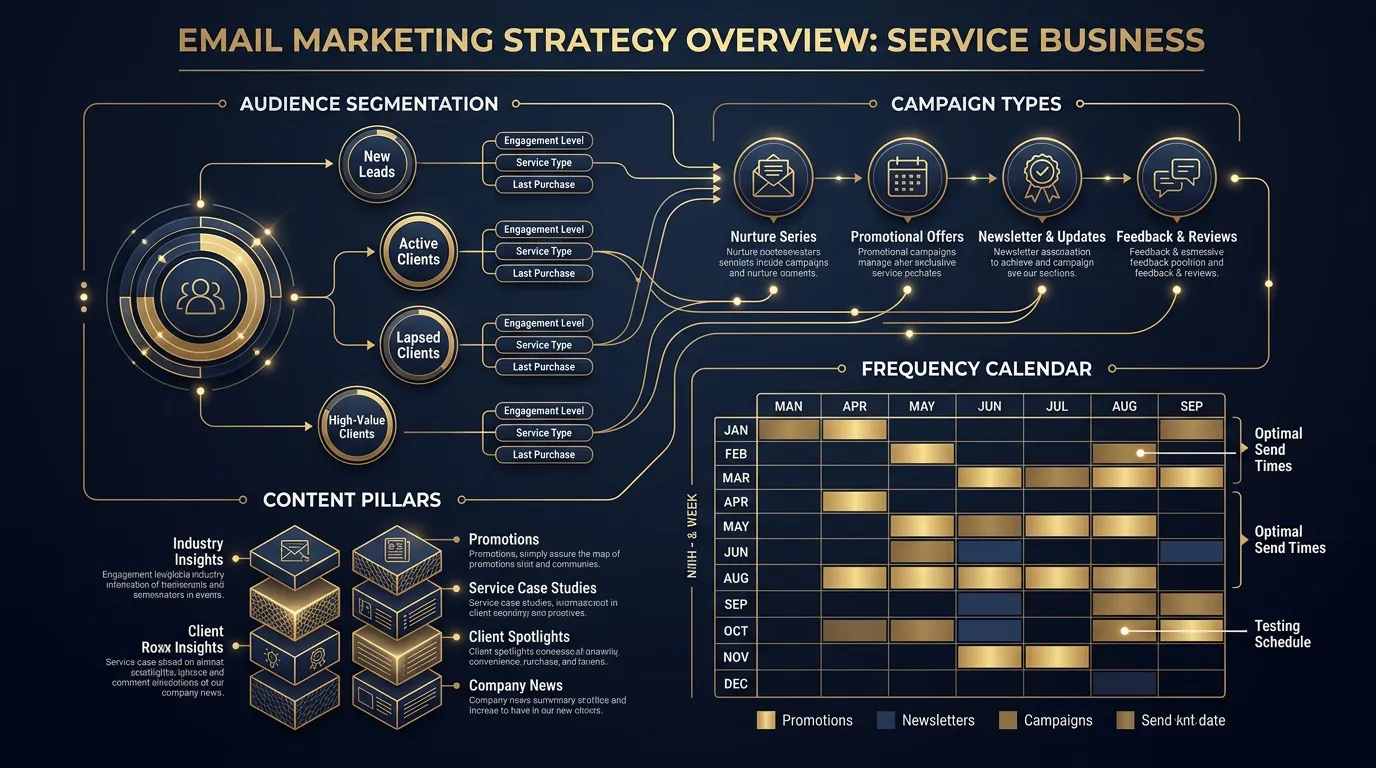
- Contact inventory across job software, forms, and spreadsheets
- Segment definitions by service, recency, city, and customer value
- Twelve month send calendar with a stated purpose per campaign
- Message map matching each segment to the offers that fit it
- Send frequency plan set to what your team can sustain
- Compliance review covering consent source and unsubscribe handling
- Success metrics defined in booked jobs and revenue per send
- Platform recommendation with integration requirements listed
Our process
List discovery
Week 1We find every place customer contact data lives, which is usually more places than expected. Job software, website form notifications, an old Mailchimp account, and a spreadsheet on someone's desktop is a typical starting inventory.
Segmentation design
Week 1 to 2Contacts get grouped by the things that change the message: what they bought, how long ago, where they live, and how much they spent. We keep the number of segments small enough that content stays maintainable.
Calendar and message mapping
Week 2 to 3We plot the year around your real seasonality and service intervals, then write a one line purpose for every send so nothing goes out because the calendar said so. Slow months get more attention than busy ones.
Measurement definition
Week 3We define what success means in numbers you care about: jobs booked from email, revenue per thousand sent, and reactivation rate. Opens get tracked but never used as the headline number.
Walkthrough and handoff
Week 3 to 4The plan gets presented on a call, adjusted against your team's real capacity, and handed over with the segment definitions and calendar in a format your platform can implement.
Realistic timeline: Three to four weeks from kickoff to a delivered strategy. The calendar covers twelve months with detail on the first quarter and outlines for the rest, since seasonality and results will change the later months anyway.
What Each Segment Should Actually Receive
A plan is real only when you can say what lands in each group's inbox and how often. Here is a starting map.
| Segment | Who is in it | What they get | How often |
|---|---|---|---|
| Recent customers | Paid you in the last six months | Thank you, care tips, referral ask | Once a quarter |
| Due for service | Past the normal interval | Reminder naming their last job | On their own date |
| Open estimates | Quoted, no answer yet | Short check ins about questions | Day 3, 7, and 14 |
| Lapsed customers | No job in two years or more | We are still here, plus one offer | Twice a year |
| Leads, not quoted | Filled a form, never booked | Proof, price range, easy booking | Weekly for a month |
| Whole list | Everyone with permission | Seasonal timing and useful advice | One or two a month |
Six rows is a full plan for most local companies. Add a seventh only when you know who will write for it.
Plan for the Hours You Actually Have
Most email plans die from capacity, not from bad ideas. A calendar with forty sends a year needs someone writing nearly every week. In a shop with three office staff, that person does not exist.
So count the hours first. A short seasonal email takes about an hour to write, build, and check on a phone. Twelve of those is a day and a half across a year. Fifty is a part time job.
Batch the writing instead. Draft a full quarter in one sitting, because you are already in the subject and the email marketing strategy work goes faster. Nothing then depends on a busy week going smoothly.
Protect the automations above all. Those run without you. If the year gets away from the team, triggered reminders still bring in jobs while the broadcast calendar slips.
What a Finished Email Strategy Should Contain
If your plan is missing any of these, it is a wish list. Check it against this before anyone starts writing.
A named owner for every send
A calendar row with no name next to it does not happen.
Segment rules written as filters
Last job before a date, service type equals X. Not a vague description.
One line of purpose per campaign
If you cannot say what it should produce, cut it from the calendar.
The consent source for each group
Where the address came from, and the date if you still have it.
A frequency cap across all sends
Nobody gets more than two emails in seven days, automations included.
A written suppression list
Staff, vendors, competitors, and anyone who asked you to stop.
A stop rule for weak campaigns
Three sends with no booked work means rewrite it or drop it.
Targets stated in jobs and dollars
Revenue per thousand sent tells you more than any open rate.
Strategy Questions That Come Up Late
Who should own the email calendar in a small company?
Should each service line get its own plan?
What do we do with a list we inherited from an old vendor?