
How To Articles
What Is a Digital Marketing Strategy? A Plain Answer
A plain answer: what a marketing strategy is, the five decisions it makes, and how to tell a real one from a list of tactics.
Call (714) 823-3164 or ask a question. Clear recommendations, even if we never work together.
A digital marketing strategy is a written decision about how a business will get customers. It names who you serve, what you sell them first, which channels you will use, what each one costs, and how you will count results. It also names what you will stop doing. A plan is the calendar that follows it.
Jump to a section
- Marketing strategy, Plan, and Tactic Are Not the Same Word
- The Five Decisions a Strategy Makes
- Why the Stop Doing List Is Half the Job
- The Six Numbers a Strategy Is Built On
- What Using a Strategy Looks Like in a Normal Week
- How to Tell a Real Strategy From a List of Tactics
- Four Words People Use as One
- What Changes Once the Decisions Are Written Down
- What a Strategy Cannot Do
- Write Your Own One Page Strategy in About 90 Minutes
- Questions

Marketing strategy, Plan, and Tactic Are Not the Same Word
Most of what gets called strategy is really a list of tasks. The three words sit at different heights, and mixing them up is why so many marketing meetings go in circles. Marketing strategy is the decision layer. It answers which work you are trying to win, from whom, and with what money. A plan is the calendar layer. It takes those decisions and gives them dates, owners, and a budget line. Tactics are the work itself: the ad, the page, the post, the call script. Here is the same idea inside a plumbing company. The marketing strategy says we make our money on repipes and water heater swaps, we serve homes over thirty years old within twenty minutes of the shop, and we win on same day answers rather than on price. The plan says the repipe page gets written in March, the person who takes calls gets a script in April, and ad money shifts to weekends in May. The tactic is the actual page and the actual ad. Watch what happens when the strategy is missing. Somebody still writes pages and still buys ads, because tactics feel like progress. Nobody can say why those ones. When results go flat, the only move left is to try a different tactic, and the year fills up with tries. A strategy is worth having because it makes some work obviously wrong. That sounds negative. It is the most useful thing a strategy does.
- Marketing strategy: who we serve, what we sell them, how we win
- Plan: dates, owners, and money
- Tactic: the page, the ad, the call script
The Five Decisions a Strategy Makes
Strip away the slides and a marketing strategy answers five questions. First, who is the customer worth having. Not everyone who could buy, but the ones with the jobs you want more of. A dental office might decide that means families within four miles, not single visit whitening customers from across the county. Second, what do you sell them first. Most service businesses have one job that opens the door and leads to more work later. Picking it changes every ad you write. Third, where will you meet them. That is the channel question, and the answer depends on how people buy your kind of work. Emergency work gets found on a phone in the first two minutes. A kitchen remodel gets researched for three weeks. Fourth, what will you say that your competitors are not saying. If your promise is quality work at a fair price, you have no promise, because the shop down the street says the same thing. Real answers sound specific. We answer on Sundays. We give a fixed price before we start. We show up in a marked truck with the tech's photo texted ahead. Fifth, how will you know it is working. That means picking two or three numbers you will look at every month, and saying where they come from. If those five have answers that everyone in your company would repeat the same way, you have a marketing strategy. If two of them are blank, what you have is a budget and a habit.
- Who is worth serving, stated narrowly enough to leave people out
- Which job you sell first
- Which channels you will use, and why those
- The promise your competitors are not making
- The two or three numbers you will judge it by
Why the Stop Doing List Is Half the Job
Ask an owner what their marketing strategy is and you get a list of things they are adding. Ask what they are stopping and the room goes quiet. That silence is why most plans stall. Money and attention are both fixed. Every new channel takes a share of both from something already running. If nothing gets stopped, the new work gets funded by quietly starving the old work, and then neither gets what it needs. Picture a hypothetical landscaping company with two thousand dollars a month to spend. They boost posts, pay for a directory listing, run a small ad campaign, and pay a vendor for monthly search work. Each piece gets about five hundred dollars. In most markets five hundred dollars of ads buys a few dozen clicks, which is not enough to tell you anything. The directory sends two calls a year. The result is four things that cannot be judged and cannot be grown. Put that same money behind one or two channels and you get a real answer within a quarter. The stop list is also where the honesty lives. It usually includes something the owner likes, a vendor somebody is friendly with, or a channel that was a family member's idea. Writing down what you are dropping, with the reason next to it, is what turns a wish list into a decision.
The Six Numbers a Strategy Is Built On
A strategy built on opinion is just a nicer argument. Six numbers turn it into arithmetic, and you can gather all six in an afternoon. Average job value: total revenue for the last ninety days divided by the number of jobs. Take it from invoices, not from memory, because memory rounds up. Close rate: of the people who asked for a quote last month, how many booked. Count them by hand if you have to. Capacity: how many more jobs a week your crews, chairs, or providers can take before something slips. Lead sources: go through the last hundred customers and mark where each one came from. Guesses are allowed as long as you label them as guesses. Repeat and referral share: what part of last year's revenue came from people you had already served. That number decides how much of your budget belongs to keeping customers rather than finding new ones. Seasonality: pull twenty four months of revenue by month and look at the shape of it. Once you have those six, a lot of arguments end on their own. If a job is worth four hundred dollars and you close one quote in three, you can pay about forty dollars for a lead and still make sense of it. If a job is worth eight thousand dollars, a hundred dollar lead is cheap. The same channel is a bargain for one business and a waste for the other, and only your own numbers can say which.
- Average job value, from ninety days of invoices
- Close rate, counted from quotes given
- Spare capacity per week, honestly stated
- Where the last hundred customers came from
- Share of revenue from repeat and referral
- Twenty four months of revenue by month
What Using a Strategy Looks Like in a Normal Week
A strategy that lives in a folder does nothing at all. Here is what it looks like when it is really running. Once a week, somebody spends twenty minutes on three things: how many real leads came in, where they came from, and what got finished from the plan. No report, no meeting, one page. Once a month, the owner and whoever runs marketing look at the two or three numbers the strategy named. They compare each one with the range the plan expected. If a number sits outside that range, they say so out loud and write down what they think caused it. Once a quarter, the plan gets edited. One thing stops, one thing gets funded harder, and the next three months get written in more detail. Twice a year the strategy itself gets questioned. Has the customer changed, has a competitor moved in with real money, has a service line grown into something else. The rhythm matters more than the paperwork. The most common failure is not a wrong decision. It is that nobody opens the document again until renewal season, so a bad assumption gets paid for eleven months in a row. A plain strategy with twenty minutes a week behind it beats a brilliant one nobody reads.
How to Tell a Real Strategy From a List of Tactics
You can test any document, including one you paid for, in about ten minutes. Look for a named customer. If it could describe any company in your trade, it was not written about you. Look for numbers that came out of your own books. Industry averages are a warning sign, because your close rate and your job value are what decide whether a channel makes sense. Look for a stop list. Look for a person's name next to each item, since departments do not do work, people do. Look for a way to be wrong. A real strategy says what result would prove it is off, and by when. Anything that cannot fail is not a strategy, it is a sales document. Then run one more check that costs nothing. Hand the plan to whoever answers your phone and ask what is wrong with it. That person knows why leads do not turn into jobs, and almost nobody asks them. If the document cannot survive that conversation, it will not survive the year. A good plan gets edited in the first month, not defended.
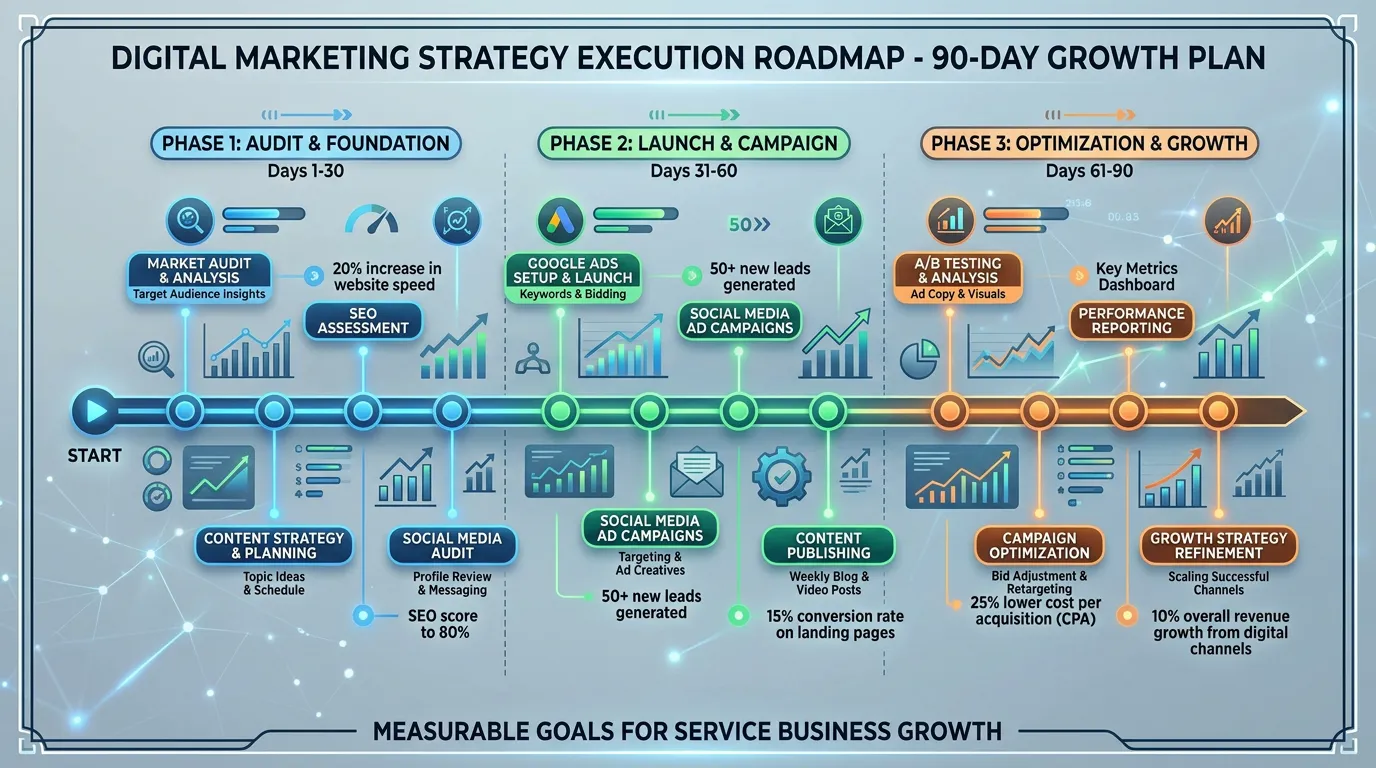
Four Words People Use as One
These get traded around as if they mean the same thing. They sit at different heights, and each answers a different question.
Work moves down the list. Evidence moves back up it.
What Changes Once the Decisions Are Written Down
Same business, same budget, same trade. The only difference is whether the decisions exist in writing.
| The moment | No written strategy | With one |
|---|---|---|
| A vendor calls with an offer | Sounds good, let us try it | Does it fit the channel plan |
| Revenue dips in month three | Add another channel | Check the number the plan named |
| Nobody owns the website work | Whoever has time this week | A person, with a date |
| What do we stop doing | Nothing, it all stays | The item that missed its mark |
| A new hire starts Monday | Six weeks of guessing | One document, one afternoon |
| Two vendors disagree | The louder one wins | Both work from the same page |
None of this needs software. It needs the decisions to exist somewhere other than your head.
What a Strategy Cannot Do
A strategy does not create demand that is not there. If almost nobody in your area is looking for what you sell, no channel plan invents those people. A good strategy finds that out in the second week and points you toward the services or the towns where the demand does exist.
It does not fix a capacity problem either. If your crews are booked five weeks out, more leads mean longer waits, and waiting customers call the next company on the list. Pricing, hiring, or scheduling comes first, and an honest plan will say so out loud.
It also does not replace doing the work well. A smart channel choice still loses to a competitor whose ads are better written and whose phone gets answered on the first ring. Strategy picks the fight. It does not throw the punches.
Write Your Own One Page Strategy in About 90 Minutes
You do not need to hire anyone to get a first version down. Answer these eight in writing, one line each, and you will be ahead of most companies in your trade.
Name the customer you want more of
Narrow enough to leave people out.
Pick the job you sell first
The one that opens the door.
Write your average job value
Ninety days of invoices, divided.
Write your close rate
Quotes given against jobs booked.
Choose two channels, not five
Fund each enough to judge it.
Write the promise you can prove
Something a rival will not copy.
Name the two numbers you watch
And where you will read them.
List what you are stopping
A plan with no cuts is a wish.
Would rather we handled it?
This article covers how to do the work yourself. If you would rather have it done for you, that is what our digital marketing strategy service is.
Digital Marketing Strategy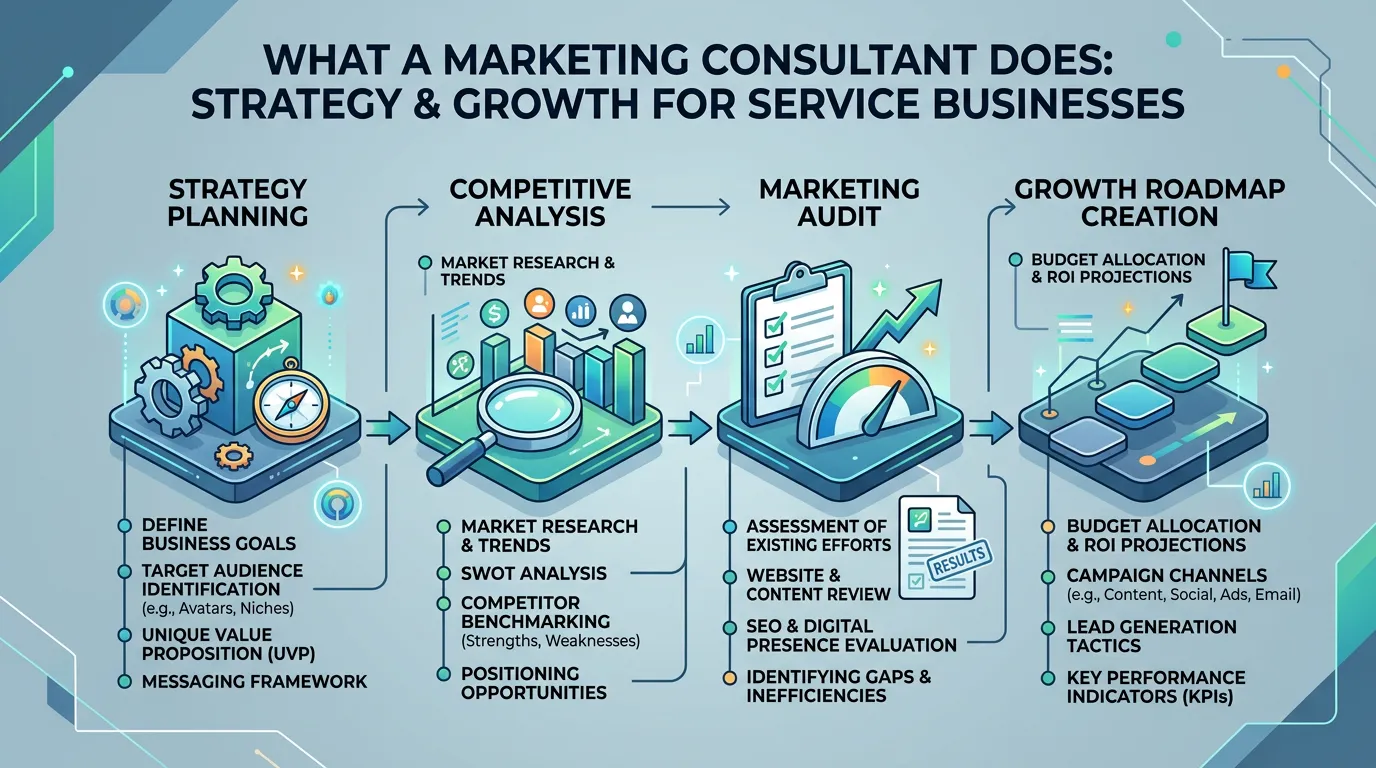
Frequently asked questions
Is a marketing strategy the same as a marketing plan?
How long should a digital marketing strategy be?
How often should it be rewritten?
Can a small business write its own strategy?
How long before a strategy shows up in revenue?
Sources
- Google Search Central: Do you need an SEO?(opens in a new tab) Google's own note that search changes can take four months to a year to show, which is why a strategy should carry timeframes and ranges instead of promises.
- Google Search Central: SEO Starter Guide(opens in a new tab) Google's plain description of the basics a site needs, which is the work most first quarter plans put ahead of anything clever.