
FAQ and Problem Solution Articles
Why Your Digital Marketing Is Not Working, and How to Find Out
How to find which layer is broken when you are paying for several channels and almost nothing turns into booked work.
Call (714) 823-3164 or ask a question. Clear recommendations, even if we never work together.
Usually nothing is broken in the way you think. The money is spread across four or five channels, none funded enough to work, and nobody records where leads come from, so nothing can be cut. Start by finding out whether the problem is demand, visibility, capture, or follow up. Then fix one layer at a time.
Jump to a section
- Before You Change Anything, Split the Problem in Four
- The Usual Cause: Four Channels, Each Half Funded
- You Cannot Cut What You Never Traced
- Judging a Channel Before It Has Had Time
- Counting Things That Do Not Pay
- When the Problem Is Not Marketing at All
- The Order to Fix It In
- Four Layers, and Where Yours Breaks
- Symptom, Likely Cause, First Move
- Fixing This Without Making It Worse
- Questions That Come Up During the Fix
- Questions
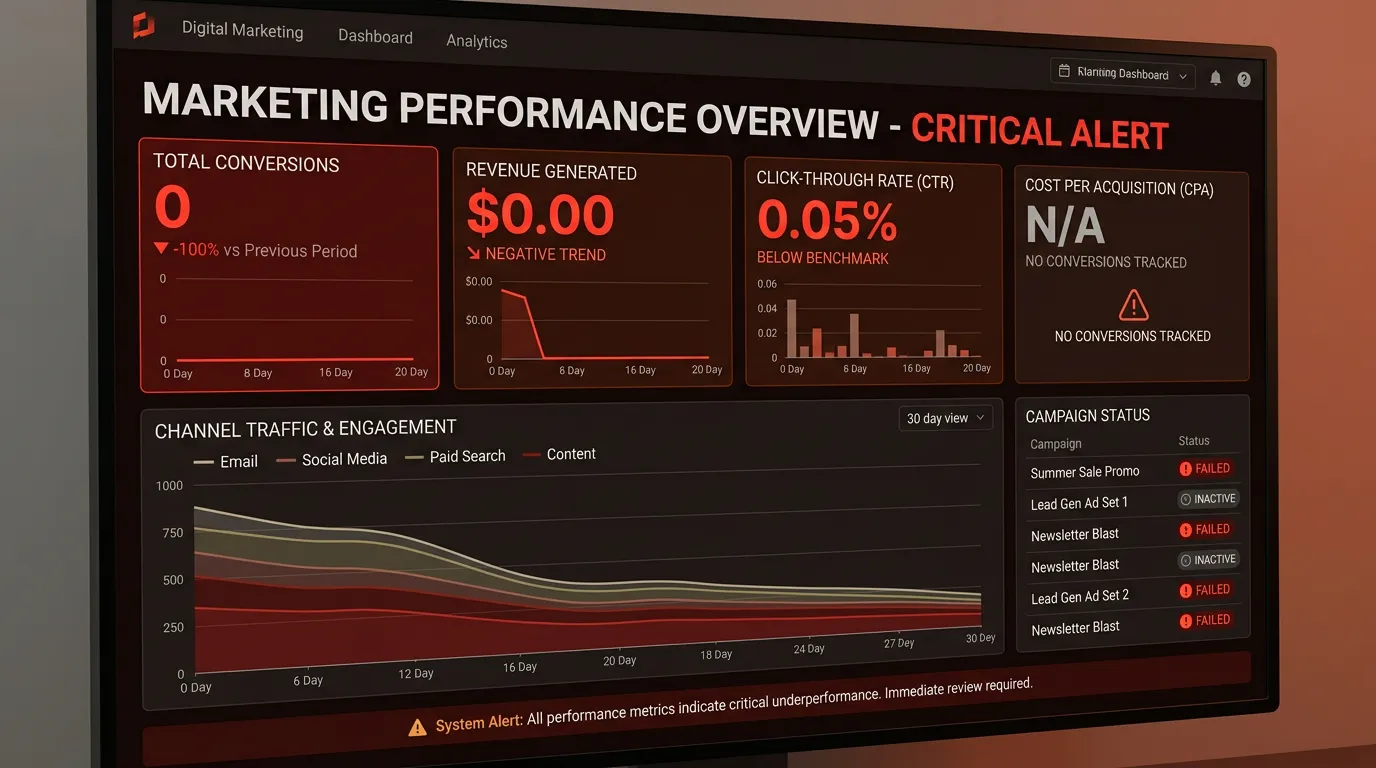
Before You Change Anything, Split the Problem in Four
When the phone goes quiet, most owners start swapping tactics. New ads, a new vendor, a new logo. That is guessing with a credit card. Work out which of four layers is broken first, because each one has a different fix. Demand is the top layer. Are people near you looking for what you sell right now. Ask your last twenty customers how they started looking, and check whether searches for your main service hold up through the year. Visibility is second. When those people look, do they find you. Search your main service plus your city on a phone that is not signed into your account, and see where you appear in the map results and in the regular ones. Capture is third. Of the people who reach your site or your profile, how many actually make contact. Steady traffic with almost no calls is a capture problem, not a traffic problem. Follow up is fourth. Of the people who did make contact, how many did you reach, and how fast. Test that one yourself. Fill in your own form on a Saturday morning and time how long the callback takes. Four layers, four different repairs. Spending more on ads only helps if the break is in the top two.
The Usual Cause: Four Channels, Each Half Funded
Here is the most common version of this problem, and it looks like bad luck rather than a decision. A business ends up with four or five channels running at once. Each got added for a good reason at the time. Each gets a quarter of the money it would need to produce a steady flow of work. The arithmetic is unkind. If a click in your trade costs eight dollars and you put four hundred dollars a month into ads, that is fifty clicks. If five in a hundred visitors get in touch, you can expect two or three leads a month from that channel. Two or three leads is not a result, it is noise. One good month and one dead month look exactly the same, so you can never tell whether the channel works. Now multiply that across four channels and you have a digital marketing budget that produces a shrug. The fix is not more money. It is fewer channels with the same money. Pick the one that best matches how your customers buy, put the full amount behind it, and give it enough weeks to produce dozens of leads rather than a handful. A channel you can actually judge is worth more than four you cannot.
You Cannot Cut What You Never Traced
The second reason nothing improves is that nobody can say where the digital marketing work came from, so nothing ever gets stopped. This is fixable this week and it costs nothing. Whoever answers the phone asks one question at the end of every call: how did you hear about us. The answer goes in one column of a spreadsheet or one field in your job software, next to the date and whether it turned into work. Google is not an answer, so ask a second question when you get it. Did you see us on the map, on an ad, or did somebody send you. Thirty days of that beats any report. It also settles arguments that dashboards cannot. Two things to expect. First, your own count will never match what the ad platform claims, because platforms count differently and people cross between devices. Use your own numbers to decide and the platform numbers to steer. Second, some of what you were about to cut turns out to be feeding the thing you were about to expand. Referrals often start with somebody seeing you somewhere else first. That is why you write it down for a month before you cut anything.
Judging a Channel Before It Has Had Time
The third cause is impatience, and it is expensive because it makes you pay the setup cost of a channel over and over without ever reaching the part that pays. Different channels run on different clocks. Paid search can bring calls in the first week, but the first month is mostly the account learning which searches are worth showing on, so cost per lead in week one tells you very little. Give it six to eight weeks before you judge the cost of a booked job. A Google Business Profile can move within days when you fix hours, categories, and photos, though building a steady flow of reviews takes months. Search visibility on your own site is the slowest of the group. Google's own guidance says changes can take four months to a year to show. Write the expected window next to each channel before you start. Then the decision to keep or kill is made against a date you set in advance, not against the mood of a slow Tuesday.
- Paid search: six to eight weeks before judging cost per booked job
- Google Business Profile: days to weeks for fixes, months for review flow
- Search visibility on your site: four months to a year
- Email to a list you own: same week
- Social: months, and it usually assists rather than books
Counting Things That Do Not Pay
The fourth cause is measuring work instead of results. Reports fill up with impressions, clicks, followers, and keyword positions. Every one of those can go up in a month where you booked less work. It happens all the time, and there is no dishonesty in it. Those numbers are inputs. They only matter if they end in a job. Replace the pile with a scoreboard that fits on one page and takes ten minutes a month to fill in. Five lines is enough: leads by source, jobs booked, revenue booked, digital marketing spend, and cost per booked job. That last one is the number that ends most arguments, because it converts every channel into the same units. A channel that sends forty cheap leads and books two jobs is worse than one that sends eight leads and books five. Only the last line shows that. Keep the scoreboard where the people doing the digital marketing work can see it. When the same five numbers get read out loud every month, the conversation moves from who is trying hardest to what is actually producing, and the decisions get much easier.
When the Problem Is Not Marketing at All
Sometimes the honest answer is that the digital marketing is fine. Check the three places where good leads die before you spend another dollar. Capacity is the first. If your soonest opening is five weeks out, people are calling the next company on the list, and every new lead just adds to a queue you cannot serve. Price is the second. If your quotes are well above your market and nothing about your offer explains why, more leads simply produce more polite no thank yous. That is a positioning problem, not an advertising one. The third is the phone. A missed call in this trade is usually a lost job, because most people move on to the next name rather than leave a message. Pull last month's call log and count how many rang out. Then look at Saturday. Take a hypothetical roofing company that cannot start work for eight weeks and misses one in four calls. No channel change fixes that, and any vendor who takes the money without saying so is not doing you a favor. Fix the constraint first, then turn the digital marketing back up.
The Order to Fix It In
Do these in order, and only one at a time, so you can tell what caused what. In the first week, start recording lead source at intake, name one person who owns callbacks during business hours, and test your own form and phone number from a phone. Those three cost nothing and they protect every dollar you spend afterward. In weeks two to four, cut or pause your weakest channel and move that money to your strongest. Write down what you expect to happen and by when. Between day thirty and day sixty, build the one page scoreboard and fill it in for the first time. You will probably find your cost per booked job is nothing like what you assumed. Between day sixty and day ninety, make the keep or kill decision on the channel you funded, using the date and the number you set in advance. Then write the next quarter with what you learned. This sequence is deliberately slow. The instinct in a bad month is to change five things at once, and that guarantees you will finish the quarter knowing exactly as much as you know today.
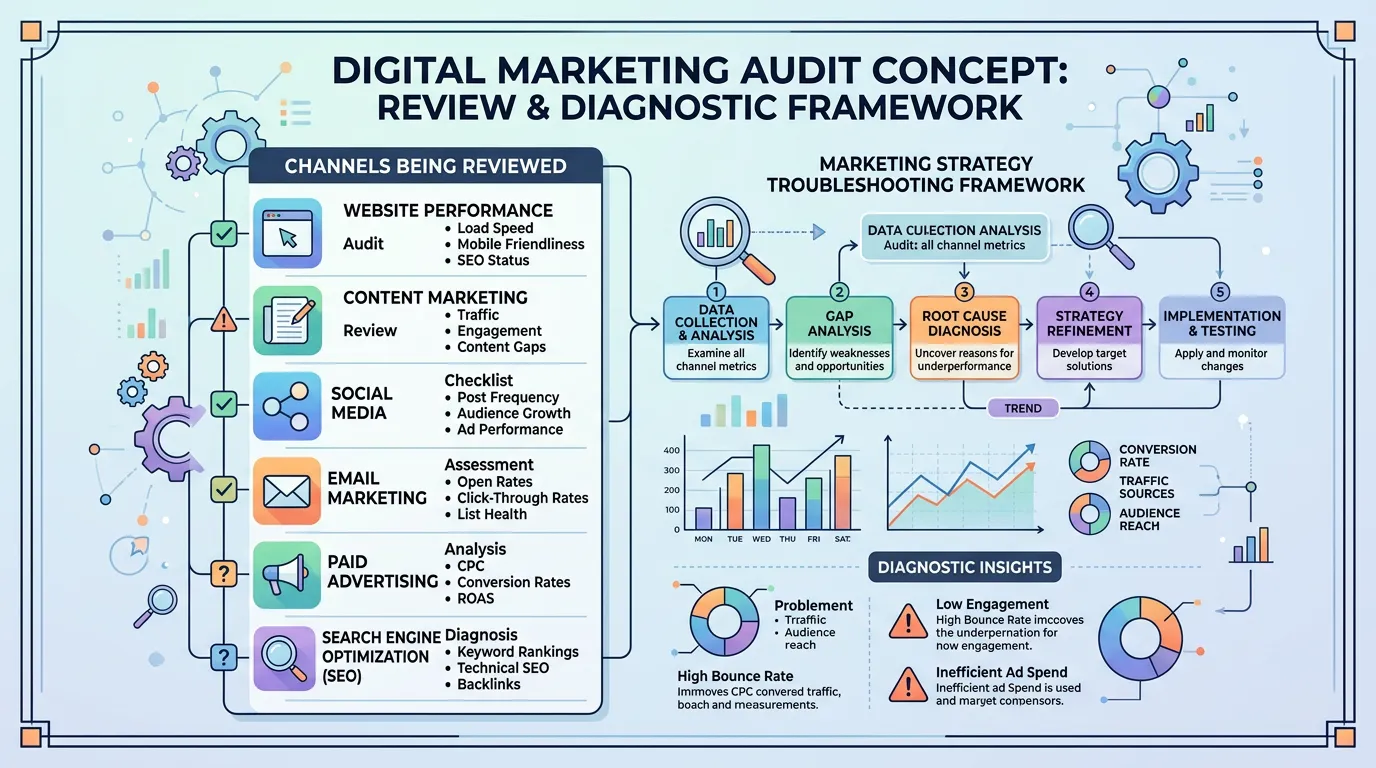
Four Layers, and Where Yours Breaks
Work down this list in order. The layer where the number falls off a cliff is the one to fix first, and the ones below it can wait.
Buying more traffic only helps if the break is in the top two layers.
Symptom, Likely Cause, First Move
Find what you are seeing on the left. The first move is the cheapest useful step, not the whole repair.
| What you see | Likely cause | First move |
|---|---|---|
| Traffic is steady, calls are not | Capture | Put a tappable number in the header |
| Ads spend, very few clicks | Budget below the going rate | Fund one campaign properly, pause another |
| Leads arrive, few book | Follow up speed | Name one person who owns callbacks |
| You cannot say what works | No source recorded at intake | Ask every caller, write it down |
| Rankings up, phone quiet | Ranking for the wrong searches | Check which pages the calls come from |
| Great months and dead months | Seasonality, not failure | Compare with the same month last year |
Change one thing at a time or you will not know which change did the digital marketing work.
Fixing This Without Making It Worse
The reaction to a slow month is usually what causes the next slow month. These habits keep the diagnosis clean while you work.
Do this
- Change one thing at a time, inside a window you set first
- Write down what you expect before you make the change
- Record the lead source at intake, every single time
- Judge a channel on booked jobs, not on clicks or views
- Compare this month with the same month last year
Not this
- Do not fire a channel in its first month
- Do not add a fifth channel to rescue four weak ones
- Do not rebuild the website before you know it is the problem
- Do not accept a report you cannot trace to a booked job
- Do not cut spending and expect last month's lead count
Questions That Come Up During the Fix
How long should I give this before I decide it failed?
Should I fire my agency over this?
Everything looks broken. Where do I actually start?
Would rather we handled it?
This article covers how to do the work yourself. If you would rather have it done for you, that is what our digital marketing strategy service is.
Digital Marketing Strategy
Frequently asked questions
How do I know if it is my website or my ads?
My competitor spends less and gets more work. Why?
Nothing changed on my end, so why did leads drop?
Should I pause everything and start over?
Can I fix this without hiring anyone?
Sources
- Google Search Central: Do you need an SEO?(opens in a new tab) Google's own statement that search changes can take four months to a year to show, which is the basis for the waiting windows in this article.
- Google Business Profile Help: Add your business to Google(opens in a new tab) The free visibility check in the second layer: confirming the business is claimed, complete, and correct on Google before any money gets spent on traffic.