
Foundational Guides
Marketing agency, Freelancer, or In House: How to Choose
What you are really buying from an marketing agency, a freelancer, and an employee, what each one truly costs, and where each one predictably breaks.
Call (714) 823-3164 or ask a question. Clear recommendations, even if we never work together.
Hire a freelancer when you know exactly what you need and it is one skill. Hire an marketing agency when you need several skills at once, a process, and someone to own the result. Hire in house when marketing is a daily job, you have enough work to fill the week, and somebody can manage that person.
Jump to a section
- What You Are Actually Buying in Each Case
- The Real Cost of Each, Including the Hidden Parts
- Where Each Option Breaks
- Match the Choice to Your Stage
- The Mix That Usually Wins
- What to Settle Before Money Changes Hands
- How to Tell in Ninety Days If It Is Working
- The Three Options Side by Side
- Four Situations, Four Answers
- Hiring Without Getting Burned
- What to Settle in Writing First
- Questions
What You Are Actually Buying in Each Case
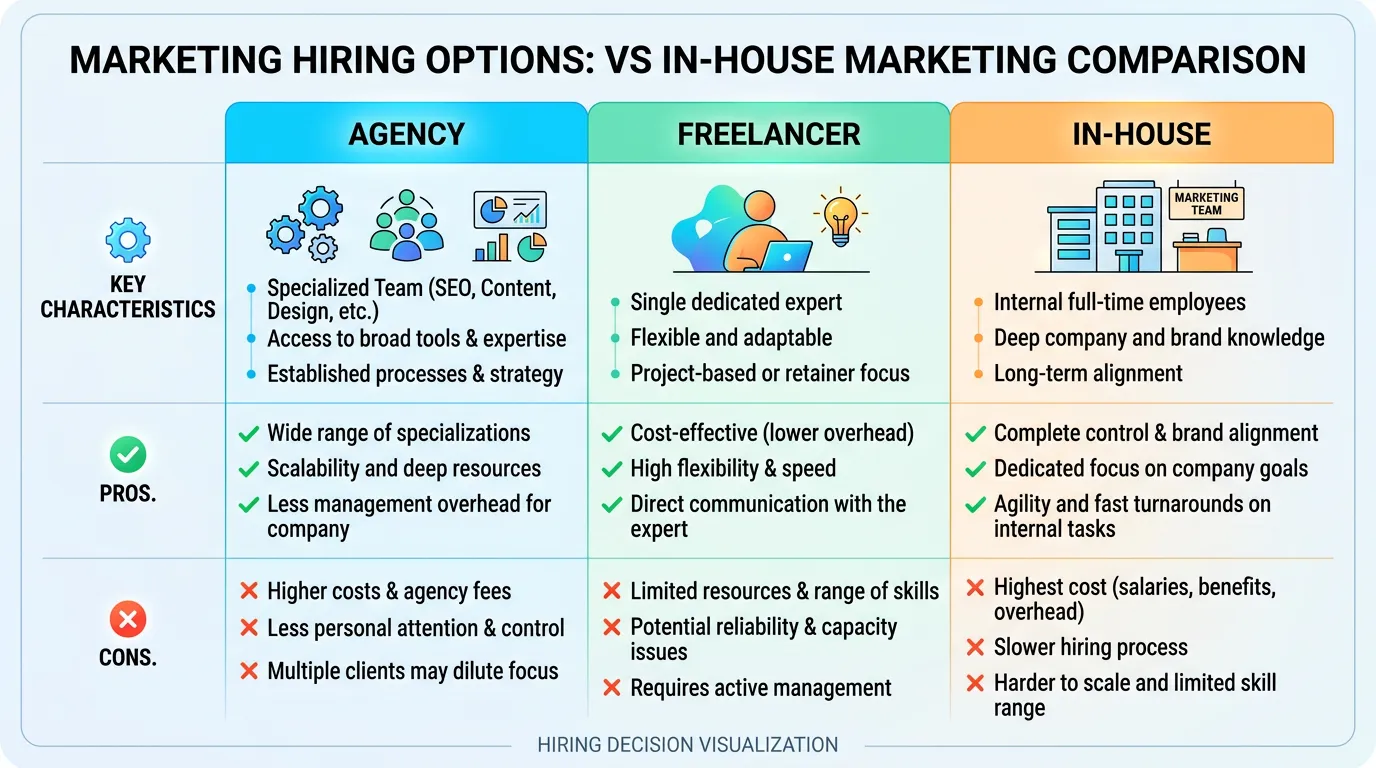
These are not three prices for the same thing. They are three different products, and mixing them up is where most bad hires begin. A freelancer sells hours in one skill. You are buying a pair of hands that already knows how to do a specific job, like writing, ads, or a website build. You supply the direction. When you know exactly what you want, that is the cheapest good work you can buy anywhere. An marketing agency sells a team and a process. You are buying several skills at once, plus the part that is hard to see: somebody deciding what to do next, somebody checking the work, and somebody still there when one person quits. You pay a premium for that layer. Whether the premium is fair depends on whether you needed the thinking or only the hands. An employee sells you their whole week. You are buying capacity, control, and speed of response. They sit in your meetings, learn your trade properly, and can be moved onto whatever matters today. In return you take on a fixed cost and a management job. Notice what is missing from all three descriptions. None of them sells results on its own. A good marketing agency, a good freelancer, and a good hire all fail inside a business with a weak offer, no follow up, and nobody answering the phone.
The Real Cost of Each, Including the Hidden Parts
Compare these on total monthly cost to get the marketing agency work done, not on the invoice. Freelancers in this market usually charge somewhere near 50 to 150 dollars an hour, or quote a project fee. A steady part time arrangement with a good one often lands between 500 and 2,000 a month. You pay for output and nothing else, which is the appeal. Marketing agency retainers for local service businesses usually run 1,000 to 5,000 a month, with multi location programs and heavy ad management going higher. That covers several people, the tools, the reporting, and the planning. It costs more per hour of hands than a freelancer and less than a salary. The employee is the one people misprice. A coordinator or manager salary is only the starting figure. Add payroll taxes, insurance, paid time off, equipment, and software, and the real cost usually lands about 25 to 40 percent above the salary itself. Then add the cost nobody writes down, which is your time. Somebody has to set direction and review the work, and if that is you for twenty hours a month, that is real money leaving the business. Check current pay in your own area before you build a plan around a number you read online. Wage data by occupation and metro area is published and free to look up.
Where Each Option Breaks
Every option has a predictable failure, and knowing yours in advance is most of the protection. Agencies break on attention. You meet the experienced person during the sale and get handed to a junior for the marketing agency work. Templates go on instead of thinking. The report shows impressions and traffic rather than booked jobs. And a small client is easy to quietly deprioritize. The guard is naming the person doing the day to day work, in writing, and insisting the reporting ends at jobs. Freelancers break on capacity and cover. One person cannot do strategy, ads, writing, and the website well, and the honest ones say so. They also get sick, land a bigger client, or go quiet for two weeks. There is no bench behind them. The guard is keeping the scope to one skill, holding all the account logins yourself, and having a second name in a drawer. Employees break on breadth and isolation. Marketing is six or seven different jobs, and one person at a small company is asked to do all of them with nobody to check the marketing agency work. They also get pulled into whatever is on fire. It is common for a marketing hire to end up handling customer service and events and doing almost no marketing. The guard is a narrow job description plus outside help for the skills they do not have.
Match the Choice to Your Stage
Advice online usually skips the only thing that decides this, which is where your business sits right now. Below roughly half a million a year with one service line, keep it simple. One freelancer on the single channel that matters, plus your own Google Business Profile work. A full agency retainer at that size usually spends more than the business can absorb, and the fit is uncomfortable for both sides. From about half a million to three million, with two or three service lines and a few crews, agencies earn their fee. You need ads, local search, a working website, and reviews all moving at once, and you do not have the hours to coordinate four separate freelancers. Above that, or with multiple locations, the shape changes again. It starts making sense to hire one person in house to own marketing, hold the vendors to account, and handle daily work, while specialists cover the parts that need depth. Season matters too. A pool company or a heating and cooling shop with a hard summer peak may want a partner who can push spend up in May and pull it back in November. Flexibility like that is easier to buy than to hire. One honest note. If revenue is uneven and cash is tight, do not sign a twelve month retainer. Buy a small project, see how the relationship feels, then grow it.
The Mix That Usually Wins
The setup that works most often is not one of the three. It is a mix with clear ownership. One person inside your business owns marketing, even if it is a slice of their week. That person does not need to be a specialist. They need to answer for the number, hold the calendar, and know where everything lives. Around them, buy depth where depth pays. Ads and local search reward pattern recognition across many accounts, which is exactly what an outside team has and one hire cannot get. Content works well as a mix, because the knowledge lives in your building and the writing does not. Websites are usually a project, not a monthly fee. The piece that makes this marketing agency work is ownership of the assets. Your business should own the Google Ads account, the Business Profile, the analytics property, the domain, the hosting, and the website files. Vendors get access, not ownership. Do that and switching vendors costs a week. Skip it and switching costs months, and sometimes your whole history goes with it. Then set one meeting a month where the vendor and your internal owner look at the same page: leads, booked jobs, and cost per job by channel. That single habit repairs more bad relationships than changing vendors ever does.
What to Settle Before Money Changes Hands
Ask these of all three types, because the answers sort the serious from the rest. Who does the marketing agency work, by name, and how much of their week do I get? What happens when that person leaves? Who owns the accounts, and can I have administrator access today? What does the reporting show, and does it stop at leads or continue to booked jobs? How long is the contract and how do I get out of it? What am I responsible for, in hours per month? Do you work with a direct competitor in my service area? Google publishes its own advice on hiring an SEO, and it is worth reading whichever option you pick, because the warning signs are the same everywhere. Anybody who guarantees a position, will not explain the marketing agency work in plain words, or will not give you access to your own accounts is telling you something. Two more that people forget to ask. What would make you tell me to spend less? A vendor who cannot name a single case where they would recommend cutting spend is selling, not advising. And can I see a recent report you sent another client in my trade, with the name removed? How a report is built shows you exactly what that team pays attention to all month.
How to Tell in Ninety Days If It Is Working
Ninety days is long enough to judge the working relationship and usually too short to judge the results. Keep those two apart. In the first thirty days you should see setup done properly. Tracking installed and tested with a real form fill and a real call. Access granted to you. A written plan with dates and owners on it. A first report with a baseline you can compare against later. If any of that is missing at day thirty, the problem is not patience. It is process. From thirty to sixty days, look at the leading signs for the channel you bought. Ads should show search terms being cleaned up, cost per lead settling down, and calls you can listen to. Local search should show profile activity and reviews arriving. Content should show pages published and impressions rising, with clicks lagging behind. From sixty to ninety, the question becomes cost per booked job rather than cost per lead. That number only exists if somebody marks which leads turned into work, so set that up in week one. Fire on process, not on a slow month. Missed meetings, reports you cannot read, no straight answer to a straight question, and work you never approved are all fair reasons to leave. A channel moving slowly in a hard market is not, as long as the person can explain why and say what changes next.

The Three Options Side by Side
Same job, three ways to get it done. The ranges are what we see in Southern California and will differ by market and by skill.
| What you compare | Freelancer | Agency | In house hire |
|---|---|---|---|
| Typical monthly cost | 500 to 2,000 | 1,000 to 5,000 | Salary plus 25 to 40 percent |
| Skills covered | One, done well | Several at once | One or two, growing |
| Who sets direction | You do | They do | Shared with you |
| Your time each month | Medium | Low | High |
| If they leave | Work stops | Someone covers | You hire again |
| Speed to start | Days | Two to four weeks | Two to three months |
| Best when | The scope is clear | Several channels move at once | Marketing is a daily job |
The row people skip is your time. A cheap option that eats ten hours of the owner's month is not cheap.
Four Situations, Four Answers
Start with what the work actually is. The right answer falls out of that faster than it falls out of a budget.
The fourth case is the common one. Hiring anybody before the plan exists is how retainers get paid for six months of guessing.
Hiring Without Getting Burned
These apply to all three options. Most of the pain we get called in to fix traces back to one of the items on the right.
Do this
- Own every account yourself and add vendors as users
- Get the name of the person doing the day to day work
- Start with one small paid project before a long retainer
- Make the reporting end at booked jobs, not at traffic
- Write down what you owe them each month, in hours
Not this
- Do not sign a twelve month contract on a first engagement
- Do not accept a guaranteed position from anybody
- Do not let a vendor create accounts under their own email
- Do not hire one employee to cover six different skills
- Do not judge the first thirty days on lead count alone
What to Settle in Writing First
Whether it is a contractor agreement or an offer letter, these seven points prevent the arguments that end relationships.
Account ownership listed item by item
Ads, analytics, profile, domain, site files
Who does the work and how much time
Named person, hours or days per month
What gets delivered every month
Things you can count, not effort
How results get reported
Leads and booked jobs, split by channel
Contract length and notice period
Thirty days notice is common and fair
What you owe them, and when
Approvals, access, photos, review time
What happens to the work if you part ways
Files, logins, and content stay yours
Worker classification checked properly
Contractor and employee are not the same
Would rather we handled it?
This article covers how to do the work yourself. If you would rather have it done for you, that is what our digital marketing strategy service is.
Digital Marketing Strategy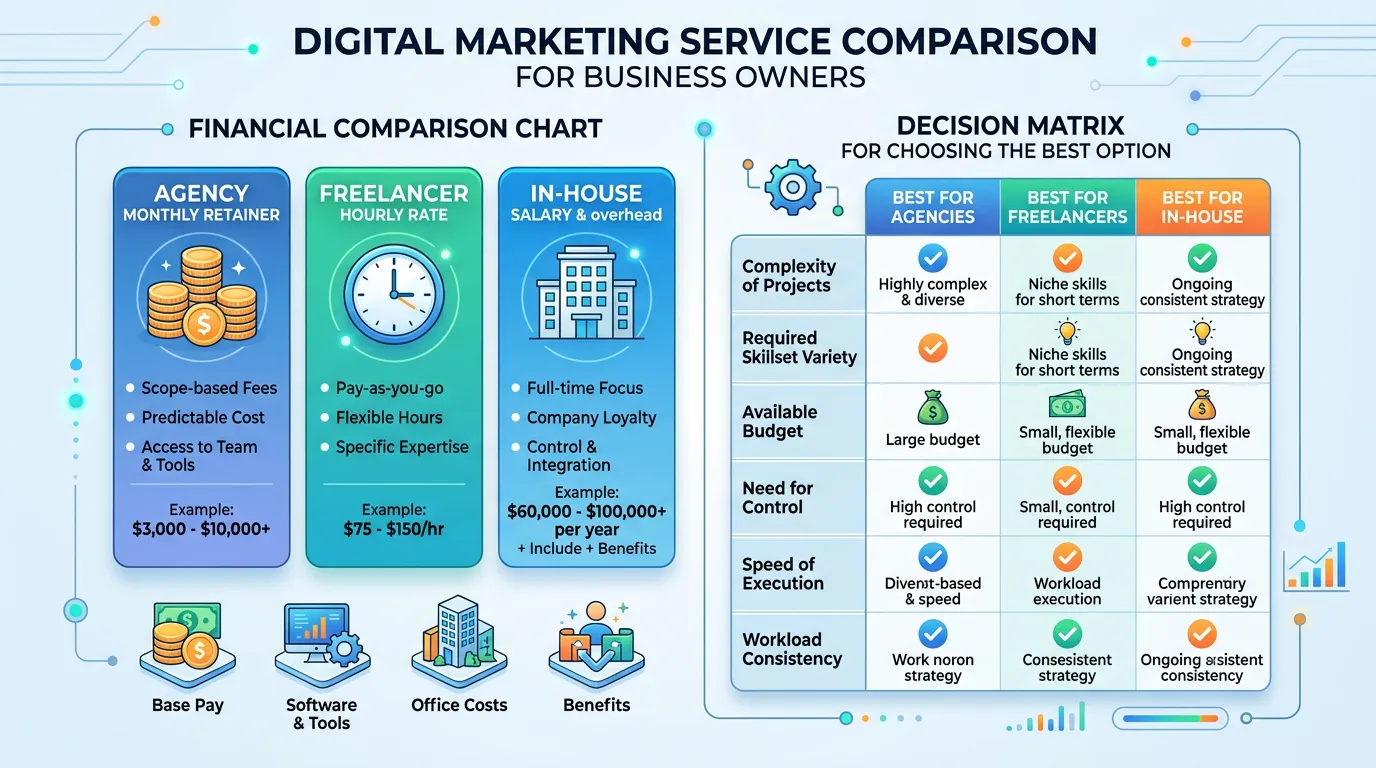
Frequently asked questions
Is an marketing agency always more expensive than a freelancer?
How much should a small service business spend on marketing?
Can I hire a marketing manager and have them run the vendors?
What is the smallest sensible first hire?
How do I compare two proposals that look nothing alike?
Sources
- Google Search Central: Do you need an SEO?(opens in a new tab) Google sets out the questions to ask before hiring an SEO and the warning signs of a bad partner, including guaranteed rankings and refusing to explain the work.
- Bureau of Labor Statistics: Occupational Employment and Wage Statistics(opens in a new tab) Published wage data by occupation and metro area lets an employer check what a marketing role actually pays locally before budgeting for a hire.
- IRS: Independent contractor or employee(opens in a new tab) The IRS explains how to determine whether a worker is an independent contractor or an employee, which affects the true cost and the paperwork of each hiring option.