
Foundational Guides
What a Full Service Marketing Agency Actually Does All Month
Full service means one team running search, ads, the site, reviews, and reporting under one plan. Here is the work that actually happens.
Call (714) 823-3164 or ask a question. Clear recommendations, even if we never work together.
A full service marketing agency runs every part of your marketing under one plan. That usually covers search, paid ads, the website, content, reviews, email, and reporting. Most of the work is a repeating monthly cycle of building, measuring, and fixing. What you are buying is coordination and staffing, not one tactic.
Jump to a section
- What Full Service Actually Covers
- The People Behind the Retainer
- What a Month Actually Looks Like
- The First Sixty Days Do Not Look Normal
- What an Agency Cannot Do for You
- How to Tell a Real Team From a Front Desk
- The Eight Jobs Inside a Retainer
- A Month on a Retainer
- Ask These Before You Sign
- Getting Your Money's Worth
- Questions
What Full Service Actually Covers
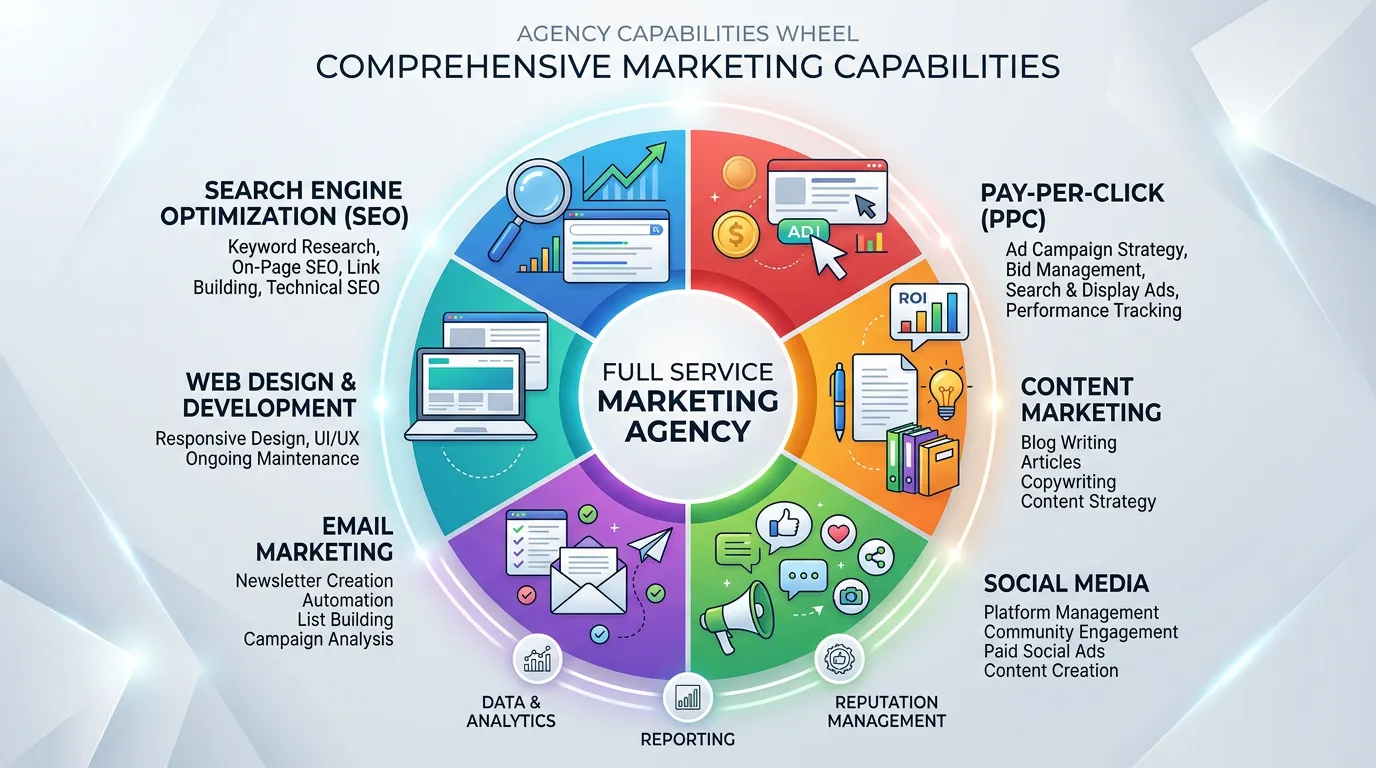
Full service is a sales term, not a job title. It means one team handles most of your marketing instead of you hiring a different shop for each piece. In practice that covers about eight things. Search work on your site, your Google Business Profile, paid ads, the website itself, writing, reviews, email, and reporting that ties them together. Three very different businesses use the same words. A generalist team does most of the work in house with a handful of people. A network shop keeps a small core and hires specialists per project. A front desk resells everything to a white label vendor and marks it up. All three can call themselves full service, and only one of them can tell you who wrote your last page. The part worth paying for is coordination. When one shop runs ads and another runs the site, a slow page or a broken form turns into an argument instead of a fix. One team owns the whole path, so the ad, the page, the form, and the follow up email get built to work together. That is the real product. Not the length of the full service list.
The People Behind the Retainer
A retainer buys hours from several people, not one person full time. The common roles are a strategist, an account manager, a search person, an ads person, a writer, a designer or developer, and an analyst. At a small shop, three or four people cover all of those. The owner is often the strategist and the ads person. That is not a red flag by itself. A generalist who has run a hundred local accounts is usually worth more to a plumber than a specialist who has only run national retail. What matters is that the hats are named and you know who wears which. Ask how many hours a month your account gets and how they split. A mid sized local retainer often buys twenty to forty hours across four people. Some of that goes to work you can see, and the rest goes to reporting, meetings, research, and fixing what broke. If nobody can answer the hours question, your account is a queue rather than a plan.
What a Month Actually Looks Like
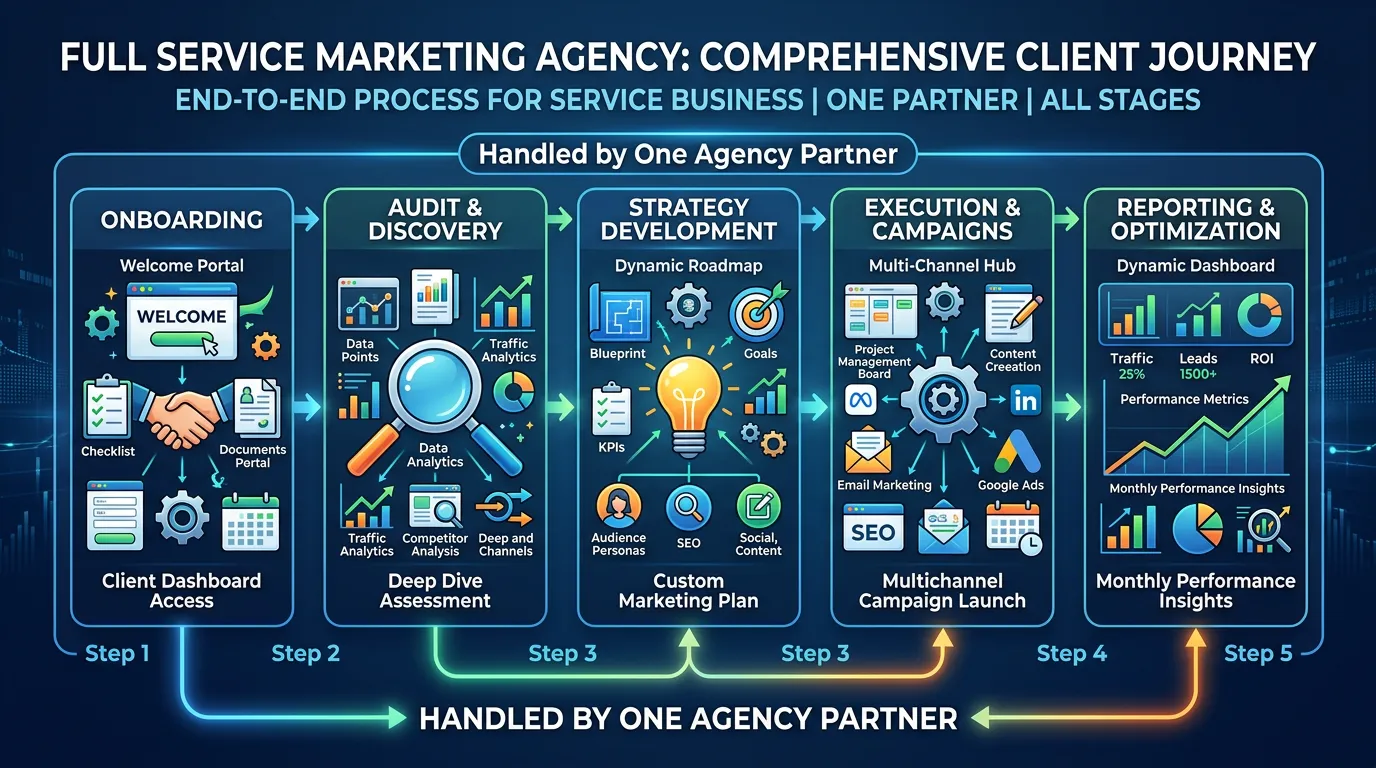
Most of a retainer is a repeating cycle. It looks about the same every month, and that sameness is what makes it work. Week one is reading. Somebody pulls last month's calls, forms, rankings, ad spend, and profile views, then holds them against the month before. This is also when broken things get caught. A form that stopped sending, a page that fell out of the index, a phone number that changed on one directory. Week two is building. New pages get written and published, ad copy gets rewritten, photos go up, the email goes out. Week three is fixing what is already live. Search terms that wasted money get blocked. A page that gets clicks but no calls gets a new headline. Review replies get written. Week four is reporting and planning. You get the numbers, what changed, and the list for next month. If your agency only touches the account in the last week of the month, you will feel it. The work that compounds is the boring middle. Anyone can launch something. Staying on the cycle for a year is the part most people underrate.
The First Sixty Days Do Not Look Normal
The start of a retainer surprises owners, because almost nothing gets published at first. Week one is access. Google Business Profile, ad accounts, analytics, Search Console, the domain registrar, the website login, and call tracking. Collecting all of it often takes two weeks, because somebody always used an email nobody has anymore. Then comes measurement. Before anyone changes a thing, calls and forms have to be tracked, or nobody can tell later whether the work paid. Then the audit and the fix list, in the order that matters. What you have to supply is real. Photos of your own work, your price ranges, your full service list, the areas you cover, and about an hour a week for the first month. An agency that asks for none of that is guessing. Expect month one to produce almost no leads. Month two usually shows movement in the fast channels, which are ads and the profile. Search work takes longer, often three to six months before it changes anything you can feel. Be careful with a shop that publishes in week one with no tracking in place. It looks fast, and the first three months cannot be judged at all.
What an Agency Cannot Do for You
An agency controls the top of the path. It does not control the rest, and honest ones say so early. They cannot answer your phone. If half your calls go to voicemail during working hours, more calls will not help you. They cannot fix your close rate either. If your estimate wins one job in ten, twice the leads means twice the wasted appointments. They cannot control Google. Nobody can promise a position, and rankings move for reasons outside your account, including updates and new competitors. They cannot create capacity. If you are booked four weeks out, more demand raises your prices, not your revenue. That may be exactly what you want, but say so, because it changes the plan. They cannot fix a business people dislike. If the bad reviews are honest, the answer is the full service, not the marketing. Marketing sends more people toward a business that already works. It makes a bad experience spread faster. The useful version of this talk happens before you sign. Ask what has to be true on your side for the plan to work. A good agency will name your biggest risk without being pushed.
How to Tell a Real Team From a Front Desk
You can usually tell in one call. Ask who does the work by name, and what they did last week on your account. A real team answers with specifics. A front desk answers with the word we and changes the subject. Check who owns the accounts. Your ad account, your analytics, your profile, and your domain should be in your name, with the agency added as a user. If the agency owns them, leaving means starting over, and some shops count on that. The same goes for the website. If the site lives only on their platform and cannot be exported, you are renting it. Read one report closely. A real report names what changed and what it did. A canned report shows a graph going up and never mentions a decision. Ask about the work you cannot see. Where the writing happens, who reviews it, and whether any part is handed to another vendor. Reselling is not automatically bad. Hiding it is. None of this asks you to know marketing. It asks you to know who, what, and where.
The Eight Jobs Inside a Retainer
Rough hours for a mid sized local account. Ask which rows your quote really includes.
| Job | What it produces | Hours a month | Usually done by |
|---|---|---|---|
| Strategy | The plan and the priorities | 2 to 4 | Owner or strategist |
| Account work | Calls, updates, chasing you | 2 to 4 | Account manager |
| Search | Pages, fixes, profile edits | 6 to 12 | SEO person |
| Paid ads | Campaigns, terms, budgets | 4 to 10 | Ads person |
| Writing | Pages, posts, ad copy, email | 4 to 10 | Writer or freelancer |
| Site work | Speed, forms, layout, fixes | 2 to 6 | Designer or developer |
| Reviews | Requests and public replies | 1 to 3 | Account manager |
| Reporting | Numbers and what changed | 2 to 4 | Analyst or strategist |
The rows that get thin on a cheap retainer are almost always writing and site work, because both take real hours and neither shows up in a graph.
A Month on a Retainer
The same four weeks repeat. When an agency skips a week, it is usually week three.
Daily work runs under all four weeks. Ads get checked, reviews get answered, messages get replies.
Ask These Before You Sign
Seven questions that turn a friendly sales call into something you can hold someone to.
Who does the work, by name?
A title is not a name.
How many hours a month do I get?
And how they split by job.
Whose name is on the accounts?
Ads, analytics, profile, domain.
Is any of it passed to a vendor?
Reselling is fine if disclosed.
What do you need from me?
Photos, prices, an hour a week.
What will month one produce?
Usually setup, not leads.
What do I keep if I leave?
Get the answer in writing.
Getting Your Money's Worth
The client side of this changes results more than most owners expect.
Do this
- Give one person on your side the job of answering the agency
- Send photos from real jobs every month without being asked
- Ask what got stopped last month, not only what got started
- Keep every account in your own name with the agency as a user
- Judge the first ninety days on work done, not on lead count
Not this
- Do not rewrite the plan every time one slow week shows up
- Do not hire a second shop for a channel without telling either one
- Do not approve a report you did not read
- Do not let calls go to voicemail while you pay for clicks
- Do not sign an agreement that keeps your website if you leave
Would rather we handled it?
This article covers how to do the work yourself. If you would rather have it done for you, that is what our digital marketing strategy service is.
Digital Marketing Strategy
Frequently asked questions
Is a full service agency cheaper than hiring in house?
How long before a retainer shows results?
Can I hire a full service agency for one channel only?
What happens to my accounts if I leave?
Sources
- Google Search Central: Do you need an SEO?(opens in a new tab) Google's own advice on hiring outside help, including the questions to ask and the promises that should worry you.
- Google Analytics 4 events guide(opens in a new tab) Calls, forms, and bookings are recorded as events, which is the tracking that has to exist before an agency changes anything.
- Analytics Help: Collect campaign data with custom URLs(opens in a new tab) Tagged links are how an agency separates each channel in reporting instead of lumping traffic into one bucket.