
How To Articles
How Pay Per Click Advertising Works, From Search to Charge
What happens in the moment between a search and your ad showing, and why you almost never pay your full bid.
Call (714) 823-3164 or ask a question. Clear recommendations, even if we never work together.
Pay per click advertising works through an auction that runs every time someone searches. Google looks at your bid, your ad quality, and the search context, then ranks the ads that qualify. You pay only when someone clicks, and the price is usually less than your top bid.
Jump to a section
- An Auction Runs on Every Single Search
- What Google Weighs When It Ranks Ads
- Why You Rarely Pay Your Full Bid
- Match Types Decide Which Searches Reach You
- How Daily Budgets Really Spend
- The Click Is the Middle, Not the End
- What Happens Between the Search and the Charge
- The Six Inputs Behind Ad Rank
- Why the Same Keyword Costs Two Prices in One Day
- Questions About the Mechanics
- Questions
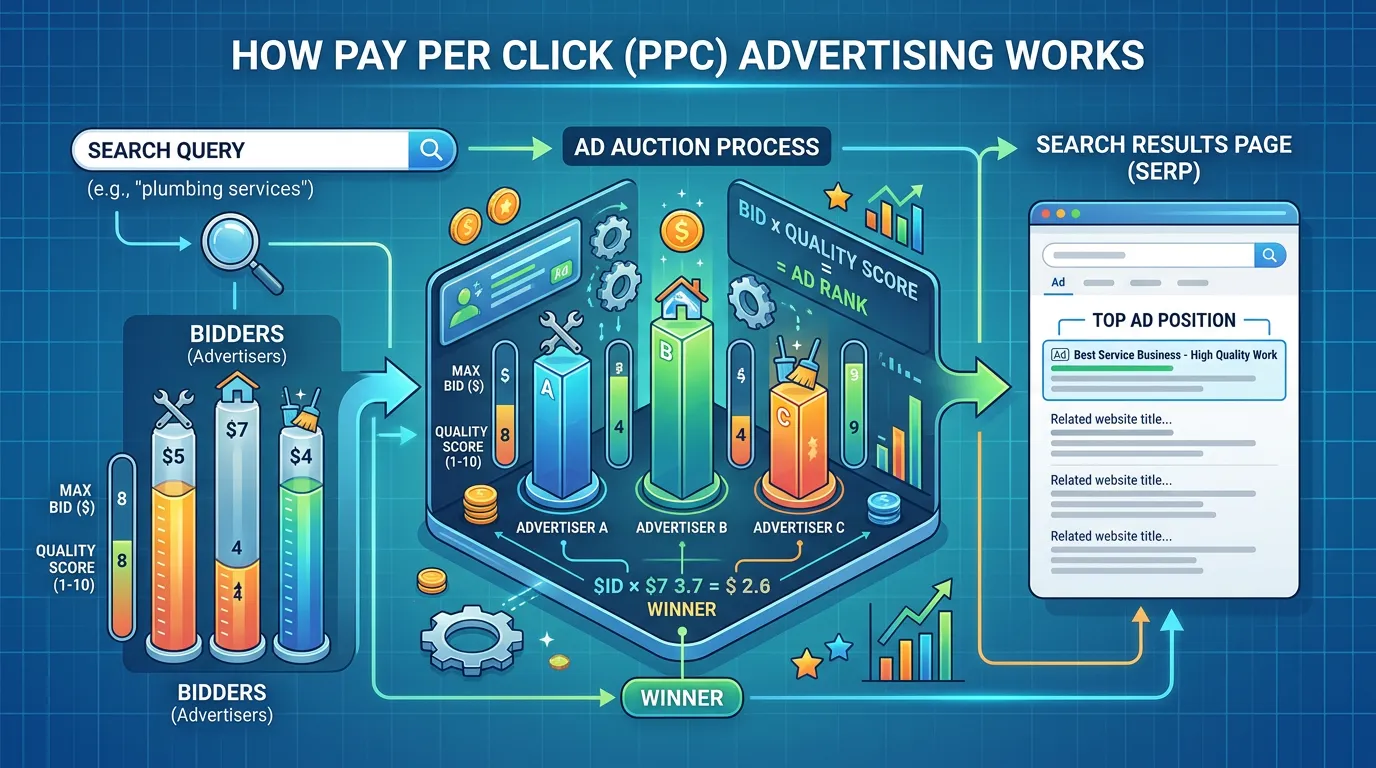
An Auction Runs on Every Single Search
Nothing about paid search is set in advance. Someone types a phrase into Google. In the time the page takes to load, Google gathers every ad that could match, checks which ones qualify, and sorts them. That whole process runs again on the next search, and the one after that. Your ad can win the top spot at 9 in the morning and miss the page at noon. Nothing in your account changed. The other bidders did. This is the first thing to understand, because it explains why paid search feels unstable at the start. You are not buying a spot on a shelf. You are entering a contest thousands of times a month. The contest also runs separately for each ad location. The ads above the results and the ads below them are picked in different auctions. That is why you can sit under the results all day and never appear on top. Google also decides whether to show any ads at all for that search. If nobody clears the bar, the page comes back with none. So three things can happen on any given search: you show high, you show low, or you do not show. All three are normal in the same week, for the same keyword, in the same account.
What Google Weighs When It Ranks Ads
Google calls the sorting number Ad Rank, and it is not just your bid. Google lists six inputs: your bid, the quality of your ad and landing page, the Ad Rank thresholds, how competitive the auction is, the context of the search, and the expected effect of your assets and ad formats. Context means the device, the location, the time of day, and the exact words used. Two of those inputs deserve most of an owner's attention. Quality is one. A shop with a sharper ad and a page that matches the search can sit above a bigger bidder. That is the whole reason a two truck company can compete with a franchise. Thresholds are the other. Google sets a floor an ad has to clear before it shows at all. A weak ad with a low bid can clear nothing and never appear, which looks the same as having no budget. People often mix this up with Quality Score. Quality Score is the one to ten number in your keyword table. Google says plainly that it is a diagnostic tool and not an input in the auction. The live checks behind it, expected click rate, ad relevance, and landing page experience, are what the auction uses. Treat the number like a smoke alarm. It tells you where to look. It is not the thing being scored.
Why You Rarely Pay Your Full Bid
Your maximum cost per click is a ceiling, not a price. Google charges the least it takes to clear the thresholds and beat the ad sitting right below you. That final number is your actual cost per click, and it is often well under your bid. So the advertiser behind you sets your price, not you. That has a useful side effect. Raising your bid can win a better spot without raising what you pay per click, because the gap to the next advertiser did not move. It also means your average cost per click hides a lot. That number blends a cheap Sunday night click with an expensive Monday morning one. Two accounts with the same average can be spending in completely different places. Quality changes the price too. When your ad and page are a better answer for the search, you can hold the same position for less than a weaker competitor pays. That is not a favor. A better match keeps people from bouncing back to the results and searching again. Most accounts now run on automated bidding, where you set a target cost per lead and Google sets each bid for you. The auction underneath is exactly the same. What changes is who does the math, and how good the data you feed it is.
Match Types Decide Which Searches Reach You
A keyword is not a search. It is a rule about which searches can trigger your ad. Google offers three rules: exact, phrase, and broad. Exact covers your term and close variants of it. Phrase covers searches that carry the meaning of your term. Broad covers all of that plus whatever Google decides is related. If you do not choose, you get broad by default, and that default costs new accounts real money. Say you sell water heater repair. On broad match your ad can show for how to fix a water heater, water heater repair training, and water heater repair jobs. All three are clicks. None of them is a customer. The tool that stops this is a negative keyword list, which is a set of words that block your ad. Build yours from your own search terms report rather than a list you found online, because every trade collects different junk. A roofer needs to block roof insurance claim help. A dentist needs to block dental school. Still, almost every trade account starts with the same few groups.
- free, cheap, discount, and coupon
- jobs, hiring, salary, and training
- how to, DIY, and fix it myself
- parts, used, rental, and wholesale
- cities and counties you do not serve
How Daily Budgets Really Spend
Budgets confuse people because Google does not stop at the number you typed. You set an average daily budget for each campaign. Google can spend up to twice that in a single day when the traffic is there, then balance the month out afterward. The monthly ceiling is your daily budget times 30.4, which is the average number of days in a month. So a 50 dollar daily budget can spend 100 on a busy Tuesday, and cannot pass about 1,520 for the month. Knowing this prevents two bad reactions. The first is panic on the day you see double spend. That is the system working the way Google documents it. The second is treating a budget cut as instant, which it is not. Budgets are set per campaign, and this is why campaign structure matters more than most owners expect. Put every service into one campaign and the cheap high volume searches will eat the money before your best job type gets a look. Split them and each service line gets its own budget and its own cost per lead. One more thing worth being clear about. Budget does not buy position. It controls how often you can show up and when you run out for the day. Ad Rank decides where you sit when you do show.
The Click Is the Middle, Not the End
A per click is the only thing Google charges you for, and it is the least interesting part of the chain. The chain is search, per click, page, call, quote, job. Money only appears at the end of it. This matters for a mechanical reason, not a philosophical one. Automated bidding learns from the events you send back to it. Tell Google that a visit to your contact page counts as a lead and it will go and buy people who visit contact pages. Tell it that a phone call lasting over 60 seconds counts and it buys people who call and talk. The system is honest. It gives you more of whatever you asked for. So the setup behind the ads decides whether the ads work. That means a tracked phone number, a form that reports back, and counting rules so one caller is not recorded as three leads. It also means marking which leads turned into booked jobs, where your system allows it. Without that, you are paying a machine to find people who fill in forms, and plenty of them were never going to buy anything. Owners often ask why an old account never got better over two years. Usually nothing was measured properly, so there was nothing to improve toward.
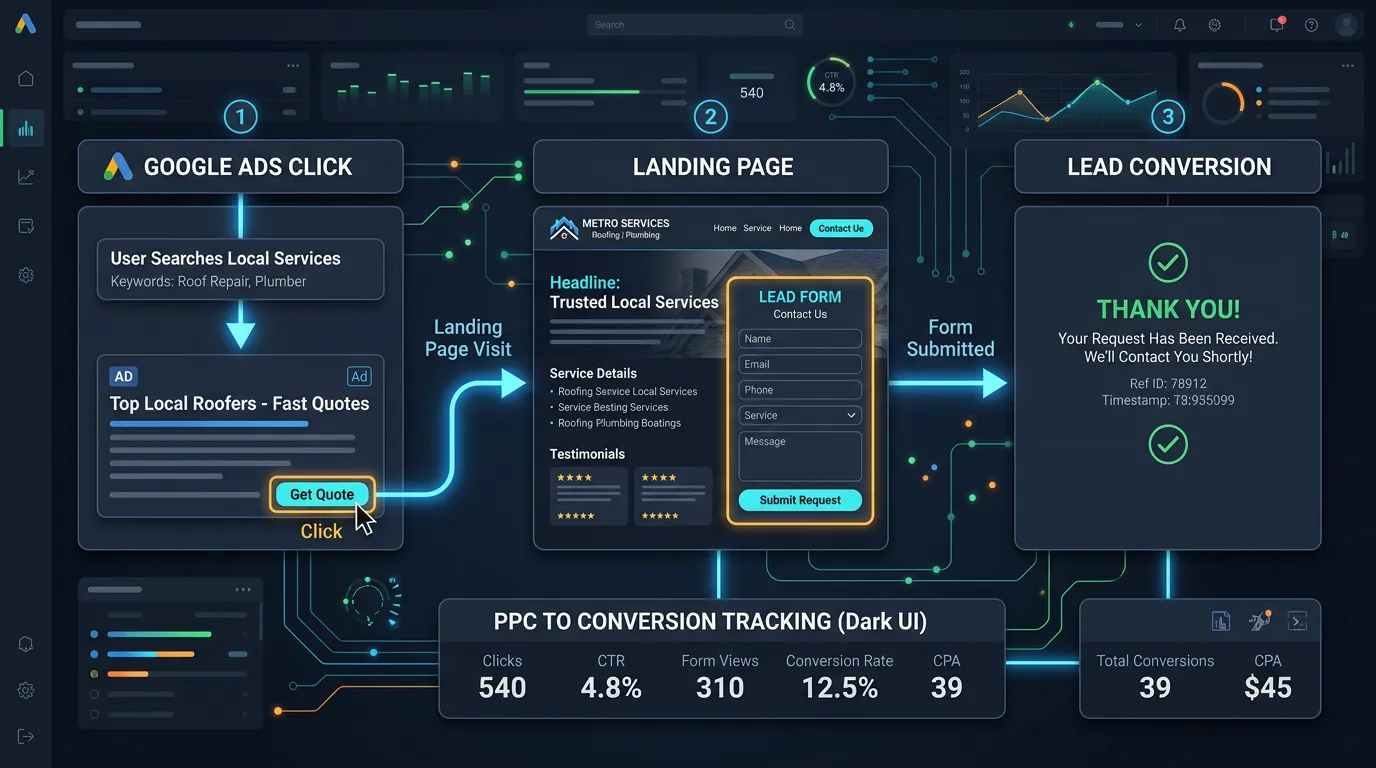
What Happens Between the Search and the Charge
A paid click looks like one event. It is really five, and they all finish before the page has loaded.
You control two of the five: the keywords that let you into the auction, and the quality that decides where you land.
The Six Inputs Behind Ad Rank
Google names these as what goes into Ad Rank. Only three of them are yours to move.
| Input | Who controls it | How fast it moves | What it changes |
|---|---|---|---|
| Your bid | You | Minutes | How high you can reach |
| Ad and page quality | You | Days to weeks | Position and click price |
| Ad Rank thresholds | Not yours | Whether you show at all | |
| Auction pressure | Competitors | Daily | What a spot costs today |
| Search context | The searcher | Every search | Which auction you enter |
| Assets and formats | You | Days | How much space you take |
Bid is the fastest lever and the one people reach for first. Quality is the slower lever and the one that lowers the bill.
Why the Same Keyword Costs Two Prices in One Day
Take a hypothetical AC repair company in Ontario. At 7 in the morning, a click on ac repair near me might cost 12 dollars. Half the county has not opened its budget yet.
By 2 in the afternoon on the first hot day of July, that same click can cost three times as much. Every AC company in the area is bidding, and people are searching from inside hot houses.
This is why one average click price is a weak planning number. Look at the range and at the hours behind it. Then decide whether the expensive hours are worth buying, or whether the same money does more work early in the morning.
Questions About the Mechanics
Do I pay when someone only sees my ad?
Does a bigger budget push me higher on the page?
Can I pay my way into the map results?
Would rather we handled it?
This article covers how to do the work yourself. If you would rather have it done for you, that is what our pay per click advertising service is.
Pay Per Click Advertising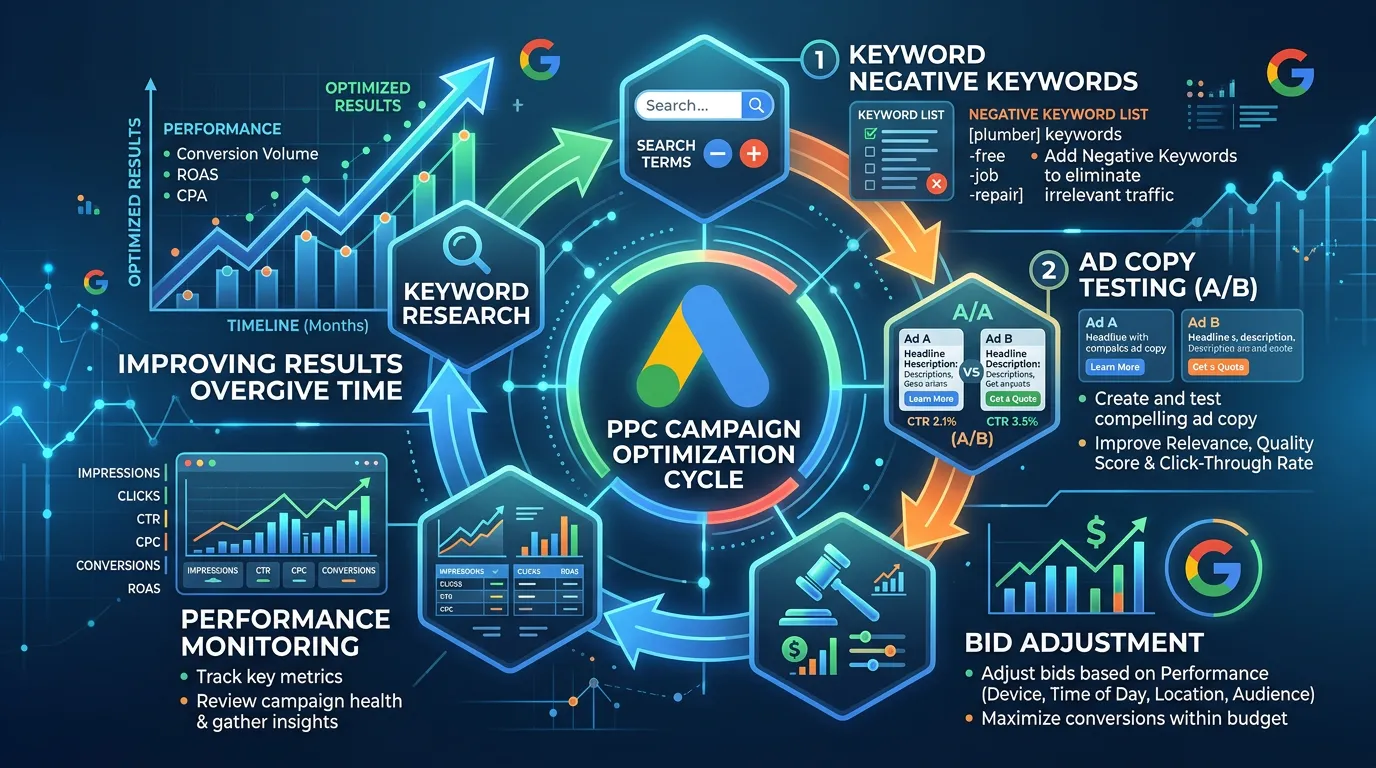
Frequently asked questions
What does pay per click actually mean?
Is Google Ads the only pay per click platform?
How long before a new account settles down?
Does clicking my own ad cost me money?
Sources
- Google Ads Help: How the Google Ads auction works(opens in a new tab) Google describes running an auction each time someone searches, with separate auctions for top ads and ads in other locations.
- Google Ads Help: About Ad Rank(opens in a new tab) Lists the inputs to Ad Rank: bid amount, ad and landing page quality, Ad Rank thresholds, auction competitiveness, search context, and the expected impact of assets and ad formats.
- Google Ads Help: Actual cost per click definition(opens in a new tab) Google states that advertisers are often charged less than their maximum bid, paying only what is needed to clear Ad Rank thresholds and beat the advertiser immediately below.
- Google Ads Help: About keyword matching options(opens in a new tab) Defines exact, phrase, and broad match, and states that keywords are treated as broad match when no matching option is chosen.
- Google Ads Help: About Quality Score for Search campaigns(opens in a new tab) Google states that Quality Score is a diagnostic tool rather than an input in the ad auction, and names expected click through rate, ad relevance, and landing page experience as its three components.
- Google Ads Help: About average daily budgets(opens in a new tab) Google documents that a campaign can spend up to twice its average daily budget on a given day, with a monthly limit of 30.4 times the average daily budget.