Foundational Guides
How Much Does Pay Per Click Advertising Cost in Southern California?
The three separate bills behind paid search, what moves each one, and how to work out what a booked job really costs you.
Call (714) 823-3164 or ask a question. Clear recommendations, even if we never work together.
Pay per click advertising has three costs: what Google charges for clicks, what you pay someone to run the account, and the pages and tracking behind it. Per click prices come from an auction, so they swing from a few dollars to more than fifty depending on your trade and county.
Jump to a section
- There Are Three Bills, Not One
- What Sets the Price of a Click
- The Only Cost Number That Decides Anything
- How Agencies Charge, and What Each Model Does
- What Pushes a Quote Up or Down
- The Floor Below Which This Does Not Work
- What Clicks Tend to Cost by Search Type
- From One Click to One Booked Job
- How to Read a PPC Quote
- Costs People Forget to Budget For
- Questions
There Are Three Bills, Not One
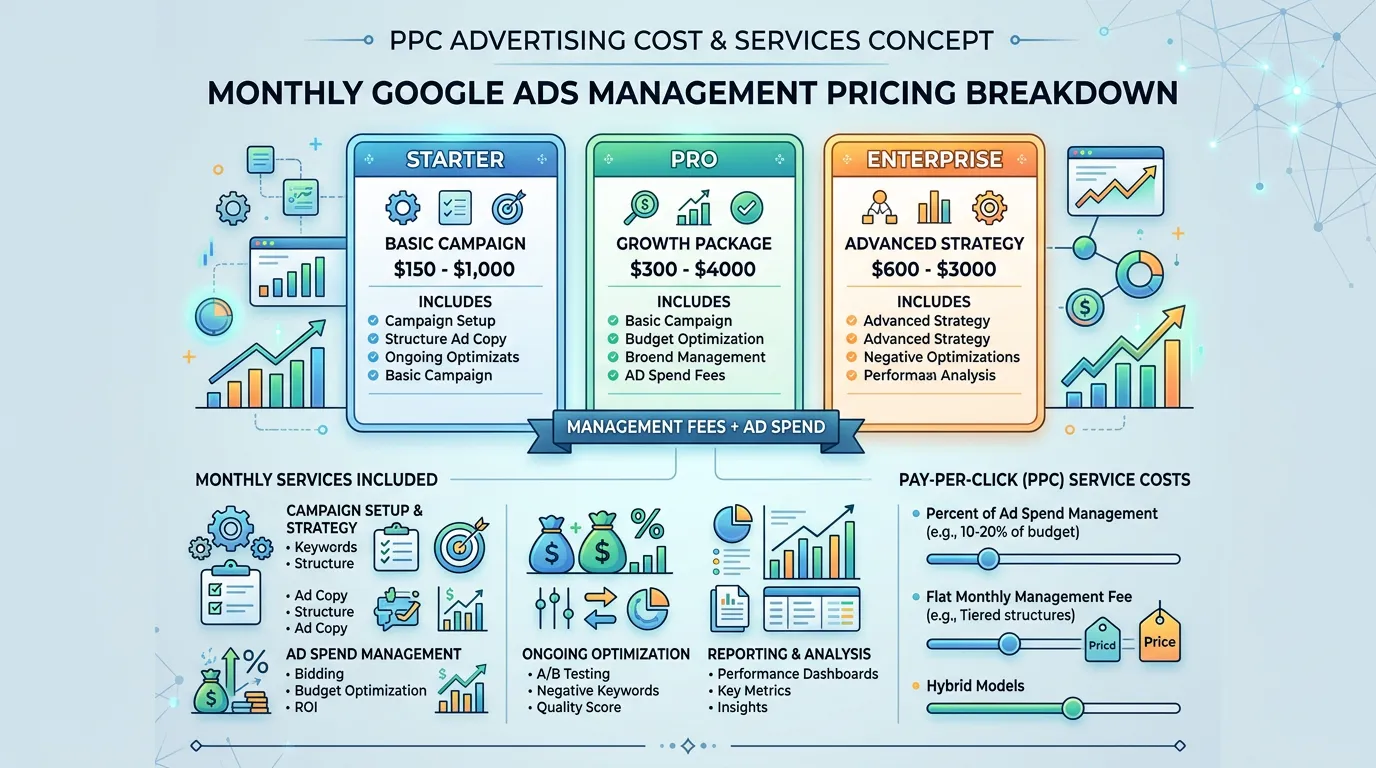
Owners usually ask what paid search costs and mean one number. There are three, and they behave differently. The first is ad spend. That is the money Google charges for clicks, billed straight to your card. You control it, you can change it today, and it goes to Google rather than to an agency. The second is management. That is what you pay a person or a company to build and run the account. It is a fee for labor, and it should not rise just because you clicked more. The third is the build. Landing pages, call tracking numbers, a tag setup, and sometimes a booking tool or a link into your CRM. Some of that is one time. Some of it is a small monthly cost that never stops. Keep the three separate on paper. When they get blended into one figure, you cannot tell whether a bad month came from expensive clicks or from work nobody did. It also makes quotes impossible to compare. One company quotes 2,000 dollars all in. Another quotes a fee plus your own spend. Until you split the three, you have no idea which is actually cheaper for the same work.
What Sets the Price of a Click
There is no rate card. Every per click price is the result of an auction, so the real driver is how many businesses want the same search and what a job is worth to each of them. Job value does most of the work. A roof replacement is worth thousands, so roofers can pay 40 dollars for a per click and still come out ahead. A 90 dollar drain snake cannot carry that price. Intent is next. Emergency words cost more than research words. Somebody typing ac not blowing cold today is far closer to paying than somebody typing how does a heat pump work. Geography matters more than people expect. The same search costs different amounts in Los Angeles County than it does in a smaller Riverside County town, because the number of bidders is different. Time of day and device shift it again. Then there is your own quality, since ads and pages that match the search can hold a position for less than a weaker competitor pays. Season closes the list. Air conditioning in July and heating in December are the most expensive weeks of the year in those trades. Some owners spend heavier in the quiet months for exactly that reason.
The Only Cost Number That Decides Anything
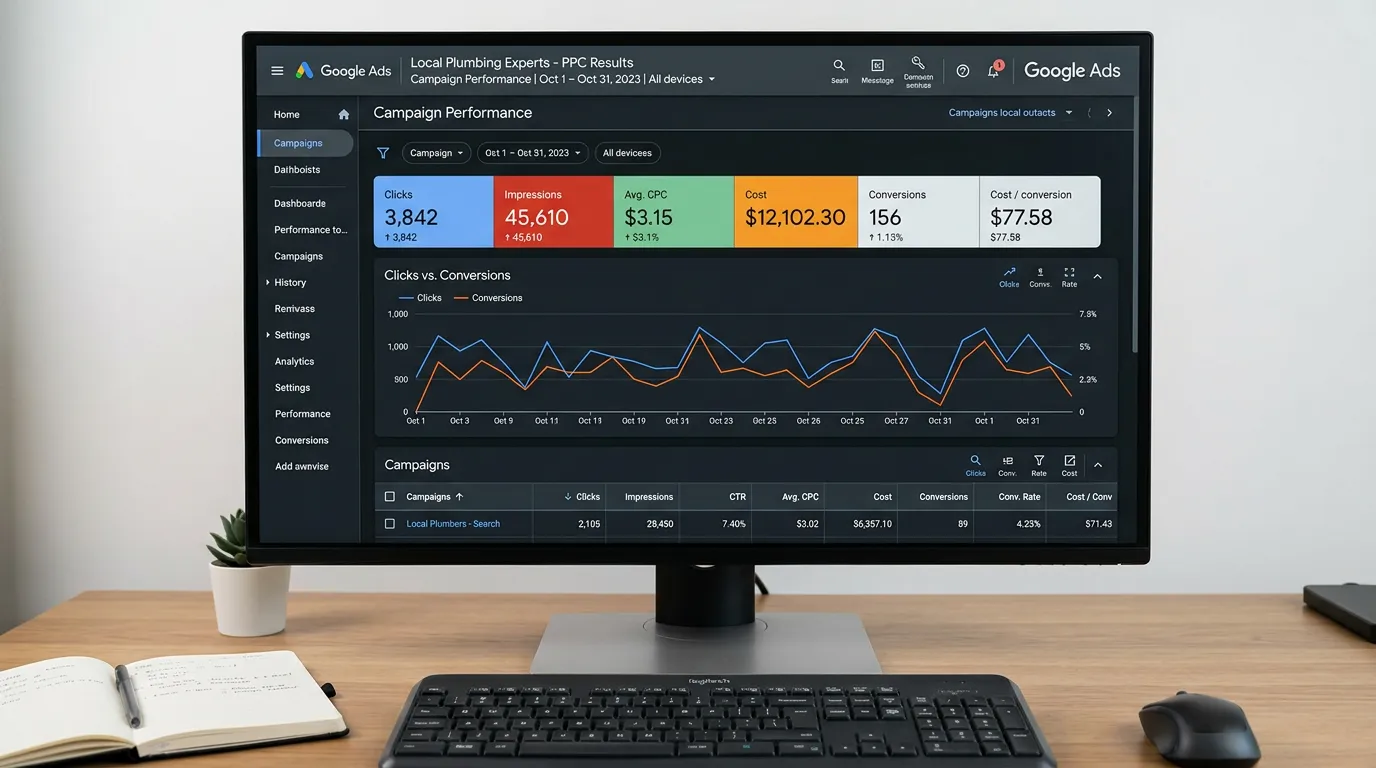
Cost per click is the number everyone asks about, and it is the least useful one you have. What matters is what a booked job costs. That takes two more numbers you already know. Start with your per click price. Say clicks average 20 dollars. Next, the share of clicks that turn into a call or a form. For local service pages that generally lands somewhere between 5 and 15 percent, and it depends far more on the page than on the ad. Take 10 percent. Ten clicks at 20 dollars is 200 dollars for one lead. Last, your booking rate. If your office books half the leads that come in, you need two leads per job. That is 400 dollars per booked job. Now the number means something real. If your average job pays 6,000 dollars, 400 is cheap and you should buy more of it. If your average job pays 350 dollars, you are losing money on every one, and no amount of bid tuning will save it. Run this math before you spend, not after the first invoice. It takes five minutes with numbers you already have, and it tells you whether paid search can work in your trade at all.
How Agencies Charge, and What Each Model Does
There are four common ways to be billed for management, and each one bends behavior in a direction. A percentage of ad spend is the oldest, often ten to twenty percent. The problem is built in. The only way that fee grows is if your budget grows, so every recommendation tends to point the same way. A flat monthly fee is charged for the account rather than the spend. It is easier to budget, and the only way to grow the fee is to make the current money work harder. The risk on that side is an account that gets quietly ignored once it is stable, so ask what happens in month seven. Hourly billing is honest and rare. It suits audits, one time builds, and owners who want a quarterly check rather than weekly work. It fits daily search term cleanup badly, because nobody wants to log a 15 minute entry. Per lead pricing sounds safest and often is not, because the lead definition is where the money hides. Ask what counts as a lead, who owns the phone number, and what happens to the leads if you leave. Whatever the model, the questions stay the same. What work happens each week, who does it, and what do you keep at the end.
What Pushes a Quote Up or Down
Two businesses in the same trade can get quotes that differ by triple, and both can be fair. Most of the gap is scope, not greed. Service lines are the biggest driver. One campaign for one service is a small job. Five service lines means five sets of keywords, five ad groups, five negative lists, and five lines on every report. Cities work the same way. A single town is simple. Twelve cities across three counties means more targeting, more landing pages, and more geographic negatives to write and maintain. What brings a quote down is simpler than owners expect. Fewer services. One city to start with. A website that already turns visitors into calls. A clean existing account with real history in it, since history is worth money to the bidding system. And a decision maker who answers the same day, because a good share of the delay in this work is waiting for approvals on copy and pages. When you compare two quotes, ask both to price the same scope. Then check which of these five items each one included before you decide one is expensive.
- How many service lines get their own campaign
- How many cities and counties you want covered
- How many platforms run at once, such as search, Local Services Ads, and Microsoft
- How many landing pages and tracking numbers are needed
- Whether closed job data gets pushed back into the account
The Floor Below Which This Does Not Work
There is a budget below which paid search is not cheap. It is just wasted. The reason is data, not greed. Bidding systems and people both need conversions to learn from, and a campaign with three leads a month gives nobody anything to act on. Work out your own floor with the math from earlier. If clicks in your trade cost 30 dollars and one in ten turns into a lead, a lead costs about 300 dollars. Ten leads a month means about 3,000 dollars of spend. If that number is out of reach, you have three honest options. Narrow the service, and bid only on the one job type that pays best, in the two towns closest to you, during the hours you answer the phone. Narrow the platform, since Local Services Ads charge per lead instead of per click, which can be a gentler start on a small trade budget. Or skip paid search for now. Put the money into your Google Business Profile, into review collection, and into a website that converts, then come back when the average job is worth more. Saying that on the first call is cheaper for you than a management fee spent on a budget that cannot work.
What Clicks Tend to Cost by Search Type
These are ranges we see in Southern California accounts, not prices Google publishes. Your own account is the only number that counts.
| Type of search | Typical range we see | Why it sits there |
|---|---|---|
| Emergency trade calls | 20 to 60 dollars | One job pays for many clicks |
| Replacement and install | 15 to 45 dollars | High ticket, heavy bidding |
| Routine repair and service | 8 to 25 dollars | More searches, smaller jobs |
| Injury and legal matters | 50 dollars and up | Case value runs very high |
| Your own business name | 1 to 4 dollars | Almost nobody bids against you |
Look at the last row. Your own name is the cheapest traffic you will ever buy, which is why brand searches belong in their own campaign with their own budget.
From One Click to One Booked Job
The same math drawn out. Change any middle step and the last box moves with it.
Lift the lead rate from 1 in 10 to 1 in 6 and the cost per job drops to about 240 dollars, with no change to your bids at all.
How to Read a PPC Quote
Two quotes can look the same and mean very different things. These questions separate them.
Do this
- Ask for the management fee and the ad spend as two separate numbers.
- Ask what happens every week, not what happens in month one.
- Ask who owns the account, the tracking numbers, and the landing pages if you leave.
- Ask for a sample monthly report with the client details removed.
- Ask what they would do first if your budget were cut in half.
Not this
- Do not accept a fee quoted only as a percentage without seeing the dollar amount.
- Do not buy a lead guarantee. Lead volume depends on demand nobody controls.
- Do not sign a twelve month term before you have seen 90 days of the work.
- Do not let anyone run your ads inside an account you do not own.
- Do not pay for management on a budget too small to gather data. Wait instead.
Costs People Forget to Budget For
These are small next to ad spend, and they are the ones that surprise owners in month two.
Call tracking numbers
A monthly fee per number, plus a per minute rate.
Landing page build
One page per service line, not one page for all.
Form or chat tools
Monthly, if you use a paid one on the site.
Real photos and video
Job site photos beat stock, and take time to gather.
Card fees on ad spend
Google bills your spend to a card every month.
Answering coverage
Somebody has to pick up after 5 PM and Saturdays.
A rebuild after a redesign
New site means new tags and fresh testing.
Would rather we handled it?
This article covers how to do the work yourself. If you would rather have it done for you, that is what our pay per click advertising service is.
Pay Per Click Advertising
Frequently asked questions
Is ad spend paid to Google or to the agency?
Is a percentage of ad spend ever fair?
How much should I spend in month one?
Does a bigger budget lower my cost per lead?
Sources
- Google Ads Help: About ad quality(opens in a new tab) Google explains that ad and landing page quality affect where ads appear and what advertisers pay, which is why quality is a cost factor and not only a ranking factor.
- Local Services Help: How leads work(opens in a new tab) Local Services Ads charge for each valid lead rather than per click, and lead prices vary by location, job type, and lead type.
- Google Ads Help: About spending limits(opens in a new tab) Google documents how campaign budgets and account spending limits cap what Google can bill, which is the control an owner has over the ad spend portion of the cost.