Pay Per Click Advertising
PPC for Local Service Businesses
Built around phone calls, local service radius, and dispatch capacity
- Timeline
- Live in two to three weeks
Call (714) 823-3164 or ask a question. Clear recommendations, even if we never work together.
PPC for local service businesses is paid search built around phone calls and a set service area, not online sales. Campaigns target the neighborhoods you drive to and run during the hours you answer. You measure them in booked jobs. Emergency work and planned work need different budgets and different ads.
The problem
Most PPC advice online is written for online stores and software companies. It talks about shopping feeds, cart abandonment, and trial signups. None of that maps to a company with three trucks and a local service radius. A local service business has real constraints an ecommerce advertiser never thinks about: you can only run so many jobs a day, a lead 40 miles out costs more in drive time than it earns, half your leads come by phone, and demand swings hard with weather. Campaigns built without those constraints produce leads you cannot serve and spend that peaks in the wrong month.
What it is
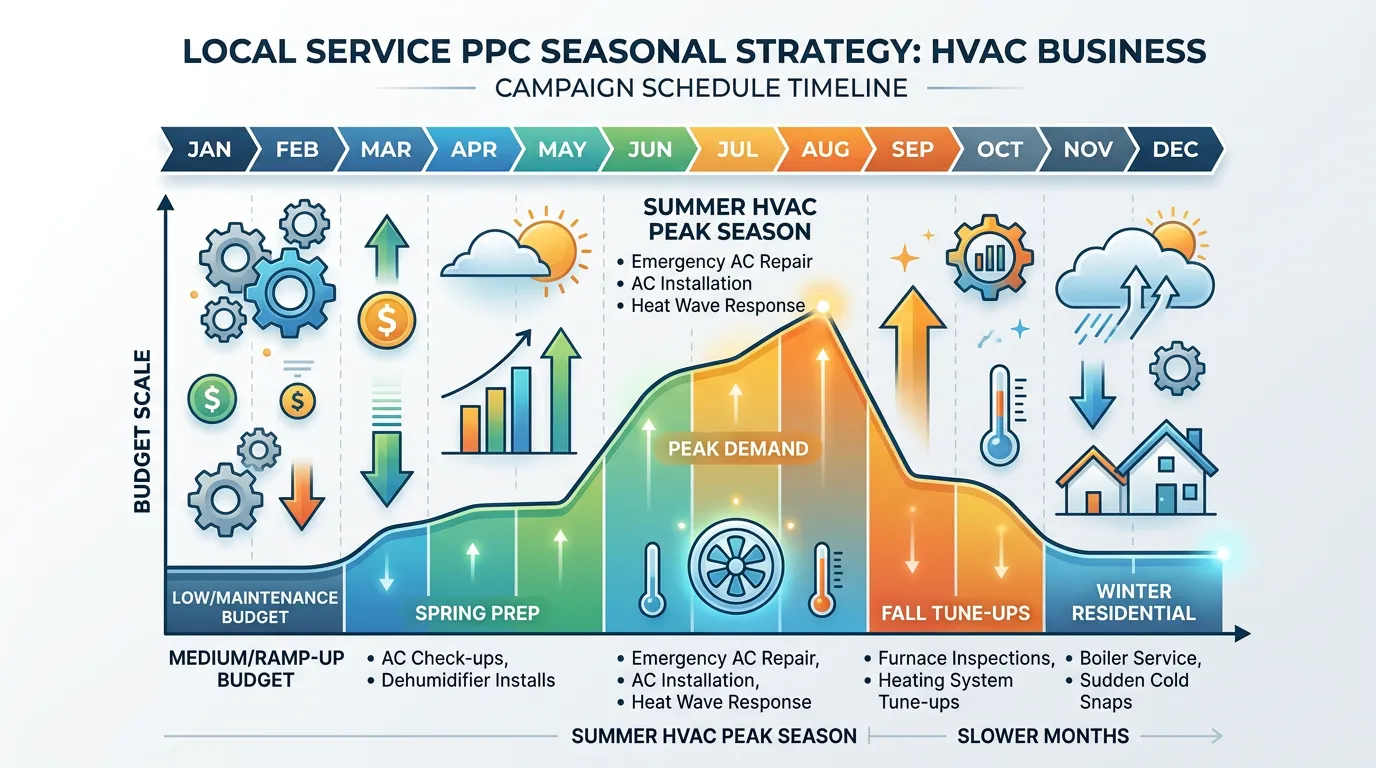
This is paid search designed for how service companies actually work. We split campaigns by urgency. Someone searching at 11 PM for no heat behaves nothing like someone researching a bathroom remodel on a Sunday afternoon. We draw location targeting around your real drive time, not a lazy 50 mile radius. Call only campaigns and call assets carry heavy weight, because most trades convert far better on the phone than on a form. Ad schedules follow your phone coverage, including after hours if you have an answering service. We plan the budget by season. That way you have money in July when the ACs fail, instead of spending it evenly across a slow spring.
Signs you need this
- You get leads from cities you would not drive to
- Your ads run at 2 AM and nobody answers the phone
- Ad spend is flat all year while your demand swings with the weather
- You are buying leads faster than your crews can service them
- Your ads compete against national franchises with much bigger budgets
What is included
- Campaign split between emergency, repair, replacement, and quote intent
- Local service area drawn by drive time with high cost outer zip codes excluded
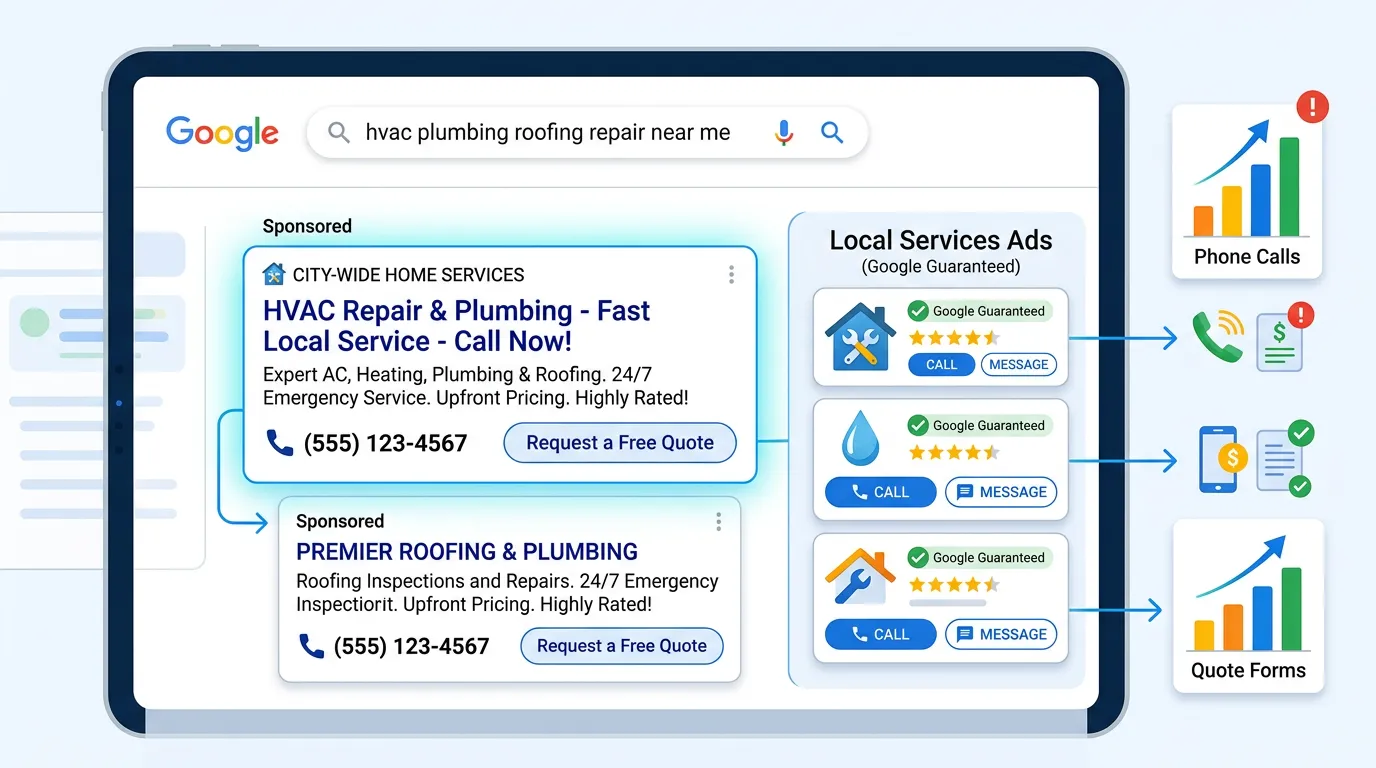
- Call only campaigns for mobile emergency searches
- Ad schedule matched to your phone coverage, including after hours handling
- Seasonal budget plan built around your historical demand curve
- Capacity guardrails so lead volume matches how many jobs you can run
- Competitor and franchise bid analysis for your specific counties
- Call recording review to hear how leads are actually being handled
- Cost per booked job reporting by service line, not just cost per lead
Our process
Capacity and Economics
Days 1 to 5Before keywords, we work out your average ticket, close rate, and how many jobs a day you can actually run. That determines the most you can pay for a lead and whether the auction in your county even works at your price.
Service Area Mapping
Days 5 to 9We build the geography from drive time and job profitability, not a circle on a map. Outer zip codes where travel eats the margin get excluded or bid down, and the highest value neighborhoods get bid up.
Urgency Based Build
Week 2 to 3Emergency campaigns run call only ads with tight keywords and higher bids. Planned service campaigns run standard search with longer landing pages, financing information, and gallery proof. Each gets its own budget.
Phone Handling Check
Week 3 to 6We listen to recorded calls from the first weeks. Missed calls, long hold times, and staff who quote prices instead of booking appointments cost more leads than any bidding mistake. You get the recordings and a short summary.
Seasonal Rebalancing
Ongoing, monthlyBudgets shift ahead of your demand curve, not after it. We raise spend before the heat wave and the first cold snap, and pull back during your slow weeks so the money is there when demand is real.
Realistic timeline: Live in two to three weeks. Calls in the first days. A real read on cost per booked job at 60 to 90 days, once enough leads have run through your close rate.
Work Out The Most You Can Pay For A Lead
Do this on paper before anyone picks a keyword. It decides whether paid search works for you at all, and it takes about five minutes.
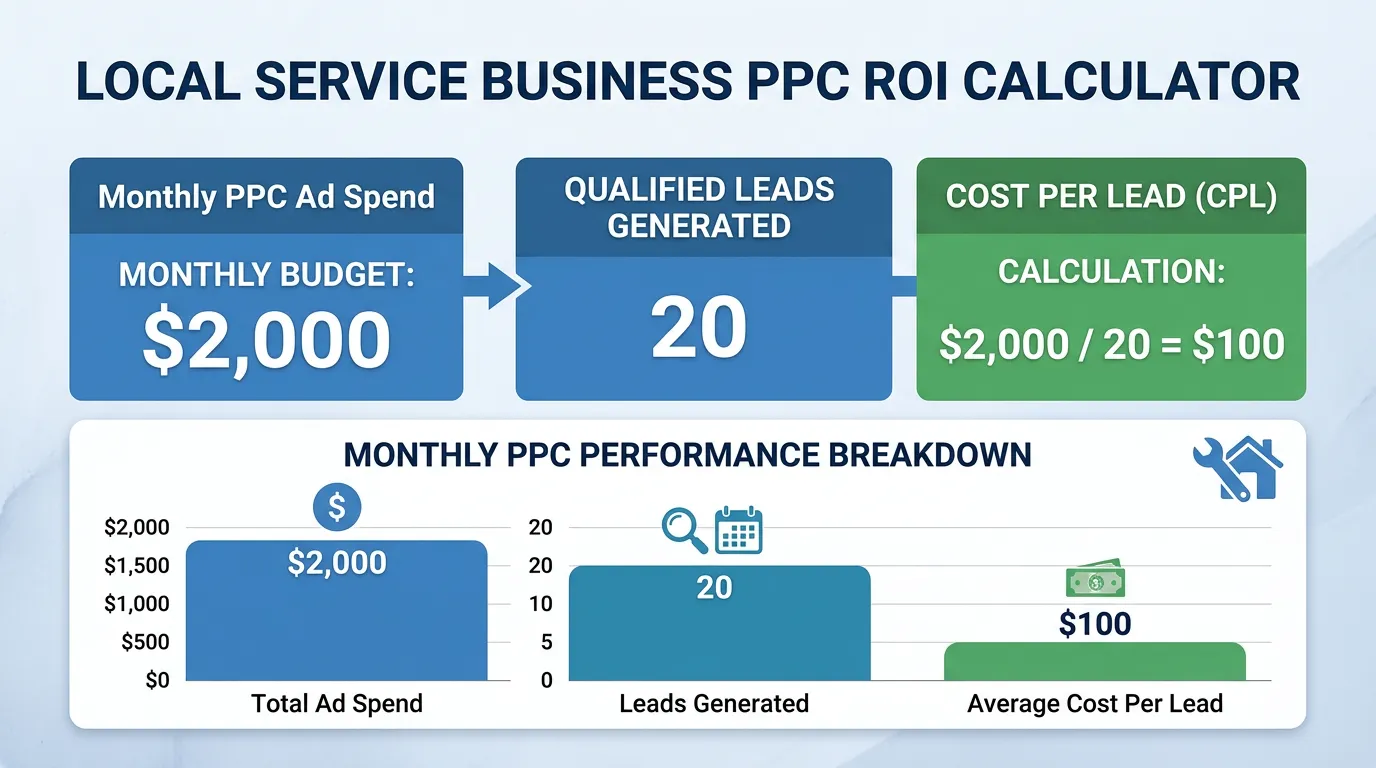
Take your average job value. Multiply by your gross margin, the share left after parts and labor. Multiply again by the share of leads you actually book. That is the most a lead can cost before you are working for nothing.
Say a repair company averages 450 dollars a job, keeps 45 percent after parts and labor, and books three of every ten leads. That is 450 times 0.45 times 0.30, which comes to about 60 dollars. Sixty is the ceiling, not the target. Aim for half of it, so a real cost near 30 dollars a lead leaves room for a slow month.
Now hold that ceiling next to click prices in your county. If clicks run 25 dollars and one in eight callers picks up the phone, a lead costs about 200 dollars. That business needs a bigger average ticket, a better close rate, or a different channel. Far better to learn that in week one than in month six.
Budget Follows The Season, Not The Calendar
Splitting a yearly budget into twelve equal months is the most common money mistake in the trades. Demand is not even, so the spend should not be either.
| Trade | Heaviest demand | Quiet stretch | What we do with budget |
|---|---|---|---|
| HVAC | First heat wave through September | Mild spring and late fall | Raise before the forecast, sell tune ups in the gaps |
| Plumbing | Steady, with holiday spikes | Few real lulls | Hold level, add money around long weekends |
| Roofing | First rains and the weeks after | Dry midsummer | Bank budget for storm weeks, run repair terms all year |
| Pest control | Warm months, ant and wasp season | Cold snaps | Front load spring, move to rodent terms in winter |
| Landscaping | Spring cleanups and fall prep | Deep winter | Two pushes a year, cut hard in between |
Auction prices climb during the rush. Being ready a week early usually costs less than reacting a week late.
What A Missed Call Actually Costs
Every step here happens inside about four minutes. Only the first one ever shows up in your ad account.
Answer speed is a bidding lever. A shop that answers on the second ring can afford more per click than one that does not.
Drawing A Service Area That Pays
Geography is the setting owners get wrong most often, and it is the one that costs the most for each mistake.
Do this
- Set location targeting to presence, so only people in the area see ads.
- Build the area from zip codes where your finished jobs actually are.
- Bid up the few zip codes that produce your best margin work.
- Exclude the outer ring where drive time eats the profit.
- Read the geographic report monthly for cities creeping in.
Not this
- Do not draw a round 50 mile radius. It buys clicks across three counties.
- Do not target people interested in your area. That reaches visitors.
- Do not chase the biggest city just because it has the most searches.
- Do not keep a zip code that has produced calls but no jobs for months.
- Do not run one bid everywhere. A 12 mile drive is not a 45 minute drive.