Pay Per Click Advertising
Ad Copy and Creative Testing
Tests headlines and images at the asset level, not whole ads
- Timeline
- Rewritten ads live in week two
Call (714) 823-3164 or ask a question. Clear recommendations, even if we never work together.
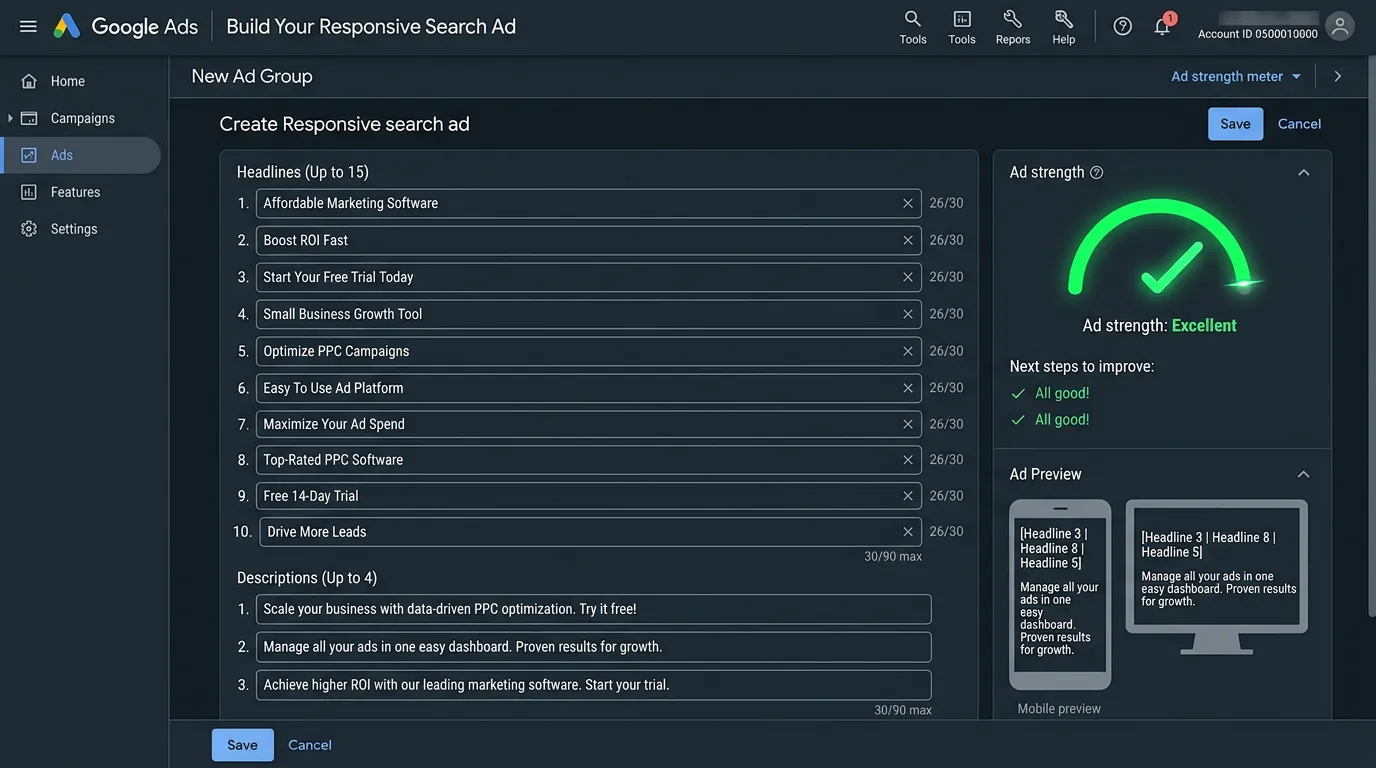
Ad copy and creative testing means writing several versions of your headlines, descriptions, and images, then running them long enough to see which combination brings cheaper leads. In responsive search ads, Google mixes assets on its own. So the testing happens at the asset level, not at the whole ad.
The problem
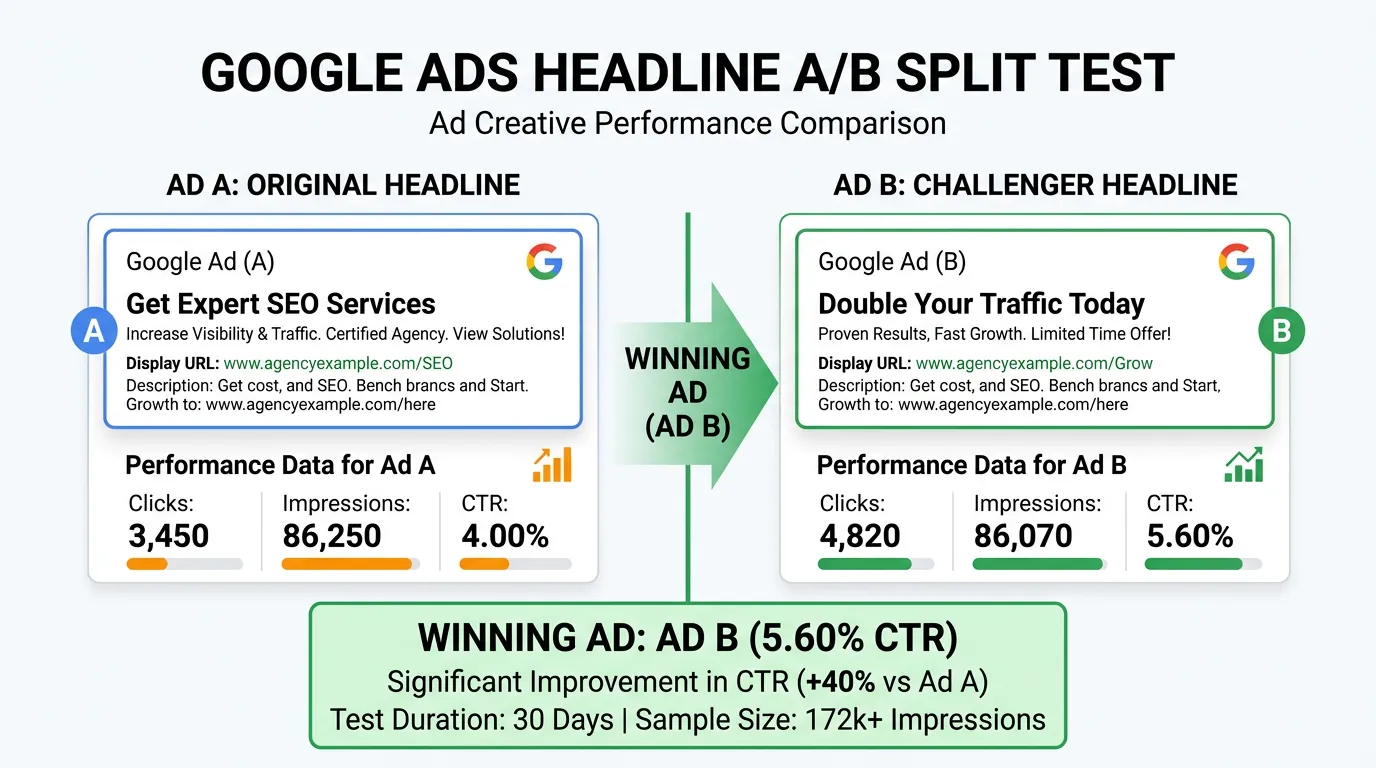
Two things break ad testing in most accounts. The first is never testing at all: three ads got written at launch in 2022 and they still run today, aimed at a market that has changed. The second is testing badly. Someone swaps five headlines at once, calls a winner after four days and 60 clicks, and declares that the word affordable beat the word licensed. That is noise, not a result. Then the account gets reorganized around a conclusion that was never real, and the next test compounds the error.
What it is
Modern Google ad testing works at the asset level. A responsive search ad holds up to 15 headlines and four descriptions, and Google builds the combinations. Your job is to feed it distinct ideas, not 15 versions of the same sentence. You pin the assets that must show in a fixed position. Then you read the asset performance ratings of Low, Good, and Best to see which ideas earn their place. We pair that with structured tests of one variable at a time: offer, proof, urgency, price framing, and call to action. For display and video, we test thumbnails, the first three seconds, and message order.
Signs you need this
- Your ads have not been rewritten since the account launched
- Every headline says some version of quality service and free estimates
- Ad strength shows Poor or Average across most ad groups
- Nobody can tell you which message currently produces your cheapest leads
- Your ads say nothing a competitor could not copy word for word
What is included
- Fifteen headlines and four descriptions per ad group, written as distinct angles
- Headline pinning strategy so brand and service always appear in position one or two
- A testing calendar with one variable changed per cycle
- Asset performance rating reviews with Low rated assets replaced monthly
- Offer and proof variants written from your actual warranties, prices, and reviews
- Display creative sets in every required size using real job photography
- Video hook tests for the first three seconds of YouTube assets
- A written log of every test, its dates, its volume, and its result
- Quarterly summary of which messages hold up over time
Our process
Message Inventory
Days 1 to 7We collect the raw material first: your warranty terms, financing options, response time, years in business, license number, review quotes, and the two or three objections you hear on every estimate call. Ads written without this default to generic claims.
Baseline Build
Week 2 to 4We rebuild the ads in each ad group with 15 genuinely different headlines, pin the brand and service headlines where needed, and let the set run untouched for two to three weeks to establish a baseline.
Single Variable Tests
Every 3 to 6 weeksEach cycle we change one thing: swap the offer, swap the proof point, or swap the call to action. Everything else stays. A test needs at least 100 clicks per variant before we read it, which for most local accounts means three to six weeks.
Asset Pruning
Ongoing, monthlyMonthly we replace assets rated Low with new angles. Assets rated Best get variations built around them. Assets with almost no impressions usually mean the idea is redundant with a stronger headline.
Cross Channel Rollout
QuarterlyWinning messages move outward. A headline that lowers cost per lead in search usually deserves a spot on the landing page hero, in the Google Business Profile description, and in display creative.
Realistic timeline: Rewritten ads live in week two. First readable test result at four to six weeks. Meaningful copy improvement stacks up over two to three quarters, not two weeks.
Eight Angles That Fill Fifteen Headline Slots
A responsive search ad holds up to 15 headlines. Most accounts fill them with 15 versions of one idea. These are the angles we pull from instead, then build variations on the ones that earn it.
Response time, written as a number
Same day, or a two hour window
Price framing that survives the phone call
Flat rate diagnostic, no trip fee
License and insurance, with the number
The CSLB number in the ad text
Warranty length, stated plainly
Parts and labor, real terms
Review count and score
Pulled from your Google profile
The city or neighborhood name
Matched to how people search
The objection you hear on every estimate
Answer it before the click
Who answers the phone, and when
A person here, not a call center
One Test Cycle, Start to Finish
A test is only worth running if it ends in a decision. This is the loop, and the step most people skip is the baseline.
For most local accounts one full cycle takes four to six weeks. That means about eight real tests a year, so pick the variables that matter.
Reading Asset Ratings Without Fooling Yourself
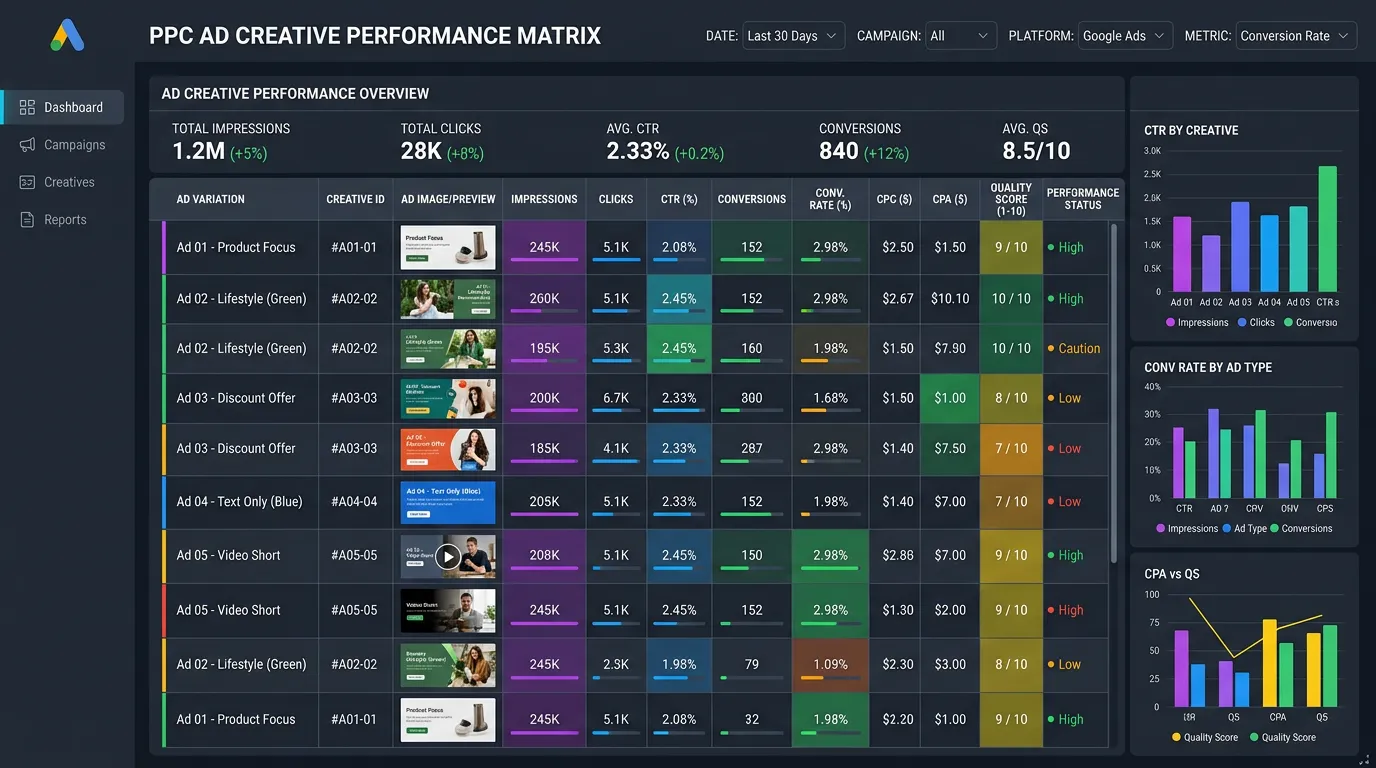
Google rates each asset Low, Good, or Best, and also shows Learning or Pending. The ratings help, but they are easy to misread.
A rating compares an asset against the others in the same ad, not against the market. Replace your two weakest headlines and something else becomes the new Low. There is always a Low. That alone does not mean the ad is broken.
An asset with almost no impressions is not failing either. It usually means Google never chose to serve it, often because it says nearly the same thing as a stronger headline, or because a pinned asset is holding that position and blocking it.
So we read three things together: the rating, the impression count, and what happened to cost per lead over the same weeks. Any one of them on its own will point you the wrong way.
A Rewrite, Line by Line
Here is what the change looks like on one ad group. Say an HVAC company runs the headline Quality Air Conditioning Service. Every competitor in the county could run that same line without changing a word.
The rewrite pulls straight from the message inventory, using that company's own real numbers: AC Repair in Chino Today. Licensed, Insured, CSLB Verified. Ten Year Parts Warranty. Answered by a Human at 9 PM. Free Second Opinion on Replacements.
None of that is clever. Each line is a fact the company already had and never put in an ad. That is the usual finding. The material for a good ad is sitting in the warranty paperwork, the license, and the review page.
The numbers do have to be true. If the warranty runs five years, write five. An ad that overstates does not only risk a policy problem, it books a caller who is already annoyed when the truck pulls up.