
How To Articles
How Long Tail Keywords Work, and How to Find Yours
What makes a search long tail, why the small numbers add up, and how to turn a four hundred row spreadsheet into a handful of pages worth building.
Call (714) 823-3164 or ask a question. Clear recommendations, even if we never work together.
Long tail keywords are specific searches that each get very little traffic but add up to most of it. They name a problem, a place, a brand, or a price, so the person searching is closer to buying. You find yours in Search Console and in your own phone calls, then group them by the answer they need.
Jump to a section
- What Actually Makes a Keyword Long Tail
- Why Small Numbers Add Up, and When They Do Not
- Where to Find Yours Without Buying a Tool
- Sorting Four Hundred Phrases Into a Handful of Pages
- Long Tail Lives in More Places Than Your Blog
- How to Judge Whether a Page Is Worth Building
- One Job, Five Levels of Specificity
- From a Spreadsheet Row to a Page That Earns
- Habits That Pay and Habits That Waste a Year
- Questions People Ask After the First Spreadsheet
- Questions
What Actually Makes a Keyword Long Tail
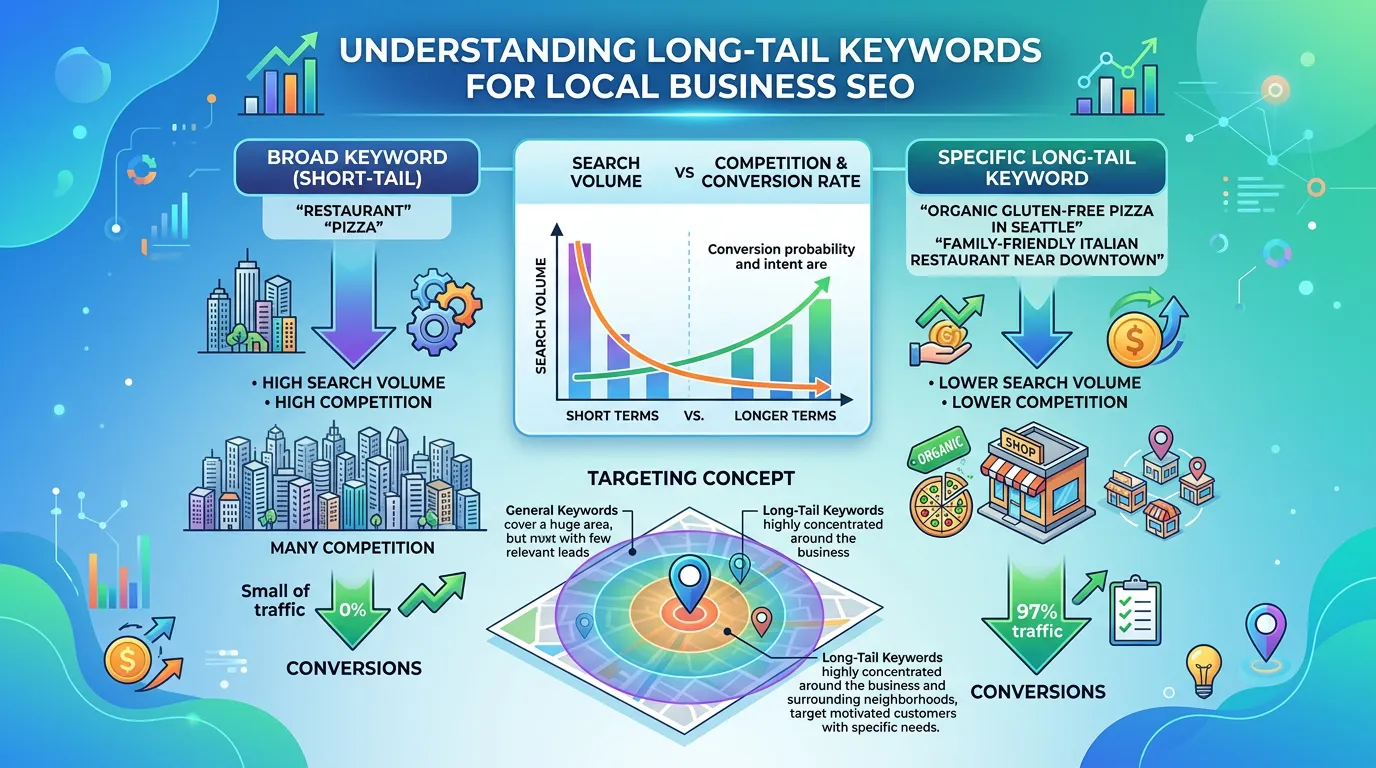
Long tail keywords are the specific searches almost nobody makes and almost everybody eventually makes. The name comes from a chart. Plot every search in your category by how often it happens and you get a tall spike on the left and a long flat line stretching off to the right. The spike is plumber. The flat line is everything like emergency plumber open sunday in rancho cucamonga. Length is a symptom, not the definition. What makes a phrase long tail is specificity. It names a problem, a place, a time, a brand, a price, or a condition. That specificity is why the searcher sits closer to buying. Somebody typing roofing is reading. Somebody typing cost to replace a tile roof in Chino has a roof and a budget question and a decision to make this month. Here is the part that gets skipped in most articles. Long tail is not a separate kind of traffic you go out and collect. It is the shape of all search. Most of the searches that reach any website are phrases nobody planned for, arriving a few at a time and never repeating. The strategy is not to predict those phrases one by one. It is to have pages good enough to catch them when they show up.
Why Small Numbers Add Up, and When They Do Not
A single long tail phrase might get ten searches a month across your county. That sounds like a rounding error and it is easy to dismiss. Two hundred of them is two thousand searches, and you can realistically hold a decent position for most of them, because your competitors have not written anything about them either. That is the entire argument for the approach. It is a volume play built out of small pieces, and it favors patient businesses over loud ones. It is also where people waste a year. Two mistakes cause most of that waste. The first is chasing phrases with no buyer behind them. How does a furnace work is a real question with real volume, and the person asking it is a student or a curious homeowner, not somebody about to call you. Answering it is fine. Counting it as a lead source is not. The second mistake is building a separate page for every wording of the same question. Furnace repair Chino, furnace repair in Chino, and Chino furnace repair are one page, not three. Search engines understand those are the same request, and a pile of near duplicate pages usually performs worse than one strong page. Ask whether the answer changes. If it does not, it is one page.
Where to Find Yours Without Buying a Tool
You already own the two best sources. The first is Search Console. In the performance report, open the queries tab and sort by impressions instead of clicks. The rows with high impressions and few clicks are searches where Google already thinks you are relevant and the searcher picked somebody else. That list is a to do list and it costs nothing. Filter for words like cost, near, best, how, and can to pull out the question shaped ones. The second source is your own phone. Ask whoever takes calls to write down the caller's first sentence for two weeks. You get phrasing no keyword tool produces, because it is the language of people who actually buy. Add the notes from quote requests and the wording inside your reviews, since customers describe a job using the same words the next customer will type. After that, use the free tools. Google's autocomplete and the related searches at the bottom of the results page show genuine phrasing. Keyword Planner inside Google Ads gives volume estimates and related terms, though it groups similar phrases together and rounds the numbers hard. Treat every volume figure as a rough size rather than a fact. The ranking of the numbers is more useful than the numbers themselves.
Sorting Four Hundred Phrases Into a Handful of Pages
The output of a good research session is an ugly spreadsheet with hundreds of rows. The real work is deciding which rows become pages. Group by the answer, not by the words. Put every phrase that would be satisfied by the same page into one pile. If a pile needs a different answer, a different price, a different process, or a different photo, it has earned its own page. If it needs the same answer with one word swapped, it belongs in a pile you already have. Three shapes cover most local businesses. Service pages carry the main phrases and the obvious variations. Sub pages under a service carry the real splits, such as repair versus replacement, a specific brand or system type, or a specific failure. Articles carry the questions people ask before they are ready to call, including cost questions, comparison questions, and what happens if I wait questions. There is a line to respect here. Making one thin page for every city and service combination you can think of is the oldest bad idea in local search, and Google's spam policies treat mass produced pages with little value as abuse. A city page earns its place when you can put real work, real photos, and real local detail on it.
Long Tail Lives in More Places Than Your Blog
Most advice treats this as a blogging exercise. For a local service business, several of the best slots are not on your website at all. Your Google Business Profile has a services field, and every service listed there is another phrase a local search can match. Most owners fill in three and stop. Write out the twenty things you genuinely do, including the small ones nobody advertises, and add each with its short description. Your review replies are indexed text where the customer already used the specific words, so replying with the job named beats replying with thanks. Photo captions and profile posts carry phrasing too. On your own site, the pages that catch long tail are less glamorous than a blog post. A clear list of the brands and systems you service. A page naming the neighborhoods and landmarks the way locals say them. Real answers in your FAQ, written as full sentences rather than one line. And a page that says what you do not do, which sounds backwards and quietly catches the people searching for exactly the thing you refuse, so they stop calling and you stop wasting the hour. Every one of those is a landing spot for a specific phrase.
How to Judge Whether a Page Is Worth Building
Before anything gets written, run each pile through four questions. Does somebody searching this have a problem you get paid to solve? Can you serve them, meaning is it in your area and on your truck? Does answering it require something you actually know, like a real price range or a real timeline? And can you write four hundred honest words about it without repeating yourself? Two yes answers and two maybes means skip it and come back later. Four yes answers means build it this week. Then set expectations for what follows. A new page gets crawled and indexed first, which takes days to weeks. Impressions arrive before clicks, often for a month or two while the page settles into a position. Long tail pages move faster than head terms because there is less competition, but faster still means eight to twelve weeks before you can judge anything honestly. After a quarter, open the queries report filtered to that page. The number to watch is not position. It is how many different phrases the page picks up. A page catching forty separate searches is doing its job even when none of them is the phrase you had in mind when you wrote it.
One Job, Five Levels of Specificity
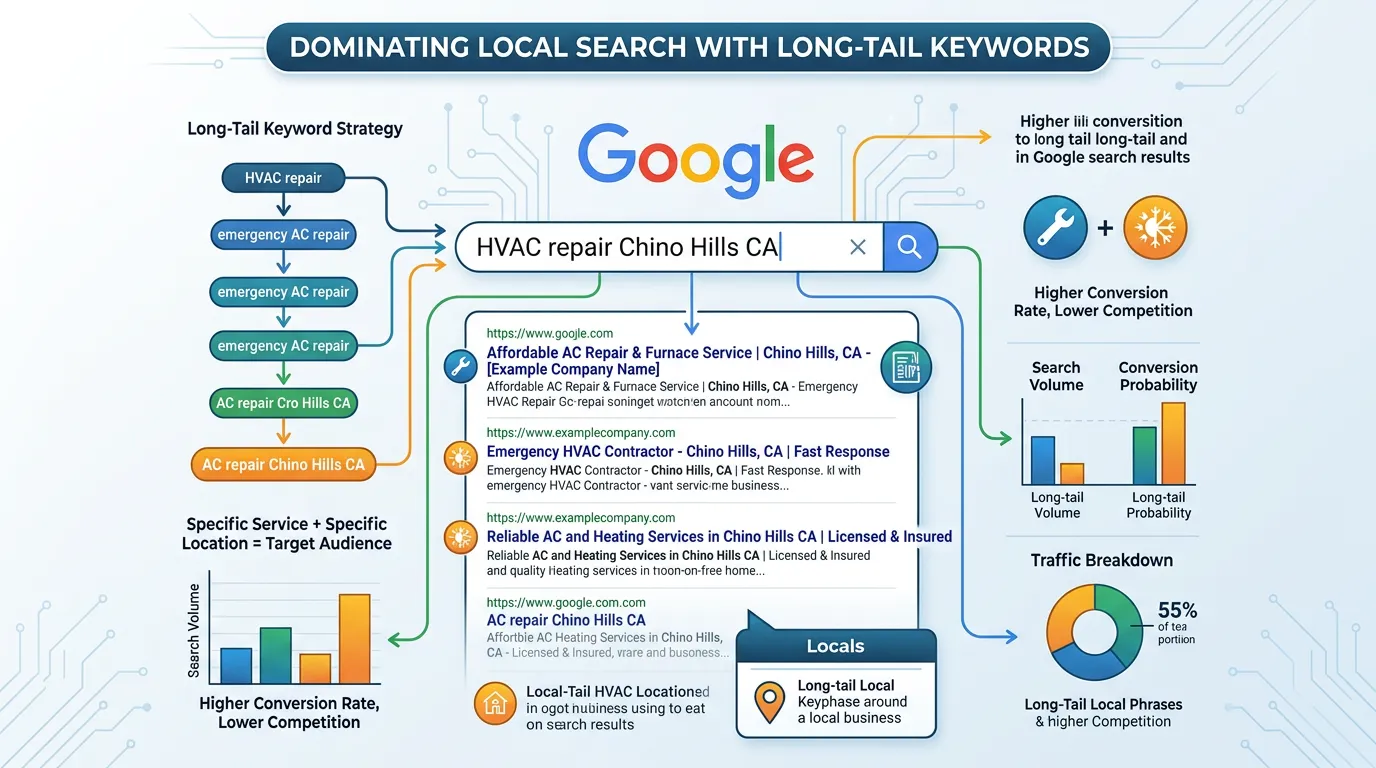
The same water heater, five different searchers. Notice how the right column changes as the phrase gets narrower.
| What they search | Why they search it | Roughly how common | Where it should land |
|---|---|---|---|
| plumber | Just starting to look around | Very high | Homepage or main service page |
| plumber in Chino | Narrowing down by place | High | The city page, if it is a real one |
| water heater repair Chino | Knows which job they need | Moderate | A sub page for that service |
| why is my water heater leaking | Has a problem, no company yet | Low each, many of them | An article that answers it plainly |
| cost to replace a 50 gallon water heater | Ready to price the job | Low, and the best intent | A cost page with honest ranges |
The bottom two rows are where most local businesses have nothing written at all, which is exactly why they are worth writing.
From a Spreadsheet Row to a Page That Earns
Five steps, and most people skip the third one. That is where the wasted year comes from.
Qualify is the step that turns four hundred rows into twelve pages. Skipping it turns them into four hundred thin pages.
Habits That Pay and Habits That Waste a Year
Almost every stalled long tail project failed on one of the items in the right hand column.
Do this
- Sort Search Console by impressions to find searches you already almost win
- Write down the first sentence callers say, for two full weeks
- Group phrases by the answer they need, then count the piles
- Add every service you truly offer to your Google Business Profile
- Judge a page by how many different phrases it catches
Not this
- Do not build a page for each wording of the same question
- Do not mass produce city and service pages with nothing local on them
- Do not chase question phrases with no buyer behind them
- Do not treat keyword tool volume figures as exact counts
- Do not give up at six weeks, since indexing alone can take that long
Questions People Ask After the First Spreadsheet
Does this still work now that search engines understand meaning?
How many long tail pages should a small business have?
What about phrases the tools show as zero volume?
Would rather we handled it?
This article covers how to do the work yourself. If you would rather have it done for you, that is what our local seo service is.
Local SEO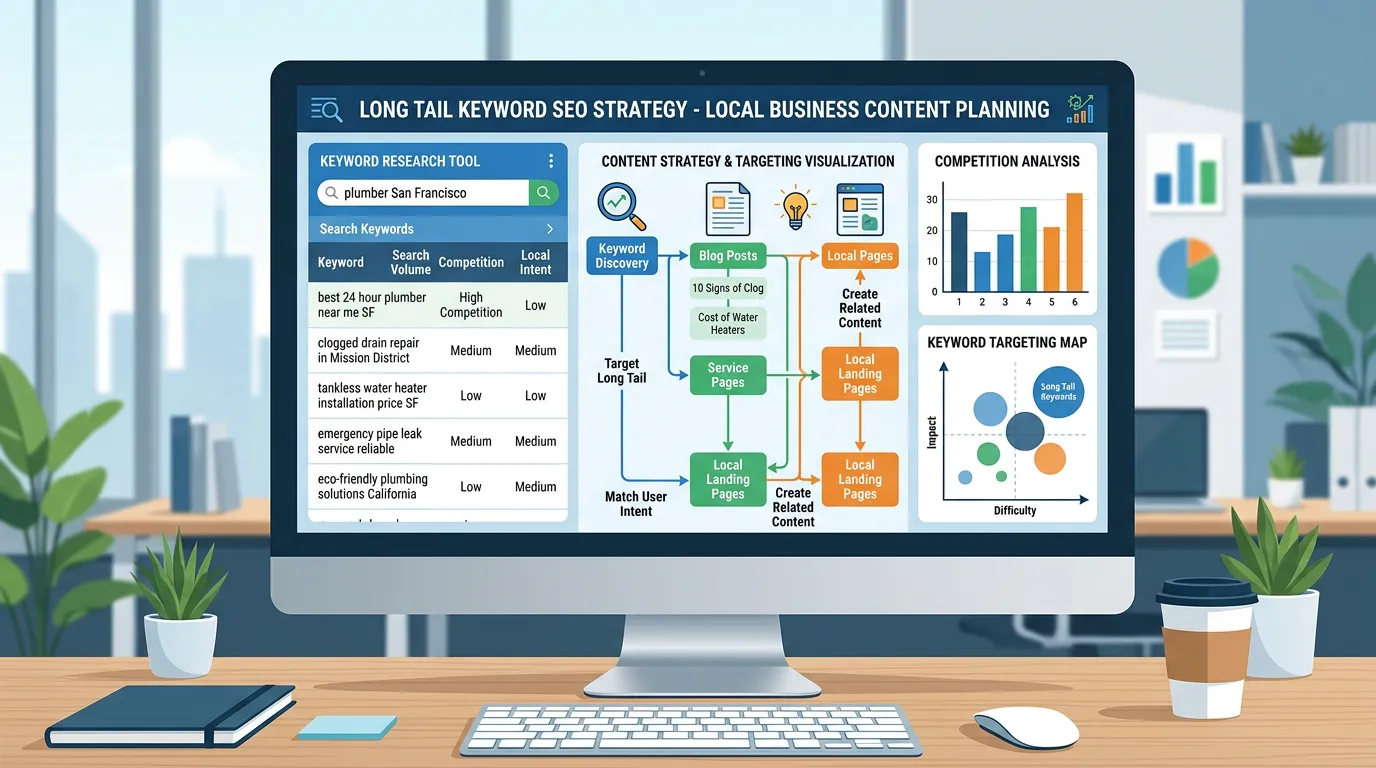
Frequently asked questions
How many words makes a keyword long tail?
Are long tail keywords easier to rank for?
Should I put the exact phrase in my page title?
Do I need a paid keyword tool to do this?
Sources
- Search Console Help: Performance report(opens in a new tab) The performance report shows clicks, impressions, and average position and can be filtered by query and by page, which is the free source for finding specific searches you already appear for.
- Google Ads Help: Use Keyword Planner(opens in a new tab) Keyword Planner is documented as a tool for discovering new keywords related to your business and viewing estimates of the searches they receive.
- Google Search Central: Spam policies for Google web search(opens in a new tab) Google's spam policies describe mass produced pages created with little value to users as scaled content abuse, which is the risk in generating a page for every city and service combination.
- Google Business Profile Help: Tips to improve your local ranking on Google(opens in a new tab) Google states that complete and detailed business information, including the services a business offers, helps Google match a business to relevant local searches.