
How To Articles
How Local SEO Works, From Search to the Three Map Results
How Google decides which three businesses get the map pack, and what each part of your setup actually contributes to that decision.
Call (714) 823-3164 or ask a question. Clear recommendations, even if we never work together.
Local SEO works by feeding Google three kinds of signals: how relevant your business looks for the search, how close you are to the person searching, and how well known your business appears online. Your Google Business Profile, your website pages, your listings, and your reviews all feed those signals.
Jump to a section
- One Search, Two Sets of Results
- Relevance, Distance, and Prominence Do the Sorting
- Your Profile Is a Record in a Database
- How Your Website Feeds Your Map Listing
- Why Google Cross Checks You Against Other Sites
- What Google Reads in Your Reviews Besides Stars
- How Fast Each Change Actually Shows Up
- What Happens Between the Tap and the Three Results
- Where Each Local Signal Lives and How Fast It Moves
- Why Your Rank Changes When You Drive Across Town
- Questions About the Mechanics
- Questions
One Search, Two Sets of Results
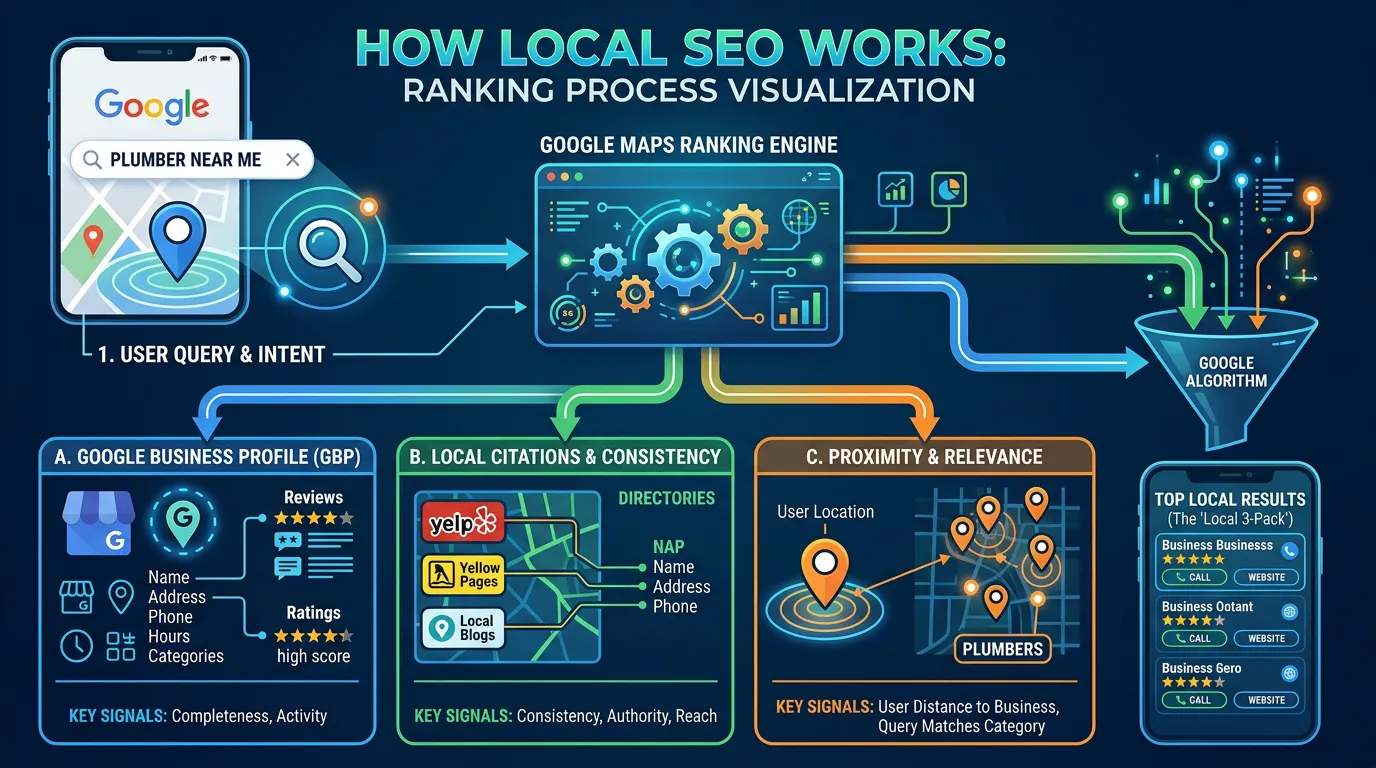
Type plumber near me on a phone and you get two lists on one screen. At the top sits the map pack, which is a small map with three business listings under it. Below that sit the normal blue links, which often include the same businesses again along with directory sites. These two lists are built in different ways, so it is normal to hold a spot in one and not the other. Tap the more places link under the map and you land in the local finder, a longer version of the same map list. Most people never tap it. That is why the three visible slots matter so much, and why fourth place feels so far away. When you check your own ranking, be clear about which list you are looking at. A report showing you at position four might mean fourth in the local finder, which is off the first screen for most searches. Ask whoever sends you a report which list the number came from. The local SEO work that moves the map list and the work that moves the blue links overlap, but they are not the same job.
Relevance, Distance, and Prominence Do the Sorting
Google says local results come mainly from three things: relevance, distance, and prominence. Those words sound vague until you look at what feeds each one. Relevance is how well your business matches the words someone typed. Google reads your primary category, your extra categories, the services you listed, your description, and the page your profile links to. If a searcher types drain cleaning and your profile only says plumber, you are less relevant than the shop that listed drain cleaning as a service. Distance is how far you sit from the person searching, not from the middle of town. Google uses the phone location when it has one. That is why you can hold the top spot in your own neighborhood and vanish six miles away. You cannot change this one without moving. Prominence is how well known your business looks. Reviews, links from other sites, news mentions, and how often people search your name by itself all feed it. Prominence is the slowest to build and the hardest for a competitor to copy. Relevance is the fastest to fix, often in a single afternoon of profile edits.
Your Profile Is a Record in a Database
It helps to stop thinking of your Google Business Profile as a web page. It is a record in a very large database, and every field in it is a filter Google can match a search against. Name, primary category, extra categories, services, products, attributes, hours, service area, and website URL are all separate fields. Fill one in badly and you drop out of the searches that field controls. The primary category carries the most weight of any single field. A shop listed as Contractor instead of Roofing Contractor is competing in the wrong bucket, and no amount of review collecting fixes that. You can add extra categories, but they count for less, and ten unrelated ones muddy what you look like. Services is the field most owners skip. Each service you add is a phrase Google can match, and you can write a short description for each one. Attributes matter more than people expect in some trades, since things like wheelchair accessible entrance show up as filters inside Maps. Fill every field you honestly qualify for and leave the rest blank.
How Your Website Feeds Your Map Listing
The link on your profile is not just a way for customers to reach your site. Google reads the page it points to and uses it to judge what your business does. Point the profile at your homepage and Google gets a general answer. Point it at a page about the exact service, when the profile is set up for that service, and the answer gets sharper. For a single location business the homepage is usually right, because it carries the most links. For a second or third location, each profile should point at that location page instead. Your name, address, and phone should appear as real text on the site, not baked into an image, since text is what gets read. Adding LocalBusiness structured data hands Google the same details in a format built for machines. It does not lift rankings on its own, but it removes guesswork about which business the page belongs to. City and service pages help too, though not the way most people think. They rarely move the map listing by themselves. They win the blue links underneath, which is a second slot on the same screen.
Why Google Cross Checks You Against Other Sites
Google does not take your word for who you are. It compares what your profile says against what the rest of the web says. Directory listings, chamber pages, supplier sites, license databases, and old review sites all carry copies of your name, address, and phone. When those copies agree, Google gets more confident the record is real. When they disagree, confidence drops. This is what people mean by citations. The count matters far less than whether they match. Fifty listings that all say the same thing beat two hundred where a third still show a number you dropped in 2019. The worst version is an old address that another business now occupies, because that sends the wrong distance signal. Start with the sites that feed others: the big data aggregators, Apple Maps, Bing Places, the main review sites, and your trade licensing board. Fix those and many smaller directories update themselves over the following months. Then search your business name in quotes next to your old suite number or old street. Anything that comes back is a copy that still needs correcting.
What Google Reads in Your Reviews Besides Stars
Count and star average are the obvious parts. They are not the only parts. The words inside a review are readable text, and a review saying they replaced our water heater the same day contains a phrase customers search for. You cannot script that, and you should not try, but you can ask in a way that prompts detail. Asking which job we did for you gets better text than asking for five stars. Recency matters because a profile with nothing new in six months looks like a business that may have slowed down. Steady beats sudden. Twenty reviews in one week after a year of silence looks like what it usually is. Spread matters for multi location companies, since reviews that all land on one profile leave the others thin. Replies are read by people more than by machines, and a calm reply to a two star review does more for the next reader than the review does against you. One rule you cannot bend: Google prohibits offering payment, discounts, or free work in exchange for reviews.
How Fast Each Change Actually Shows Up
Different fixes move on different clocks, and knowing which is which keeps you from panicking in week three. Profile edits like categories, services, hours, and description usually go live within a few hours to a few days, and some sit in review before they publish. A category change can shift what you rank for within days, though the shift is not always up. New pages on your site have to be crawled and indexed first, which takes days to weeks, and then they need more time to gather signals. Listing corrections spread outward slowly, since every directory updates on its own schedule and some take a full quarter. Reviews and links compound instead of jumping. Neither moves much in a week, and both keep paying for years. So do the local SEO work in that order. Fix the profile fields first, because they cost nothing and land fastest. Build or repair the pages next. Start review collection and local outreach at the same time, since they need the longest runway. Doing it backwards is how people end up six months in with a decent link profile and a primary category that was wrong the whole time.
What Happens Between the Tap and the Three Results
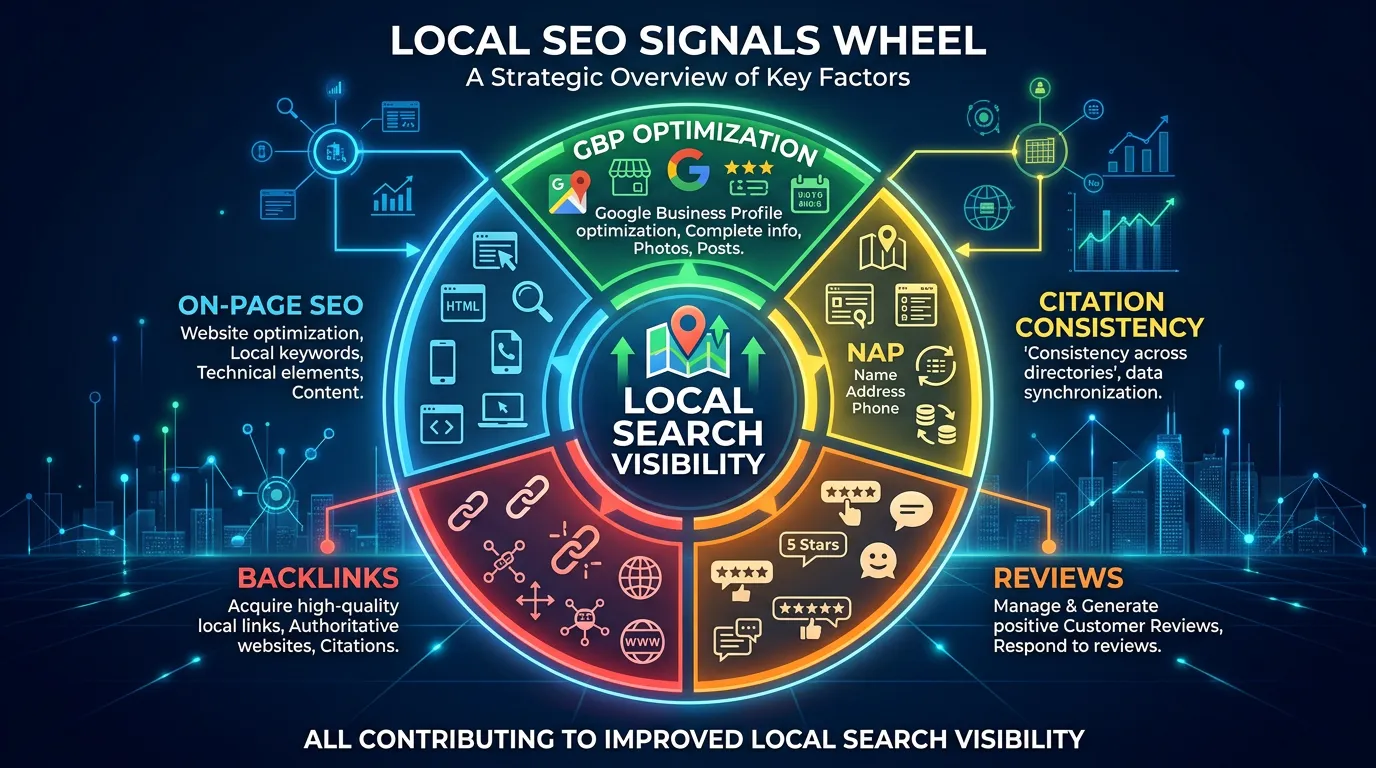
A local search is not one step. It is five, and your work lands at different points in the chain.
Your categories and services decide whether you make the set at all. Reviews and links decide where you land once you are in it.
Where Each Local Signal Lives and How Fast It Moves
The list is the same for every business. What changes is which row is broken for you.
| Signal | Where you change it | How fast it can move | What it mostly affects |
|---|---|---|---|
| Primary category | Google Business Profile | Days | Which searches you appear in |
| Service list | Google Business Profile | Days | Longer, specific searches |
| Linked page | Your website | Two to four weeks | How Google reads your topic |
| Name, address, phone | Profile plus directories | One to three months | Trust in the record |
| Reviews | Customers, on request | Months, compounding | Prominence and call rate |
| Local links | Other people's sites | Months, compounding | Prominence, hardest to copy |
The two fastest rows are free to change. Most businesses that are stuck are stuck on one of them.
Why Your Rank Changes When You Drive Across Town
Ask two employees to search the same phrase from two different houses and they will send you two different screenshots. Neither one is wrong. Google rebuilds the result set around the person, so the answer changes with the address.
This is why a single rank number for a whole city means very little. Better tools scan a grid of points across your service area and report a position at each one. You end up with a map of where you win and where you do not.
That map changes how you spend money. Take a hypothetical HVAC company that sits in the top three within four miles of the shop and nowhere past seven. The fix is rarely more work on the same city. It is a second real location, a partner, or accepting that the far edge belongs to somebody closer.
Questions About the Mechanics
Does adding more service areas make me rank in more places?
Does a post office box or a rented mailbox count as an address?
Do I have to keep the same phone number forever?
Would rather we handled it?
This article covers how to do the work yourself. If you would rather have it done for you, that is what our local seo service is.
Local SEO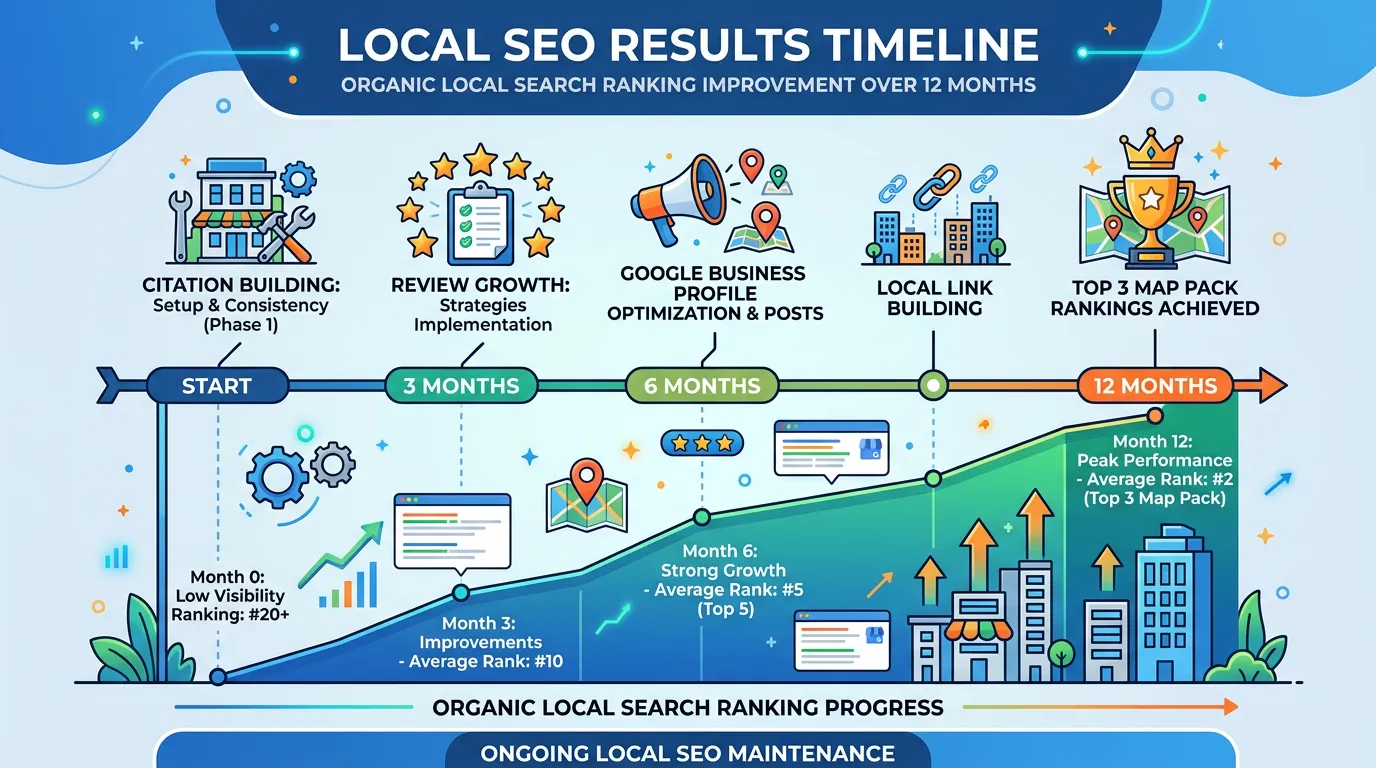
Frequently asked questions
Does my address have to be inside the city I want to rank in?
How many categories should I add to my Google Business Profile?
Do I need a website if I already have a Google Business Profile?
Why does a competitor rank above me with fewer reviews?
Sources
- Google Business Profile Help: Tips to improve your local ranking on Google(opens in a new tab) Google states that local results are based mainly on relevance, distance, and prominence, and describes what feeds each one.
- Google Search Central: Local Business (LocalBusiness) structured data(opens in a new tab) Google documents LocalBusiness structured data as the way to give business details such as address, hours, and location in a machine readable format.
- Google Business Profile Help: Manage your service areas(opens in a new tab) Service area businesses can list service areas by city, postal code, or region, up to a limit of twenty areas.