
Foundational Guides
How Much Does Video Marketing Cost, and What Moves the Price
Four pricing shapes, the ranges you will see quoted, and the eight things that decide whether a video quote comes back high or low.
Call (714) 823-3164 or ask a question. Clear recommendations, even if we never work together.
Video is priced four ways: per finished video, per shoot day, per project, or as a monthly fee. Small business work is commonly quoted somewhere between one thousand and five thousand dollars for a single finished video. What moves that number most is the number of locations, the filming hours, and how much editing the footage needs.
Jump to a section
- The Four Ways Video Gets Priced
- What Is Actually Inside a Video Quote
- The Eight Things That Move a Quote the Most
- What Doing It Yourself Really Costs
- Why Editing Is Where the Money Goes
- The Costs That Show Up After the Shoot
- How to Compare Two Quotes That Look Nothing Alike
- Rough Market Ranges by Pricing Shape
- Ask These Before You Approve a Video Quote
- Buying Video Without Overpaying
- Where a Shoot Day Budget Actually Goes
- Questions
The Four Ways Video Gets Priced
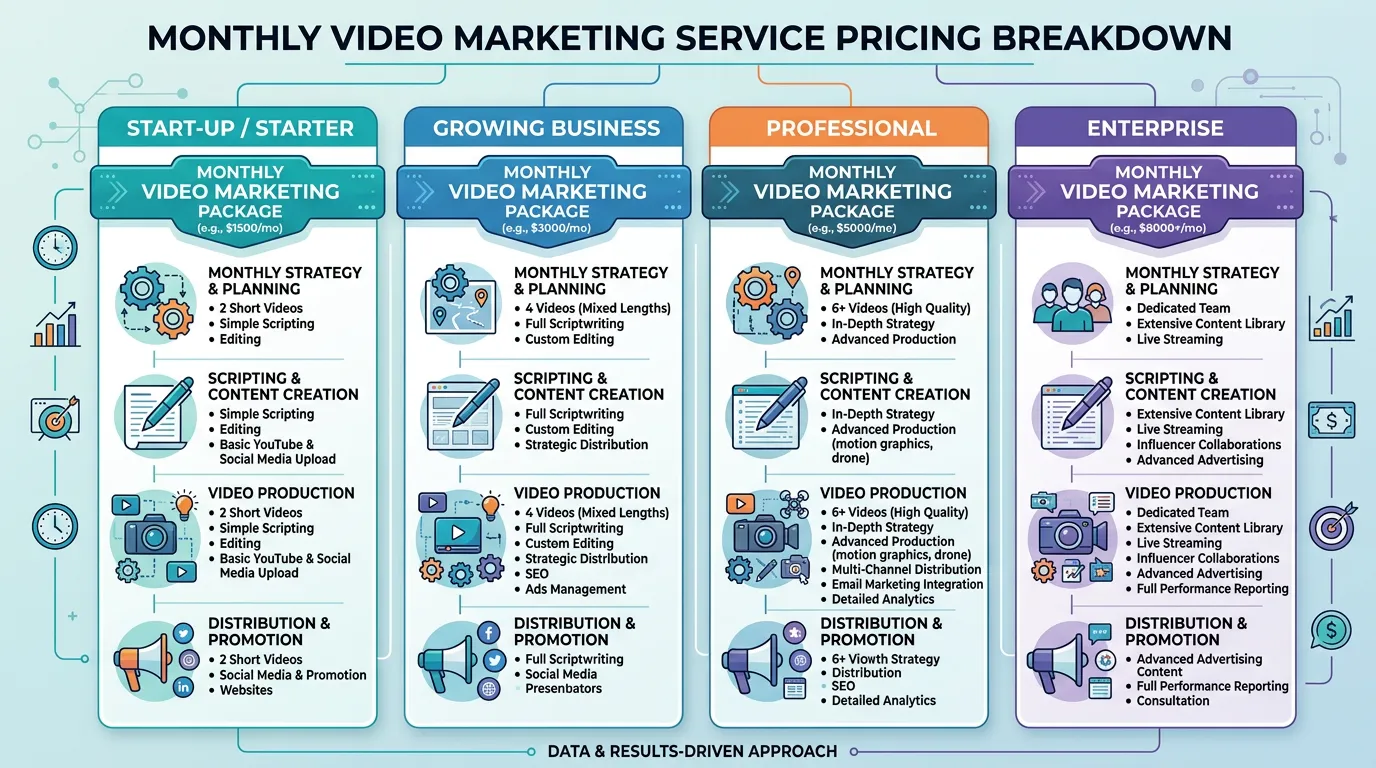
Video quotes come in four shapes, and telling them apart is most of the video marketing work. Per video is the simplest. You pay a fixed price for one finished piece on one topic. It is easy to budget and the most expensive way to buy in volume. Per shoot day buys a crew for a set number of hours. Whatever gets filmed in that window is yours, so the price per finished video drops fast if you arrive with a list. Per project covers a planned set from the first meeting to the final files. That is the common shape for a rebuild or a launch, and it should always come with a written deliverable list. Monthly is the fourth. You pay a fee that covers planning, editing, publishing, and an agreed number of clips, usually cut from footage that already exists. Two quotes for the same amount of money can mean completely different things across these shapes. Before you compare any numbers, ask which shape you are looking at and how many finished videos come out the other end.
What Is Actually Inside a Video Quote
Three buckets, always. Pre production is the planning: deciding what to film, writing scripts, building a shot list, and picking locations that will not fight the audio. It looks like the least important line and it is where the quality gets decided. Production is the filming day itself, plus travel, gear, and however many people are on the crew. Post production is editing, color, sound, captions, graphics, music, and exports. Owners are usually surprised by the split. Filming is often the shortest part. A six hour shoot can produce several days of editing, because every finished minute means sorting through many minutes of footage. When a quote arrives as one number with no breakdown, ask for those three lines. This is not about haggling. It is about seeing where the money goes, so you know what you are cutting if you need a cheaper version. A quote that is heavy on production and light on post usually means fast, simple edits. That can be exactly right for job site clips and quite wrong for a customer story.
The Eight Things That Move a Quote the Most
Two quotes differ for reasons that have almost nothing to do with camera gear. Below are the levers, roughly in the order of how hard they push. Most of them are under your control before anyone shows up, which makes this the list to negotiate against. Two are worth watching closely. Deliverable count creeps quietly, because horizontal, square, and vertical versions of six videos is eighteen files to build and check, not six. And unlimited revisions is never actually free. It is either priced in from the start or it turns into an argument later, so agree on a number of rounds and what a round is allowed to change.
- Number of locations, since every move costs setup time
- Travel outside the crew's normal area, billed as time or mileage
- Filming hours, which set how many people are booked for the day
- Edit complexity, from a straight cut to motion graphics and animation
- Number of deliverables, since each format is another export and check
- Paid talent or a voice actor instead of you and your crew
- Rush turnaround, because it pushes other work aside
- Revision rounds beyond the one or two written into the quote
What Doing It Yourself Really Costs
Filming it yourself is a real option, and for short clips it is often the right one. Just price it honestly. A usable kit is a phone you already own, a tripod, a clip on microphone, and one light. That set runs in the low hundreds of dollars, not thousands, and it handles job site clips and quick updates fine. The cost that gets missed is hours. Editing is the part that eats a weekend. A one minute vertical clip takes a beginner far longer than it takes someone who does it daily. Multiply that by a weekly posting habit and the free option starts to look expensive. So split the video marketing work by type. Film the everyday clips yourself, because you are already on site and nobody else can be. Hire out the pieces where quality shows most: customer stories, service explainers, and anything that will run as a paid ad. There is a middle path too. Some shops will edit footage you send them and bill by the hour, which keeps the camera cost at zero and buys back your evenings.
Why Editing Is Where the Money Goes
Ask any editor where the hours go and the answer is the same. Watching footage. Before a single cut gets made, someone has to sit through everything filmed and mark the usable parts. That step scales with how much you shot, which is why a loose shoot day costs more to edit than a planned one. Captions are the next chunk. Automatic captions get names, brands, and trade words wrong constantly, so a person has to correct them by hand. It is not hard work, it is slow work, and it is worth paying for, since most viewers are reading rather than listening. Then come versions. The same story cut for a service page, a vertical feed, and a fifteen second ad is three edits, not one export. Each one needs its own opening, because the vertical version has to earn attention in the first second. Music is the last line people forget. Licensed tracks are cheap. Ask what the license covers and whether it follows the video into paid ads.
The Costs That Show Up After the Shoot
The invoice for filming is not the whole bill. Plan for four more items. Hosting is first. YouTube is free and it is the right choice for most local businesses. A paid host costs a monthly fee and buys a player with no suggested videos at the end, which some owners want on a sales page. Posting labor is second. Somebody has to upload, write titles, build thumbnails, and schedule. If that somebody is you, it is still a cost. Ad spend is third, and it is separate from creative. A video ad with no budget behind it reaches almost nobody, so decide the media budget before you commission the creative, not after. Refresh is fourth. Core explainers can run a year or more. Ad creative wears out faster, and short clips are consumed weekly by design. An honest video budget has two lines. One for making things, one for keeping them running. Businesses that only budget the first line end up with a good library and nobody watching it.
How to Compare Two Quotes That Look Nothing Alike
Put both quotes into the same units before you look at price. Finished videos, deliverable files, shoot hours, revision rounds, and who owns the raw footage. Once those five sit side by side, a cheap quote often turns out to be a smaller job rather than a better deal. Ask for a sample of recent work in your trade, not a highlight reel. A montage proves someone can cut to music. A full customer story proves they can get a real answer out of a nervous person, which is the much harder skill. Ask who is on the shoot day. One person filming and running sound works for simple setups and slows down on a job site. Two people costs more and usually finishes on time. Finally, get the deliverable list in writing with the count, the formats, and the delivery date. Most disputes about video are not about quality. They are about someone expecting nine files and receiving three, and that is a paperwork problem. Paperwork is cheap to fix in advance.
Rough Market Ranges by Pricing Shape
Ranges you will commonly see quoted in US dollars. Treat them as a sanity check on a proposal, not as a price list.
| Shape | What you get | Common range | Best fit |
|---|---|---|---|
| Per finished video | One edited video, one topic | 1,000 to 5,000 | You need two or three videos |
| Per shoot day | A crew for a day, many videos | 1,500 to 6,000 | You have a list ready to film |
| Per project | A planned set, start to finish | 5,000 to 25,000 | A launch or a full rebuild |
| Monthly | Planning, edits, and posting | 1,000 to 5,000 a month | A steady flow of clips |
| Editing only | You film, they cut | 75 to 200 an hour | Your crew already films daily |
The biggest single swing is how many finished videos come out of one booked day. Arriving with a list moves you down every row.
Ask These Before You Approve a Video Quote
Eight questions that turn a vague proposal into something you can hold someone to.
How many finished videos do I get?
Count the topics, not the export files.
How many file versions per video?
Horizontal, square, vertical, and any ad cuts.
How long is the shoot day?
And what the rate is if it runs long.
Who is on the crew that day?
One person or two changes the pace a lot.
How many revision rounds are included?
And what a round is allowed to change.
Do I get the raw footage?
Ask for it in writing, on a drive or a link.
Are captions and transcripts included?
For every deliverable, not just the long cut.
What is the delivery date?
A date, not a range like a few weeks.
Buying Video Without Overpaying
The cheapest quote and the best value are rarely the same line. These habits protect both.
Do this
- Batch topics into one shoot day instead of booking several
- Arrive with a written list of what gets filmed and in what order
- Ask for the three cost buckets broken out on the quote
- Buy the pieces where quality shows and film everyday clips yourself
- Get the deliverable count and the delivery date in writing
Not this
- Do not pay for animation on a video that only needs a person talking
- Do not order every format for a video that lives on one page
- Do not book a rush turnaround you did not actually need
- Do not sign a long monthly agreement before seeing one finished video
- Do not judge a quote by the camera gear listed in the proposal
Where a Shoot Day Budget Actually Goes
Setup and moving eat more of a shoot day than anyone expects. Lights, a sound check, and finding a spot where the compressor is not running take real time. That is why a second location costs more than a second video at one location.
Filming itself is fast when the planning was done. A scripted two minute explainer might take twenty minutes to capture across a few takes. An unscripted customer interview takes longer, because the good answer usually shows up on the third try.
Editing is where the invoice quietly grows. Sorting footage, cutting, fixing captions, and exporting versions is measured in days, not hours. When a quote looks unusually low, this is almost always the bucket that got thin.
Would rather we handled it?
This article covers how to do the work yourself. If you would rather have it done for you, that is what our video marketing service is.
Video Marketing
Frequently asked questions
Is a cheap videographer a bad idea?
Does one long video cost more than several short ones?
Do I have to pay for music?
Should I pay monthly or one time?
Sources
- Add photos and videos to your Business Profile(opens in a new tab) Google's limits for profile video decide how many extra short exports a shoot has to deliver, which is part of the deliverable count.
- Google Analytics 4 events guide(opens in a new tab) Calls, forms, and bookings are recorded as GA4 events, which costs nothing in software and is priced only as setup labor.
- Video SEO best practices(opens in a new tab) Thumbnails, titles, and a page for each video are part of publishing work, not filming, so they belong in the post production line of a quote.