Lead Generation Systems
Sales Funnel Design for Service Businesses
Maps every stage from first touch to signed job
- Timeline
- Four to six weeks to map and design the funnel
Call (714) 823-3164 or ask a question. Clear recommendations, even if we never work together.
Funnel design is planning the full path a customer takes from first contact with your business to a signed job. It sets what you offer at each stage, what happens between stages, and who is responsible for moving the customer forward. It is the architecture, not the individual pages or forms.
The problem
Most service businesses have one funnel stage: someone calls, someone gives a price. That works for emergency work and fails badly for anything a customer thinks about for three weeks. A 40,000 dollar remodel buyer is not ready to book on the first visit and there is nothing built to hold them. So they get a quote, go quiet, and buy from whoever stayed in contact. The opposite failure is copying a software funnel: a lead magnet, a seven email nurture, a webinar. Nobody attends a webinar to pick a plumber. The funnel has to match how expensive local services are actually bought.
What it is
Funnel design starts by mapping how your best customers actually bought. We usually review a dozen recent closed jobs and ask what happened at each step. From that we name real stages: first contact, qualification, estimate scheduled, estimate delivered, decision, booked. Each stage gets an offer that fits it. Early on, that might be a cost guide or a free inspection. In the middle, a project walkthrough or a financing explainer. Late, a limited scheduling window. Each stage also gets a defined next action, a person who owns it, and a maximum time before something happens. Then we find the stage with the worst drop off and fix that one first. Improving your weakest stage moves the whole number.
Signs you need this
- You give quotes and then never hear from most of those people again
- Emergency callers and big project buyers get treated the same way
- Nobody can tell you what percentage of estimates turn into jobs
- Leads sit between stages for days with no defined next action
- Your only offer is a free estimate and it is the offer at every stage
What is included
- Stage map built from interviews about a dozen recent closed and lost jobs
- Drop off analysis showing where the most leads currently disappear
- Defined offer for each funnel stage matched to buyer readiness
- Named owner and maximum response time for every stage transition
- Handoff rules between marketing, office staff, and estimators
- Funnel math model showing leads needed at each stage to hit a revenue goal
- Different funnel paths for emergency work and considered purchases
- Objection map listing the three reasons deals stall and the asset that answers each
- Stage by stage conversion benchmarks to measure against monthly
Our process
Interview Real Deals
Week 1 to 2We walk through recent won and lost jobs with whoever sold them. What did the customer see first, what did they ask, how long did they take, and what finally decided it. Real deal history beats a theoretical journey map every time.
Define Stages and Math
Week 2 to 3Stages get named in your language, not marketing language, and we attach numbers: how many leads become estimates, how many estimates become jobs, average ticket. That model shows what a five point improvement is actually worth.
Build Offers Per Stage
Week 3 to 5Each stage gets something to move the customer forward. A cost guide early, a project walkthrough mid, a scheduling incentive late. Offering a hard sell to someone three weeks from deciding is the most common funnel mistake.
Split the Paths
Week 4 to 6Emergency work and considered purchases need separate funnels. A burst pipe caller needs one tap to a human. A kitchen remodel buyer needs weeks of contact. Running both through the same path serves neither well.
Fix the Worst Stage
Ongoing, quarterlyWe attack the largest drop off first rather than improving everything a little. Then we remeasure, and the bottleneck usually moves somewhere else, which is exactly what should happen.
Realistic timeline: Four to six weeks to map and design the funnel. Implementation of the stage offers and handoffs runs another 4 to 8 weeks. Stage conversion improvements are measured quarterly.

The six stages a service funnel actually has
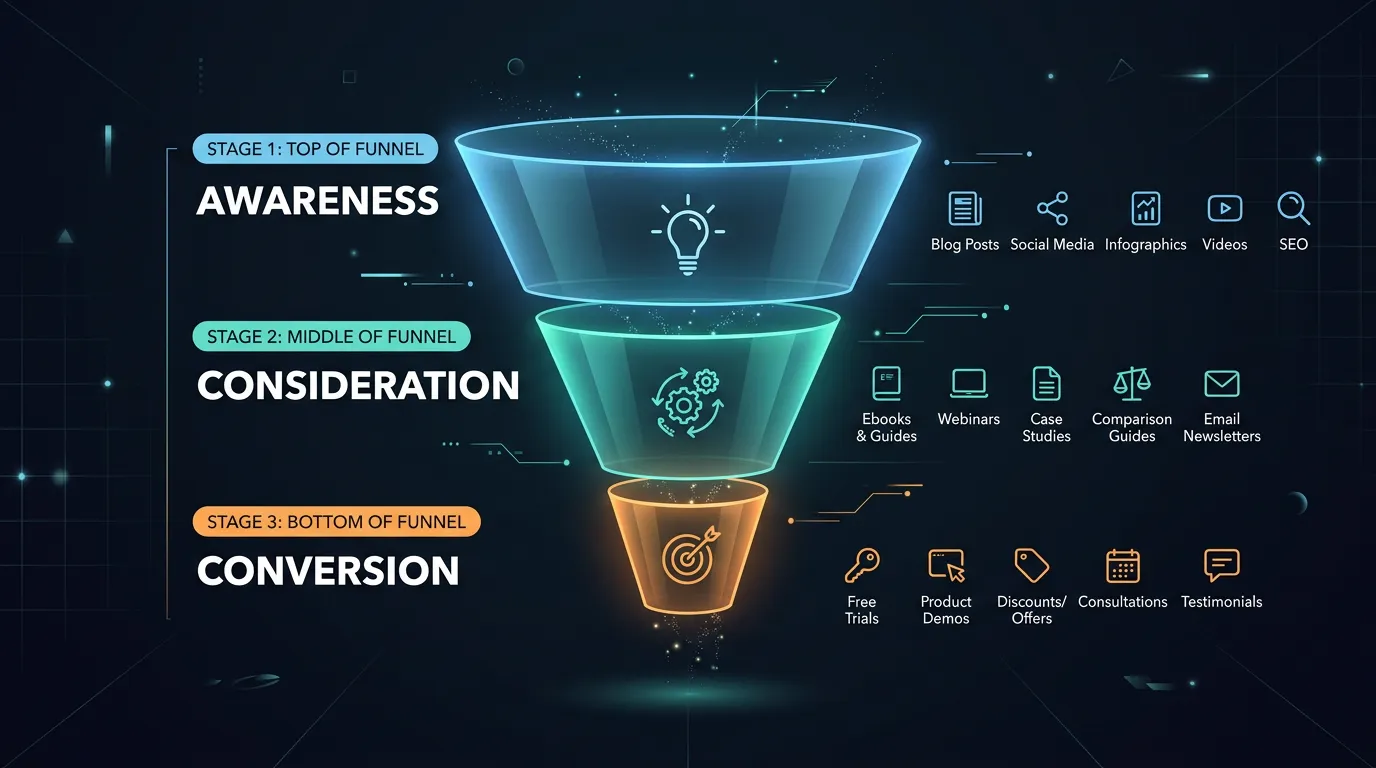
Software funnels talk about awareness and consideration. Service businesses sell in steps you can point at, and those steps have dates and owners.
Count how many leads sit in each stage right now. The biggest pile is the stage to fix first.
Funnel math on the back of an envelope
Stages only help once you attach numbers to them. Here is a made up remodeler, used to show how the math runs.
Say 100 leads come in during a month. The office reaches 70 of them. Of those, 40 book an estimate and 34 keep the appointment. Twelve sign. The average job is 22,000 dollars, so the month is worth about 264,000 dollars.
Now change one number. If the office reaches 85 instead of 70, and every rate after that stays the same, the month ends near 14 or 15 jobs. That is roughly 60,000 dollars from answering the phone faster, with no new traffic bought.
Run this with your own numbers before you spend anything. It usually points at a stage you were not thinking about.
Stage design that survives a busy office
Most funnel maps die because they were built for a slide, not for the person answering the phone on a Monday.
Do this
- Name stages in the words your estimator already uses
- Give every stage one owner by name, not a department
- Put a clock on each move, such as two business hours
- Write entry rules so two people sort the same lead alike
- Let a ready buyer skip straight to booked
Not this
- Do not build a stage nobody can see in the CRM
- Do not run a burst pipe caller through a nurture sequence
- Do not count an unreturned voicemail as first contact
- Do not add a stage just to make a report look complete
- Do not let one stage mean two different things
Two funnels, side by side
Urgency changes everything about the path. This is the same company running both, which is what most service businesses need.
| Step | Burst pipe at 7pm | Kitchen remodel |
|---|---|---|
| First touch | One tap to a live human | Form or call, either is fine |
| Response target | Under 60 seconds | Same business day |
| Qualifying | Address and access only | Scope, timing, decision maker |
| Next offer | A truck on the way | A design visit or cost guide |
| Follow up length | One day | Six weeks to six months |
| Who owns it | Whoever is on call | One named salesperson |
| What kills it | A voicemail greeting | Silence after the bid |
One process for both paths serves neither. Two well built paths cover almost every service business.
Funnel questions owners ask
Who should own the funnel in a small company?
How long should a lost deal stay in the funnel?