Digital Marketing Strategy
Strategic Marketing Roadmaps
Turns a list of good ideas into an order of operations
- Timeline
- Two to three weeks when an audit or strategy already exists
Call (714) 823-3164 or ask a question. Clear recommendations, even if we never work together.
A strategic marketing roadmap is a written plan that puts marketing work in order over the next 12 months. It lists what gets done each quarter and who owns it. For each item it also shows what it depends on, what it costs, and which number it should move. Decisions stop being made month to month.
The problem
Everyone has the list. Redesign the site, start Google Ads, get more reviews, do video, fix SEO, send a newsletter. The list is not wrong. The problem is that all six start in the same month, three stall because they depend on the website that is not finished, the ads run to a page that does not exist yet, and by month four the team is exhausted and nothing is done. Sequencing failures look like effort failures. They are not. Strategic marketing work has dependencies as real as framing before drywall, and most plans ignore them entirely.
What it is
A roadmap is a schedule with reasons attached. We take the channels we recommend and break the strategic marketing work into phases. Then we put those phases in order by dependency and payback. Foundation work comes first, because everything else runs on it. That means working tracking, a site that converts, an accurate profile, and a process that answers leads. Next comes demand capture, the channels that catch people already looking, because they pay back fastest. Demand creation comes after that. It is slower, and it is only worth funding once capture is working. Each item gets an owner by name, a rough cost, a start window, and the metric it should move. Dependencies are drawn out plainly, so nobody launches ads to a page that will not exist for six weeks. The first quarter is written at task level. Quarters two through four are written at objective level. Pretending to know the exact task list for month ten is how roadmaps become shelf decoration. We also write the review points. Those say what gets checked at 90, 180, and 365 days, and what result would justify a change of course.
Signs you need this
- You have a list of strategic marketing projects and no order to work them in
- Work keeps stalling because something else was not finished first
- A new marketing hire is asking what to work on and nobody has an answer
- Every quarter starts with the same conversation and no decision
What is included
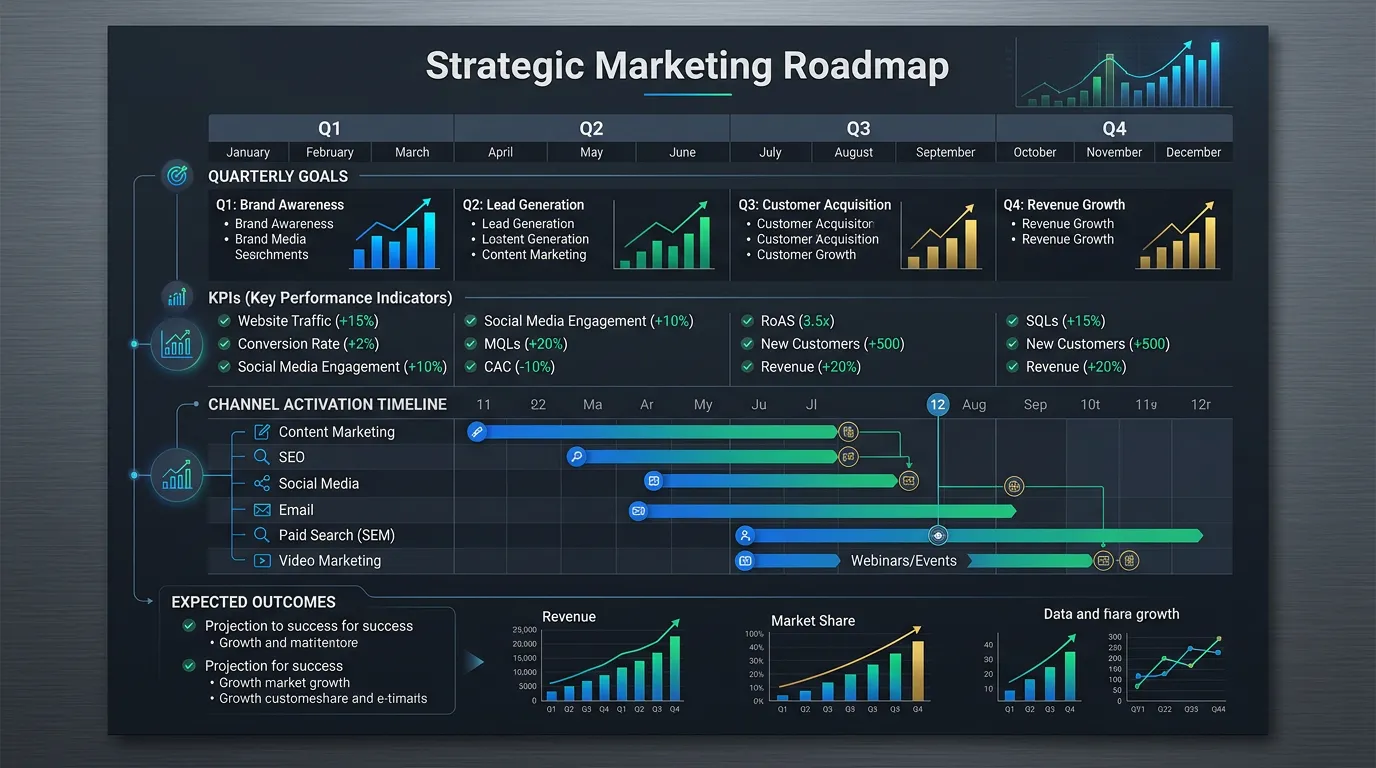
- Phased 12 month plan split into foundation, capture, and creation work
- Quarter by quarter milestone list with target dates
- Named owner for every item, internal or vendor
- Dependency map showing what blocks what
- Cost estimate per phase including one time and recurring items
- Target metric attached to each phase with a realistic range
- Review points at 90, 180, and 365 days with defined decision criteria
- One page summary version for posting where the team will see it
Our process
Inventory the work
Week 1Every recommendation from the audit or strategy becomes a discrete item with a cost, an effort estimate, and a dependency list. Vague items like improve SEO get broken into things a person can actually start on a Monday.
Map dependencies
Week 1 to 2We chart what has to exist first. Tracking before optimization. Landing pages before paid traffic. Review process before asking anyone to promote reviews. This step usually reorders the plan more than anything else.
Sequence by payback and capacity
Week 2Items get ordered by how fast they pay back and how much of your team's limited attention they take. A business with one office manager cannot start four things in January no matter how good all four are.
Assign owners and targets
Week 2 to 3Each item gets a named owner and the number it should move. Unowned items get cut or explicitly parked, because an item with no owner is a wish. Targets are stated as ranges with the assumption written next to them.
Set review points and deliver
Week 3We define what gets checked at 90, 180, and 365 days and what result would trigger a change of course. Then the roadmap gets presented, adjusted for real world constraints, and handed over with a one page summary.
Realistic timeline: Two to three weeks when an audit or strategy already exists. The roadmap itself spans twelve months, with quarter one detailed to the task and later quarters set at objective level. Expect to revise at the six month review, since results from the first two quarters usually change the ranking of what comes next.
Why Order Beats Effort
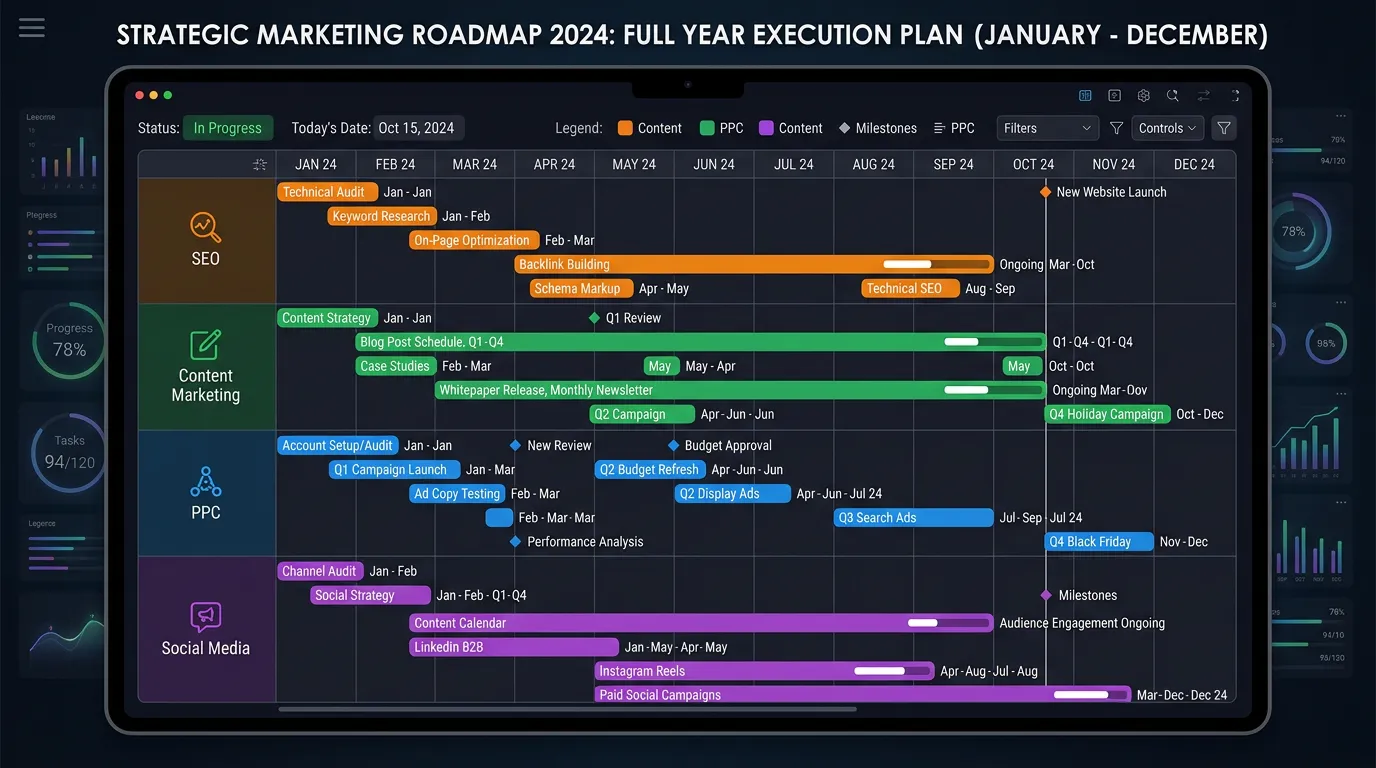
Strategic marketing work stacks like a build. Skip a layer and everything above it sits crooked.
Each layer only gets funded once the one before it works. That rule alone reorders most plans.
Writing a Roadmap Your Team Will Actually Use
The gap between a plan that runs and a plan that sits in a folder is usually format, not strategy.
Do this
- Put one person's name next to every item, never a department
- Give the first 90 days real start dates, not just a quarter
- State the number each item is supposed to move
- Hold the whole first quarter to five or six items
- Print the one page version and hang it where the team works
Not this
- Do not schedule two big projects inside your busiest month
- Do not list an item you have no budget for yet
- Do not plan month ten in the same detail as month one
- Do not hand the owner more than two items at a time
- Do not bury the plan in a tool nobody opens
A Worked First Quarter for a Four Truck HVAC Company
Picture a made up HVAC company running four trucks out of the Inland Empire. Summer carries the whole year. That means the roadmap has to be finished by March, or the planning happens during the only months that pay.
Quarter one holds five items and nothing more. Fix call tracking so every call has a source. Rewrite the two service pages that already get traffic. Clean up the Google Business Profile categories and service list. Set an automatic review request text after every completed job. Build one paid search campaign for AC repair across three cities.
None of that is exciting. All of it has to exist before June, because in June the office manager has no spare hours and the answer to every request becomes after summer.
Quarter two then carries one objective, not five: hold cost per booked job under a set number while call volume doubles. Quarters three and four stay directional. Shift the ad copy to heating in September. Decide on maintenance plans in November. That is enough detail to act on and honest about what nobody can know yet.
A roadmap is not a wish list with dates on it. It is a written decision about what you are not doing this quarter.
When the Roadmap Meets Real Life
Can the plan survive losing a key person?
What if the first quarter runs late?