Digital Marketing Strategy
Marketing Budget Allocation Guidance
Works backward from revenue goal to the leads and dollars required
- Timeline
- Two to three weeks standalone
Call (714) 823-3164 or ask a question. Clear recommendations, even if we never work together.
Budget allocation guidance sets how a marketing budget gets split across channels, and what has to be true before money moves. It works backward from your revenue goal, close rate, and job value to the number of leads you need. Then it assigns dollars by expected cost per lead and holds back a share for testing.
The problem
Marketing budgets get set two bad ways. Either a percentage of revenue gets picked because someone read that number in an article, or the budget is whatever is left after everything else is paid, which means it gets cut in exactly the months when demand is soft and marketing matters most. Neither method connects to how many jobs the company needs. Then within the marketing budget, money sits where it was first put. An ad campaign that stopped working in November keeps running in March because nobody set a rule for moving it, and the account only gets reviewed when the credit card gets declined.
What it is
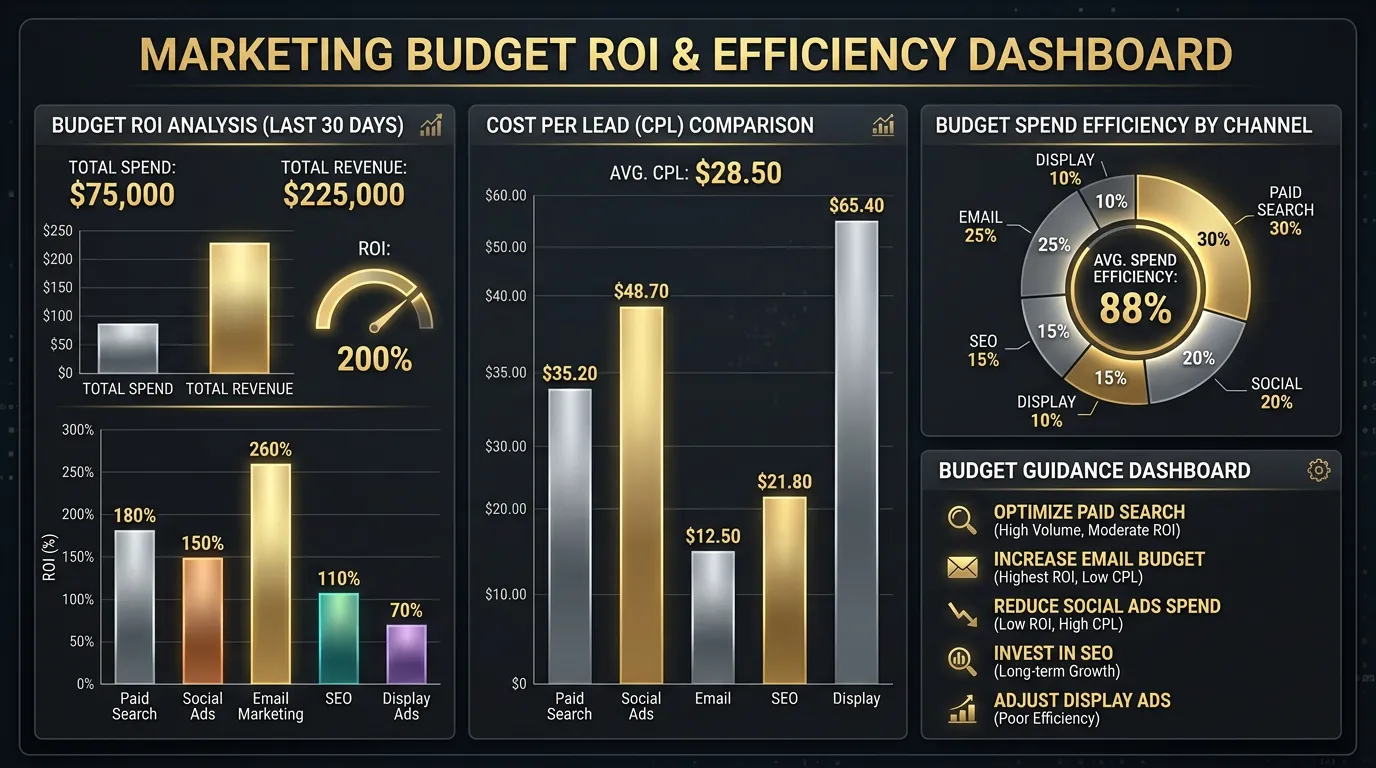
This is arithmetic before it is strategy. Start at the revenue target and divide by average job value. That gives you the number of jobs you need. Divide that by your close rate to get the qualified leads you need. Every channel also produces leads that are not qualified, so add that share in to get total leads needed. Then apply expected cost per lead by channel, and you have the spend the plan requires. If that number is bigger than the business can afford, we work the other levers instead of pretending. You can raise close rate. You can raise average job value with better estimating or added services. Or you can narrow the geography so the same money buys more density. Once the total is set, it gets split by channel weight. A testing reserve, usually ten to twenty percent, comes out of that total and gets spent on purpose rather than left over. Then we write the movement rules. They say what performance triggers a shift of money, how much can move at once, and how long a channel gets before you judge it. Last, we set the cut order for slow months. Cuts then follow a decision made in a calm month, not a panic in a bad one.
Signs you need this
- Your marketing budget is a percentage somebody picked years ago
- Spend gets cut in slow months and raised in busy ones, which is backward
- You do not know your cost per booked job on any channel
- Money sits in a campaign nobody has evaluated in six months

What is included
- Backward math from revenue goal to jobs, leads, and required spend
- Marketing budget floor and ceiling with the reasoning for both
- Channel by channel dollar allocation with expected lead volume ranges
- Testing reserve sized and scoped with a defined success bar
- Movement rules stating when and how much money shifts between channels
- Cut order for slow months, decided in advance
- Unit economics sheet covering cost per lead, cost per job, and payback
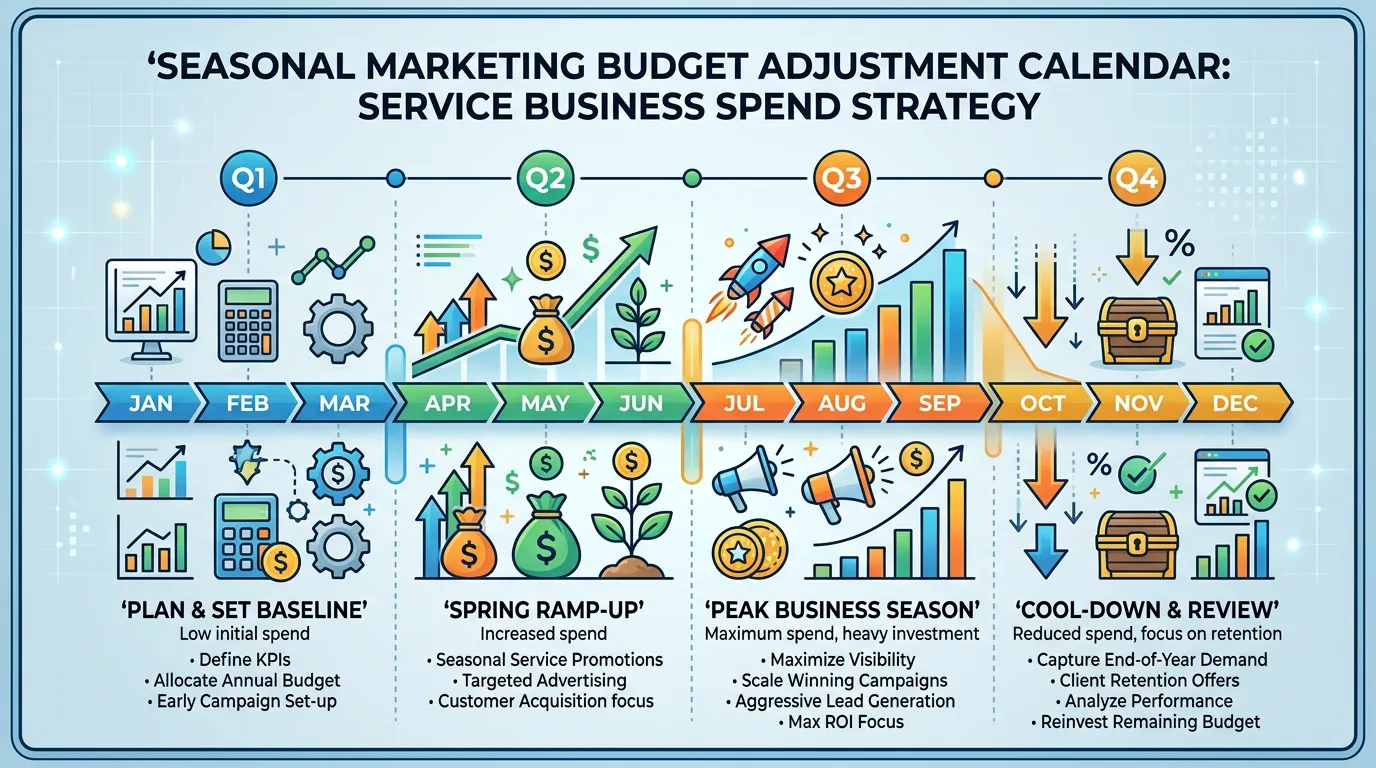
- Seasonality adjusted monthly spend plan rather than a flat twelfth
Our process
Establish the unit economics
Week 1Average job value, close rate, gross margin, and repeat rate. If those are unknown we build estimates from invoices and label them as estimates. Everything downstream depends on these four numbers being roughly right.
Work backward to required spend
Week 1Revenue goal to jobs to qualified leads to total leads to dollars, using expected cost per lead by channel. The output is often uncomfortable, which is useful, because it makes the goal and the marketing budget argue with each other honestly.
Reconcile with reality
Week 2When required spend exceeds what the business can fund, we adjust the goal or work the other levers: close rate, job value, or service area density. We do not fix the gap by assuming a better cost per lead than the market gives.
Split by channel and reserve for testing
Week 2Dollars get assigned by channel weight with a testing reserve carved out first, so it does not get quietly absorbed. Each channel allocation carries an expected lead range so you can tell later whether it delivered.
Write movement and cut rules
Week 2 to 3Rules define what evidence justifies shifting money, the maximum shift per month, and the order things get cut when revenue dips. Written in advance, these rules survive a bad month better than judgment made during one.
Realistic timeline: Two to three weeks standalone. The allocation should be reviewed quarterly and recalculated annually or whenever average job value or close rate moves more than about fifteen percent, since both feed directly into how much you can afford to pay for a lead.
From Revenue Goal to Monthly Spend
The math runs backward. Each step is one division, and the last step is your marketing budget.
If the last number is too big, change the goal or the levers. Do not change the cost per lead to make it fit.
A Worked Example You Can Copy on Paper
Take a made up remodeling company that wants 1.2 million in revenue next year. Average job runs 30,000. That is 40 jobs.
They close one estimate in four, so they need 160 qualified leads. About a third of what comes in is not qualified, wrong area or wrong budget, so the real target is roughly 240 leads.
At an average of 150 dollars per lead across their mix, that comes to 36,000 for the year, or 3,000 a month. Against 1.2 million in revenue that is three percent, which looks cheap for remodeling.
Cheap is the signal. It usually means the cost per lead assumption is optimistic, or the close rate is not really one in four. The math does not hand you a marketing budget. It starts an honest argument between your goal, your close rate, and your prices, and that argument is the whole exercise.
Rules for Moving Money Between Channels
Write these in a good month. Rules written during a bad month are just panic with a font.
Do this
- Cap how much can move at once, ten to twenty percent is normal
- Require 30 days of data before you judge a change
- Move money toward cost per booked job, not cost per click
- Keep the testing reserve separate from the main pool
- Name the one person allowed to approve a shift
Not this
- Do not cut tracking, phone answering, or profile work first
- Do not raise spend on a channel nobody has checked in 60 days
- Do not judge a channel during a week your phones went down
- Do not let one great month rewrite the whole plan
- Do not pay a percentage of spend with no lead target attached
Budget Questions That Come Up Mid Year
What do I do with money freed up by a paused channel?
My cost per lead jumped 40 percent. Should I cut the channel?