Content Marketing
Topic Cluster Development
Groups pages around one service instead of scattering topics
- Timeline
- Two to three weeks to produce the map and audit
Call (714) 823-3164 or ask a question. Clear recommendations, even if we never work together.
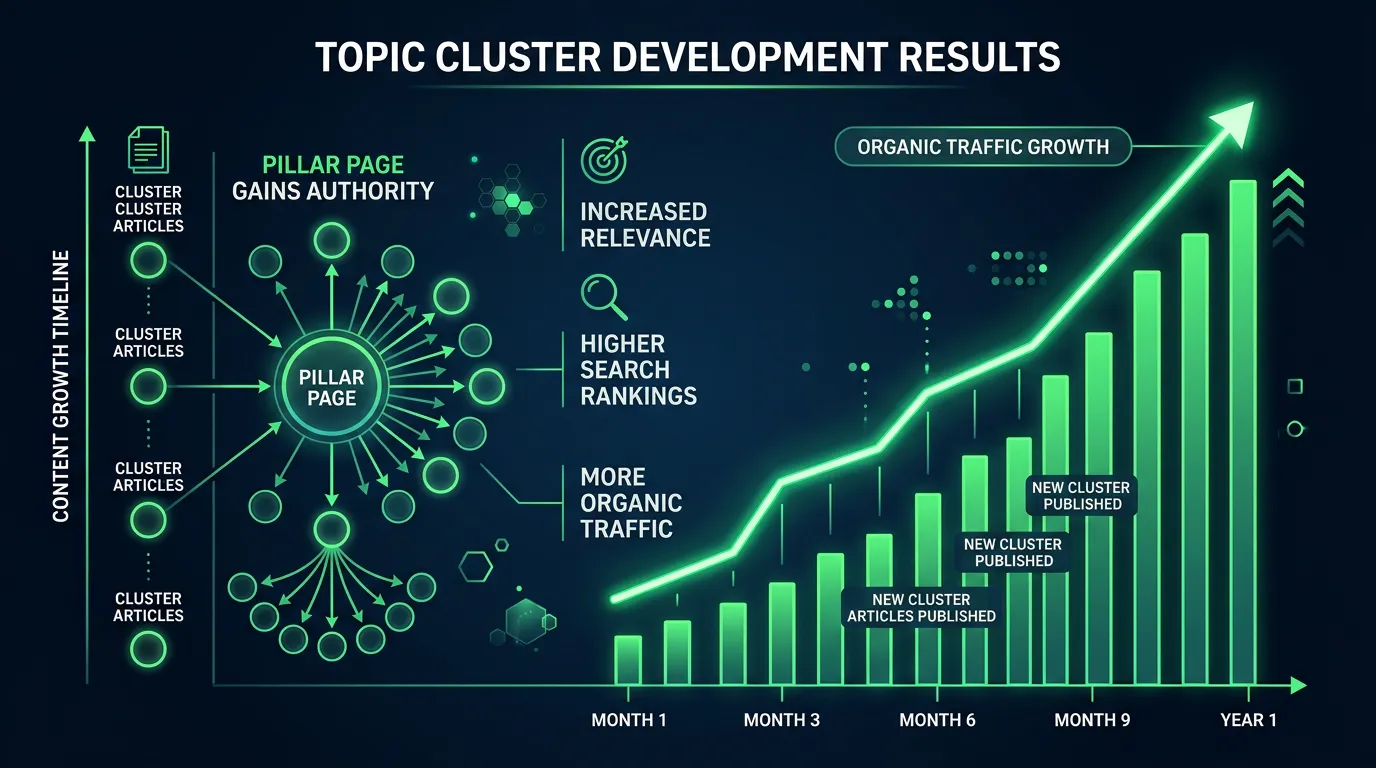
Topic cluster development is organizing content into groups, where one central page covers a broad service and several supporting pages cover the specific questions inside it. Every page in the group links to the others. That structure shows depth on a subject and helps each page rank better than it would alone.
The problem
Most service business blogs are a pile, not a structure. One post about water heaters, one about kitchen remodel trends, one about a holiday promotion, one about hiring. Nothing links to anything. Google looks at the site and sees shallow coverage in ten directions instead of real depth in one. Meanwhile a competitor who published eight connected pages about water heaters owns every water heater search in the county. Scattered publishing also creates a second problem: two or three of your own pages compete for the same query and none of them wins.
What it is
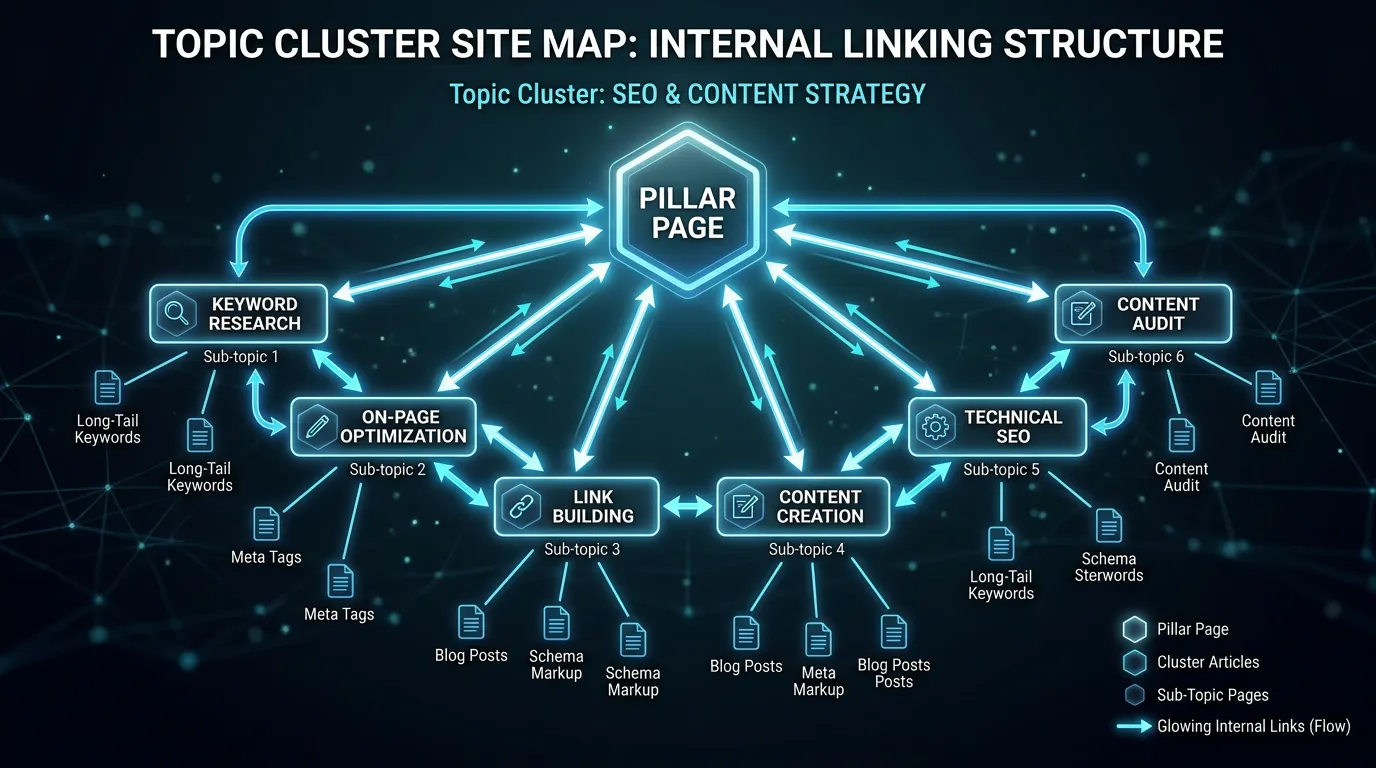
A topic cluster is a hub page that covers a service broadly. Around it sit supporting pages, each going deep on one question inside that service. Internal links run from every supporting page to the hub, and from the hub back out. Development means mapping which clusters your business needs. Then we audit what you already have, place those pages into clusters, find the gaps, and set the linking rules. It also means fixing cannibalization, where several of your pages target the same query and split their own signals. We build one cluster at a time to completion. A finished cluster produces results, and three half finished ones produce nothing.
Signs you need this
- Your blog posts cover unrelated topics with no connection between them
- Two or more of your pages target the same search and both rank poorly
- You have 30 or more published pages and almost no internal links
- Competitors dominate every search around one service you also offer
- Search Console shows the wrong page ranking for your most important query

What is included
- Cluster map naming each hub and the supporting topics beneath it
- Audit placing every existing page into a cluster, a merge, or a retirement list
- Cannibalization report identifying pages competing for the same query
- Gap list of missing supporting topics per cluster, in production order
- Internal linking rules defining which pages link where and with what anchor text
- URL and navigation structure recommendations for the cluster
- Redirect plan for any pages being merged or removed
- Priority order stating which cluster gets built first and why
- Progress tracker showing cluster completion percentage
Our process
Inventory Everything
Week 1We crawl the site with Screaming Frog and export every URL, its target query, its impressions, and its conversions. Most sites discover pages nobody remembers publishing and a few that quietly bring in traffic.
Assign to Clusters
Week 1 to 2Every page gets placed under a hub, marked for merging into another page, or marked for retirement. Merging two weak pages about the same topic into one strong page is often the single fastest ranking gain available.
Find the Gaps
Week 2For each cluster we list the supporting questions a complete resource would cover, then mark which ones you have. The missing ones become the production queue, ordered by search demand and buying intent.
Set Linking Rules
Week 2 to 3Every supporting page links up to the hub with a consistent anchor. The hub links out to every supporting page. Sibling links only happen where the connection is genuinely useful to a reader. Rules stop the linking from turning into noise.
Build One Cluster to Completion
Month 1 to 4 per clusterWe finish a cluster before opening the next one. A complete cluster around your best margin service, with the hub and all supporting pages linked, is what moves rankings. Partial clusters everywhere do not.
Realistic timeline: Two to three weeks to produce the map and audit. A full cluster typically takes 3 to 4 months to build out, with ranking effects showing 2 to 3 months after completion.
A finished water heater cluster, page by page
This is the shape of one complete cluster for a plumbing company. One hub, seven supporting pages, and every link accounted for.
| Page | Type | Search it answers | Links to |
|---|---|---|---|
| Water heater service | Hub, service page | water heater repair chino | All seven below |
| Repair or replace | Comparison | should i repair or replace | Hub and the cost page |
| Replacement cost | Cost guide | water heater replacement cost | Hub and the tankless page |
| Tankless or tank | Comparison | tankless vs tank water heater | Hub and the cost page |
| No hot water | Problem guide | water heater not heating | Hub and the repair page |
| Leaking from the base | Problem guide | water heater leaking bottom | Hub and the cost page |
| Permits and code | Local explainer | water heater permit chino | Hub and the cost page |
| How long they last | Explainer | how long do water heaters last | Hub and repair or replace |
The hub is the clusters service page, not a blog post, because that is the page that takes calls. Seven supporting pages is roughly four months of work at two pieces a month.
Spotting cannibalization in Search Console in ten minutes
You do not need a paid tool for this. Open Search Console, go to the Performance report, and click the Queries tab. Pick one query that matters to your business and click it.
Now switch to the Pages tab with that query filter still on. If two or more of your pages show up, they are splitting the clusters work. Also watch for a query where the ranking page keeps changing month to month. That flipping means Google is not sure which page you meant.
Once you find a pair, the fix is rarely to delete one. Move the better material into the stronger page, then point the weaker URL at it with a 301 redirect. Keep the URL that already has links and history, even when the other one reads better today.
Our rules for merging two pages that compete
Merging is the fastest win in cluster work and the easiest to get wrong. We follow the same order every time.
Keep the URL with the most links and history
Age and backlinks are hard to rebuild. Wording is not.
Move the unique sections over before you redirect
Anything only on the losing page gets rewritten into the winner.
Use a 301 redirect instead of deleting
A deleted page throws away every link pointing at it.
Fix every internal link that pointed at the old URL
Leaving them is sloppy and slows the page for readers.
Rewrite the title to cover both intents
One page now answers what two pages half answered.
Update the sitemap and request indexing
It cuts the wait from weeks down to days.
Watch the merged page for six weeks
A dip in week one is normal. A dip in week six is not.
A half built cluster ranks about the same as no cluster at all. Depth is the entire point, and depth is not something you get 60 percent of.
When a cluster is the wrong move
Clusters need a real supply of questions to be worth building. If your service is one simple thing people buy once with almost no research, eight supporting pages is money better spent on ads or your Google Business Profile.
The second case is a site with technical problems underneath it. If pages are slow, blocked from indexing, or duplicated across a hundred near identical city URLs, adding structure on top does not fix any of that. Sort the foundation out first.
We also stop when the hub page cannot convert. There is no point pushing link value into a service page with no phone number near the top and no reason to trust you. That page gets fixed before a single supporting piece gets written.