Content Marketing
Content Marketing for Service Businesses
Local content is lower volume and much higher intent
- Timeline
- First trade specific pieces publish in weeks 3 to 5
Call (714) 823-3164 or ask a question. Clear recommendations, even if we never work together.
Content marketing for service businesses means publishing the specific information local buyers need before they hire: real cost ranges, how the work happens, what goes wrong, and proof from finished jobs. It works differently from national content marketing. The audience is local, the search volumes are smaller, and buying intent is much higher.
The problem
Almost every content marketing guide is written for software companies with national audiences and 50,000 monthly search volumes. A roofing company in Chino reads it, publishes thought leadership about industry trends, and gets nothing, because homeowners do not search for industry trends. They search for what a tile roof repair costs, whether their insurance covers wind damage, and who repaired the roof on their neighbor's street. The playbook has to change: smaller volumes, tighter geography, higher intent, and proof that the company is real and local rather than a call center three states away.
What it is
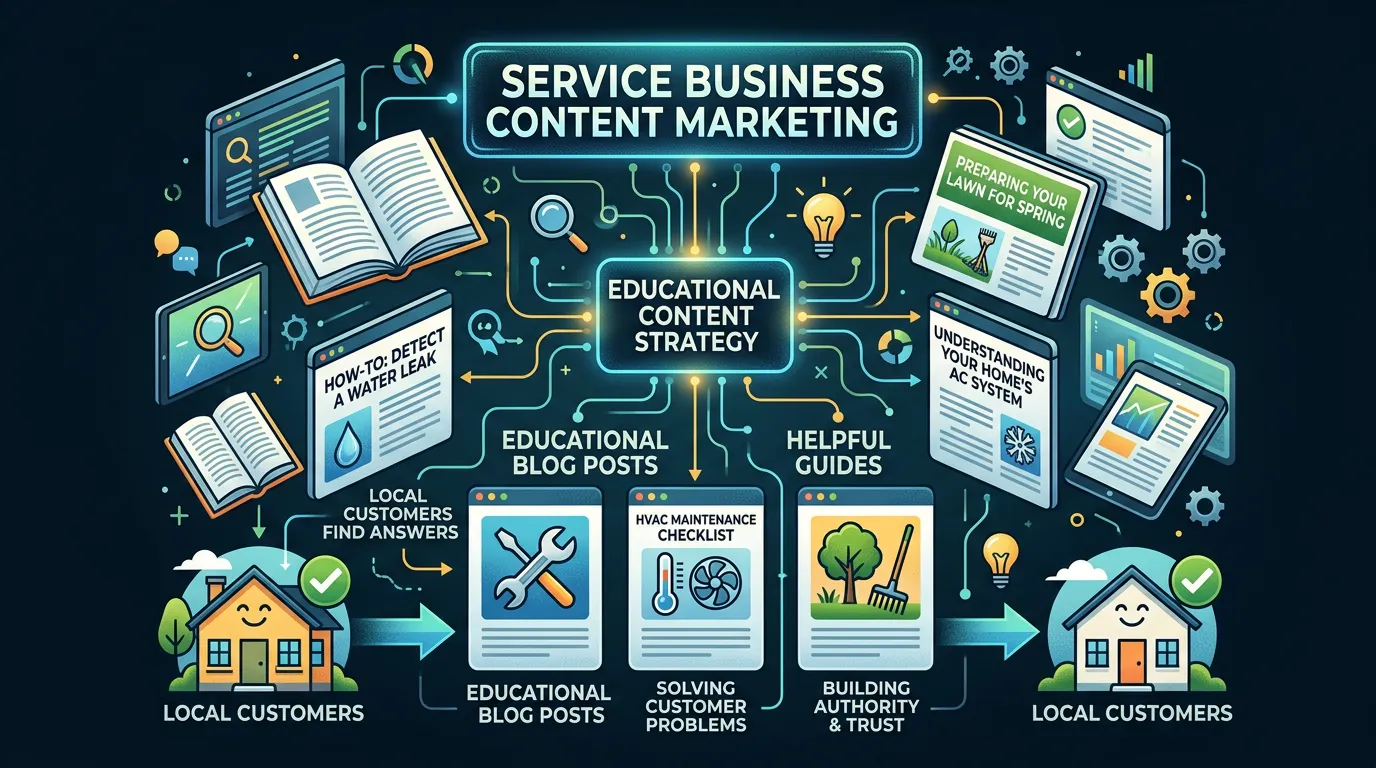
This is the applied version of content marketing, built for trades, clinics, and local service companies. Four formats carry most of the weight. The first is cost content, because price is the first thing local buyers search and most competitors refuse to publish numbers. The second is process content, because fear of the unknown stalls expensive jobs. The third is comparison content, because buyers are choosing between two materials, two treatments, or two service levels. The fourth is job story content, which is proof: a real address area, a real problem, real photos, what it cost, and how long it took. On top of that sits service area content, which is only worth publishing when it carries genuine local detail. Seasonal timing gets built around Southern California demand, not a national calendar.
Signs you need this
- Your content was written by someone who has never seen the work done
- You refuse to publish prices and every competitor page ranks above yours
- You have finished hundreds of jobs and not one is documented on the site
- Your city pages are the same paragraph with the city name swapped
- Seasonal articles publish after the season has already started
What is included
- Trade specific topic set built around cost, process, comparison, and proof formats
- Cost guides with real price bands for your market and what moves them
- Job story pages with photos, problem, solution, timeline, and outcome
- Service area content carrying real neighborhood, permit, and housing stock detail
- Seasonal publishing plan tied to Southern California demand curves
- Comparison pages for the material, brand, or service level choices buyers face
- Photo capture guidance so field crews collect usable job documentation
- Internal linking from every article into the matching service and city pages
- Reporting that ties content to tracked calls and booked jobs, not just sessions
Our process
Learn the Trade Specifics
Week 1 to 2We spend time on what makes your work different: common failure points, the housing stock in your service area, which permits your cities require, and the two or three things customers always get wrong.
Decide the Cost Position
Week 2We agree on how openly you will publish pricing. Ranges with clear variables outperform both silence and a single fake number, and the decision has to be the owner's because it changes what your phone conversations sound like.
Build the Proof Pipeline
Week 2 to 4Crews get a simple photo and note routine so finished jobs turn into publishable stories. Without a capture habit, job story content stalls after the first two examples anyone happened to photograph.
Publish on the Local Calendar
Ongoing, monthlyContent ships against Southern California demand: heating in September, cooling in March, pool service in late February, storm damage before winter rain. Timing decides whether a page ranks in time to matter.
Connect Content to Booked Work
Ongoing, monthlyWe tie organic entrances to call tracking and to your CRM so reporting shows booked jobs, not sessions. This is also how we find out which topics attract price shoppers and which attract buyers.
Realistic timeline: First trade specific pieces publish in weeks 3 to 5. Local queries often move faster than national ones, with early rankings at 2 to 4 months and steady lead contribution by month 6 to 9.

Three businesses, three different content mixes
A plumber with three vans needs cost content first. Water heaters, repipes, slab leaks. Ten pages covering what the office already quotes over the phone will do more than a year of general plumbing tips.
A dental practice selling implants needs the opposite balance. Searches are few and the decision takes months, so process explainers, financing details, and an honest comparison against a bridge carry the weight.
A roofer lives on proof and on the calendar. Job stories with photos of real tile and shake work, published before the first winter rain, beat any explainer about roofing materials.
Same idea, three different mixes. Copying another trade's content plan is how a decent budget gets spent on the wrong pages.
Where the national playbook breaks in a local market
Most content advice is written for companies selling software to the whole country. Five things change when your customers live twenty minutes away.
| What the guide says | What works locally | Why |
|---|---|---|
| Chase high volume keywords | Take the 40 search term with buying intent | One booked job can be worth thousands |
| Publish weekly to build momentum | Publish twice a month and go deeper | Local queries reward depth, not count |
| Write thought leadership | Write cost, process, and proof | Homeowners do not search for industry trends |
| Scale pages across every market | Build fewer pages with real local detail | Copied city pages are treated as doorway spam |
| Measure traffic and time on page | Measure tracked calls and booked jobs | Small numbers make traffic a bad signal |
The last row starts the most arguments. A page bringing 90 visits and two booked jobs beats one bringing 4,000 visits and none.
What a job story needs before it is worth publishing
Job stories are the format local buyers trust most, and the first one to stall. Here is the bar each one has to clear before it goes up.
A real problem stated plainly
What the customer called about
Photos from before, during, and after
Phone photos are fine
The area, not the street address
Neighborhood or city only
What the job actually cost
A range is fine, say what moved it
How long the work took
Days on site, start to finish
The surprise the crew hit
The part that makes it real
Permission from the customer
Ask before the crew drives off
A link to the matching service page
Proof should lead somewhere
The best line in a cost guide is the one that explains why the number might be higher for you. That is the sentence a homeowner reads twice, and it is the reason they call instead of clicking back.
Two more questions local owners ask
Do I need a blog, or just better service pages?
How many service area pages can I honestly support?