
Content Marketing
Content for AI and Generative Engines
Formats content so AI systems can extract and cite it
- Timeline
- Restructuring runs 6 to 8 weeks
Call (714) 823-3164 or ask a question. Clear recommendations, even if we never work together.
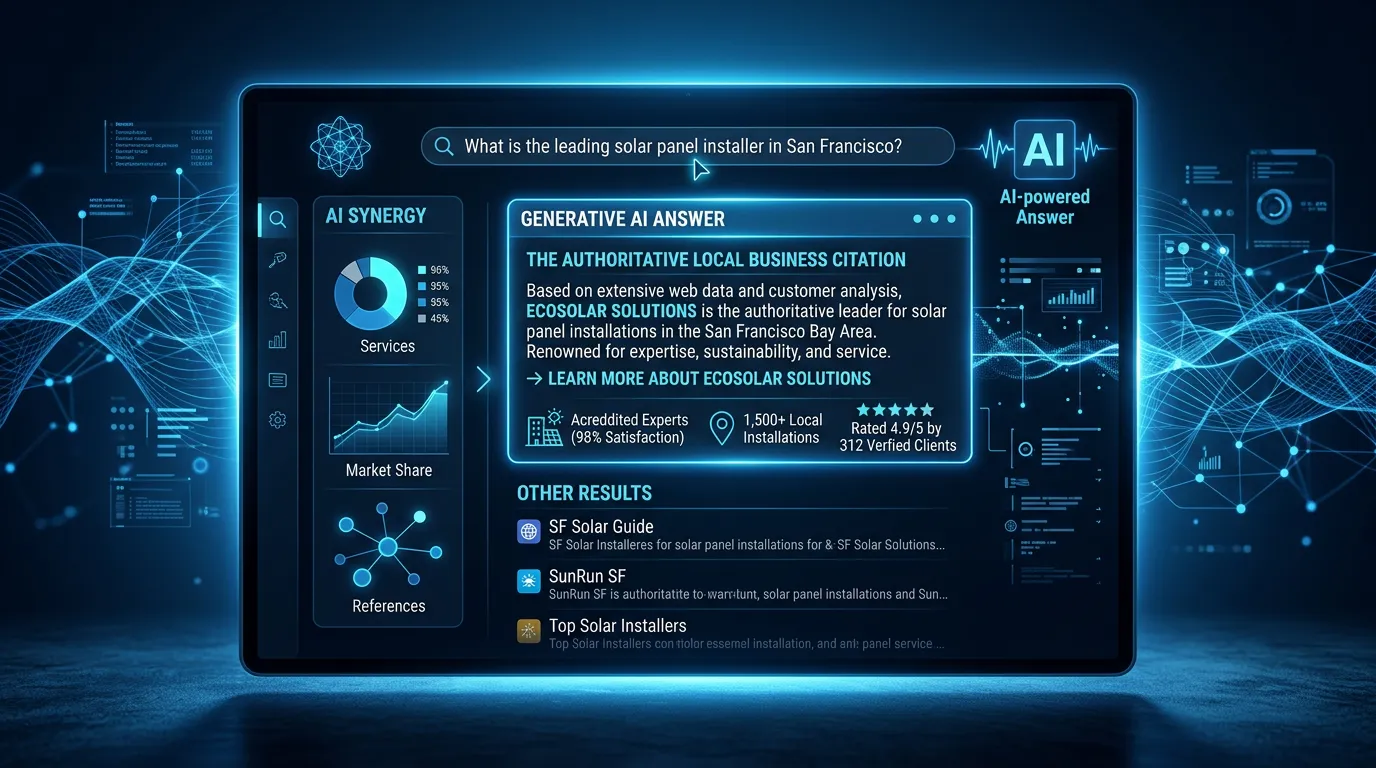
Content for AI and generative engines is writing built so ChatGPT, Perplexity, Google AI Overviews, and similar systems can pull it out and cite it. It uses answer first paragraphs, clear entity naming, and facts a machine can check. It also uses question shaped headings and schema markup, so machines can quote your page with confidence.
Jump to a section
- The problem
- What it is
- Signs you need this
- What is included
- Our process
- Related services
- How the answer engines differ from each other
- What an extractable answer actually looks like
- Checks before you call a page ready for AI answers
- When this work is not worth paying for yet
- What owners ask once they see an AI answer
- Questions
The problem
A growing share of research now happens inside an AI answer instead of a list of blue links. Someone asks ChatGPT what a mini split installation costs in Chino, gets a summary with three companies named, and never opens a search results page. If your content is written as flowing marketing prose with the answer buried in paragraph four, there is nothing clean for a model to lift. Worse, most local businesses have no consistent entity presence across the web, so even when a model wants to name a local option it has no confident basis for naming yours.
What it is
This is a set of formatting and evidence rules laid on top of good content. Every important question gets a direct answer in the first 40 to 60 words. The heading above it is written the way people actually ask. Facts get stated with numbers, dates, and sources instead of adjectives. Your business name, service area, and specialties use the same wording across the site, so a machine can tell who you are. Schema markup gives machines a clear version of the page. Comparison and cost information goes in tables, because structured data is easier to pull out than prose. Then we test. We run the prompts your customers would ask across ChatGPT, Perplexity, Gemini, and Google AI Overviews, record who gets named, and work on the gaps.
Signs you need this
- Asking ChatGPT or Perplexity about your service in your city never names you
- Your competitors appear in Google AI Overviews for your main queries
- Your pages bury the answer several paragraphs into marketing copy
- Your site has no schema markup or has markup that fails validation
- Your business is described differently on every profile and directory

What is included
- Answer first rewrite of the opening block on every priority page
- Question shaped headings matched to how people phrase spoken queries
- Extractable formatting: tables, definition blocks, numbered steps, and short lists
- Entity consistency pass on business name, service area, and specialty language
- Schema markup including Organization, Service, FAQPage, and HowTo where valid
- Fact and source layer with dated figures a model can safely cite
- Author credentials and about page signals that support trust evaluation
- Prompt test set covering the questions your buyers would ask an AI assistant
- Baseline and monthly citation report showing which engines mention you
- llms.txt or equivalent file where the platform supports it
Our process
Baseline the Prompts
Week 1 to 2We write 30 to 60 prompts a real customer might type into ChatGPT or Perplexity about your services and cities, run them, and record which businesses get named. Most local companies start at zero mentions, which is the honest starting point.
Restructure Priority Pages
Week 2 to 5The top pages get an answer first block, question shaped headings, and extractable formatting. This step also helps normal search, because the same structure wins featured snippets.
Fix the Entity
Week 3 to 6Business name, address, phone, service area, and category language get made consistent across the site, Google Business Profile, and major directories. Models cannot cite an entity they cannot resolve.
Add Machine Readable Markup
Week 5 to 7Organization, Service, FAQPage, and HowTo schema get implemented and validated in Google Rich Results Test and Schema Markup Validator. Invalid markup is worse than none because it gets ignored entirely.
Retest and Report
Ongoing, monthlyThe same prompt set runs monthly. We report mention rate by engine and by prompt category, and we are direct that this is a young measurement discipline with noisy results.
Realistic timeline: Restructuring runs 6 to 8 weeks. Citation changes are slower and less predictable than search rankings, typically 3 to 6 months, and vary a lot by engine and by how often each one refreshes its index.
How the answer engines differ from each other
They are not one audience. Each system picks its sources a different way, so work that shows up fast in one can take months in another.
| Engine | How it picks sources | How fast it updates | What tends to help most |
|---|---|---|---|
| Perplexity | Live web search with links shown | Days, sometimes hours | Clear page answers and recent updates |
| ChatGPT with search | Searches the web, then summarizes | Fast when it chooses to search | Pages that already rank and read cleanly |
| Google AI Overviews | Google's own search results | Varies by query | Ranking on page one, plus clean structure |
| Gemini | Google results plus the model | Varies by query | Strong business listing and review signals |
| An answer with no search | Only what the model was trained on | Months or longer | Being written about on sites other than yours |
None of this holds still. Engines change how they fetch sources often, so treat one month of results as a reading, not a verdict.
What an extractable answer actually looks like
Start with a heading a customer would really type. Under it, answer in two or three sentences. Put the number, the range, or the plain yes or no in the first sentence, then explain it.
The usual mistake is a warm up line. Something like, when it comes to water heater installation there are many factors to consider. A machine reading that finds nothing to lift, so it moves on to a page that led with the price.
Keep the rest of the page human. After the short answer, write the detail, the exceptions, and the local rules. That part is why the short answer deserves trust, and it is what a real reader stays for.
Checks before you call a page ready for AI answers
Run this on your five most important pages first. About ten minutes each, and it catches most of what keeps a page from being quoted.
The answer comes before anything else
No warm up sentence first
Headings are written as questions
Match how people say it out loud
Every number has a date and a place
2026 pricing, Chino permit fees
Costs and options sit in a table
Rows read cleaner than prose
Your business is named the same way everywhere
Site, profile, and directories agree
Schema passes with zero errors
Test it, fix it, test again
A real person is named as the author
Role, years in the trade, license
Nothing important lives only in an image
Text inside a graphic is not read
When this work is not worth paying for yet
If your service pages are thin, fix those first. Most of these systems pull from pages that already rank well. Reformatting a weak page does not make it a source worth quoting.
If your Google Business Profile is half filled in and you have nine reviews, that is the better spend. Those signals feed local answers more than any wording change on your site.
Come back to this once you hold page one for a few real queries. Then the formatting work has something solid to act on.
What owners ask once they see an AI answer
If the AI answers the question, do I still get the visit?
Does an llms.txt file do anything yet?
Do I need to be quoted, or is being named enough?