
Trend and AI Search Articles
How Voice Search Optimization Works, and What It Is Not
How a spoken question gets turned into one answer, and the short list of things that decide whether the answer names your business.
Call (714) 823-3164 or ask a question. Clear recommendations, even if we never work together.
Voice search optimization is the work of getting picked as the one answer a phone or speaker reads out loud. There is no separate voice index. Assistants turn speech into text and run it through normal search, so the voice search work is clear answers written early on the page, accurate local business data, and pages that load fast.
Jump to a section
- There Is No Separate Voice Index
- Spoken Questions Are Longer and Sound Like People
- Most of These Questions Are Local, So Your Profile Does the voice search work
- Answer in the First Two Sentences
- The Technical Part Is Smaller Than It Gets Sold As
- How to Measure Something You Cannot See
- What Happens Between the Question and the Answer
- Typed and Spoken Versions of the Same Search
- Voice Advice Worth Following, and Advice to Skip
- Questions About How Spoken Answers Get Chosen
- Questions
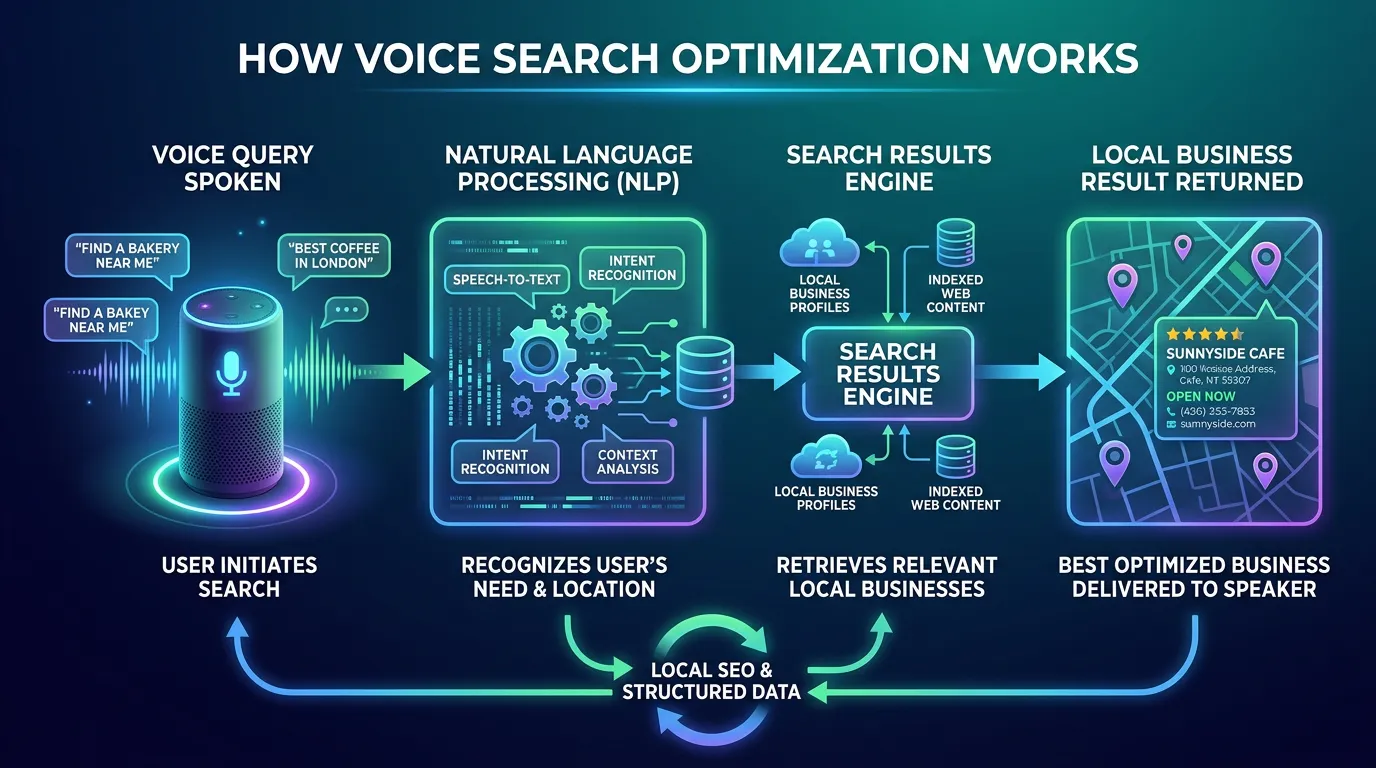
There Is No Separate Voice Index
When someone asks a phone or a speaker a question, no special voice database gets opened. The device turns speech into text, then runs that text through normal search. What comes back is the same material a typed search would produce, filtered down to whatever the device can read out loud. On a phone with a screen you often get a card plus a short spoken line. On a speaker with no screen you get one answer and nothing else. So voice search optimization is not a separate service you bolt on. It is regular search work judged by a harder standard. A typed search gives ten results and the person picks. A spoken search gives one, sometimes three for a local question. If your page is the fourth best answer, a typed search still sends you visitors. A spoken search sends you nothing. That gap is the real difference, and it explains why the advice that works is mostly about being clear and being local rather than about a special tag. It also means almost everything you do for voice pays off even if nobody ever talks to their phone. Clearer answers help readers who are in a hurry. Faster pages help everyone. Correct hours stop wasted calls. You are not building a second website. You are raising the standard on the one you have.
Spoken Questions Are Longer and Sound Like People
People type like they are filling in a form and speak like they are talking to a person. Typed, it is plumber chino. Spoken, it is who is the best plumber in Chino that can come out today. The second one is longer, uses question words, and carries an extra condition. Those extra words are the opening, because far fewer businesses have written anything that answers them directly. You do not have to guess what your customers say. Open Search Console, go to the performance report, and filter your queries for words like how, why, what, can, near, and today. Those rows show the spoken shape of your topic even when they were typed. Then do the low tech version. Ask whoever answers your phone to write down the first sentence out of a caller's mouth for two weeks. That notepad beats most keyword tools, because it is the actual language of people who already call you. Two patterns show up nearly every time. People describe a problem rather than a service. They say my water heater is leaking, not water heater replacement. And they attach a condition: today, this weekend, cheap, near me, open now. Pages that use the customer's words and answer the condition get picked. Pages named after the voice search service line, with no problem language anywhere on them, do not.
Most of These Questions Are Local, So Your Profile Does the voice search work
For a service business, most spoken questions end in something like near me or in Ontario. Those searches get answered by the local system, not by your homepage. Google picks local results using relevance, distance, and prominence, and your Google Business Profile is the record it reads. So the highest value voice work for a local company happens inside that profile rather than inside your site. Get the primary category right, because it decides which searches you are eligible for at all. Fill in the services list, since each service you add is one more phrase a spoken request can match. Keep hours current, holidays included, because open now is a filter people say out loud constantly. Add the attributes you honestly qualify for. Picture a mobile mechanic in Chino whose profile says closed on Saturday while the van actually runs Saturdays. Every Saturday morning question skips right past that business, and no amount of writing fixes it. The distance part is the one you cannot fix. A speaker sitting in a living room reports a precise location, so a spoken near me search is tighter than a typed one on a laptop. Businesses often find they win spoken local searches within a few miles and lose them past that. That is geography, not a content problem, and no page will solve it.
Answer in the First Two Sentences
An assistant builds a spoken answer by lifting a short passage out of a page. It cannot read three paragraphs of setup before the point arrives. So structure the page the way you would answer the question at a counter. Put the direct answer in the first forty to sixty words under the heading, then explain. Make headings match the question a person would actually say. How much does a water heater replacement cost in Chino is a heading. Water Heater Solutions is not. Under each heading, keep the first answer self contained, so it still makes sense pulled out on its own with nothing around it. Then add the detail a reader wants and a machine can quote: a price range, a timeframe, a step count, a brand you carry. Keep sentences short. Read the paragraph out loud, and if you run out of breath, cut it. Digits, plain words, and one idea per sentence all survive being read aloud. Long sentences with three clauses do not. This is the same writing that helps a busy person on a phone at a job site, which is why it is worth doing whether or not a speaker ever reads it. If you only change one thing after reading this, move your answer above your introduction.
The Technical Part Is Smaller Than It Gets Sold As
There is one piece of markup built specifically for spoken answers, and almost nobody reading this can use it. Speakable structured data tells Google which sentences to read out loud, but it is still marked beta and it is aimed at news publishers, currently for English speaking users in the United States. If someone quotes you for adding speakable markup to a plumbing site, ask them to show you the documentation. FAQ markup used to be the standard advice in this space. That advice has expired. Google narrowed FAQ rich results to a small set of well known government and health sites, and has since removed the feature from voice search results. Writing real questions and real answers on your page is still worth doing, because it matches how people ask. Expecting a rich result out of the markup is not. What actually helps here is boring. Organization and LocalBusiness structured data give machines a clean record of who you are, where you are, and what you do. A page that loads fast on a phone gets used more than a slow one, especially on a weak signal in somebody's driveway. Working headings, real text instead of words baked into an image, and a site that is secure all matter. None of it is exciting. All of it works.
How to Measure Something You Cannot See
No analytics tool has a voice filter. Nothing in voice search Console or GA4 tells you that a search was spoken. Anyone selling you a voice search ranking report is selling you a guess, and you should say so out loud. Instead, measure the things that move when voice work lands. First, watch question shaped queries in voice search Console. Filter for how, what, why, can, and cost, and track whether impressions and clicks on those rows grow over a quarter. Second, watch your Google Business Profile for calls and direction requests, since a spoken local search usually ends with a tap on the call button instead of a website visit. Third, listen. When callers start opening with the exact sentence you wrote as a heading, something is working. Set the timeline honestly while you are at it. Profile fixes can change what you show up for within days. New pages have to be crawled and indexed first, which takes days to weeks, and then they need time to gather signals. Judge this over a quarter, not a month. And keep the whole thing in proportion. Voice is one more door into the same building. Winning it usually means you did the ordinary work well, not that you found a trick nobody else knows.
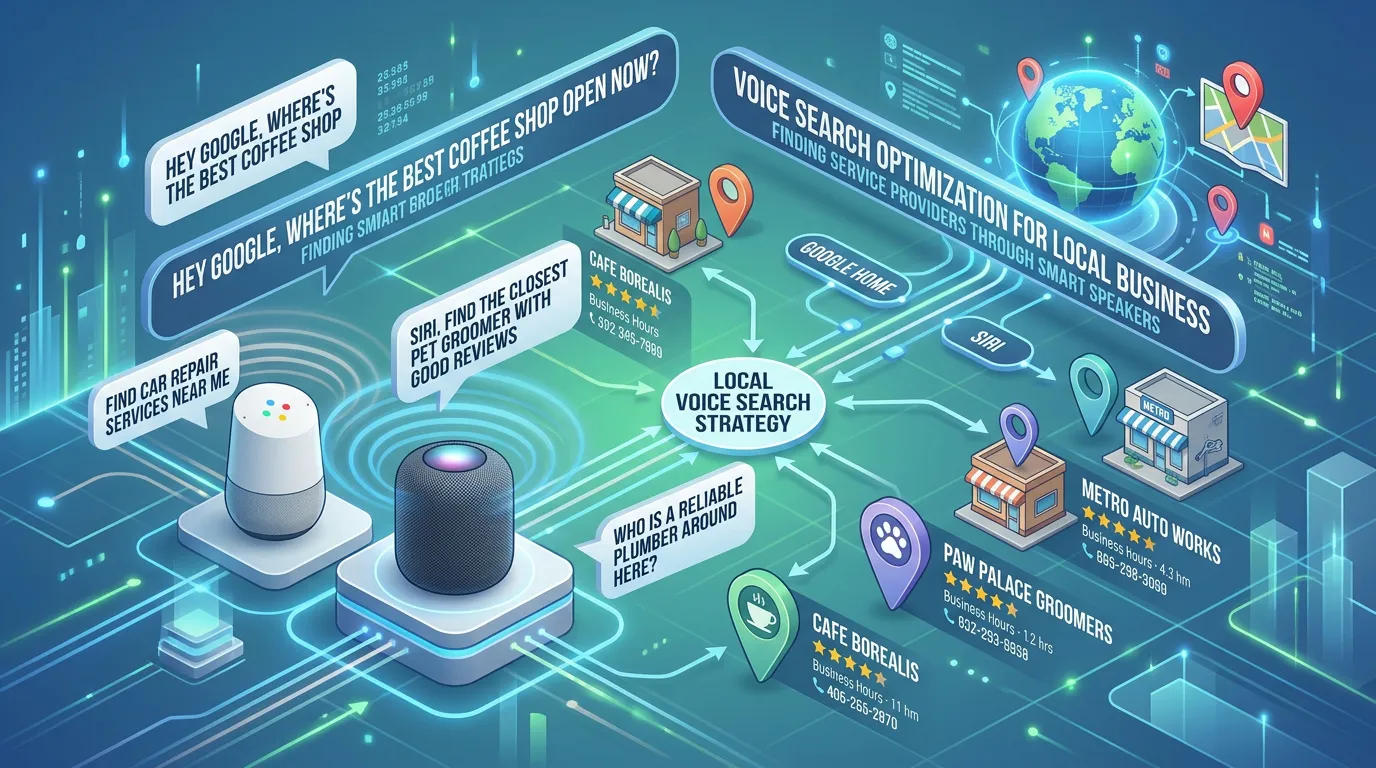
What Happens Between the Question and the Answer
A spoken search is five steps, and your work lands at three of them.
Your profile decides whether you survive the local filter. Your writing decides whether your passage is the one picked.
Typed and Spoken Versions of the Same Search
Same customer, same job, two very different strings. The right column is where the voice search work goes.
| Typed version | Spoken version | What changes | Where you win it |
|---|---|---|---|
| ac repair chino | who can fix my air conditioner today near me | Adds urgency and a location | Profile hours, category, and service list |
| water heater cost | how much does it cost to replace a water heater | Wants a number, not a page | A real price range in the first line |
| dentist open now | is there a dentist open right now near me | Open now becomes a hard filter | Accurate hours, holidays included |
| roof leak | my roof is leaking what should I do | Problem language, not service language | A page named for the problem |
| plumber reviews | who is the best plumber in Chino | Asks for a judgment call | Review count, recency, and replies |
Notice that four of the five wins happen off your website. That is normal for a local service business.
Voice Advice Worth Following, and Advice to Skip
This topic attracts more bad advice than most. Here is the split, based on what the voice search engines actually document.
Do this
- Answer the question in the first forty to sixty words under each heading
- Write headings as the question a customer would say out loud
- Keep profile hours, categories, and the services list current
- Use the caller's words, including the problem they describe
- Make the page load fast on a phone with a weak signal
Not this
- Do not buy a voice search ranking report, because that data does not exist
- Do not add speakable markup unless you publish news
- Do not expect FAQ markup to produce a rich result any more
- Do not build a separate page for every way a question can be phrased
- Do not stuff near me into your titles, since Google reads location from the searcher
Questions About How Spoken Answers Get Chosen
Do smart speakers all use the same business data?
Is voice search big enough to plan a whole strategy around?
Where does voice end and AI answers begin?
Would rather we handled it?
This article covers how to do the work yourself. If you would rather have it done for you, that is what our generative engine optimization service is.
Generative Engine Optimization
Frequently asked questions
Do I need a separate page or a separate site for voice search?
Will adding schema markup get me into voice answers?
How long does this take to show up?
Does voice matter if my customers are older?
Sources
- Google Search Central: Speakable (Article, WebPage) structured data(opens in a new tab) Google documents speakable as a beta feature that works for users in the United States with English set on Google Home devices, and describes it for publishers of news content.
- Google Search Central: In-depth guide to how Google Search works(opens in a new tab) Google describes crawling, indexing, and serving results, which is the same pipeline a spoken query runs through after speech is converted to text.
- Google Business Profile Help: Tips to improve your local ranking on Google(opens in a new tab) Google states that local results are based mainly on relevance, distance, and prominence, and explains that categories and business information feed relevance.
- Search Console Help: Performance report(opens in a new tab) The performance report shows clicks, impressions, and average position and can be filtered by query, which is how question shaped searches get tracked over time.