
Foundational Guides
What Generative Engine Optimization Costs, and What Moves the Price
How this generative engine optimization work gets priced, what the hours really go into, and the seven things that decide whether your quote comes back low or high.
Call (714) 823-3164 or ask a question. Clear recommendations, even if we never work together.
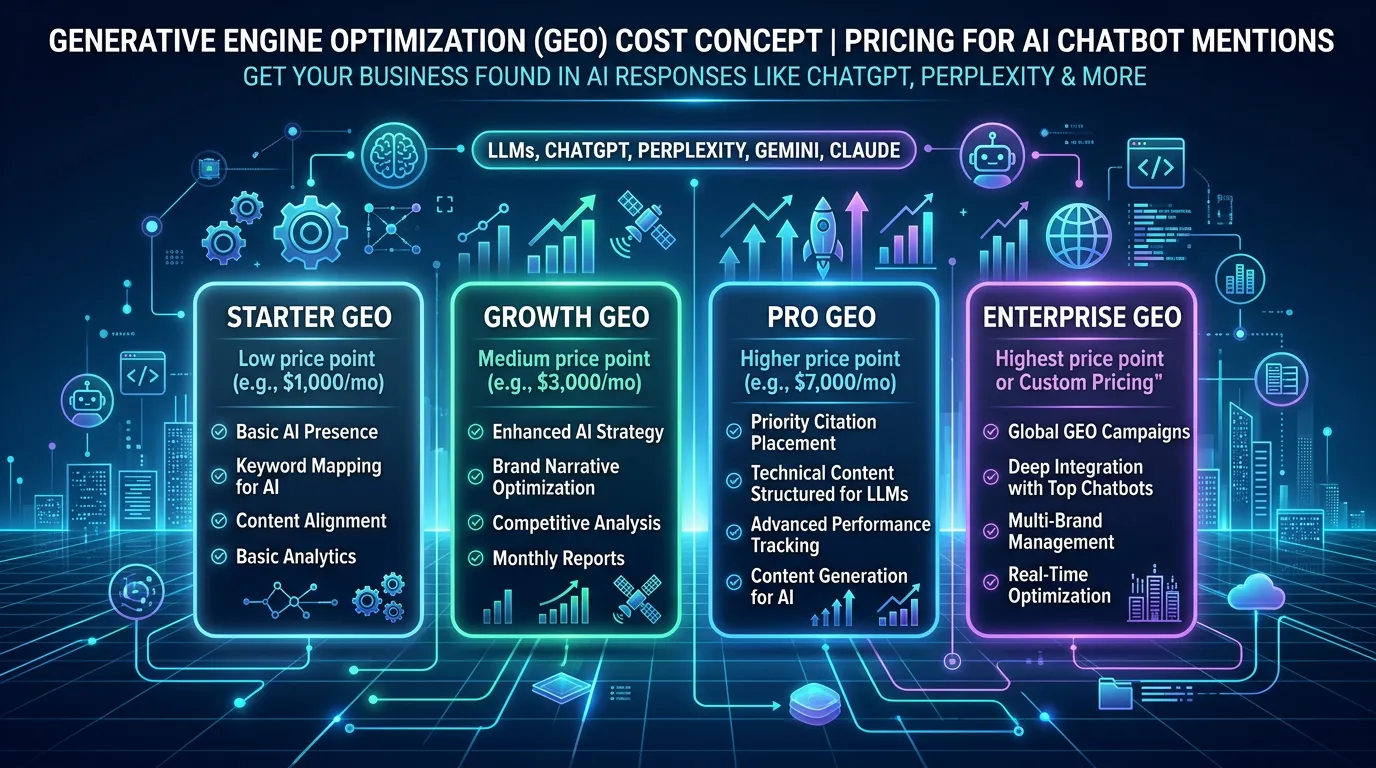
There is no list price for this generative engine optimization work. It gets sold three ways: a one time audit, a fixed project, or a monthly retainer. What you pay depends on how many services and cities need covering, how much of your content has to be rewritten, and how messy your business data is on the day you start.
Jump to a section
- The Three Ways This Work Gets Sold
- What the Hours Actually Go Into
- The Seven Things That Move Your Number
- Why Two Quotes for the Same Job Come Back Miles Apart
- What You Can Do Yourself, and What That Saves
- When Paying for This Is the Wrong Call
- Terms to Settle Before You Sign
- Ranges You Will See Quoted
- How to Read a Proposal for This Work
- Why the First Ninety Days Cost More Than the Rest
- What the Price Should Name Before You Sign
- Questions
The Three Ways This Work Gets Sold
Almost every quote you get will be one of three shapes. The first is a one time audit. Someone builds a list of the questions your customers ask, runs them against the major engines, records who gets named, and hands you a report with a fix list. You get a clear picture and a plan. You do not get any of the generative engine optimization work done. The second shape is a fixed project. That covers a defined batch of work: rewrite this many pages, build and validate the markup, clean up this many listings, then stop. It suits a business that has someone in house who can carry it forward. The third shape is a monthly retainer. Testing repeats every month, pages keep getting rewritten, listings keep getting corrected, and someone keeps working on outside mentions. This is what most agencies sell, because the outside mention part never really finishes. A fourth option exists and gets ignored too often. Hourly help. You do the generative engine optimization work, and you buy a few hours a month from someone who has done it before to check your direction. For a small shop with a capable office manager, that can be the best value on the list. It only works if someone on your side actually has the time.
What the Hours Actually Go Into
Understanding the bill starts with understanding what takes time. Building the question list takes a few hours, because the questions have to be the ones customers really ask, pulled from your calls, your emails, and your search data. Running those questions is slower than people expect. Each question gets asked on several engines, and every result gets logged with the sources it cited. Thirty questions across four engines is a hundred and twenty runs, and someone has to read every one. Automated tools help, but a person still has to sort what the results mean. The entity work is next. That means checking your name, address, phone, and hours across your site, your profiles, and the directories that carry your data, then fixing what disagrees. Some of those fixes need a phone call and a wait. Content rewriting is the biggest single line for most businesses, because pages have to be restructured, not lightly edited. Markup is quick to write and slow to validate. Then there is outreach for outside mentions. That means finding the sites the engines quote in your category, working out who runs them, and asking. It is the slowest part of the job and the part with the least predictable result, which is exactly why cheap plans quietly leave it out.
The Seven Things That Move Your Number
Two businesses in the same trade can get quotes that differ by five times, and both quotes can be honest. What separates them is scope and starting condition. Service lines matter first. One service means one set of questions. Six services means six sets, and the testing load grows with each one. Cities work the same way. A single location shop testing one city is a small job. A contractor covering four counties needs the questions repeated per area, because the answers differ by city. Content condition is next. If your service pages are already detailed and honest, rewriting them is editing. If they are three thin paragraphs from 2016, they are being written from scratch. Entity mess is the sleeper. A business that has moved twice, changed its phone number, or trades under two names has old records scattered everywhere, and every one of them has to be found and corrected. Regulated fields cost more because claims need review. Medical, legal, and financial pages often go through a compliance step, and that step adds weeks. Your starting mention footprint matters too. Finally, who does the generative engine optimization work. A specialist agency, a generalist agency, and a freelancer price the same scope differently.
- Service lines: each one adds its own question set
- Cities or service areas: answers differ by place, so testing multiplies
- Content condition: editing is cheap, rewriting from nothing is not
- Entity mess: old addresses and numbers each need chasing down
- Regulated fields: claim review adds time to every page
- Existing outside mentions: starting from zero is the slow case
- Who does the generative engine optimization work: specialist, generalist, or freelance
Why Two Quotes for the Same Job Come Back Miles Apart
Ask three vendors to get you visible in AI answers and the numbers can look nothing alike. Read what is behind them before you judge. The cheap quote is usually a plugin and a paragraph. Someone installs markup, adds an FAQ block to a few pages, and sends you a monthly PDF. No question list, no engine testing, no listing cleanup, no outreach. It is not fraud. It is just a fraction of the job, sold with the same label. The expensive quote is usually a person running tests by hand every month, reading the cited sources, rewriting real pages, chasing bad listings through several data providers, and pitching outside sites. That is a lot of human hours and the price says so. The useful question is not which one is cheaper. It is which one matches the problem you actually have. If your site is solid, your listings are clean, and you are already quoted for some questions, the light version may be enough to keep you there. If nothing on the web says your name except your own site, the light version cannot solve that at any price, because the missing piece is other people's pages and no plugin creates those.
What You Can Do Yourself, and What That Saves
A fair amount of this is free if you have the time. Build your own question list from the calls you already take. Ask each question in a signed out window and write down who gets named and which links get cited. That single habit gives you the baseline that vendors charge for, and it takes a few evenings. Fixing your own listings is free too. It is dull work, and it is the part with the fastest payback, because wrong data does active harm. Rewriting your pages is free if you can write. Put the answer in the first two lines of each section and use headings that repeat the customer question. What is hard to do alone is the outside mention work. That means finding which sites the engines quote for your category, then getting on them. Some of that is easy, like joining a trade association or asking your supplier to add you to their dealer page. Some of it needs relationships you may not have. The honest split is this. An owner with four hours a month can do the testing, the listing cleanup, and most of the writing. Pay for the outreach and for a second opinion on what the results mean.
When Paying for This Is the Wrong Call
Some businesses should not buy this yet, and a vendor who tells you so is worth keeping. If your Google Business Profile is unclaimed or wrong, fix that first. It is free and it feeds the same engines. If your site is a handful of thin pages with no service detail, there is nothing for a model to quote and no rewriting budget will change that in a month. Build real pages first. If you have almost no reviews, the sources that describe your work do not exist yet, so start there. If your job value is low and your volume comes from repeat customers and referrals, the math may never work. AI referral traffic is small at most local sites today. It converts well because the visitor arrived holding a recommendation, but small times good is still small. A business with a two hundred dollar average job needs a lot of those visits to pay for a retainer. A roofer, a lawyer, or a clinic with a job value in the thousands can justify it on a handful of calls. Work out what one new customer is worth to you before you read any proposal. That number decides whether this is a smart spend or an expensive hobby.
Terms to Settle Before You Sign
Price is only half of what you are agreeing to. Settle the terms too. Ask about length first. Month to month costs a little more and is worth it with a vendor you have not worked with. If a year is required, ask what happens at month three if nothing has moved. Ask who owns the generative engine optimization work. The pages, the markup, the question list, and the test log should all be yours when you leave. A vendor who keeps the question list is holding your baseline hostage, and rebuilding it costs you the whole first month again. Ask what is included versus billed separately. Listing corrections through paid data providers, press outreach, and design work on rewritten pages are the three that most often turn up as extras. Ask how progress gets reported. A report should show which questions you were named in, which you lost, and which sources got cited, not a single score with no working behind it. Last, ask what happens after an engine update wipes out a good month. The right answer is a calm one. These systems change without notice, and a vendor promising steady month over month gains is telling you something they cannot know.

Ranges You Will See Quoted
These are ranges commonly quoted in the market, not our prices and not a promise. Use them to sanity check a bid you are already holding.
| How it is sold | Range commonly quoted | What that usually covers | Where it falls short |
|---|---|---|---|
| One time audit | About 1,500 to 6,000 | Baseline tests, gap list, fix plan | You still have to do the work |
| Fixed project | About 3,000 to 15,000 | Rewrites, markup, listing cleanup | Stops the day the pages ship |
| Monthly retainer | About 1,000 to 10,000 a month | Testing, writing, outreach, reports | Slow to show a return |
| Hourly help | About 125 to 300 an hour | Direction and answers, not doing | Needs a capable person in house |
| Add on to an SEO plan | A few hundred a month | Markup and an FAQ block | Rarely includes real testing |
The gap between the middle rows and the last row is where most disappointment lives. A few hundred a month does not buy a person reading a hundred test results.
How to Read a Proposal for This Work
Two proposals can use identical words and mean completely different things. These questions pull them apart in about ten minutes.
Do this
- Ask how many questions get tracked and how often they run.
- Ask which engines are tested and whether a person reads them.
- Ask who fixes wrong listings and how many are included.
- Ask what the outside mention work involves each month.
- Ask for a sample report with the client name removed.
Not this
- Do not pay for any promise that a model will name you.
- Do not accept a screenshot of one good answer as proof.
- Do not buy markup on its own and call the job done.
- Do not sign a year with a vendor you have never used.
- Do not accept a mention count with no source list behind it.
Why the First Ninety Days Cost More Than the Rest
Nearly all the setup lands in the first quarter. The question list gets written, the baseline gets run on every engine, every listing gets checked, and the worst pages get rebuilt. That is the heavy end of the job and it only happens once.
After that the monthly work is smaller. You re run the same questions, fix what slipped, add pages for new questions, and keep the outside mention work moving along.
If a quote is flat from month one, ask what you are buying in month seven. If it is front loaded, ask what the number drops to and when. Either answer is fine. Not having an answer is the warning sign.
What the Price Should Name Before You Sign
Every line below deserves a real answer in writing. A missing answer is not a saving. It is a cost that arrives later.
Number of tracked questions
A count, not the word several.
Engines covered
Which ones, and how often tested.
Pages rewritten per month
A count and rough depth per page.
Markup included
Which types, and who validates it.
Listing cleanup
How many, and who makes contact.
Outside mention work
What gets pitched, and to whom.
Reporting
What is measured and how often.
Exit terms
Who owns pages, markup, and logs.
Would rather we handled it?
This article covers how to do the work yourself. If you would rather have it done for you, that is what our generative engine optimization service is.
Generative Engine Optimization
Frequently asked questions
Can I just add schema markup and be done?
Is this cheaper than regular SEO?
Should I pay for a tool that tracks AI mentions?
How small is too small for this?
Sources
- Google Search Central: Do you need an SEO?(opens in a new tab) Google sets out what to ask a search vendor before hiring, including scope, reporting, and contract terms, and warns against anyone guaranteeing rankings.
- Google Search Central: Google Search Essentials(opens in a new tab) Google lists the technical requirements and best practices a page must meet to be eligible to appear in Search, which is the base layer this generative engine optimization work depends on.
- Google Search Central: Intro to how structured data markup works(opens in a new tab) Google documents the structured data formats and the validation step, which supports the point that markup is quick to write and slower to verify.