How To Articles
How Social Media Marketing Actually Works for a Service Business
The two audiences on social media, what the feed is really doing with your posts, and how a profile visit turns into a phone call.
Call (714) 823-3164 or ask a question. Clear recommendations, even if we never work together.
Social media marketing works by giving people who already know your name a reason to trust you. You post real work, you answer messages fast, and your profiles stay current. Most of the value comes from people checking you out before they call, not from strangers scrolling past.
Jump to a section
- Two Audiences, and Only One of Them Matters Much
- What the Feed Is Actually Doing With Your Post
- The Life of One Post, Start to Finish
- Where Social Media Touches Search and Referrals
- How a Profile Visit Turns Into a Phone Call
- How to Tell If Any of It Is Working
- What Social Media Cannot Do for You
- From a Job Site Photo to a Ringing Phone
- What Each Number in Your Insights Tells You
- Why Your Reach Keeps Going Down
- Two More Questions About the Machinery
- Questions
Two Audiences, and Only One of Them Matters Much
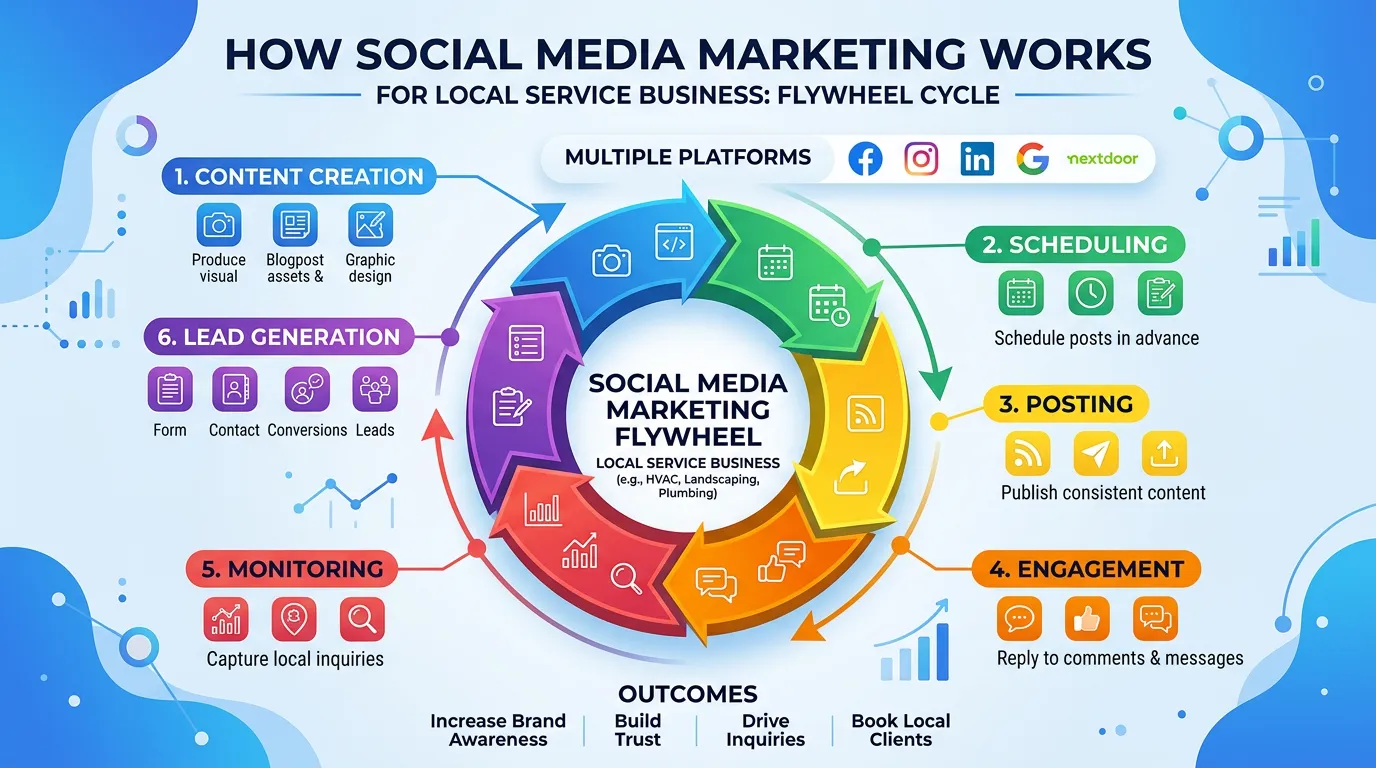
Two kinds of people see your business on social media, and they are worth very different amounts to you. The first already has your name. A neighbor recommended you, or they saw your truck, or they found you on Google an hour ago. Before they call, they look you up. That look includes your Facebook page and your Instagram profile. The second kind is a stranger scrolling past. They were not looking for you, and they were not looking for a plumber. Reaching that person is possible, but it takes paid ads and repetition, and it costs real money. For most local service businesses, the first group is where the value sits. That changes what a good profile needs to do. The person checking you out is not reading your captions closely. They want three things fast. Are these people still in business? Do they do the kind of work I need? Does somebody answer? A page with a post from last week, a dozen photos of finished jobs, and replies under every comment answers all three in about fifteen seconds. A page with 84 followers and a last post from 2022 answers the first one badly, and nothing further down the page can undo that. This is why an abandoned profile does more harm than no profile at all.
What the Feed Is Actually Doing With Your Post
Every major feed is ranked, not chronological. The platform does not show your post to everyone who follows you. It guesses which posts each person is most likely to respond to, then fills the screen with those. Your post is one candidate among thousands. It competes with a cousin's baby photos, a group somebody joined last month, and paid ads from businesses spending money to be there. That is the whole reason organic reach on a business page is small. Reach has been shrinking for years, and it will keep shrinking, because the number of posts keeps growing while the number of slots does not. A post that reaches a small share of your followers is not a broken post. That is the normal outcome, and planning around it saves a lot of frustration. The second thing to understand is that you do not own the audience. Followers are borrowed. The platform decides who sees you, and it can change that overnight with no notice and no appeal. Every business that built its entire customer list inside one app has learned this the hard way. So use social media for proof and reach, then move the relationship somewhere you control. That means a phone number in your system, an email address, and a customer record. Social media is the introduction. Your own list is the relationship.
The Life of One Post, Start to Finish
It helps to know what happens after you press publish. The post does not go out to everyone at once. It gets shown to a slice of your followers first, usually the ones who interact with you most. What those people do next decides how far it travels. Comments, shares, and saves push a post further than likes do, because they take more effort, and the platform reads effort as interest. Most of a normal photo post's reach happens on the first day. By day three it is finished. Short vertical video behaves differently. Those clips get shown to people who do not follow you, so a good one can keep picking up views for a week or longer. That is why one useful video is often worth more than four ordinary photo posts. It is also why you should check a post twice: once after 24 hours, once after seven days, and write both numbers down. Two habits come out of this. First, post when your own audience is awake. For home services that usually means early morning or evening, not the middle of a work day. Second, answer the first comments quickly. Early replies keep a post alive while the platform is still deciding what to do with it.
Where Social Media Touches Search and Referrals
Social media does not sit in its own box. Type your business name into Google and look at the first page. For most service businesses, the Facebook page, the Instagram profile, and sometimes a YouTube channel all show up there, next to the website and the Google Business Profile. That page is what a referred customer sees. Every live profile on it is one more thing saying you are real, and one less slot for something you do not control. Be careful with the ranking claim, though. A link in a social post does not work like a link from a website. Treat any effect on search as indirect. What does help is quieter than a ranking. More people type your name into Google. More of them land on a current profile instead of a dead one. Referrals work the same way. A neighbor asks a local group who to call about a broken gate. Five people answer. If your customers can picture your name, you get mentioned. If your page has been silent for two years, the person who almost recommended you does not bother. None of this shows up in a report as a lead from social media. It shows up as more calls that say a friend sent them. That is real, and it is very hard to count.
How a Profile Visit Turns Into a Phone Call
Here is the part most owners never test. Somebody likes a post, taps your name, and lands on your profile. What happens next is the whole game, and it usually breaks in small, boring ways. The phone number is missing. The link goes to your home page instead of the page about the service in the post. The hours are wrong, so the button says closed on a Saturday when your crews are working. The contact button points at an email nobody has opened since 2021. Messages sit unread for days. Test it yourself in about five minutes. Log out of the app, or use a private window, find your own page the way a stranger would, and try to call yourself in two taps. Then send your page a message and see how long it takes anyone inside your company to notice. Most owners are surprised, and not in a good way. While you are in there, check that the phone number matches the one on your Google Business Profile. Google asks for accurate, consistent business details across the places you appear, and a customer who sees two numbers wonders which one is real. Fix the handoff before you spend a dollar on content. Better posts feeding a broken profile only waste better work.
How to Tell If Any of It Is Working
Measurement happens in three layers, and you need all three, because each one lies on its own. The first layer is the platform. Inside Facebook or Instagram you can see reach, profile visits, link clicks, saves, and messages. Profile visits and messages are the two worth watching, because they sit closest to intent. The second layer is your website. Tag the links you post so your analytics knows where a visit came from. Those tags are the utm values on the end of a link, and they cost nothing. Then make sure calls and form fills are recorded as events, so a visit that becomes a lead is counted as one. Skip that step and social traffic looks like traffic and nothing more. The third layer is a person asking. Put how did you hear about us on your intake form, and have whoever answers the phone actually ask it. Expect a gap between the three layers. Someone sees a job photo on Tuesday, remembers you on Friday, and searches your business name. Your analytics calls that a branded search, not a social visit. That is not a tracking bug. It is how people behave. Read these numbers over 90 days rather than week to week, and treat the direction as the answer.
What Social Media Cannot Do for You
An honest list of the limits saves everybody time. Social media will not create demand for an emergency trade. Nobody scrolls Instagram, sees a great photo, and decides their water heater should fail tonight. Those customers search, and that money belongs in search. It will not fix a 3.2 star rating either. If your reviews are the problem, posting more photos just sends more people to go read them. Fix the reviews first. It will not replace your Google Business Profile, which is where most ready to buy local demand still arrives. And it is slow for a brand new company with no finished jobs to show, because the whole thing runs on work you have already done. There is one more limit worth saying out loud. If your crews will not send photos, and nobody in the office will chase them, the program stalls by month three. That is the most common reason social media fails at a service business, and no agency can fix it from the outside. If that sounds like your company, either solve the photo habit first or run a smaller version. Keep the profile current, answer every message inside a day, and skip the content calendar until the photos are flowing.

From a Job Site Photo to a Ringing Phone
Five steps sit between a photo taken on a job and a call in your office. Most programs break at step four.
Steps two and three belong to the platform. Steps one, four, and five belong to you, and that is where the work pays off.
What Each Number in Your Insights Tells You
Every app reports a pile of numbers. Only a few of them connect to a phone call. Here is how to read the common ones.
| Number | What it tells you | What it hides | How often to check |
|---|---|---|---|
| Followers | How many people opted in once | Whether any of them are local | Rarely |
| Reach | How many screens the post hit | Whether anybody looked | Monthly |
| Saves and shares | The post was worth keeping | Very little, this one is honest | Every post |
| Profile visits | Somebody wanted to know more | Which post sent them | Weekly |
| Messages | A real person is asking | How fast anyone replied | Daily |
| Link clicks | Interest in the page you sent | What happened on the site | Weekly |
If you only track two numbers, track profile visits and messages. They sit closest to the phone call.
Why Your Reach Keeps Going Down
Owners watch reach fall and assume they were punished for something. Almost always, they were not. More accounts post every year, and the number of slots in a feed has not grown.
Paid posts take some of those slots. So do friends and family, which every platform says it prefers to show. A business page starts at a disadvantage and stays there.
The fix is not to post more. It is to post fewer and better things, reply to everything that comes in, and buy reach when you need to be in front of people who do not follow you yet.
Two More Questions About the Machinery
Do hashtags still do anything?
Does deleting a post hurt my page?
Can I post the same thing on two platforms?
Would rather we handled it?
This article covers how to do the work yourself. If you would rather have it done for you, that is what our social media marketing service is.
Social Media Marketing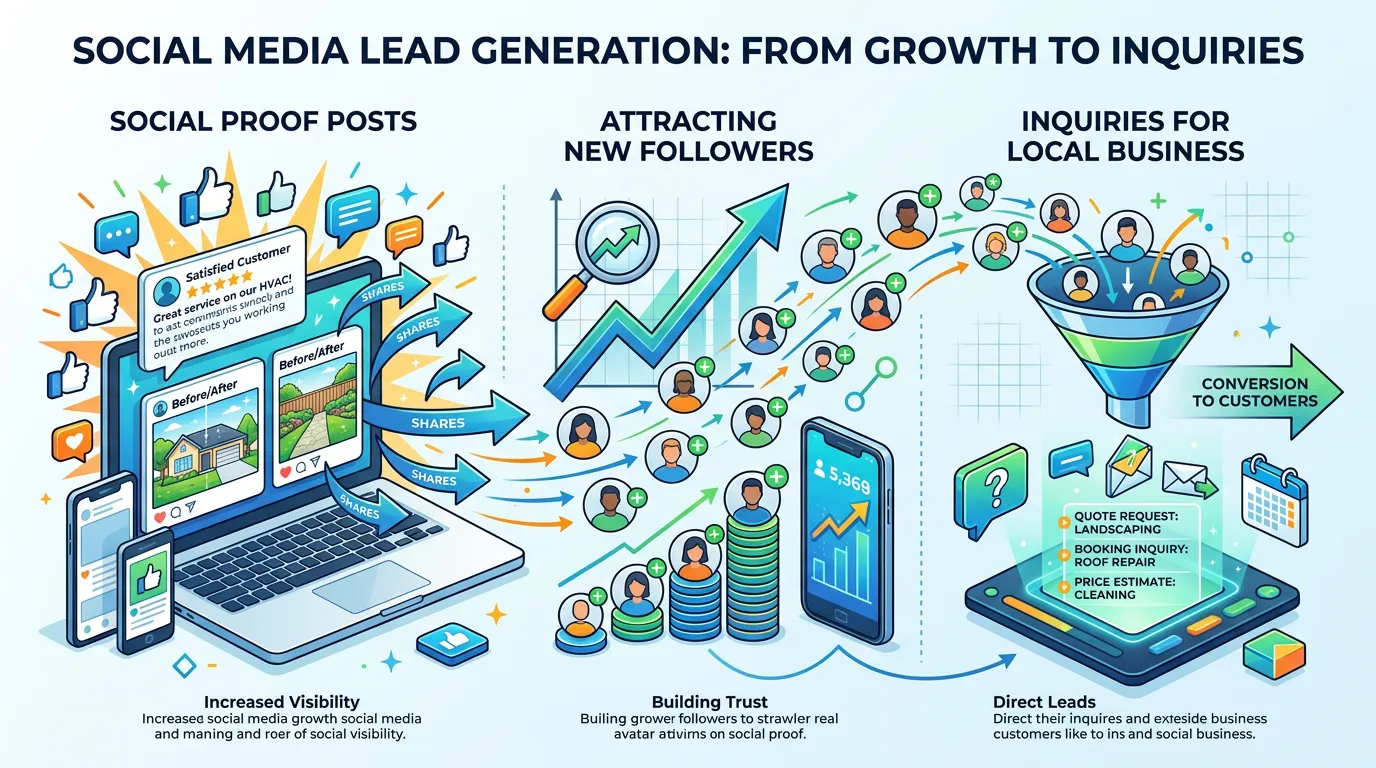
Frequently asked questions
Is social media a Google ranking factor?
How long before social media does anything?
What is the difference between organic and paid social media?
Should I post from my personal profile or a business page?
Sources
- Google: Guidelines for representing your business on Google(opens in a new tab) Google asks that your business name, address, and contact details be accurate and consistent across the places your business appears.
- Google Search Central: SEO Starter Guide(opens in a new tab) Google covers the basics every published page needs, including the titles, descriptions, and links that social traffic lands on.
- HHS: HIPAA Privacy Rule(opens in a new tab) Medical, dental, and care businesses are bound by patient privacy rules, which is why posting anything that identifies a patient needs written consent.