
Foundational Guides
How Much Social Media Marketing Costs for a Local Business
The four ways social media marketing gets priced, the seven things that move your quote, and how to work out what it takes to break even.
Call (714) 823-3164 or ask a question. Clear recommendations, even if we never work together.
Social media marketing is usually sold as a monthly fee. Scheduling tools run from free to about 100 a month. A freelancer posting a few times a week is commonly quoted between about 400 and 1,200. Full management with video and message handling costs more, and ad spend is a separate budget.
Jump to a section
- What You Are Actually Paying For
- The Four Shapes a Quote Comes In
- The Seven Things That Move Your Number
- Ad Spend Is a Separate Pocket
- The Hours You Still Owe After You Hire Someone
- Doing the Break Even Math
- When Not to Pay for This Yet
- Four Ways Social Media Work Gets Priced
- What to Have Ready Before a Pricing Call
- Comparing Two Social Media Quotes
- Questions
What You Are Actually Paying For
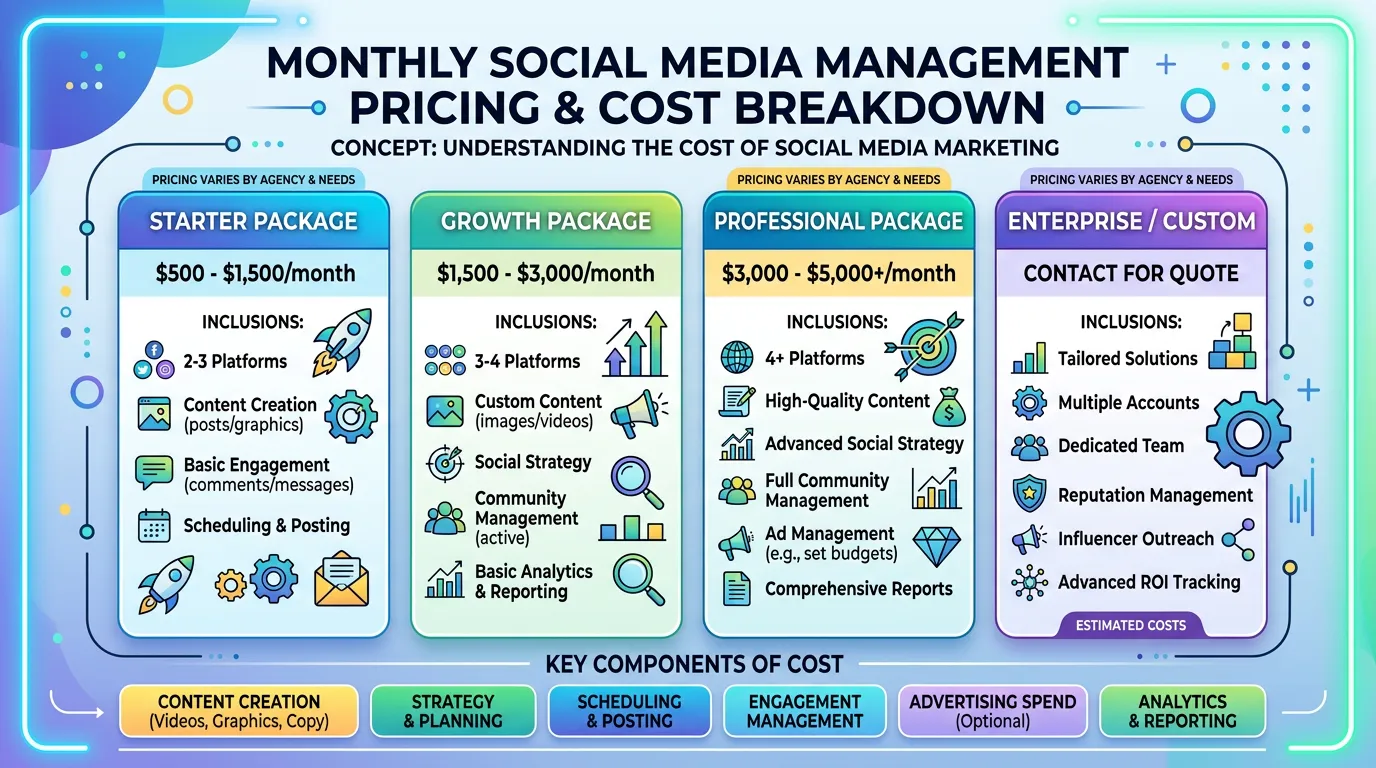
A social media fee is mostly labor, so the fastest way to judge a price is to count the hours inside it. Six jobs get paid for. Setup and profile cleanup happens once and takes a few hours per platform. Content production is the biggest line: sorting photos, cutting clips, writing captions, and building a month of posts. For a small local page that is commonly four to ten hours a month, and more when video is involved. Scheduling and publishing is small, an hour or two. Replies and messages are the sneaky one. Each reply takes a minute, but it happens every day, and a page that gets real questions can eat two to five hours a month. Reporting is another hour or two. Ad creative, when it is included, is its own line. Add it up and a modest program is fifteen to twenty five hours a month of somebody's time. Now put a rate on those hours. At 60 an hour you land near 900 to 1,500. At 125 an hour you land closer to 1,900 to 3,100. That arithmetic explains most of the spread you see in quotes. When a price looks impossibly low, hours are the thing that got cut, and the first two cut are almost always the replies and the real photos.
The Four Shapes a Quote Comes In
Almost every price you get is one of four shapes, and they are not really competing with each other. They suit different sizes of business. The first is software only. A scheduling tool costs from free to about 100 a month and buys you automation, not judgment. You still take the photos and write the words. The second is per post work. A freelancer or a local content person charges by the piece, commonly somewhere between about 40 and 150 a post depending on whether video is involved. That is honest pricing and it works, as long as you accept that nobody is watching the inbox. The third is monthly management, which is what most agencies sell. For one location, one or two platforms, and two or three posts a week, quotes in Southern California commonly land somewhere between about 800 and 2,500 a month. The fourth is full service with video. Somebody comes to job sites, shoots, edits vertical clips, runs the inbox, and builds ad creative. That work commonly starts around 3,000 a month and climbs, because a shoot day is a real cost with travel inside it. Hourly coaching also exists, usually between about 100 and 250 an hour, and it fits an owner who will do the work but wants a plan first.
The Seven Things That Move Your Number
Two businesses on the same street can get quotes that differ by a factor of three. These are the reasons, roughly in the order of how much they move a price. One more thing quietly moves it too: how rough the starting point is. A page abandoned for three years needs a cleanup month before anything else happens. Most providers price that as a one time setup fee, which is fair. Ask what the fee covers and whether it ever repeats.
- Platform count. Each extra platform adds production and inbox time, not just a copy and paste.
- Posting frequency. Going from two posts a week to five roughly doubles the content line.
- Video. Filming and editing cost more than photos, and on site shoot days cost the most of all.
- Who supplies the photos. Crews sending them saves real money. Somebody driving out to shoot costs it.
- Message volume. A page fielding forty questions a month costs more to run than one fielding four.
- Locations. Every address needs its own profile, its own local content, and its own inbox.
- Approvals and rules. Dental, medical, and care businesses need a consent step before anything is posted.
Ad Spend Is a Separate Pocket
Management fees and ad spend are two different budgets, and mixing them is how people end up disappointed. The fee pays a person to do work. The spend goes to the platform and buys reach. A quote that folds both into one number is hiding the split, so ask for it in writing. Providers charge for the ad side in three ways: a flat monthly fee, a percentage of spend that commonly sits somewhere between about 10 and 20 percent, or a line buried inside a larger retainer. Flat fees are easier to compare, and they give nobody a reason to talk you into a bigger budget. Two costs hide on the spend side. The first is creative. Local audiences are small, so the same people see your ad again and again, and it stops working after a few weeks. New creative is part of the running cost, not a one time build. The second is where the ad points. Sending paid traffic to a home page wastes it, so budget for the page behind the ad. Before you pick a spend number, work out what one lead is worth to you. Then the budget stops being a guess. It becomes a number of leads you can afford to buy.
The Hours You Still Owe After You Hire Someone
Every social media quote assumes work on your end, and almost none of them say so out loud. Count those hours before you compare prices. Photos are the big one. Somebody on your team has to take them and send them in, which is about a minute per job and a real habit to build. Somebody has to answer the questions only you can answer, like whether you serve Chino Hills or what a repair like that usually runs. Somebody has to approve posts, if you want approval, and that step is where most programs slow down. And somebody has to sit on the monthly call. Add it up and a well run program still costs you two to four hours a month. Name the person and write it into the plan. When a program dies, it almost never dies because the provider stopped working. It dies because the photo flow stopped and nobody inside the company noticed for six weeks. If nobody on your team can own that hour, say so before you sign. An honest provider will change the plan, price a shoot day, or tell you to spend the money somewhere else this year.
Doing the Break Even Math
The useful question is not whether a price is high. It is how many jobs it takes to cover it. Here is a hypothetical. A landscaping company charges an average of 4,000 for an install and keeps about 1,600 of that after crew and materials. At those numbers, a 1,500 monthly fee is covered by one extra install a month. Then ask the harder question: can you picture where that install comes from? If you cannot, the price is too high for you right now, whatever the market rate says. Trades with repeat customers get better math. A dental practice counts a new patient across several years, so break even can be a fraction of one new patient a month. A roofer sees the same customer once a decade and should stick with the simple version. Last, fund a real time frame. Profile work and faster replies show up quickly. Content and referral effects take six to twelve months, and no honest provider can promise a result by a date. Google itself warns against anyone guaranteeing a top position in search, and the same warning fits anyone guaranteeing followers or leads. If you cannot fund six months of the fee before new work arrives, start smaller.
When Not to Pay for This Yet
Sometimes the right answer is to spend the money somewhere else, and a provider who tells you that is worth keeping. Hold off on a paid social program if any of these are true. Your Google Business Profile is unclaimed or thin, because that is where ready to buy local demand shows up first and it costs far less to fix. Your rating sits under four stars, because more visitors only means more people reading those reviews. Your website cannot take a call or a form on a phone. You have no finished work to show and no way to collect photos. In each of those cases the same money buys more somewhere else. Start with the profile, the reviews, and the phone path. Then keep a minimum version of social media running: correct business details, a post every couple of weeks, and every message answered inside a day. That much costs almost nothing and it prevents the abandoned page problem. Once the basics are solid and photos are arriving from the field, a paid program has something to work with, and the price stops feeling like a gamble.
Four Ways Social Media Work Gets Priced
Ranges below are what small service businesses in Southern California commonly see quoted. Your number depends on the seven factors above.
| Shape | Common range | What you get | Who it fits |
|---|---|---|---|
| Software only | Free to about 100 a month | Scheduling and basic reports | An owner who will do the work |
| Per post | About 40 to 150 a post | Content, nothing else | A team that watches its own inbox |
| Monthly management | About 800 to 2,500 a month | Posts, replies, and reporting | One location, one or two platforms |
| Full service with video | About 3,000 a month and up | Shoot days, clips, ad creative | Visual trades and multi location |
| Hourly coaching | About 100 to 250 an hour | A plan and a training session | An owner who needs direction |
Nobody sells all four. Decide which shape fits your company before you collect quotes, or you will compare prices for different jobs.
What to Have Ready Before a Pricing Call
Twenty minutes of gathering usually changes the number you get back, because a provider guessing high is protecting themselves from what they cannot see.
Every profile you own, including the dead ones
Old pages an employee made count, and they have to be found or closed.
The date of your last real post
It tells a provider whether this is repair work or upkeep.
How many messages and comments you get a month
This is the line that inbox labor gets priced against.
Who takes photos today, and on what phone
A working photo habit is the single biggest discount available.
Your average job value and close rate
You need both to judge any price in under a minute.
Number of locations and service areas
Each address is its own profile, inbox, and content stream.
Any rule that limits what you can post
Patient privacy, franchise brand rules, or manufacturer approval.
A monthly ad budget, if you want ads
Keep it separate from the fee so both stay easy to read.
Comparing Two Social Media Quotes
Two proposals can read almost the same and mean very different work. These questions separate them fast.
Do this
- Ask how many hours a month the fee assumes, and where they go
- Ask who answers messages, and how fast they promise to do it
- Ask to see three real posts they wrote for a business like yours
- Ask what happens when your crews send no photos for a month
- Ask what you keep if you leave: profiles, photos, and access
Not this
- Do not pay extra for a promise about followers or reach by a date
- Do not accept a quote that folds ad spend and labor into one number
- Do not buy five platforms when your customers use one
- Do not let a provider open new profiles under their own account
- Do not judge a price before you know your average job value
The cheapest quote and the most expensive quote usually differ by one thing: whether anybody is reading your inbox.
Would rather we handled it?
This article covers how to do the work yourself. If you would rather have it done for you, that is what our social media marketing service is.
Social Media Marketing
Frequently asked questions
Is a cheap social media package ever worth it?
Should I pay per post or pay a monthly fee?
Do I have to sign a long contract?
Does the quoted price include ad spend?
Sources
- Google Analytics 4 events guide(opens in a new tab) Form fills, calls, and bookings are recorded as GA4 events, which is free to use and priced only as setup labor.
- Google Search Central: Do you need an SEO?(opens in a new tab) Google warns that nobody can guarantee a top position in search results, which is the same warning that fits guaranteed follower or lead promises.
- FTC: Endorsement guides, what people are asking(opens in a new tab) Paid or incentivized endorsements have to be disclosed, which adds a review step and cost to any influencer or customer post program.