
FAQ and Problem Solution Articles
Why Your Business Page Gets No Likes, Comments, or Messages
Five reasons a local business page goes quiet, how to check each one in your own numbers, and when low engagement does not matter at all.
Call (714) 823-3164 or ask a question. Clear recommendations, even if we never work together.
Most local pages get little engagement because the followers are not local customers, every post looks the same, and nobody replies. Engagement may also not be your real problem. If profile visits, messages, and calls are steady, a quiet like count is fine. Check the audience first, then the format.
Jump to a section
- First, Check Whether Anything Is Actually Broken
- Your Followers May Not Be Your Customers
- The Feed Rewards Response, Not Posting
- Every Post Looks Like Every Other Post
- Bursts and Silence Beat You Up
- Nobody Answers, So Nobody Starts
- When Low Engagement Is Not Actually Your Problem
- Where the Drop Actually Happens
- A 30 Day Reset for a Quiet Page
- Fixing a Quiet Page Without Wasting Money
- Two Questions About Regulated Industries
- Questions
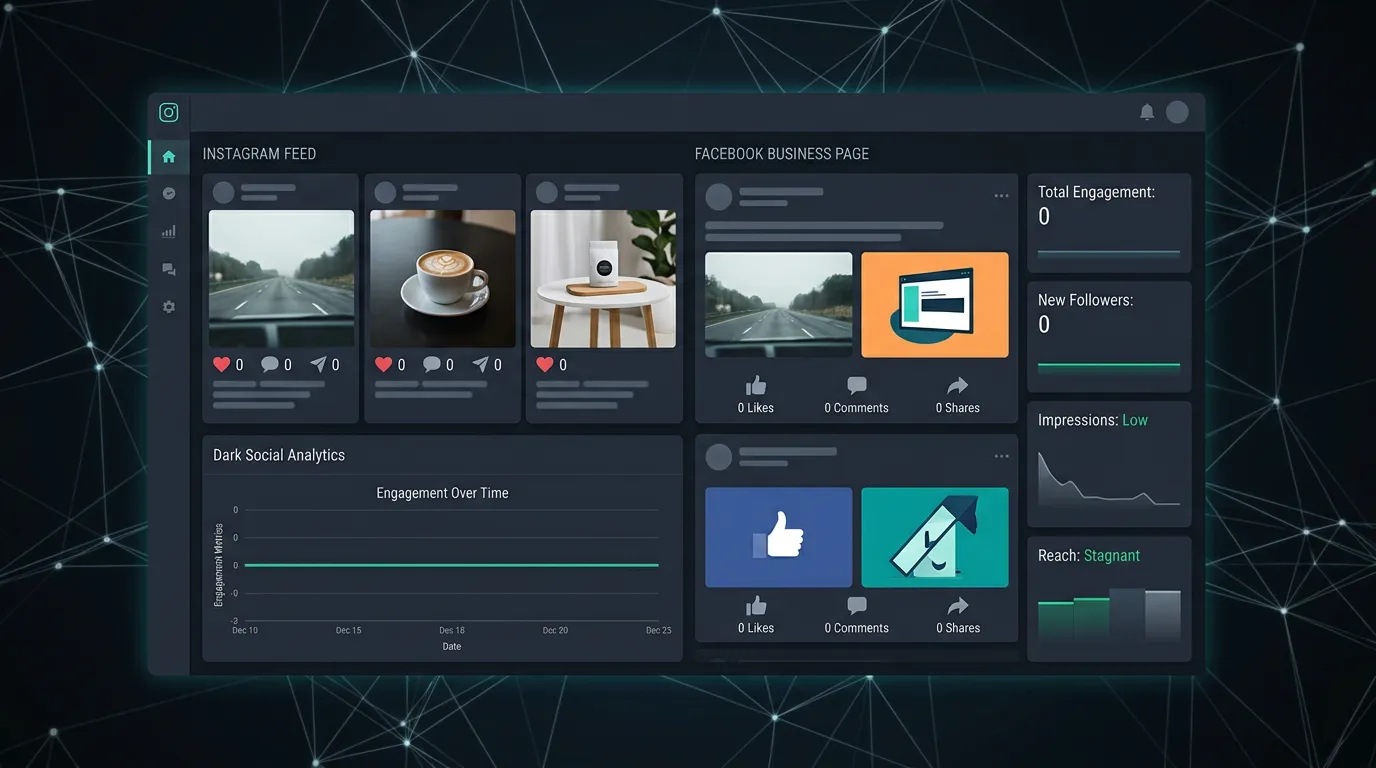
First, Check Whether Anything Is Actually Broken
Before you change anything, find out if you have a real problem. Engagement rate is a simple bit of arithmetic. Take the likes, comments, shares, and saves on a post, divide by the number of people it reached, and turn it into a percent. Do that for your last twenty posts and write the numbers in a column. Now ignore every benchmark you have read online. Those averages come from every kind of account in every industry, and they tell you nothing about a landscaping page in Ontario with 380 local followers. The number that matters is your own from three months ago. If the rate held steady but the reach fell, your content is fine and your distribution shrank. If reach held steady but the rate fell, the posts themselves stopped landing. Those two problems have different fixes, and most owners guess wrong because they only look at likes. One more check before you go further. Open your last twenty posts and mark which ones got any reply at all. If two or three carry all of the response, you already know what works. The problem is usually that you post nineteen of the other kind.
Your Followers May Not Be Your Customers
This is the most common cause and the least fun to hear. Open your audience or insights tab and look at where your followers live. Plenty of local pages find that half their followers are in another state, or another country. That happens for three reasons. Somebody ran a giveaway years ago and collected people who wanted a free gift card. Somebody bought followers, or a past agency did. Or a post went unexpectedly wide once and pulled in people who will never hire you. Those followers still count when the platform decides who to test your next post on. It shows the post to people who do not care, they scroll past, and the post dies before your real customers ever see it. There is no button that fixes this cleanly. What works is slow. Stop chasing follower count entirely. Post the things only a local person responds to: a street name, a neighborhood, a local high school, a storm last week. Over a few months your real audience grows and the dead weight stops mattering as much. If a large share is clearly fake, some owners start a fresh page. That is a real option, but it costs you the history and any reviews on the old one, so weigh it carefully.
The Feed Rewards Response, Not Posting
Feeds are ranked, not chronological. The platform is trying to guess which posts a person will respond to and put those near the top. It learns from what happened the last few times it showed them your work. If your last six posts got shown and nothing happened, the next one gets tested on a smaller group. That is the quiet spiral most business pages are stuck in, and posting more often makes it worse, not better. What breaks the spiral is a post that earns a real response. A few things reliably do. Faces get more response than equipment. Motion gets more than a still photo. A before and after gets more than either, because people cannot help comparing them. A genuine question gets answers, as long as it is a question a normal person can answer in four words. Avoid the fake version, since nobody answers what is your favorite season. Ask which of these two tile layouts they would pick. One habit matters as much as the content. Be there for the first hour. Reply to every comment while the post is new, because the platform is still deciding what to do with it, and a conversation under the post is the strongest signal you can send.
Every Post Looks Like Every Other Post
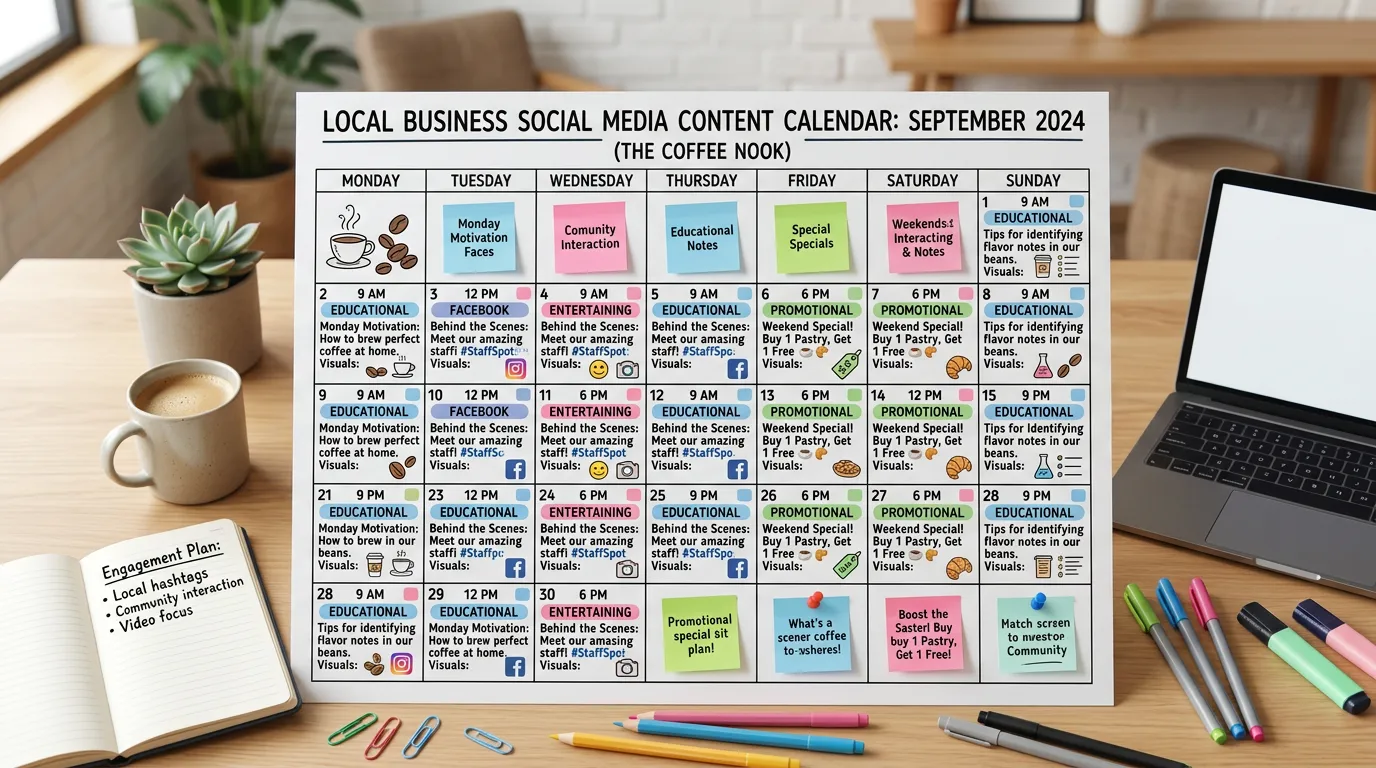
Pull up your page and look at the grid the way a stranger would. If the last twelve posts are all the same shape, that is your answer. The usual pattern at a service business is a single photo of finished work, a caption about quality and service, and a phone number. It is not wrong, but it is invisible, because your competitor two towns over is posting the identical thing. Sameness is a distribution problem, not just a taste problem. When somebody has scrolled past nine of your posts without stopping, the platform stops offering the tenth. Mix the shapes on purpose. Rotate through four kinds. A finished job, which proves the social media work. A person, which proves there is a company behind it. A short teaching clip, which answers the question customers ask every week. And a piece of proof, like a message from a happy customer with the name removed. Four shapes on a two post a week rhythm covers a month. One more thing to check: stock photography. A stock image of a smiling person in a hard hat gets nothing, every time. A slightly crooked photo of your own crew in the sun beats it. People can tell the difference in half a second, and they respond to the real one.
Bursts and Silence Beat You Up
Look at your posting dates for the last year. Most service businesses show the same pattern: eleven posts in January, four in February, nothing from March through August, then three in one week in September when somebody remembered. That rhythm hurts twice. Your audience never builds a habit of seeing you, and every restart begins from a colder position than the last one. Steady beats heavy. Two posts a week you can hold through your busy season are worth more than daily posting that dies by March. Set the rhythm around your worst month, not your slowest one. There is a seasonal trap inside this too. The months you go quiet are usually the months you are busiest, which are the months you have the most photos and the most finished work to show. That is exactly backwards. The fix is boring: capture during the busy season, publish some of it during the slow one. Keep a folder of good photos you never posted, and you will always have material in the month when nothing is happening. It also means your quiet season looks busy to anyone checking you out, which is the season you most need to look busy.
Nobody Answers, So Nobody Starts
Go look at your last month of comments and messages. Count how many got a reply, and how long each one took. At a lot of local businesses the honest answer is that comments get a thumbs up at best and messages sit unread for days. That has two costs. The obvious one is the missed inquiry, and it is bigger than owners think, because a message on a business page is usually somebody who is ready to talk. The second cost is quieter. A comment with no reply under it is a dead end, and people who see dead ends stop commenting. You trained your own audience not to bother. Fixing this takes no budget and no creativity. Pick a person, give them ten minutes twice a day, and set a rule: every comment gets a real sentence back, and every message gets an answer inside one business day. Turn on the notifications so it stops depending on memory. Within a few weeks the comment count usually rises on its own, because people got something back the last time. If your inbox has a backlog, clear it before you post anything new. Answering an eleven day old question late still beats never.
When Low Engagement Is Not Actually Your Problem
Here is the part almost nobody says. For a local service business, engagement is a weak measure of whether social media is doing its job. Most of the value comes from people who look you up before calling, and looking does not leave a like behind. A page can get four likes a week and still be earning its keep, if profile visits are steady, messages arrive, and callers mention seeing your work. Check those three before you conclude anything is broken. If they are healthy, stop optimizing for likes. Keep posting real work at a steady pace and put your energy into replies and photos. If profile visits are falling too, then you have a genuine reach problem and the earlier sections apply. And be honest about the ceiling. A business with 300 real local followers is never going to look busy compared to a national brand, and it does not need to. Three hundred neighbors who see every post are worth more than twelve thousand followers scattered across the country. Judge the page by the phone, not by the applause.
Where the Drop Actually Happens
Engagement is one step in a chain. Finding which step lost people tells you what to fix.
A drop between followers and reach is an audience problem. A drop between reach and response is a content problem. They need different fixes.
A 30 Day Reset for a Quiet Page
Work these in order. The early items cost nothing and usually explain most of the drop before you spend a dollar.
Week 1: clear the inbox and every unanswered comment
Late replies still beat silence, and it resets the habit.
Week 1: check where your followers live
If most are out of area, expect low numbers and stop worrying.
Week 1: mark which of your last 20 posts got any reply
The winners are your template. Copy their shape, not their words.
Week 2: fix the profile a visitor lands on
Phone number, hours, service area, and a link that matches the post.
Week 2: build a folder of unposted job photos
Twenty photos buys you two months of steady posting.
Weeks 2 to 4: post twice a week, four different shapes
Finished job, a person, a short teaching clip, a piece of proof.
Weeks 2 to 4: reply to everything within the first hour
Set a phone alert so it does not depend on remembering.
Day 30: compare profile visits and messages, not likes
Those two move first, and they are the ones tied to calls.
Fixing a Quiet Page Without Wasting Money
Most of what owners try after a slow month makes the next month slower. Here is the split.
Do this
- Post the photo your crew took on a phone, crooked and all
- Ask a question a person can answer in four words
- Name the neighborhood, the street, or the local landmark
- Reply to every comment in a full sentence, fast
- Cut the platforms nobody engages with and give the time back
Not this
- Do not buy followers, ever, including from a cheap growth service
- Do not run a giveaway that attracts people outside your service area
- Do not post more often to escape low reach, it speeds the spiral
- Do not use stock photos of models pretending to do your trade
- Do not judge a month by likes when messages and calls went up
Two Questions About Regulated Industries
Our office cannot post patients. What do we post?
Can we ask customers to post about us?
Would rather we handled it?
This article covers how to do the work yourself. If you would rather have it done for you, that is what our social media marketing service is.
Social Media Marketing
Frequently asked questions
Did the platform shadow ban my page?
Should I delete my old page and start over?
Will paying to boost a post fix low engagement?
How many followers does a local business actually need?
Sources
- Google Analytics 4 events guide(opens in a new tab) Calls and form fills are recorded as GA4 events, which is how a social visit gets tied to a real inquiry instead of a like count.
- HHS: HIPAA Privacy Rule(opens in a new tab) Dental, medical, and care businesses are bound by patient privacy rules, which limits what a page can post without written consent.
- FTC: Endorsement guides, what people are asking(opens in a new tab) Endorsements that are paid for or incentivized have to be disclosed, including posts by customers who received something in return.