
How To Articles
How Reputation Management Works, From One Job to One Review
The three loops behind review work, how a single review travels from a finished job to your profile, and where each one usually breaks.
Call (714) 823-3164 or ask a question. Clear recommendations, even if we never work together.
Reputation management works as three loops. Generation asks happy customers for a review at the end of a job. Response answers what arrives, so the next reader sees how you handle problems. Monitoring watches every platform where your name shows up. Together they shape what a buyer sees at the moment they choose.
Jump to a section
- Three Loops That Run at Different Speeds
- How One Review Actually Gets Made
- Your Name Search Is the Real Home Page
- Two Jobs: Getting Found and Getting Picked
- The Ask Has to Live Inside a Step You Already Do
- What the Reply Does That the Review Cannot
- What Monitoring Looks Like in a Normal Week
- From Finished Job to Published Review
- What Each Loop Does and What Breaks Without It
- Review Management and Reputation Management Are Not the Same Job
- How the Machine Works, in Short
- Questions
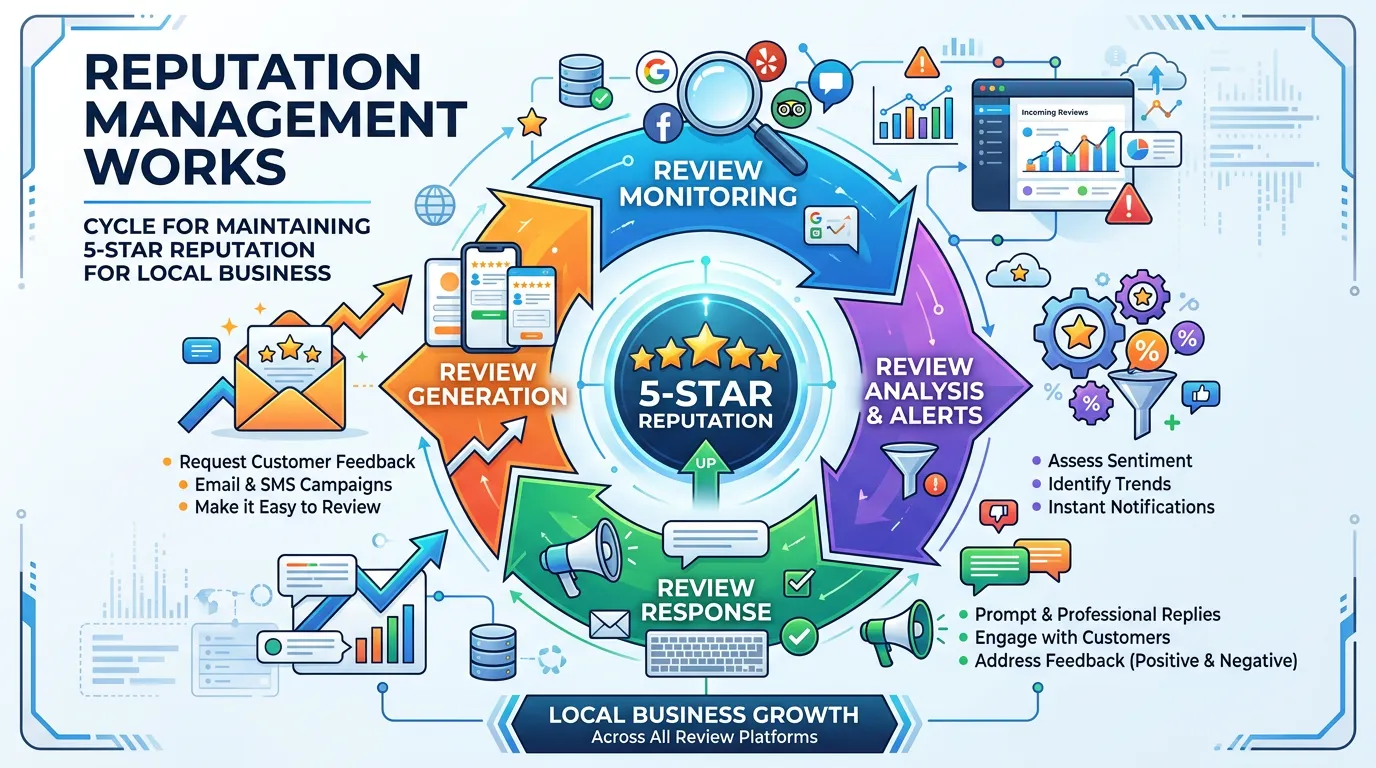
Three Loops That Run at Different Speeds
Reputation management is not one task. It is three loops running at once, and they run at different speeds. The first loop is generation. You ask happy customers for a review, and a few of them do it. This loop is tied to finished jobs, so it runs every day you work. The second loop is response. A review lands, someone reads it, and someone writes a reply. This loop runs a few times a week. The third loop is monitoring. Somebody watches every place your name shows up and flags what needs a person. That one runs quietly in the background. Most owners only run the second loop, and only when a bad review scares them. That is why the reputation management work feels like firefighting instead of a system. Take any one loop out and you can see what it was doing. Run only generation and your profile fills with reviews nobody answered. Run only response and you are polishing replies under a rating that never moves. Run only monitoring and you get a very well documented decline. The three feed each other. New reviews give you something worth replying to. Replies give the next reader a reason to call. Monitoring tells you which complaint keeps coming back, so the people who can fix it hear about it. Pull one out and the other two get weaker within a couple of months.
How One Review Actually Gets Made
Follow a single review from start to finish and the whole system makes more sense. A job ends. Someone marks it complete in your software, or writes it on a paper ticket. That moment is the trigger. A text or an email goes out with a link. The customer taps it on their phone. The link opens a Google review box, and they need to be signed in to a Google account to use it. Most people on an Android phone already are. Many people on an iPhone are not, and that is where a share of your requests quietly die. They pick a star count, type a sentence or two, and hit post. Then it goes to a checking step. Google runs the text through automated screening for spam and policy problems. Most reviews clear it fast. Some take a few days. A few never publish at all. Now count the places that path can break. The trigger never fires because nobody marked the job done. The text goes to a landline. The link is four taps deep instead of two. The customer meant to do it later and forgot by dinner. Each break is small on its own. Together they explain why a shop serving eighty customers a month ends up with three reviews.
Your Name Search Is the Real Home Page
Reviews are the loudest part of this reputation management work, but they are not all of it. Type your business name into Google and look at what comes back. That page is what a customer sees after a friend hands them your name. For most service businesses it holds the same handful of things. Your Business Profile panel sits on the right, with your stars and your newest reviews inside it. Your website is usually first on the left. Then come directory listings, your Facebook page, maybe Yelp, maybe a trade association profile. Sometimes an old news item, a job board posting, or a page that is not about you at all. Anything on that page you do not control is a project. Not a crisis, just a project. The fix is rarely deletion. It is usually building and strengthening pages you do own, so the ones you do not own get pushed further down. That takes months, because you are competing for space on a page you cannot edit. This part also carries into AI answers. When a chat tool summarizes your business, it is reading the same public pages a person would read. A clean, current set of profiles gives it better material to work from. A stale one gives it whatever is left.
Two Jobs: Getting Found and Getting Picked
Reviews do two separate jobs, and it helps to keep them apart in your head. The first job is getting found. Google says local results are sorted by relevance, distance, and prominence. Review count, rating, and how recent they are all feed prominence, along with links and mentions. So reviews are one input into where you sit in the map results. They are not the only one, and they will not fix a wrong primary category. The second job is getting picked. This one is bigger and almost nobody measures it. Two businesses show up side by side. One has 4.8 stars from 180 reviews with a new one from last week. The other has 4.1 from 26, and the newest is two years old. Both were found. Only one gets the call. That second job is why review work pays back even when your position on the page has not moved. You are not trying to climb past anybody. You are trying to win the choice that happens after both of you are already on the screen. If rank is the only number you track, you will miss the part that actually changed.
The Ask Has to Live Inside a Step You Already Do
The biggest reason review systems fail is that asking became an extra chore. Anything extra gets dropped in a busy week, and every week is busy. So the ask has to sit inside a step that already happens every single time. For a home service company that step is usually closing out the job in the field software. For a dental office it is the front desk taking payment. For a repair shop it is handing back the keys. Pick the step, then wire the request to it. Timing matters more than wording. The good window is short. You want to ask while the customer still feels relief that the problem is gone. On most home service jobs that is the same day, often within a few hours. Wait a week and the feeling has faded into a bill. Who asks matters too. A request from the technician who did the reputation management work gets a better response than one from a company address nobody recognizes, so put their name in it. And test the link on a real phone every few months. Platforms change their URLs, and nobody sends you a notice when they do.
What the Reply Does That the Review Cannot
A review belongs to the customer. The reply belongs to you, and it is doing a different job than most owners think. You are not writing to the reviewer. That conversation is usually over. You are writing to the next fifty people who read it while deciding whether to call you. A reply that works has four parts and takes about ninety seconds. Thank them, or acknowledge the problem. Name the specific thing, so it reads like a person and not a template. Say what you did, or what changed because of it. Then move it offline with a name and a number. Nothing else belongs in there. Two habits sink a reply. The first is arguing. The reader cannot tell who was right, but they can tell who lost their temper. The second is detail about the customer. Never confirm what they bought, when you were at their house, or anything about their health. In a medical or dental office, confirming that someone was a patient is a privacy problem and not just a bad look. Keep the public reply short and take the facts to a phone call.
What Monitoring Looks Like in a Normal Week
Monitoring sounds like software, but most of it is a routine. Somebody has to be the person who checks, and it needs to be a named person with a named backup. Here is what a normal week holds. Alerts arrive as reviews land, on whichever platforms you actually get reviewed on. Someone clears them daily, which usually means reading four things and replying to two. Anything under four stars goes to the owner before a reply is posted. Once a month, the reviews get tagged by theme. Price, timing, communication, cleanliness, and the work itself covers most trades. Tagging takes twenty minutes and it is the step almost everyone skips. It is also the step that pays. Three reviews mentioning late arrivals is not a marketing problem, it is a dispatch problem, and the tag is how it reaches the person who can fix it. The month end report should hold five numbers: requests sent, reviews received, average rating, response rate, and average time to reply. Rating moves last, so judging the whole program by rating in month two will tell you the wrong thing.
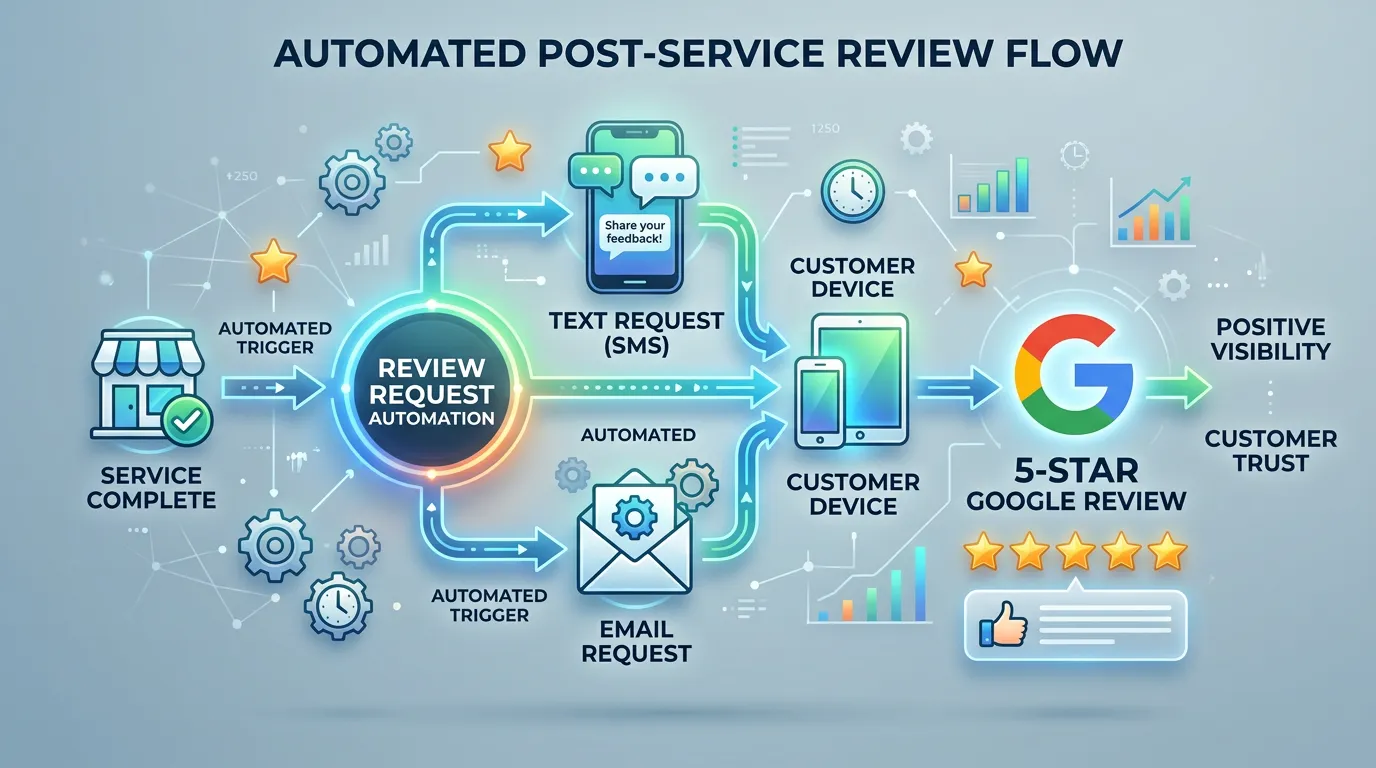
From Finished Job to Published Review
Every review takes the same path. Knowing the path tells you where yours are getting lost.
Three of the five steps happen outside your office. That is why the two you do control, the trigger and the reply, are worth so much attention.
What Each Loop Does and What Breaks Without It
Five moving parts. Most small businesses run one of them. Running three of these well beats running all five badly.
| Part | What it does | How often | What breaks without it |
|---|---|---|---|
| Generation | Asks customers at the right moment | Every finished job | Reviews go stale and the rating stalls |
| Response | Answers what lands, good and bad | Two or three times a week | Complaints sit with no reply under them |
| Monitoring | Watches platforms and mentions | Daily alerts | You hear about problems from a customer |
| Theme tagging | Sorts feedback into causes | Monthly | The same complaint repeats all year |
| Name search work | Shapes page one for your name | Quarterly | Old pages keep the spot you want |
Notice the frequency column. Two of these are daily habits and three are calendar tasks. Mixing them up is why programs die in month four.
Review Management and Reputation Management Are Not the Same Job
The two terms get used as if they mean one thing. They do not, and the difference decides what you should be paying for.
Review management is the narrower job. Ask, reply, monitor, report. It lives on Google, Yelp, Facebook, and your trade directories. Most small service businesses only need this.
Reputation management is wider. It covers reviews, and it also covers what sits on page one for your name, what former staff wrote on hiring sites, what a local news piece said years ago, and what a chat tool now says about you.
The wider version costs more and takes longer, because moving a page you do not own is slow work. Buy the narrow version first. Step up only when a search for your name turns up something reviews cannot fix.
How the Machine Works, in Short
Which platform should I start with?
How fast does any of this show up?
Can I turn reviews off?
Would rather we handled it?
This article covers how to do the work yourself. If you would rather have it done for you, that is what our reputation management service is.
Reputation Management
Frequently asked questions
Is reputation management the same as SEO?
Who inside a small company should own this?
Does replying change my star rating?
What happens if I stop doing it?
Sources
- Google Business Profile Help: Tips to improve your local ranking on Google(opens in a new tab) Local results are sorted by relevance, distance, and prominence, and review count and rating feed prominence.
- Google Business Profile Help: Tips to get more reviews(opens in a new tab) Google allows businesses to ask customers for reviews using a link or QR code, and prohibits offering free or discounted goods in exchange.
- Google Business Profile Help: Manage customer reviews(opens in a new tab) Google's own reply guidance: keep responses short and courteous, and sign off with a name so it reads as a real person.