
Foundational Guides
How Much Reputation Management Costs, and What Moves the Number
What reputation management costs, the four shapes a quote comes in, and the specific things that push the number up or pull it down.
Call (714) 823-3164 or ask a question. Clear recommendations, even if we never work together.
Reputation management is usually sold as a monthly fee. Review software commonly runs 50 to 300 a month. A managed service for one location is often quoted between about 500 and 2,000. The number moves with how many reviews you get, how many locations you have, and whether you are repairing damage or keeping a good rating steady.
Jump to a section
- What You Are Actually Paying For
- The Four Shapes a Quote Comes In
- What Pushes a Quote Up
- What Pulls a Quote Down
- Software Cost and Service Cost Are Two Different Lines
- The Costs Nobody Puts in the Proposal
- Do the Break Even Math Before You Sign
- Rough Market Ranges by What You Are Buying
- Cheap Is Not a Discount, It Is a Different Product
- How to Compare Two Reputation Quotes
- Numbers to Bring to Your First Pricing Call
- Questions
What You Are Actually Paying For
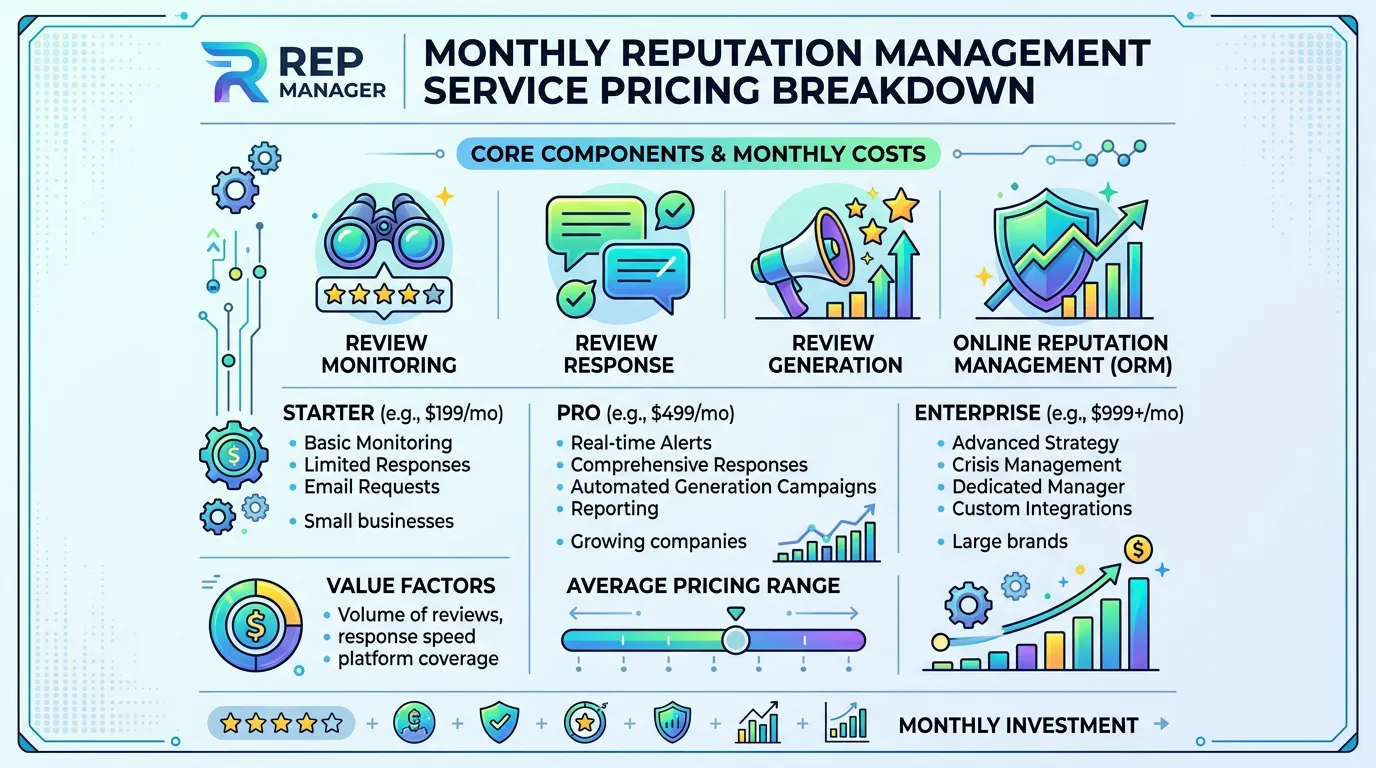
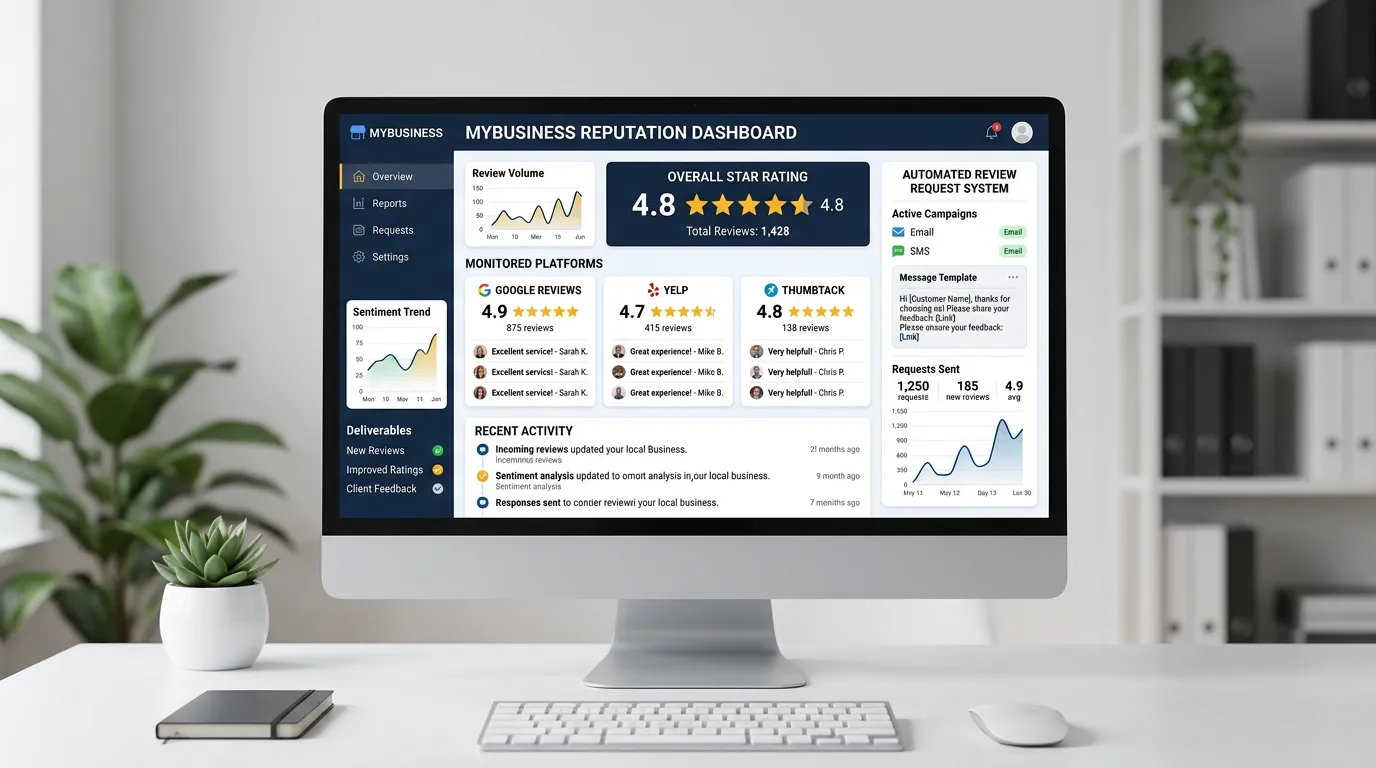
A reputation invoice is not a payment for stars. It is a payment for three things: a person's time, a tool subscription, and a process that keeps running when your week gets busy. Ask any provider to split the monthly fee across those three and you will learn more than any package name tells you. Time is the biggest line. Somebody reads each review, checks the job file, drafts a reply, gets it approved, and posts it. On a shop getting twenty reviews a month, that is real work with a real cost. Tools are the second line. Review software, alert monitoring, and text message sending all cost money, whether you pay the vendor directly or it sits quietly inside the fee. Text messages in particular are billed per send by nearly every platform. The third line is setup, and it is front loaded. Building request templates, testing links on real phones, claiming abandoned profiles, and writing the response rules all happen in the first six weeks. That is why month one usually costs more to deliver than month six. It is also why a provider billing the same hours in month twelve should be asked what changed.
The Four Shapes a Quote Comes In
Almost every quote you see is one of four shapes, and they are not really competing with each other. They suit different sizes of business. The first is software only. You buy a review tool and run it yourself. Around Southern California these run from roughly 50 a month at the small end to 300 or more per location for platforms that also handle messaging and monitoring. You are buying automation, not judgment. The second is a monthly managed service. A provider runs the asking, the replies, and the reporting. Single location service businesses commonly see quotes somewhere between about 500 and 2,000 a month, with the software either inside that number or billed separately. The third is per location pricing, which is how most multi location work gets quoted. Expect a base fee plus something in the range of 100 to 400 for each address, since every location has its own profile, its own reviews, and its own crew. The fourth is project work. Recovery after a bad stretch, or cleaning up page one for your business name, is quoted as a fixed project because the effort is front loaded and does not repeat every month. Those quotes commonly start in the low thousands and climb with how much damage there is. Hourly coaching also exists, usually somewhere between 100 and 250 an hour. It fits an owner who will do the reputation management work but wants the plan.
What Pushes a Quote Up
Two businesses in the same trade can get quotes that differ by three times. That is almost always scope, not greed. The clearest driver is review volume, because reply labor is priced per review. A dental office getting sixty reviews a month costs more to run than a remodeler getting six, even though the remodeler may be the bigger company. Number of locations is next, for the same reason. Each address is a separate profile with its own rating, and the company average hides the one that is dragging. The third driver is your starting condition. Repairing a 3.4 rating with two hundred reviews behind it is a different job than keeping a 4.8 healthy, and recovery loads most of its hours into the first ninety days. Regulated trades cost more too. A medical, dental, or legal practice needs every public reply checked against privacy rules before it goes out, and that check is real time from a person who knows the rules.
- High review volume, since replies are priced per review and not per company
- More locations, each with its own profile, rating, and crew
- Starting from a damaged rating instead of a healthy one
- Regulated trades where every reply needs a privacy check
- More platforms than Google, each with its own rules and login
- Reviews in more than one language, which needs a writer for each
What Pulls a Quote Down
The same logic runs backwards, and some of it sits in your hands. A single location with a healthy rating, one platform that matters, and a team that already mentions reviews at the job needs far fewer hours than a business starting from a mess. Doing part of the reputation management work in house is the biggest lever you control. Sending the request is the cheapest task on the whole list and the one your staff is best placed to do, because they are standing right there when the job ends. Handing over only the replies and the monitoring cuts a quote noticeably. Being ready helps just as much. If your profiles are claimed, your review links work, and someone can approve a reply within a day, the provider spends hours on the reputation management work instead of chasing you. Slow approvals cost money in every service business, and this one is no exception.
- One location and one platform that actually matters
- Staff who send the request themselves at the end of the job
- Profiles already claimed, with logins someone can find
- A healthy rating that needs holding, not repairing
- A named person who can approve a reply within a day
- Fewer than about twenty reviews a month to answer
Software Cost and Service Cost Are Two Different Lines
Ask early whether the software is yours or theirs. It matters more than the price does. If the provider buys the tool and puts you inside their account, you are renting. Leave and you lose the request history, the templates, and sometimes the saved review links. If you hold the contract, you keep all of it and pay the vendor directly, which usually shows up as a lower service fee. Neither setup is wrong. Just know which one you signed. Ask what the tool is actually being used for as well. Many review platforms are sold as full marketing systems, with webchat, payments, and a shared inbox bundled in. If you only use the review part, you are paying for the rest. That is a fine trade when the bundle replaces two other subscriptions, and a poor one when it replaces nothing. One warning deserves its own line. Some tools survey the customer first and send only the happy ones on to Google. That is review gating, and it breaks platform policy. A cheap tool that does it is not cheap, because the reviews it collects can be removed later and your profile can be flagged.
Do the Break Even Math Before You Sign
The useful question is not whether a price is high. It is how many jobs it takes to cover it. Take your average job value and the share of calls you turn into work. Here is a hypothetical. An HVAC company with an 800 average ticket that books about half its calls needs roughly three extra calls a month to cover a 1,200 fee. That is a number an owner can judge in about a minute. Then add repeat value, if your trade has any. A dental practice measures a new patient across years, so break even can be a fraction of one new patient a month. A roofer who sees each customer once a decade cannot use that math and should stick with the simple version. Last, fund a real time frame. Rating moves slowly because it is arithmetic, and no honest provider can promise a number by a date. Google itself warns against anyone who guarantees a position in search, and the same warning fits anyone guaranteeing a star average. If you cannot fund six months of the fee without the extra work showing up, start with the free version. Ask every customer yourself, reply to everything, and revisit this in a season.
Rough Market Ranges by What You Are Buying
Ranges quoted around Southern California. Treat them as a sanity check, not a price list. Every one of them moves with review volume.
| What you buy | Common range | What it covers | Where it falls short |
|---|---|---|---|
| Do it yourself | Your time only | Asking, replying, watching Google | Stops during the first busy week |
| Review software | 50 to 300 a month | Sending, alerts, dashboards | Nobody writes the replies |
| Managed, one location | 500 to 2,000 a month | Asking, replies, monitoring, reporting | Thin if review volume is very high |
| Managed, multi location | Base fee plus 100 to 400 each | Per location profiles and reporting | Cost scales with every address |
| Recovery project | Low thousands and up | Audit, triage, rebuild plan | Front loaded, months before it shows |
The gap between rows two and three is where most disappointment lives. Software sends the request. It does not read a one star review and decide what to say.
Cheap Is Not a Discount, It Is a Different Product
A 99 a month review plan is not the same service at a lower price. It is a different service, and knowing that up front can save you a year.
At that budget nobody is reading your job file before replying to an angry customer. The math does not allow it. What you get is an automated send and a dashboard.
Some of that has real value. If your team will do the reading and the writing, a cheap tool handling the sending is a good trade and an honest one.
It goes wrong when the low fee is bought as a replacement for a person. Twelve months later the rating has not moved, and the owner decides reviews do not matter in their trade. That belief costs far more than the fee ever did.
How to Compare Two Reputation Quotes
Two proposals can read almost the same and mean very different things. These questions separate them.
Do this
- Ask how many reviews a month the fee assumes, and what happens above that number
- Ask who writes the replies, and to see three real examples with the names removed
- Ask whether the software contract sits in your name or theirs
- Ask what you keep if you leave: the history, the templates, the review links
- Ask what month seven looks like, once the setup work is finished
Not this
- Do not pay extra for a promise about your star rating by a certain date
- Do not buy a tool that surveys customers first and forwards only the happy ones
- Do not accept review count as the only number in the monthly report
- Do not sign twelve months with a provider you have never worked with
- Do not let anyone write replies for a medical or dental office without a privacy check
Numbers to Bring to Your First Pricing Call
Gather these before you ask for a quote. It takes about twenty minutes, and it usually changes the number you get back.
Your review count and rating on each platform
Google first, then anywhere else you appear.
The date of your newest review
It tells a provider whether this is repair or upkeep.
Completed jobs per month
This sets how many requests can realistically go out.
Reviews received per month right now
This is the line reply labor gets priced against.
How many locations and profiles you have
Include the abandoned ones you forgot about.
Who on your team touches the customer last
That person is where the ask is going to live.
Any platform you cannot solicit on
Yelp discourages asking, and some trades have rules.
Would rather we handled it?
This article covers how to do the work yourself. If you would rather have it done for you, that is what our reputation management service is.
Reputation Management
Frequently asked questions
Is it cheaper to just buy the software?
Should I pay per review?
Can I pause once my rating looks good?
Why will nobody give me a price on the phone?
Sources
- Google Search Central: Do you need an SEO?(opens in a new tab) Google states that nobody can guarantee a number one ranking, which is why a fee should be tied to work done rather than to a promised result.
- Maps User Generated Content Policy: Prohibited and restricted content(opens in a new tab) Incentivized and biased reviews are prohibited, which is why per review fees and review gating tools carry real risk to your profile.
- Google Business Profile Help: Tips to get more reviews(opens in a new tab) Asking with a link or QR code is allowed, while offering free or discounted goods in exchange is not. That sets the boundary any paid program has to work inside.