
How To Articles
How Lead Generation Actually Works, Step by Step
A plain guide to how lead generation works: the demand you catch, how a click becomes a tracked lead, and the four numbers that decide your jobs.
Call (714) 823-3164 or ask a question. Clear recommendations, even if we never work together.
Lead generation works by catching demand that already exists and moving it through four steps. Someone finds you, reaches you, gets contacted back, and books. Each step has a number attached. Multiply those numbers and you get jobs. Fixing the weakest step usually costs less than buying more traffic.
Jump to a section
- What Counts as a Lead, and What Does Not
- The Three Kinds of Demand You Are Catching
- How a Click Becomes a Tracked Lead
- The Four Numbers That Multiply
- Why Response Time Moves the Contact Rate
- Emergency Work and Planned Work Run on Different Clocks
- From Search to Booked Job
- What Each Kind of Demand Needs From You
- Why Two Companies With the Same Traffic Get Different Results
- Questions People Ask About the Basics
- Questions
What Counts as a Lead, and What Does Not
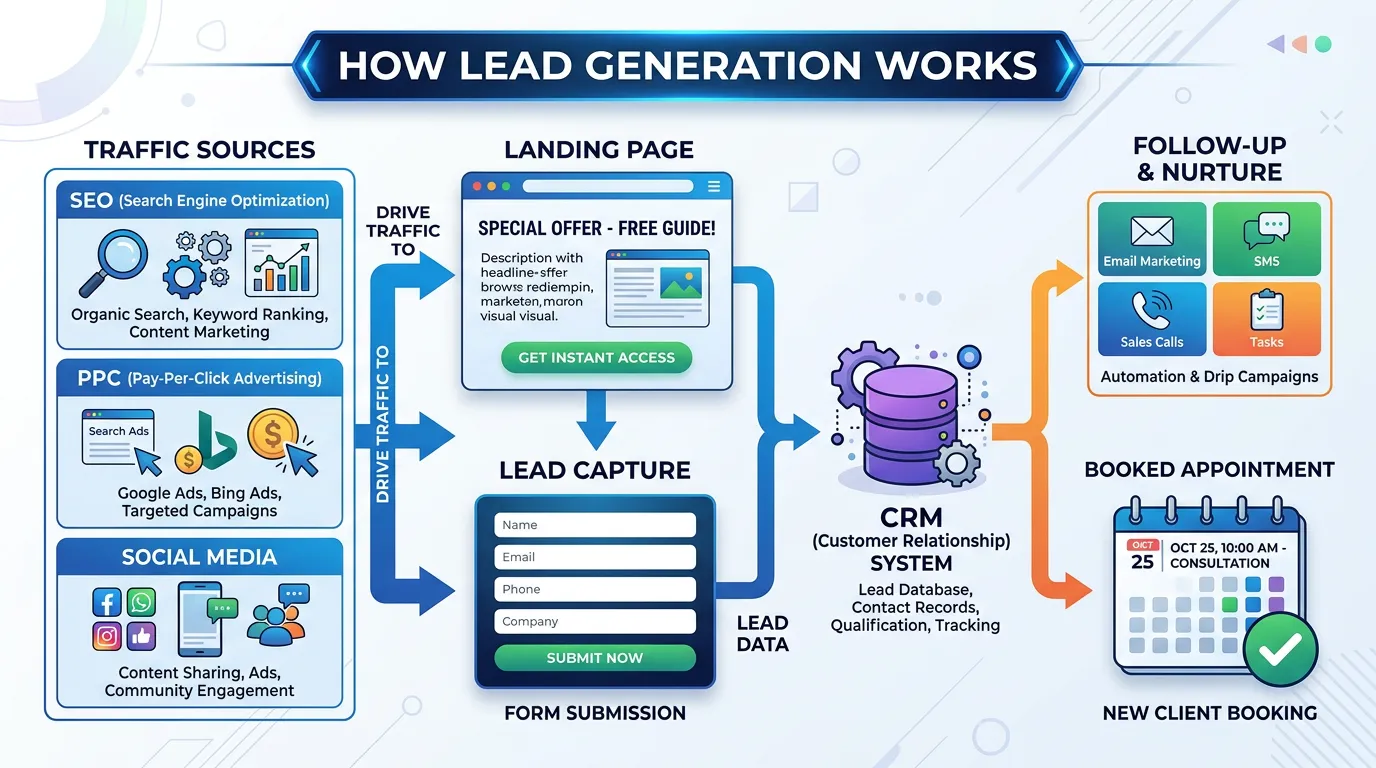
Most arguments about marketing start with a counting problem. One person counts every form and every ring. Another counts only the jobs that got on the calendar. Both call the number leads, and the two numbers are never close. So pick your definitions and write them down where the whole office can see them. An inquiry is any contact at all. That includes wrong numbers, robocalls, a supplier asking for the office manager, and the form a bot filled in at 3am. A lead is a real person with a real need you can serve, in an area you cover. An opportunity is a lead that reached a quote or a booked appointment. A booked job is work on the calendar with a date. Take a hypothetical plumbing company with 60 inquiries in a month. Twelve are junk. Eight sit outside the service area. Six are current customers asking about a warranty. That leaves 34 real leads. If the owner reports 60 and the office knows it was 34, every cost per lead number in that company is wrong by almost half. Counting is not paperwork. It decides which channel looks good and which one gets cut. A source that sends 20 inquiries and 18 real leads beats a source that sends 40 inquiries and 15. You cannot see that until the definitions hold still for a full month.
- Inquiry: any contact at all, including junk and wrong numbers
- Lead: a real person with a need you can serve in your area
- Opportunity: a lead that reached a quote or an appointment
- Booked job: work on the calendar with a date on it
The Three Kinds of Demand You Are Catching
Lead generation does not create demand out of thin air. It catches demand at three different stages, and each stage behaves differently. The first group is ready now. The water heater is leaking, the air conditioning quit in August, the tenant is locked out. These people search, tap the first number that works, and hire whoever answers. They will not read your about page. What they need is a number they can tap, a line that gets picked up, and a straight answer about whether you can come today. The second group is comparing. They know they want the work done and they are collecting two or three quotes over a week or two. Remodels, roofs, solar, elective dental work, and most legal matters sit here. These people read. They look at photos, price ranges, warranties, and reviews. What they need is proof and a low pressure way to start, such as a quote request that does not demand a street address before anyone has spoken. The third group is not looking yet. They know something is wrong but have not decided to spend money on it. This is where an email list, video, and helpful pages pay off, slowly. Most service businesses sell to the third group the same way they sell to the first, then wonder why nothing converts. One offer does not fit all three.
How a Click Becomes a Tracked Lead
Here is the part most owners never see. A visitor clicks a link. If that link carries campaign tags, usually called UTM tags, the browser hands your analytics a source, a medium, and a campaign name. Google Analytics 4 opens a session and holds those values. When the person submits a form, your site fires an event, and that event carries the session with it. That is how a lead gets a source attached to it. Phone calls work differently, because a call leaves no trail in a browser. Call tracking software swaps the number shown on the page for a temporary one tied to that visit. When the phone rings on that number, the software knows which visit produced it. Three things break this chain often. First, paid links with no campaign tags, which dumps the visit into direct traffic where it tells you nothing. Second, a form that posts to a page hosted by another company, which ends the session before the event fires. Third, a phone number that lives inside an image, which no software can swap and no phone can tap. There is one more quiet gap. If your booking tool loads inside a frame owned by another company, clicks inside that frame are invisible to your site. Ask the vendor whether a completed booking gets passed back to you as an event. Many can do it, and it is usually switched off by default.
The Four Numbers That Multiply
Lead generation is a chain of four numbers, and they multiply rather than add. Traffic is how many people arrive. Capture rate is the share who contact you. Contact rate is the share you actually reach after they raise a hand. Booked rate is the share of those conversations that turn into work. Say a hypothetical heating and air company gets 1,000 visits in a month. Two percent contact them, so 20 leads. They reach 70 percent of those, so 14 conversations. They book half, so 7 jobs. Now change one number and leave the rest alone. Push capture from 2 percent to 3 percent and the month ends with 10 jobs instead of 7. That is roughly 43 percent more work from the same traffic and the same ad budget. This is why the answer to a slow month is so often not more traffic. Doubling traffic doubles the cost of getting it. Moving one rate costs a form change and a rule about who calls back. Write your four numbers on one line each month. Most owners can guess traffic and jobs but have never measured the middle two, and the middle two are where the money hides. A lead you never reached cost you everything it cost to earn and returned nothing.
- Traffic: the people who arrive
- Capture rate: the share who contact you
- Contact rate: the share you actually reach
- Booked rate: the share who become work
Why Response Time Moves the Contact Rate
Contact rate is the number most businesses never look at, and it is the easiest one to move. Think about what a customer does after they hit send. Most of them do not sit and wait. They open the next tab and fill in two more forms. Whoever calls back first gets to book the appointment, and the other two get a polite no. That is the whole mechanism. It is not about being the best company in town. It is about being the one on the phone while the problem is still on their mind. Two habits fix most of it. First, decide who owns the callback during working hours and say that person's name out loud. A shared inbox owns nothing, and three people all assuming someone else called is the most common failure in small offices. Second, build a path for the hours when nobody is there. An automatic text saying a real person will call at 8am buys you the morning. Voicemail that arrives on a phone as text works too. Neither is fancy. Both beat silence. Weekends are where this gets tested. Pull last month's leads, sort them by day, and look at Saturday and Sunday. If those leads were answered on Monday afternoon, you already know where a chunk of your money went.
Emergency Work and Planned Work Run on Different Clocks
Two service businesses can run the same system and still need different settings. Emergency work closes in minutes. A burst pipe or a dead furnace is decided the same day, often the same hour. For that work, the whole system is speed, and almost nothing else matters. A follow up sequence that runs for three weeks is close to pointless, because the job was done by somebody else on day one. Planned work is the opposite. A kitchen remodel, a roof, a bathroom, an estate plan, or a knee replacement can take weeks or months from the first search to a signature. There the money sits in patience. A quote that goes quiet is not a lost job. It is a job waiting on a spouse, a bonus check, or a season. The follow up window for planned work should run at least 60 to 90 days, and longer for big tickets. Southern California adds its own rhythm on top. Air conditioning calls spike with the first real heat, roofing calls follow the first rain, and both leave long quiet stretches in between. If you judge a channel during one of those stretches, you will cut something that works. Match the review window to the sales cycle. Emergency work can be judged in 30 days. Planned work needs a full quarter before the numbers mean much.
From Search to Booked Job
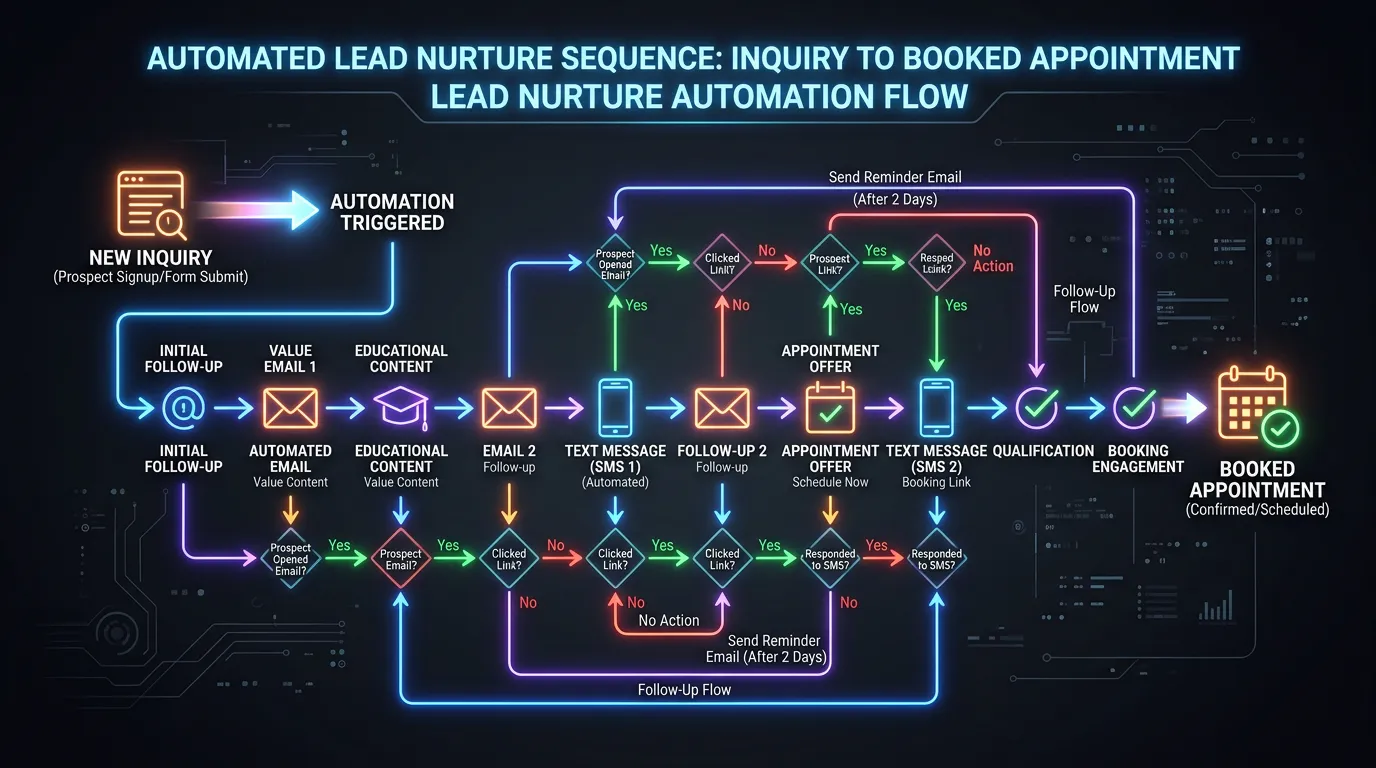
Five steps sit between a person with a problem and a job on your calendar. A break at any one of them costs the whole chain.
The weakest step decides the output. Adding traffic to a broken third step only raises the cost of the loss.
What Each Kind of Demand Needs From You
The same website has to serve three very different visitors. Here is what each one is actually looking for.
| Demand type | What they do first | What they need | Wait before hiring |
|---|---|---|---|
| Ready now | Tap the first number that works | A tappable number and a live answer | Minutes to a few hours |
| Comparing quotes | Read reviews and look at photos | Proof, a price range, and an easy quote form | One to three weeks |
| Not looking yet | Read or watch, then leave | Useful answers and a reason to stay in touch | Months, sometimes longer |
Most sites are built for one of these three. The other two leave without a trace and never show up in a report.
Why Two Companies With the Same Traffic Get Different Results
Put two roofing companies side by side, each with 1,000 visits a month. One books seven jobs and the other books two. Nothing about the traffic explains that gap.
The first company answers on the second ring, uses a form with four fields, and texts people back after hours. The second sends every lead to one inbox that gets read at lunch. Same market, same ads, very different month.
This is why a report that stops at traffic is not much use. Sessions and rankings are inputs. Answered calls and booked jobs are the output, and only one of those pays for the trucks.
Questions People Ask About the Basics
Is a phone call a lead, or does only a form count?
How long before a new lead goes cold?
Do I need software before I can start?
Would rather we handled it?
This article covers how to do the work yourself. If you would rather have it done for you, that is what our lead generation systems service is.
Lead Generation Systems
Frequently asked questions
What is the difference between lead generation and SEO?
How many leads should my website produce?
Do I need a CRM to generate leads?
Can I tell which lead came from which source without paying for tools?
Sources
- Google Analytics 4 events guide(opens in a new tab) Form fills, calls, chats, and bookings are recorded as GA4 events, which is how a lead gets tied back to a traffic source.
- Guidelines for representing your business on Google(opens in a new tab) Google's rules for the phone numbers shown on a Business Profile, including how a call tracking number may be used alongside your main line.